Crab Pot Fishing from an Inflatable Catamaran: The Australian Setup Guide
A practical guide to chasing mud crabs, blue swimmers and sandies from an inflatable catamaran — pot selection, deck layout, baiting, and the legal rules every Aussie crabber needs to follow.
At a glance
A practical guide to chasing mud crabs, blue swimmers and sandies from an inflatable catamaran — pot selection, deck layout, baiting, and the legal rules every Aussie crabber needs to follow.
- Why a catamaran beats a tinnie for crabbing
- Picking the right pots
- Bait that actually works
- Deck layout for a catamaran crabber
What we'd put you in
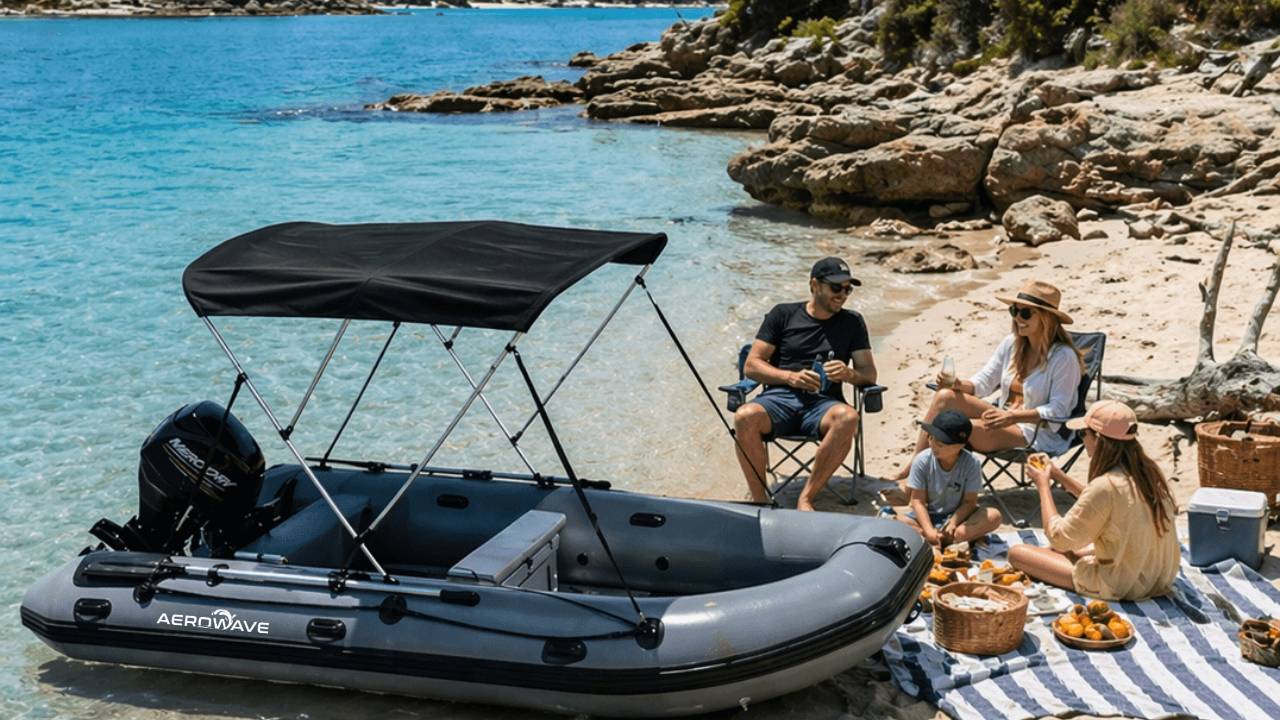
Aerowave Viper 400 Sovereign
If you're reading about catamarans, this is the one we build most of.
US$3,167 USD
Delivered to your door, today's rate
- Free freight to United States · local taxes payable on arrival
- 7-year hull warranty
🇺🇸 Shipping to United States · landed price quoted in writing
Yes — we ship the Aerowave Viper 400 Sovereign to United States. Here's the landed price.
If you're reading about catamarans, this is the one we build most of.
Written for Australian readers — but the boat ships to you. We are an Australian builder and this article is written from Australian waters. That changes nothing about what you can order: the same hull, the same 7-year warranty and the same certification go out to United States every week.
Aerowave Viper 400 Sovereign
- Boat package (export price)
- US$3,726
- 15% tariff relief credit
- − US$559
- Express air freight to United States
- Included
- Import duty, taxes & customs clearance
- Payable on arrival
- Estimated landed, USD
- US$3,167
Indicative, converted at today's rate, before local duty and tax on arrival. Ask below and we'll put a fixed figure in writing, valid 30 days.
- 7-year hull warranty
- 1500 GSM / 1.2 mm VALMEX® Heavy Plus hull
- CE certified to ISO 6185-3 and EU Directive 2013/53/EU
- Door-to-door, tracked the whole way
Your price, delivered to your door — freight included.
We email the full PDF quote (spec, freight, finance, WavePay) to your inbox in under 60 seconds. No spam — one quote, one follow-up.
See it for yourself
Real boats. Real owners. Real people behind them.
Plenty of what you read online these days is generated. Check us out properly — the factory, the reviews and the owners are all one click away. Why we use AI, and how to check we’re real
How our boats are built
Walk the production line: thermo-welded seams, 1.2 mm VALMEX Heavy Plus hulls, over-pressure relief valves on every chamber.
See the buildGoogle Maps reviews
Real Australian owners, five stars, published on our Google Business Profile with the map — read them there, not just on our own site.
Open Google Maps reviewsOwner stories
Boats in use — offshore, on rivers, on rescue duty. Photos and words from the people who actually own them.
Read owner stories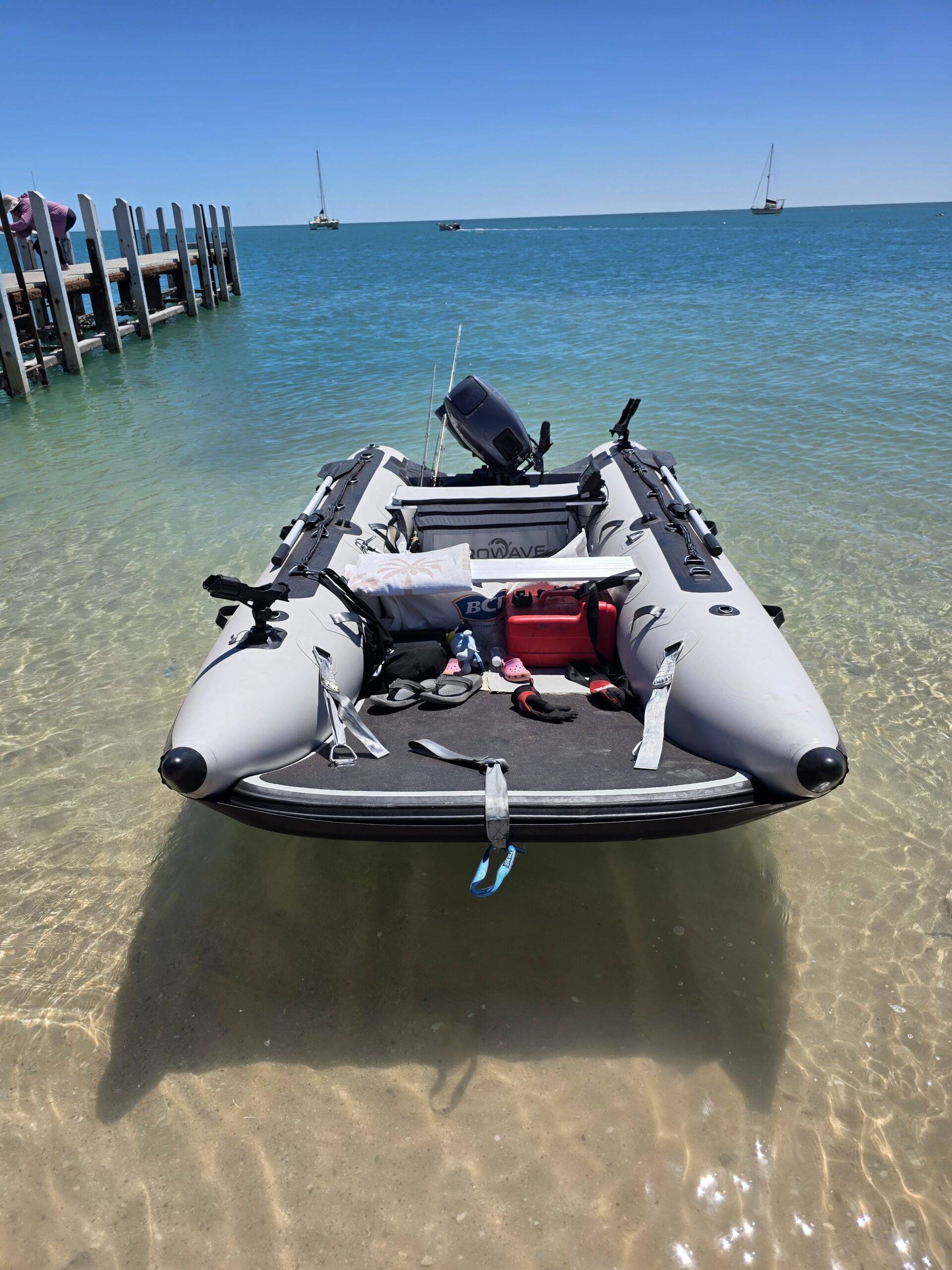
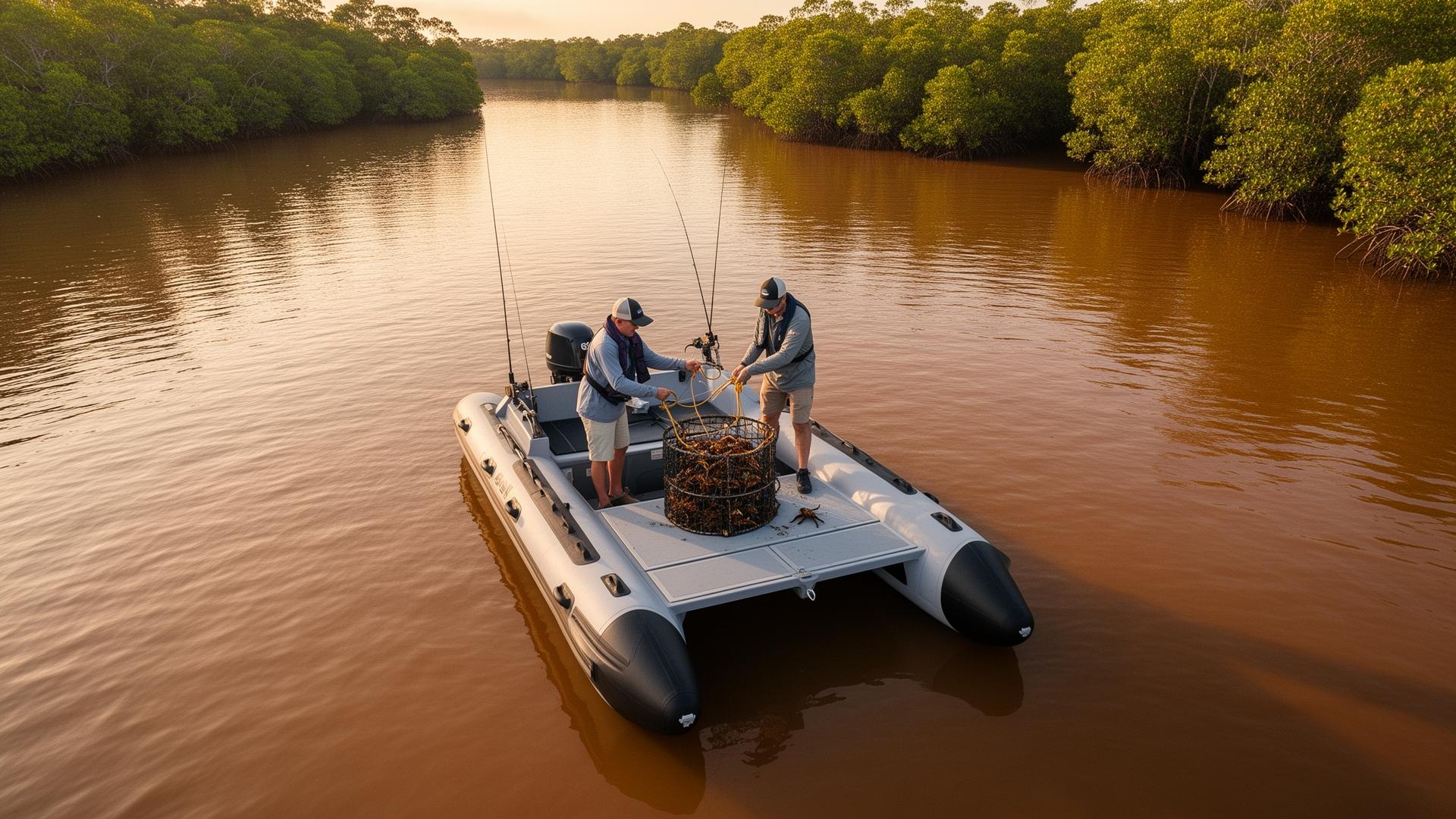
If you have ever tried to work a stack of mud crab pots from a tinnie, you already know the problem: the deck is narrow, the gunwales are sharp, and one slipping pot can put a hole in a $1,200 livewell. An inflatable catamaran flips that maths around. A wide, flat, soft deck with two large tubes either side is genuinely the best crab boat platform most Aussie estuary crabbers will ever step onto — and the price of entry is a fraction of a glass cat.
This guide is the one we wish someone had given us when we started chasing crabs out of the Daly, the Noosa River and Moreton Bay. It covers pot choice, deck layout, baiting, how to actually drop and retrieve without losing a pot, and the legal bits the rangers will absolutely check.
Why a catamaran beats a tinnie for crabbing
Three reasons, in order of how much they will change your day:
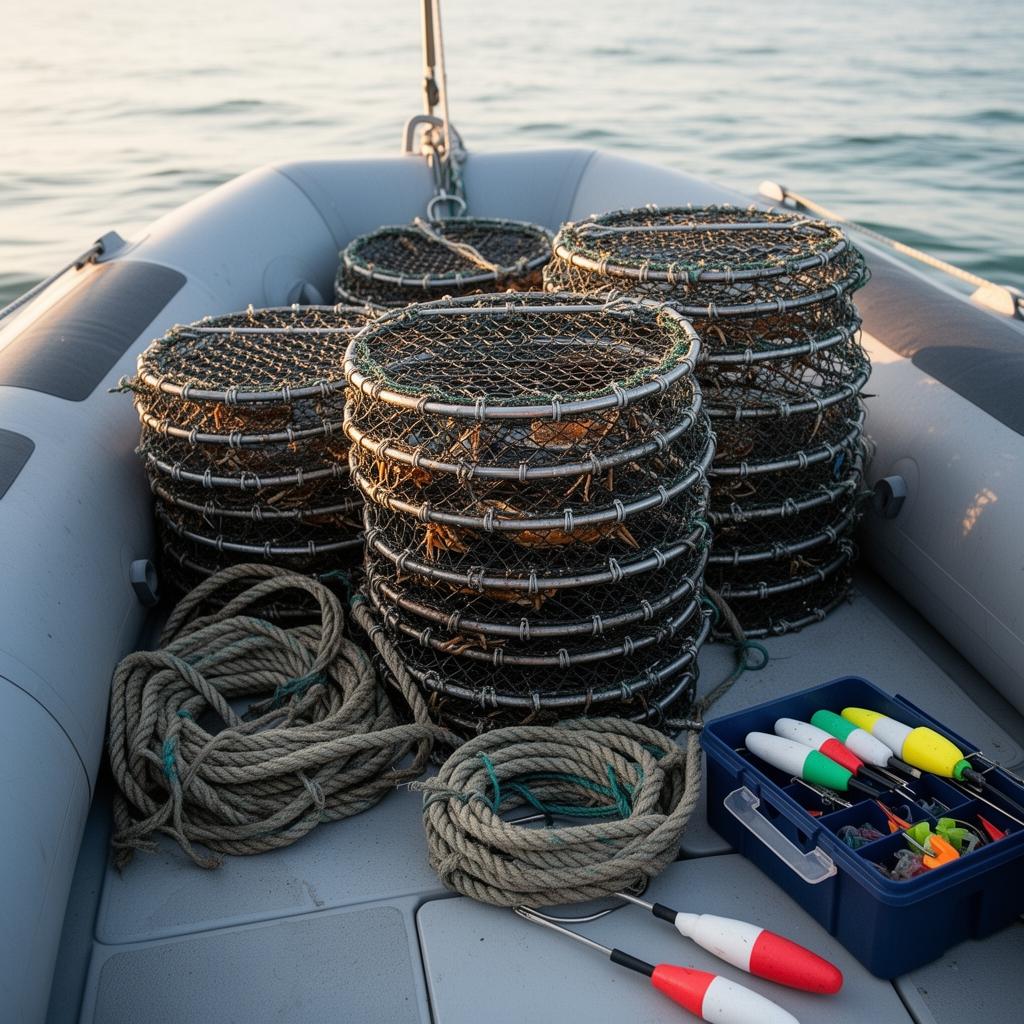
- Deck space. A 3.6 m inflatable catamaran has roughly 40% more usable deck area than a 3.7 m punt because the tubes are not eating into your floor. You can stack 8 round pots and still have room to gut a fish.
- Stability at rest. Crabbing is 90% standing still. A cat sits on two widely-spaced tubes, so it does not roll when one person steps to the gunwale to haul a pot. A mono-hull tinnie heels noticeably and tips ropes overboard.
- Shallow draft. Most Aussie crab country is 0.4 m to 1.5 m of tannin water with oyster racks and submerged stumps. A cat with an Air Deck floor draws around 180–220 mm fully loaded — you can poke up creeks a punt will not enter.
If you are still comparing platforms, our inflatable catamaran range overview walks through the deck dimensions of each model.
Picking the right pots
There is no single "best" crab pot — it depends on species and state.
| Pot type | Best for | States allowed (recreational) | Notes |
|---|---|---|---|
| Round collapsible (4-entry) | Mud crabs, sand crabs | NT, QLD, WA, NSW | Easy to stack flat. Sinks fast. |
| Witches hat / dilly | Blue swimmers, sandies | NSW, VIC, SA, WA | Banned in QLD and NT. Check local rules. |
| Hoop / drop net | Blue swimmers | NSW, VIC | Active fishing, no soaking. |
| Square hard-frame | Mud crabs (commercial style) | NT, QLD with limits | Bulky on a cat deck. |
A pair of pots per person is the rough rule. In QLD recreational crabbers may use a maximum of 4 pots per person; in the NT it is 10; in NSW it is 1 hoop net per person plus witches hats with strict tagging. Always check the current rules with your state fisheries agency before you head out — limits change and fines start at around $500.
Bait that actually works
- Mud crabs: fresh mullet heads, chicken frames, or kangaroo neck. Mud crabs hunt by smell over 200 m+, so oily and bony is the rule.
- Blue swimmers and sand crabs: pilchards, fish frames, or pippie meat in a small mesh bait bag.
- What does not work: cooked bait, anything frozen for more than two months, or commercial pellets. The plume is too weak.
Rebait every 24 hours in summer — fresh bait outfishes old bait 3 to 1.
Deck layout for a catamaran crabber
The mistake most first-time cat crabbers make is treating the deck like a tinnie. You do not need a single "work station" — you need two clear lanes.
Port side (drop side):
- Pots stacked midship, lashed down with a single bungee.
- Bait bucket forward of the pots, with a lid (smell brings mosquitoes and salties).
- Coiled rope draped over the tube, NOT on the floor. A loop around an ankle in 3 m of water with a 5 kg pot attached is the most common Aussie boating fatality you have never heard of.
Starboard side (haul side):
- Empty deck for the catch bin and a measuring gauge.
- A 60 L Esky doubled as a seat and a kill tank with ice slurry.
- Crab tongs and a stout glove hooked to the carry handle.
The transom stays clear for the outboard. On a cat, the outboard well sits between the tubes, so prop wash will not foul a pot rope dropped behind the boat — a real advantage over a mono-hull where ropes love finding the leg.
Dropping a pot from a catamaran
Cats sit higher above the water than a tinnie because the tubes lift you. That means a pot dropped over the side hits the water harder. Two-step it:
- Lower the pot to water level with the rope hand-over-hand.
- Release. The pot sinks square instead of tumbling — fewer tangles, fewer escaped crabs on retrieval.
Mark the float with your fishing licence number and date as required in QLD and NSW. Use a hard polystyrene float of at least 15 cm — not a plastic bottle. Rangers do check.
Retrieving without losing your pots
The single biggest cause of lost pots is drifting over the rope and cutting it with the prop on approach. On a cat this is easier to avoid because you can idle in from upwind, kill the motor, and drift onto the float — the wide tubes give you enough lateral stability to stand and haul without re-engaging the prop.
If the tide is ripping (anything above 2 knots in a Top End creek), tie off to a mangrove root first. A cat sitting beam-on to current with one person leaning over a tube is fine; the same manoeuvre in a tinnie gets people wet.
Cleaning and storage at the end of the day
Salt water and crab juice will eat anything they touch. After a crabbing trip:
- Rinse the pots in fresh water and stack upside down to drain.
- Hose the deck — including under the pots where bait juice collects.
- Wipe the tubes with a 10% vinegar solution if you have been in mangrove mud (the tannins will stain PVC if left more than 48 hours).
- Air dry the deck before deflating. A wet rolled cat will grow mould within a week in Darwin or Cairns humidity.
Our inflatable boat maintenance guide covers long-term tube care if you are running a heavy seasonal program.
Legal must-knows by state
- NT: 10 pots per person, mud crab minimum 14 cm carapace, no berried (egg-carrying) females.
- QLD: 4 pots per person, mud crab minimum 15 cm, witches hats banned, $500+ fines for unmarked pots.
- NSW: Hoop nets only (no traps left to soak), tag every gear with name and address.
- WA: Blue swimmer minimum 127 mm carapace, 10 traps per person in the West Coast bioregion.
- VIC and SA: Mostly drop nets only, daily bag limits apply.
Always carry a crab measure. Undersize crabs and berried females must go back, alive, with minimal handling — drop them, do not throw them.
Why this matters for your bottom line
A good day's crabbing puts 6–10 mud crabs in the Esky. At Sydney Fish Market wholesale that is $300–$500 worth of seafood, and it is the kind of trip families and small charter operators repeat 30+ times a year. A platform that handles the load safely and packs into the back of a 4WD pays for itself fast — which is exactly why so many of our WaveRunner 380 and Viper 400 Sovereign buyers are weekend crabbers, not offshore cowboys.
If you are sizing a boat specifically for crabbing, the 380 is the sweet spot for two people with 8 pots; the 400 is the choice if you also want to take the family out on weekends without unpacking gear.
Weekend-Proof Score 17 questions · about 2 minutes
Will the boat you're about to buy survive an Australian summer?
Seventeen straight questions about where you'll use it, what you'll ask of it and the boat you're weighing up. You get a score out of 100, the exact weak points in your plan, and the one boat that genuinely fits.
Free · your result shows on screen · no email required
So which one is yours?
Pick how you'll actually use it and we'll take you straight to the right hull.
I want to fish it
Open bow, rod holders, deck space you can stand and cast from.
Viper Sport 400Family, diving and the beach
3.8 m Series 3 catamaran — low bow to climb back in wearing fins or a tank.
WaveRunner 380Tender / one-person launch
3.3 m hard-floor boat that packs into a bag and still takes a beach landing.
Viper 330Shop gear featured in this guide
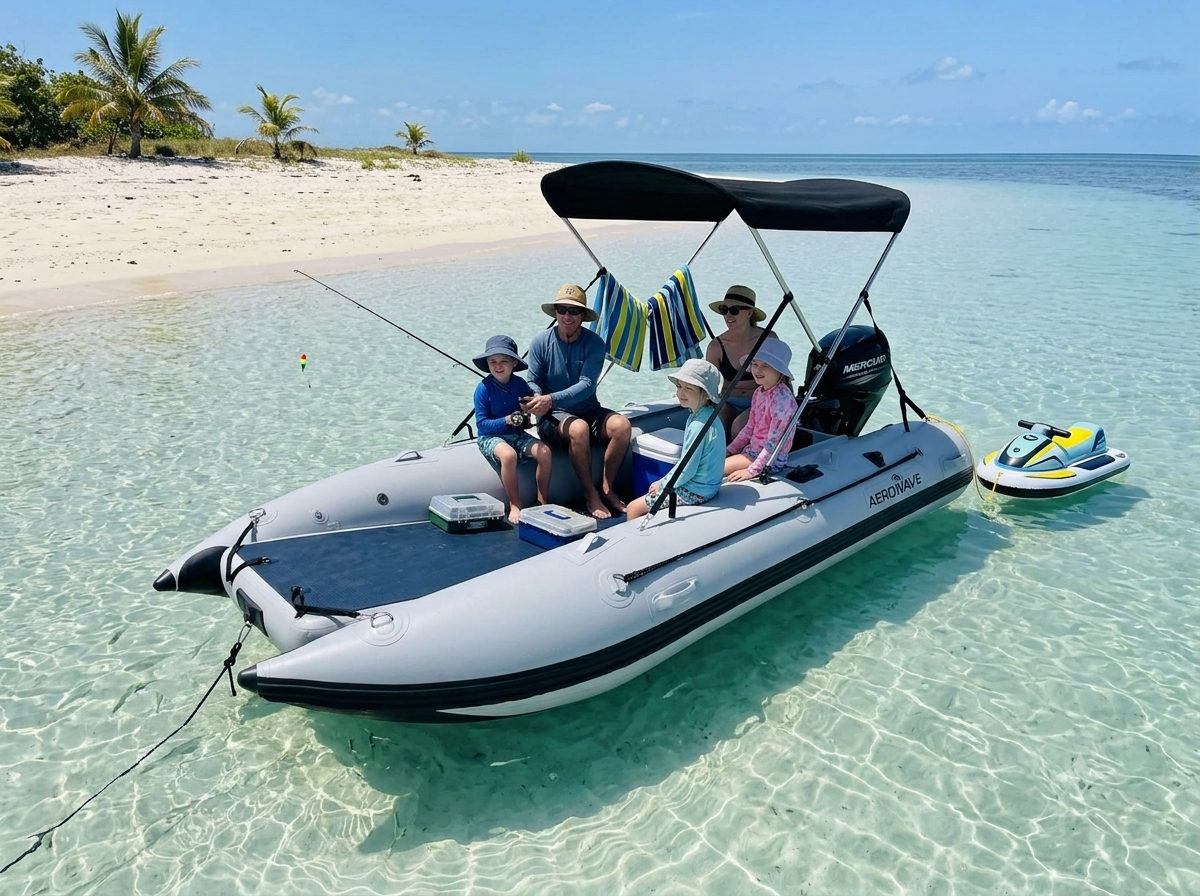
Aerowave WaveRunner 380 Series 3 Catamaran Package
The WaveRunner 380 Series 3 is a premium 3.8m inflatable catamaran package built for Australian and worldwide families, fishing, and coastal day boating — ideal for snorkeling and spearfishing — offering serious stability and premium German Valmex® construction.
Free freight to United States · local taxes payable on arrival
Aerowave Viper 400 Sovereign
Flagship 4m enclosed-bow inflatable catamaran. German VALMEX® 7321 Heavy Plus 1.2mm commercial-grade fabric, 10 PSI high-pressure drop-stitch air deck floor with VALMEX non-slip surface, LockPro wheels, full Bimini and FREE express delivery Australia-wide included. Winter special — save $1,000 until 31 August 2026.
Free freight to United States · local taxes payable on arrival
Aerowave Viper 365 Open Bow
Premium 3.65m Inflatable catamaran — built the same way as our flagship Viper 400 sports boat, just 35cm shorter. German VALMEX® 7321 Heavy Plus 1.2mm commercial-grade fabric, 10 PSI high-pressure drop-stitch air deck floor with VALMEX non-slip surface, LockPro wheels, full Bimini and FREE express delivery Australia-wide included.
Free freight to United States · local taxes payable on arrival
Not sure which suits you? Talk to a real boat owner.
Before you spend a cent
Buying from Australia, delivered to United States
You have never heard of us, we are on the other side of the world, and the internet is full of fakes. Fair enough. Here is everything you would need to check us out, in one place — no forms, no chat bot.
Australian designed business
Easy Inflatables, Avoca Beach NSW 2251. ABN 96 856 548 613. International orders ship from our Hong Kong hub.
222 owner reviews, 4.8 average
Read them in full, good and bad, on our reviews page.
CE certified, 7-year hull warranty
ISO 6185-3 and EU Directive 2013/53/EU. Warranty honoured worldwide.
Tracked, insured, door to door
FREE freight to United States · local tax/duty on arrival.
- Who am I actually buying from?
- Easy Inflatables, Avoca Beach NSW 2251, Australia. ABN 96 856 548 613. Sean is the owner and skipper, Gary Stewart handles sales on +61 2 4335 1603, Karen Matthews handles email. The boats are Australian designed; international orders ship from our Hong Kong dispatch hub so your landed price stays competitive. Phone us before you pay a cent — a real person answers.
- Is this really an Australian product?
- Yes — Australian designed and engineered on the NSW Central Coast. Manufacturing is done offshore to our spec, and international orders ship direct from our Hong Kong dispatch hub. If we routed every boat through Australia first, the freight alone would roughly double or triple your cost for the same hull.
- What do I pay, and what is not included?
- The delivery and import terms depend on your country. EU, UK, New Zealand and named Asia/Pacific lanes include duty and tax; US freight is free but US buyers pay import charges on arrival. Other destinations show their terms before payment.
- How do I pay safely?
- Card through Stripe (Visa, Mastercard, Amex, Apple Pay, Google Pay) or bank transfer. Card payments carry your bank's own dispute protection. We never ask for crypto, gift cards or payment to a personal account.
- What if it arrives damaged?
- Every boat ships fully tracked and insured door to door. Photograph the carton and the boat on arrival and email us — transit damage is claimed and replaced through us, not left with you and the courier.
- Is the warranty real outside Australia?
- Yes. The 7-year hull warranty on 1.2 mm VALMEX Heavy Plus and Orca Hypalon hulls applies wherever you are. Replacement parts are held in Australia and at our overseas hub and go out by express courier to your door.
- Is the boat actually certified?
- All Aerowave catamarans are CE certified to ISO 6185-3 and EU Directive 2013/53/EU. Certification paperwork is supplied with the boat — ask and we will send it before you order.
Frequently asked questions
- Can I run a crab pot rope out the back of an inflatable catamaran without it fouling the prop?
- Yes — the outboard sits between the tubes on a cat, so prop wash is clear of pot ropes dropped from either side. Drop pots from a tube, not the transom, to be safe.
- How many crab pots can I realistically fit on a 3.6 m inflatable catamaran?
- Eight to ten round collapsible pots stacked midship, with enough room for two anglers, an Esky and a bait bucket. A 4 m cat comfortably handles fifteen.
- Will mud crabs damage the PVC tubes of an inflatable catamaran?
- Adult mud crabs can pinch through 0.9 mm PVC if they grab the tube directly. Always use crab tongs to move them from pot to Esky, and never let a live crab loose on the deck. The 1.2 mm fabric on premium catamarans gives a bigger safety margin.
- Is an inflatable catamaran legal for commercial crabbing in Australia?
- Yes, provided the boat is registered for survey and the operator holds the relevant Coxswain or Marine Licence. Several Top End commercial crabbers use inflatable catamarans as tender boats off larger mother vessels.
- What is the minimum outboard size for hauling 10 loaded crab pots back to the ramp?
- A 9.9 hp will plane a loaded 3.6 m cat with two adults and ten pots in flat water. Step up to 15–20 hp if you are crossing open bays or running upstream against tidal current.
Ready to set sail?
Premium German-fabric inflatable catamarans, built to order and delivered to your door. Talk to our team or browse the fleet.
Like this guide? Get the next one in your inbox.
Owner-tested tips, gear deep-dives and Aussie boating know-how — no spam.