How Much Weight Can an Inflatable Boat Hold? Capacity, Load Calculations and Free Surface Effect
Real load ratings for 3.3 m to 4.5 m inflatable boats, how to calculate your actual load, and why free surface effect decides whether your boat feels planted or twitchy.
🇺🇸 Boats shipping to United States
See landed prices in USD before you bounce.
Door-to-door delivery to United States in 7–14 days. Choose a boat, see local-currency pricing, or request a fixed landed quote from the sales team.
Why load capacity is the number one question buyers ask
Every week someone asks us the same thing before they ask about price: how much weight can an inflatable boat actually hold? It's the right question. Get it wrong and the boat feels wet, slow and nervous. Get it right and it just works — you load the family, the gear, the fuel and the esky, and the boat still planes, still tracks straight and still gets you home dry.
The short answer: a modern 3.3 m inflatable catamaran carries roughly 500–600 kg. A 4.0 m carries 700–800 kg. A 4.5 m carries close to a tonne. But the headline number on a spec sheet is only half the story. What matters is how that weight is distributed, how the hull behaves as the load moves, and how much of the rated capacity you should realistically use.
Reading a capacity rating properly
A capacity rating is a maximum, not a target. It is the combined weight of people, motor, fuel, batteries, safety gear, anchor, chain, rods, ice, water and everything else you throw in. Three things sit inside that number:
- Persons capacity — the number of adults the boat is certified to carry.
- Maximum load — total mass including motor and fuel.
- Maximum power — the largest outboard the transom and hull are engineered for.
Our own ratings across the Aerowave range look like this:
| Model | Type | Persons | Max load (approx) | Max power |
|---|---|---|---|---|
| AeroCat 330 | Catamaran | 4 | 500 kg | 15 hp |
| Viper 330 | Catamaran | 4 | 550 kg | 20 hp |
| Viper 365 Open Bow | Catamaran | 5 | 650 kg | 30 hp |
| Viper 400 Sovereign | Catamaran | 6 | 750 kg | 30 hp |
| Viper 430 | Catamaran | 7 | 850 kg | 40 hp |
| Viper 450 | Catamaran | 7 | 900 kg | 40 hp |
| Sport Series 360 SI | Monohull | 5 | 650 kg | 30 hp |
| Sport Series 420 | Monohull | 6 | 800 kg | 40 hp |
Treat 80% of the rated load as your comfortable working figure. That leaves headroom for wet gear, a bigger-than-expected catch, and the fact that fuel and water are heavier than most people estimate — petrol is about 0.75 kg per litre, water is 1 kg per litre, and a 24 L fuel tank plus a full 20 L water container is already 38 kg before anyone steps aboard.
Doing the load calculation properly
Work it out on paper once and you will never guess again. A realistic four-adult day on a Viper 400 Sovereign:
- 4 adults at 85 kg average — 340 kg
- 20 hp four-stroke outboard — 48 kg
- 24 L fuel, full — 18 kg
- Battery, anchor and 6 m chain — 28 kg
- Safety gear, PFDs, flares, first aid — 12 kg
- Rods, tackle, bait board, net — 18 kg
- Esky with ice and food — 35 kg
Total: 499 kg against a 750 kg rating. That is 66% loaded — exactly where you want to be. The boat still planes on 20 hp, still turns flat, and you still have room for a bigger catch on the way home.
Now run the same numbers on a 3.3 m boat rated to 500 kg and you are at 100% before the fish are in the box. That is how people end up disappointed with a boat that is, on paper, perfectly adequate.
Free surface effect — the thing nobody explains
Here is the part that separates a boat that feels planted from one that feels twitchy: free surface effect.
Any liquid that can slosh around inside the hull — bilge water, a half-full fuel bladder, a live well without baffles — shifts as the boat rolls. That moving mass adds to the roll instead of resisting it. Worse, the effect is not proportional to the amount of water; it is driven by the width of the free surface. A thin, wide film of water across a flat floor is far more destabilising than the same volume in a deep, narrow container.
Three practical consequences:
- Drain the bilge. Ten litres of water sitting flat across a 1.8 m wide floor moves more centre of gravity than 30 L in a jerry can lashed to the transom.
- Keep tanks full or empty, not half. A half-full tank is the worst case for slosh.
- Baffle or secure anything liquid. Live wells, water containers and bait buckets should be strapped and, ideally, full.
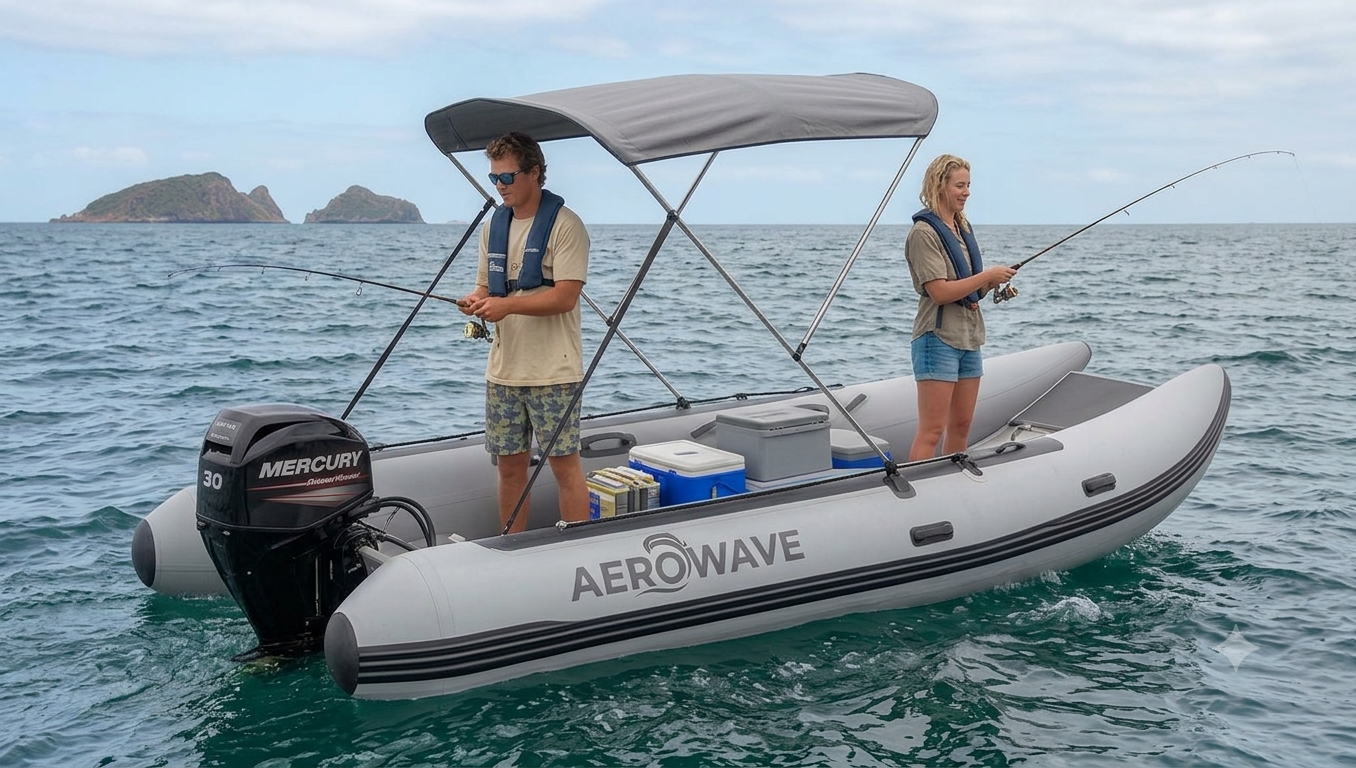
This is where hull form matters enormously. A catamaran carries its buoyancy in two widely spaced tubes, so the righting moment is huge and the free surface effect has far less leverage to work with. That is the single biggest reason a 4 m inflatable catamaran feels so stable with four adults standing on one side — the geometry is fighting for you.
Catamaran versus monohull for load carrying
Both work. They work differently.
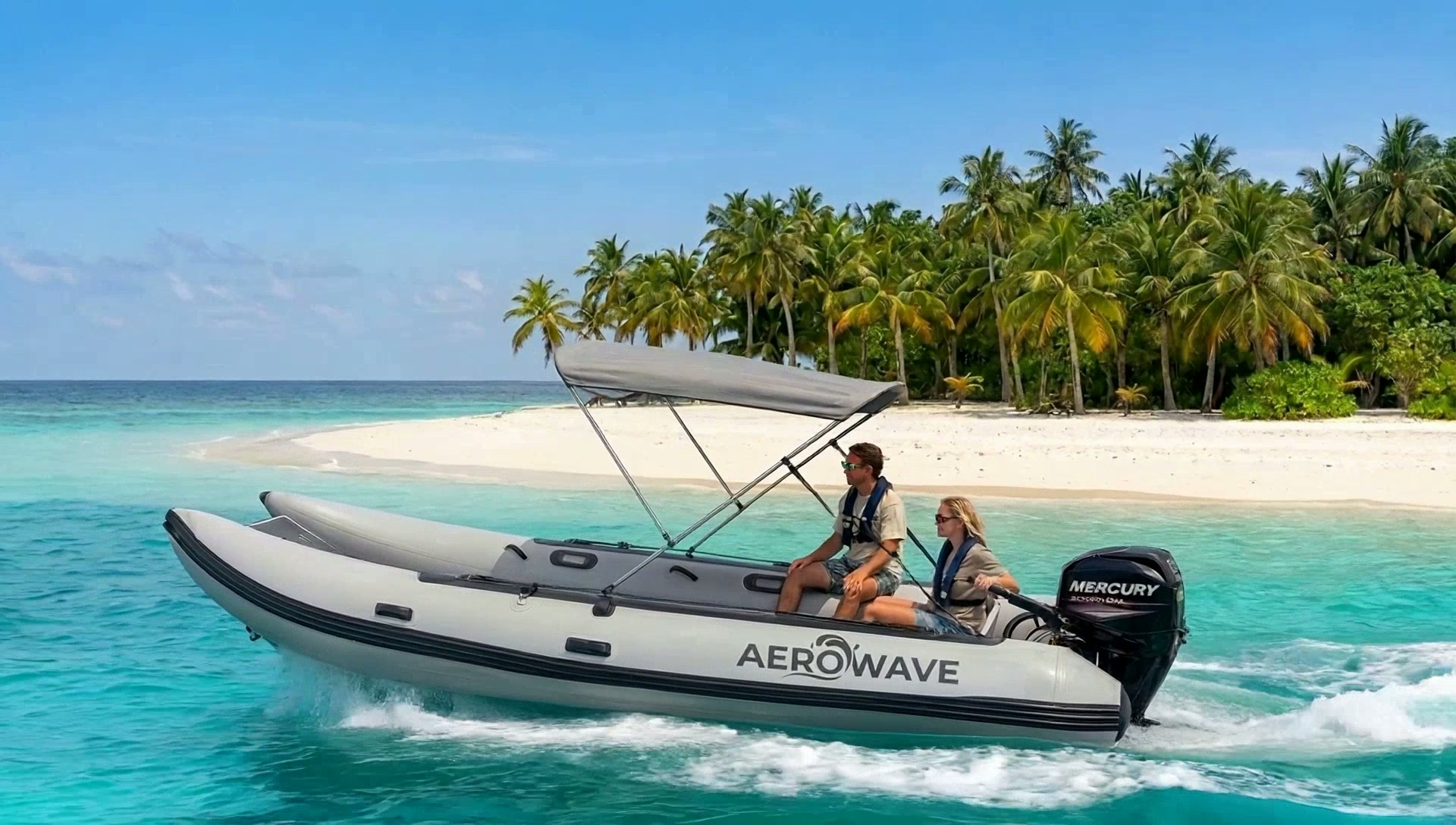
Catamarans — the Viper and AeroCat ranges — sit on top of the water rather than pushing through it. Buoyancy is spread across two full-length tubes with an open tunnel between them, which gives you:
- Enormous initial stability, so weight can move around the deck without the boat leaning hard
- A wide, flat, usable deck — the load can be spread out rather than stacked
- Very shallow draft even fully loaded, which matters on sandbars and boat ramps
- Straight tracking under load instead of wandering
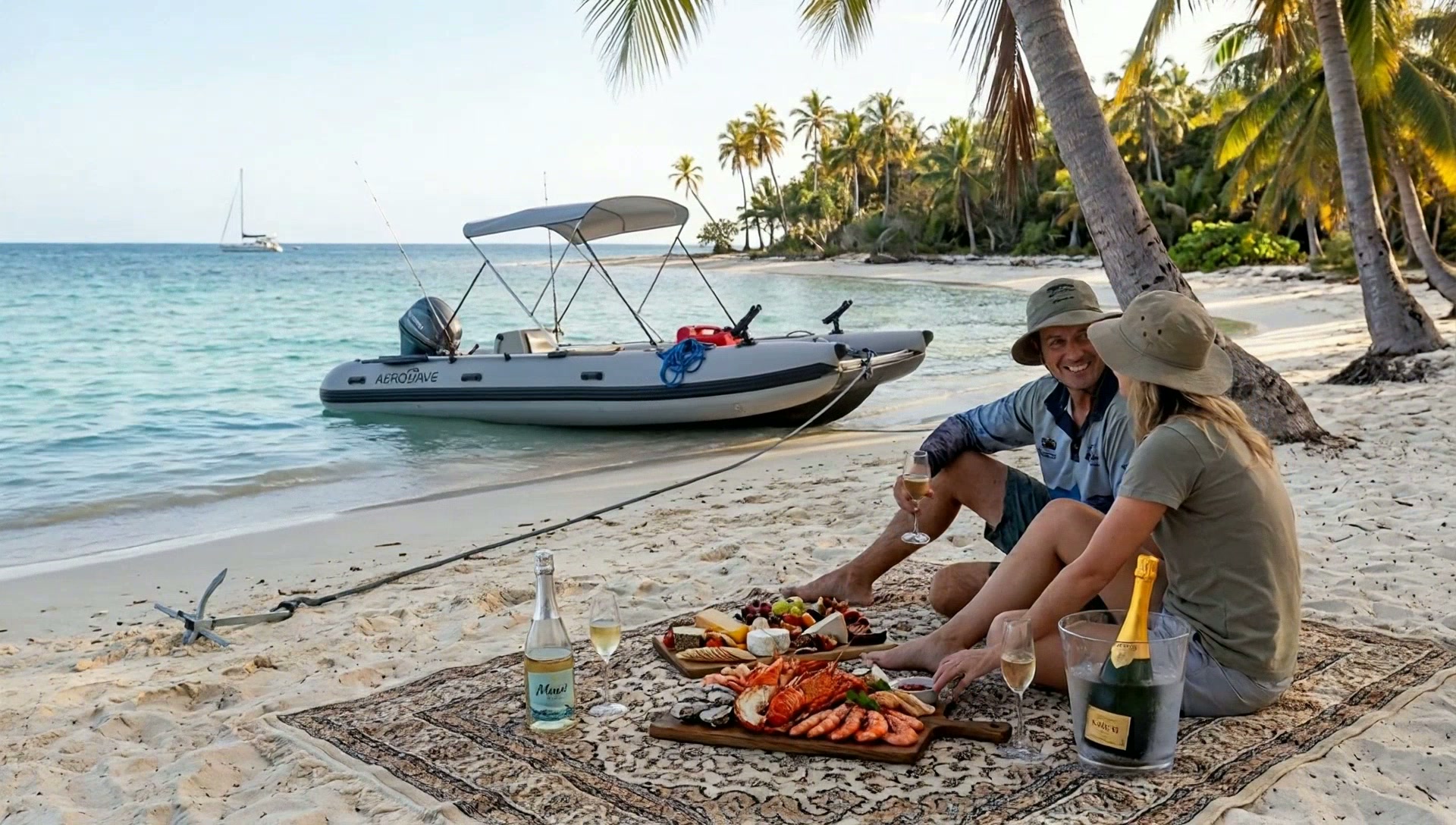
They are the better choice if you carry people and gear, fish standing up, camp off the boat, or launch off a beach.
Monohulls — the Sport Series — use a Deep-V hull that cuts through chop rather than riding over it. Under load they:
- Sit deeper as weight goes on, which softens the ride in a short, sharp sea
- Hold a course beautifully at speed
- Prefer weight kept low and centred rather than spread wide
They are the better choice if you run long distances in open water and want the softest possible ride at speed.
Neither is "more capacity" for a given length. What changes is how the boat feels as you approach that capacity.
Where the weight should sit
Load distribution is worth as much as load capacity:
- Fore and aft: aim for slightly stern-biased at rest so the boat lifts onto the plane quickly, then move a passenger forward once you are up. Too much weight aft and the bow rides high, you burn fuel and you lose visibility. Too much forward and the boat ploughs.
- Side to side: obvious but routinely ignored. Two people plus the esky on one side of a small boat is a real trim problem.
- High versus low: every kilo you can put on the floor instead of on a seat lowers the centre of gravity. Heavy items belong under seats and against the floor, always.
On a catamaran, spread the load wide and low. On a monohull, keep it centred and low.
Fabric, seams and why they matter under load
Weight is a fatigue problem as much as a buoyancy problem. Loaded tubes at 8–10 PSI, dragged across sand and hit by Australian UV, work the fabric and the seams every single trip.
Every Aerowave Viper is built on German VALMEX® 1500 GSM / 1.2 mm Heavy Plus with welded seams. The AeroCat range uses VALMEX® 1100 GSM / 0.9 mm. Both are genuine VALMEX; the Heavy Plus is the thicker, longer-service option — 10 to 12 years of real service life in Australian conditions. Orca Hypalon is available as an upgrade across the boat range.
The reason we bang on about fabric in a capacity article is simple: a rated load means nothing on a hull that has gone soft at the seams. Capacity is a promise the fabric has to keep for a decade.
Practical rules we give every customer
- Add up your real load before you choose a length. Include the esky and the fuel.
- Buy for 80% of the rating, not 100%.
- Go one size up if you are between two models — nobody has ever regretted the extra 300 mm.
- Keep the bilge dry, always.
- Fill or empty liquid containers; never leave them half.
- Heavy gear goes on the floor, under seats, centred.
- Match the outboard to the loaded weight, not the empty weight.
Which Aerowave suits your load?
- Two adults, day fishing, car boot storage — AeroCat 330 or Viper 330.
- Family of four plus gear — Viper 365 Open Bow or Viper 400 Sovereign.
- Five or six adults, or serious camping loads — Viper 430 or Viper 450.
- Long open-water runs at speed — Sport Series monohull.
If you want the numbers run for your exact use case, send us your load list and we will do the calculation and tell you honestly which model fits — including telling you when the smaller boat is enough.
Shop gear featured in this guide
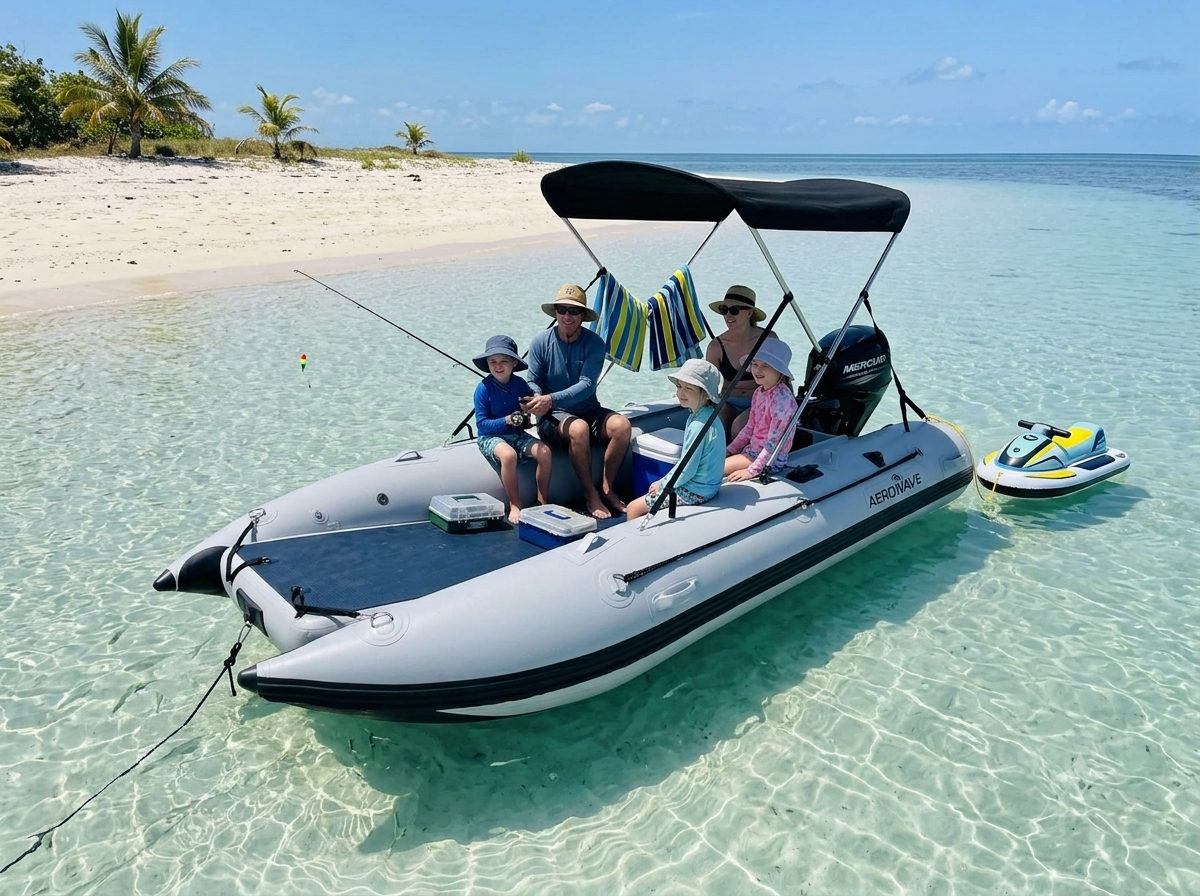
Aerowave WaveRunner 380 Series 3 Catamaran Package
The WaveRunner 380 Series 3 is a premium 3.8m inflatable catamaran package built for Australian and worldwide families, fishing, and coastal day boating — ideal for snorkeling and spearfishing — offering serious stability and premium German Valmex® construction.
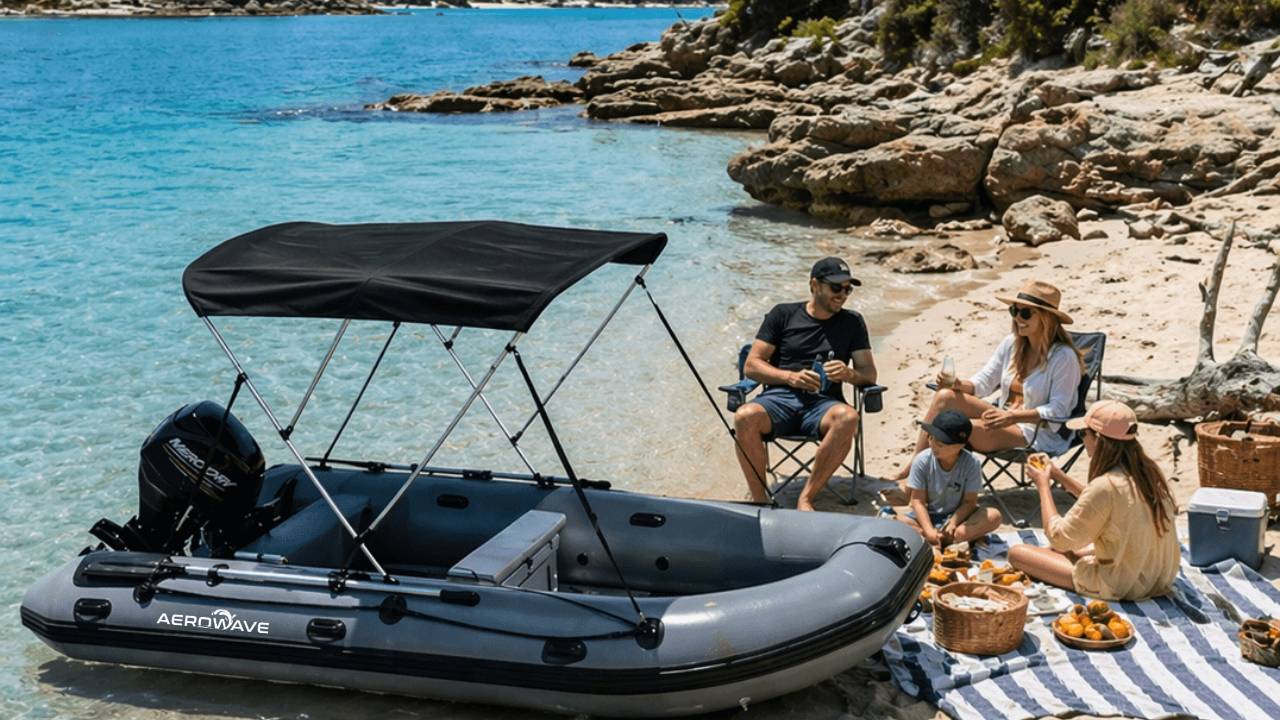
Aerowave Viper 400 Sovereign
Flagship 4m enclosed-bow inflatable catamaran. German VALMEX® 7321 Heavy Plus 1.2mm commercial-grade fabric, 10 PSI high-pressure drop-stitch air deck floor with VALMEX non-slip surface, LockPro wheels, full Bimini and FREE express delivery Australia-wide delivery included. Winter special — save $1,000 until 31 August 2026.
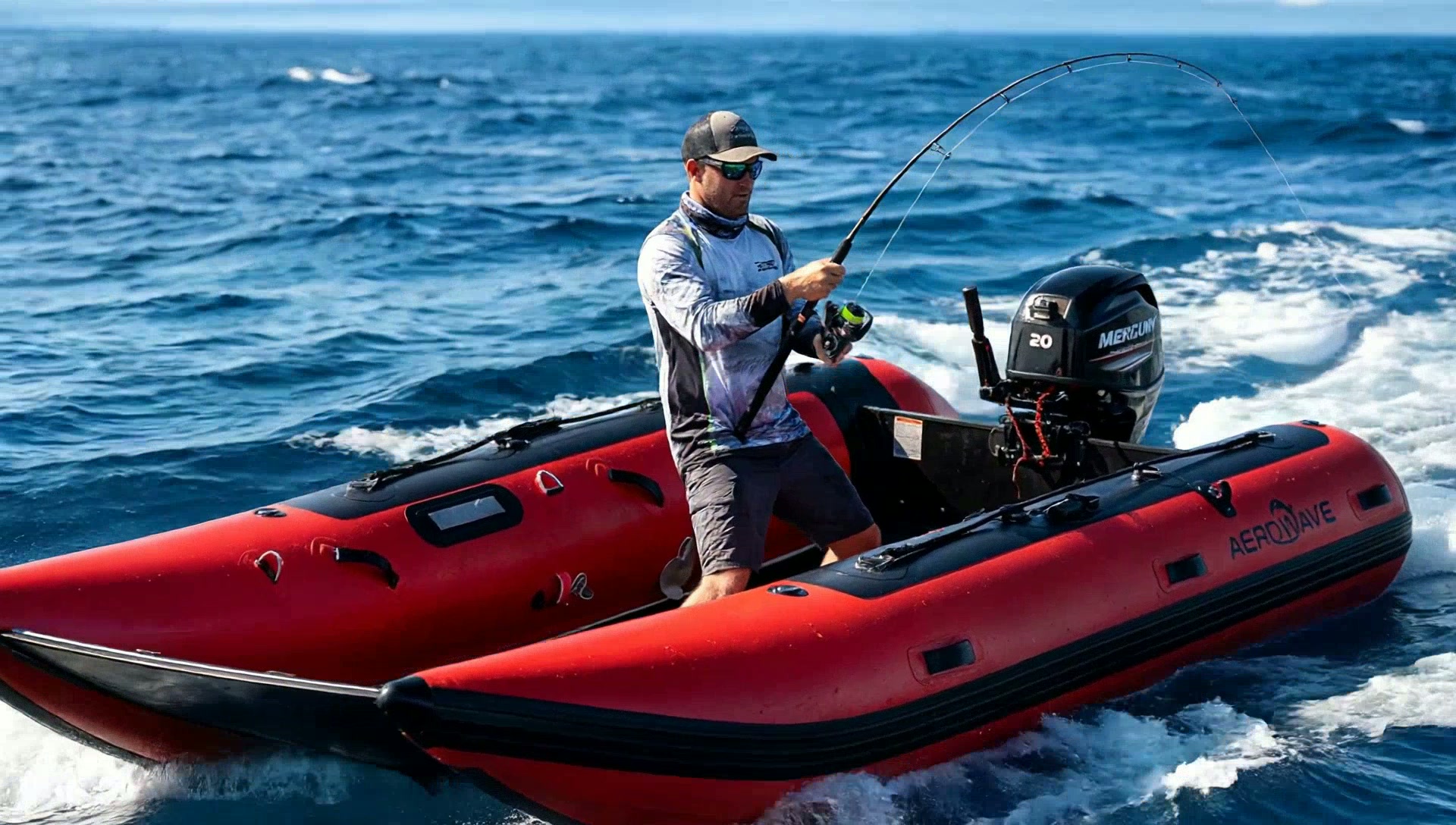
AeroWave AeroCat 360 Inflatable Catamaran
Same proven hull design, shape and look as our flagship Aerowave Viper catamarans — built lighter using 0.9mm Valmex® fabric instead of the Viper's 1.2mm. The AeroWave AeroCat 360 is our 3.6m inflatable catamaran built from 0.9mm Valmex® fabric — intentionally lighter than our 1.2mm Viper hulls so it folds smaller, packs lighter and is easy to handle solo. Twin-hull stability, 5-Year Warranty with global support and priced ~$500 below comparable 0.9mm imports.
Not sure which suits you? Talk to a real boat owner.
Frequently asked questions
- How much weight can a 3.3 m inflatable boat hold?
- Around 500–550 kg total, including people, outboard, fuel and gear. That is comfortable for two to three adults on a day trip, or four adults with light gear. Our AeroCat 330 is rated to 500 kg and the Viper 330 to 550 kg.
- How much weight can a 4 m inflatable catamaran hold?
- Roughly 700–800 kg. The Viper 400 Sovereign is rated to 750 kg, which comfortably covers four adults, a 20 hp four-stroke, full fuel, anchor, battery and a loaded esky with headroom to spare.
- Should I load an inflatable boat to its maximum rating?
- No. Treat 80% of the rated load as your working maximum. That leaves margin for wet gear, extra fuel, a big catch and the weight most people underestimate — water at 1 kg per litre and petrol at about 0.75 kg per litre.
- What is free surface effect on a small boat?
- It is the destabilising effect of liquid that can slosh freely inside the hull — bilge water, half-full tanks, unbaffled live wells. The moving liquid shifts with the roll and amplifies it. Keep the bilge drained and tanks either full or empty, never half.
- Do catamarans carry more weight than monohulls?
- Not necessarily more for a given length, but they carry it more comfortably. Twin widely spaced tubes give a much larger righting moment, so weight can move around the deck without the boat leaning hard, and draft stays shallow even when fully loaded.
- Where should heavy gear go in an inflatable boat?
- Low and centred. Every kilo on the floor instead of on a seat lowers the centre of gravity. On a catamaran spread the load wide across the deck; on a Deep-V monohull keep it centred over the keel line.
- Does the outboard weight count toward the load rating?
- Yes. Maximum load includes the outboard, fuel, battery and all gear as well as people. A 20 hp four-stroke is around 48 kg before a drop of fuel goes in, so it needs to be in your calculation from the start.
Ready to set sail?
Premium German-fabric inflatable catamarans with FREE Sea Freight or Express Air Delivery — your choice at cart. Talk to our team or browse the fleet.
Like this guide? Get the next one in your inbox.
Owner-tested tips, gear deep-dives and Aussie boating know-how — no spam.