Inflatable Boats for Caravanners & Grey Nomads in Australia: The Free-Camp Buyer's Guide
A practical 2026 buyer's guide for grey nomads and caravanners — how to pick, pack, pump and launch an inflatable boat from your van without a second trailer.
At a glance
A practical 2026 buyer's guide for grey nomads and caravanners — how to pick, pack, pump and launch an inflatable boat from your van without a second trailer.
- Why a fold-down inflatable is the right boat for caravan life
- The four real specifications that decide the buy
- 1. Packed size vs your van's storage hole
- 2. Total dry weight you can lift one-handed onto a tailgate
What we'd put you in
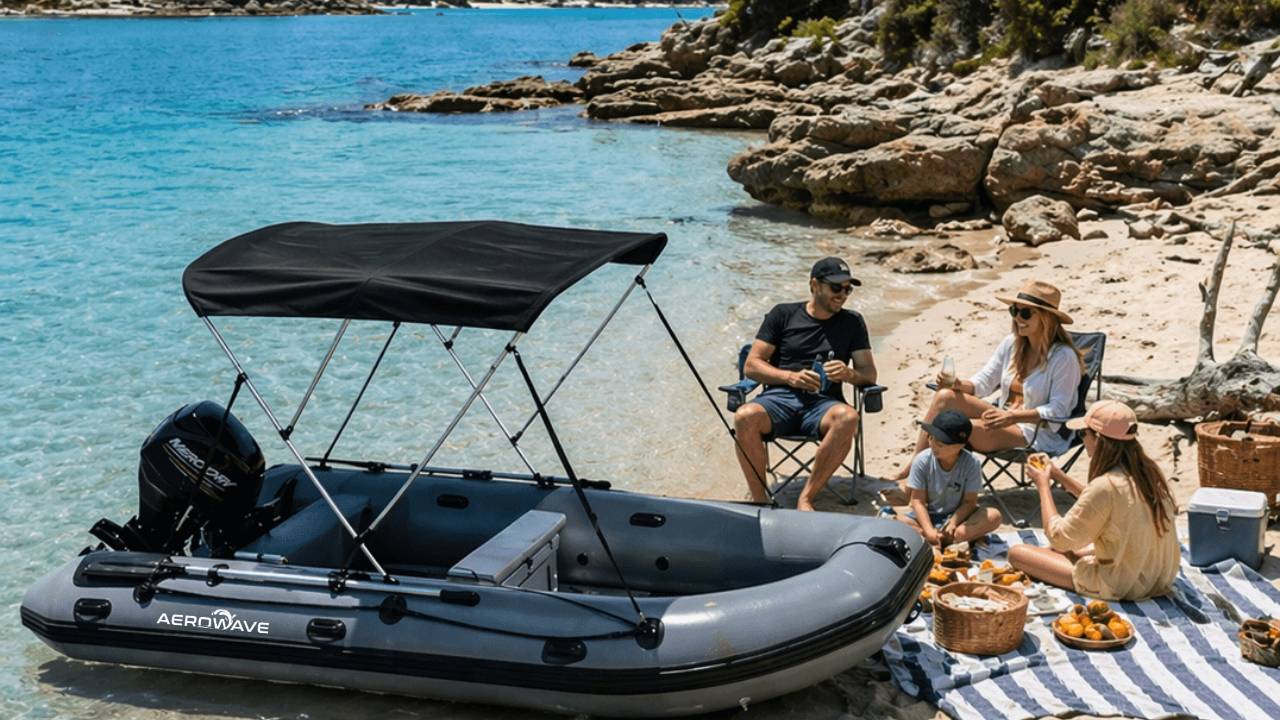
Aerowave Viper 400 Sovereign
Our best-selling boat: 4.0 m, 1.2 mm VALMEX hull, 7-year hull warranty.
US$3,167 USD
Delivered to your door, today's rate
- Free freight to United States · local taxes payable on arrival
- 7-year hull warranty
🇺🇸 Shipping to United States · landed price quoted in writing
Yes — we ship the Aerowave Viper 400 Sovereign to United States. Here's the landed price.
Our best-selling boat: 4.0 m, 1.2 mm VALMEX hull, 7-year hull warranty.
Written for Australian readers — but the boat ships to you. We are an Australian builder and this article is written from Australian waters. That changes nothing about what you can order: the same hull, the same 7-year warranty and the same certification go out to United States every week.
Aerowave Viper 400 Sovereign
- Boat package (export price)
- US$3,726
- 15% tariff relief credit
- − US$559
- Express air freight to United States
- Included
- Import duty, taxes & customs clearance
- Payable on arrival
- Estimated landed, USD
- US$3,167
Indicative, converted at today's rate, before local duty and tax on arrival. Ask below and we'll put a fixed figure in writing, valid 30 days.
- 7-year hull warranty
- 1500 GSM / 1.2 mm VALMEX® Heavy Plus hull
- CE certified to ISO 6185-3 and EU Directive 2013/53/EU
- Door-to-door, tracked the whole way
Your price, delivered to your door — freight included.
We email the full PDF quote (spec, freight, finance, WavePay) to your inbox in under 60 seconds. No spam — one quote, one follow-up.
See it for yourself
Real boats. Real owners. Real people behind them.
Plenty of what you read online these days is generated. Check us out properly — the factory, the reviews and the owners are all one click away. Why we use AI, and how to check we’re real
How our boats are built
Walk the production line: thermo-welded seams, 1.2 mm VALMEX Heavy Plus hulls, over-pressure relief valves on every chamber.
See the buildGoogle Maps reviews
Real Australian owners, five stars, published on our Google Business Profile with the map — read them there, not just on our own site.
Open Google Maps reviewsOwner stories
Boats in use — offshore, on rivers, on rescue duty. Photos and words from the people who actually own them.
Read owner storiesInflatable Boats for Caravanners & Grey Nomads in Australia: The Free-Camp Buyer's Guide
Around 80,000 Australians live on the road full-time, and roughly twice that number tow a caravan for months at a stretch. The single biggest piece of feedback from boating-curious grey nomads is the same every time: "I'm not towing a second trailer." Fair enough. A second trailer means a second rego, a second set of bearings, a second reverse-park at every free camp, and a sharp drop in fuel economy on the inland runs.
That is exactly the gap an inflatable boat fills — and why packable boats have quietly become one of the most-asked-about pieces of caravan kit in 2026. This guide is for anyone touring Australia with a van, a motorhome, a camper trailer or a slide-on, who wants to fish a dam, tender to a houseboat, or paddle a glassy lake at sunrise without a second trailer behind the tug.
The decisions below are about fit, weight, pump, floor and launch — the stuff that actually matters when you're rolling into a remote camp at 4 pm.
Why a fold-down inflatable is the right boat for caravan life
There are four practical reasons the inflatable wins over a tinny for long-term touring:
- Storage footprint. A 3.3–4.0 m inflatable rolls down to roughly the size of a folded camping chair plus a 600 mm duffel. It fits in the rear boot of a full-size caravan, in a slide-out tray, on the bed of a ute under a canopy, or in a roof box. A tinny needs a trailer or a roof rack rated to 60–80 kg dynamic load — and most caravan roofs are not.
- Weight per person carried. A complete 3.3 m inflatable with electric pump, oars and bag is typically 35–55 kg. A 3.0 m tinny hull alone is 45–60 kg before you add the trailer.
- Launch flexibility. Inflatables launch from a sandy beach, a grass bank, a rock platform or a boat ramp. No reverse, no bunks, no winch, no tow vehicle.
- Stealth. Pontoon hulls are quiet on the water — useful around bird life, calm dawn fishing and at houseboat moorings where neighbours sleep nearby.
The trade-off is honest: you spend 10–20 minutes assembling at the start of the day and the same again pulling down. That's the deal. For nomads who stay 3–7 nights at most camps, it's a deal worth making.
The four real specifications that decide the buy
Forget colour and badges. Buy on these four numbers in this order:
1. Packed size vs your van's storage hole
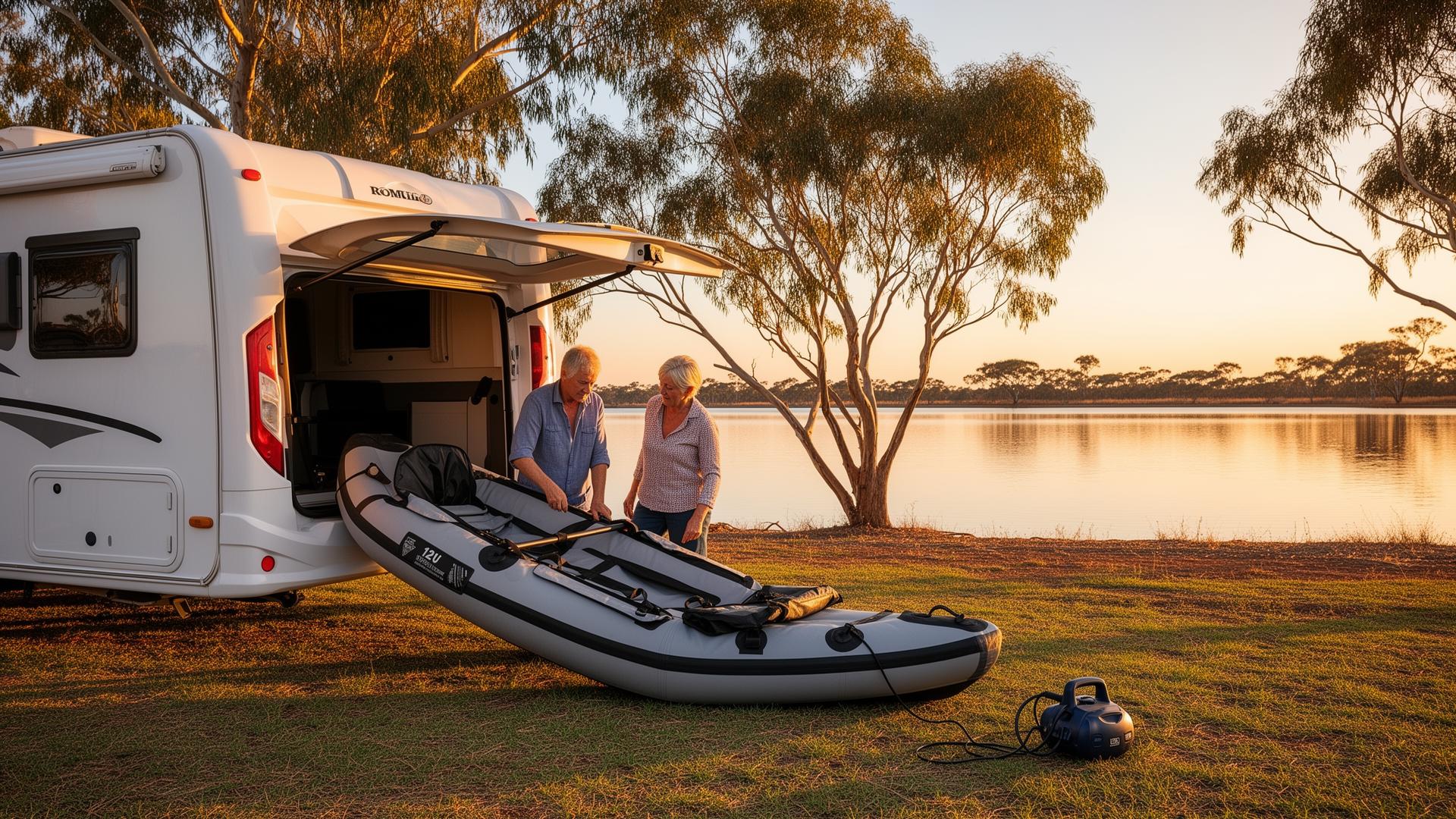
Measure the smallest enclosed compartment you have on the van — usually the rear boot or an external locker — and take the interior width and depth. Most quality 3.3–4.0 m inflatables pack into a hull bag around 1100 × 600 × 380 mm. A separate floor bag adds 1150 × 350 × 200 mm. If your locker is shallower than 380 mm, look at an air-deck floor model rather than a marine ply or aluminium floor — the air-deck rolls flat.
2. Total dry weight you can lift one-handed onto a tailgate
A realistic target for a couple in their 60s and 70s is under 50 kg for the heaviest single item. That usually means:
- Hull pack: 25–35 kg
- Floor pack: 12–20 kg
- Pump + accessories bag: 4–8 kg
Two trips from the van to the water. No hernias.
3. Floor type — air-deck vs aluminium vs marine ply
For caravan life specifically:
- Air-deck floor is the lightest and packs flattest. Good for calm freshwater, estuaries and tender duties. Easier on older backs.
- Marine ply floor is the most rigid for standing up and casting. Heavier and bulkier.
- Aluminium floor is the most durable in saltwater and the easiest to clean of sand. Middle weight.
If you're 80% freshwater dams and rivers, take the air-deck and don't look back. If you're heading north for barra and crab country, the aluminium floor earns its weight.
4. Pump compatibility with your house battery
This is the spec almost no buyer checks before purchase, and it's the one that ruins the first morning. A premium electric pump for a 3.3–4.0 m boat draws 15–25 amps at 12 V during the final high-pressure stage. Your caravan house battery is fine. The 12 V outlet in the dash of your tow vehicle is not — most are fused at 10–15 A and the pump will trip them.
Run the pump off:
- A direct Anderson plug wired to the house battery (best — pump cycles in 4–6 minutes)
- A portable LiFePO4 power station of 500 Wh+ (good — pump cycles in 5–8 minutes)
- An inverter generator if you're at a powered site (fine — uses the AC pump)
Avoid running the pump through a 1000 W inverter on the cigarette lighter circuit. It will brown out at the final pressure stage every time.
Where in Australia this setup actually shines
Grey-nomad routes built around fold-down boats are some of the best-kept boating itineraries in the country. A short hit-list of spots where a packable inflatable opens the trip up:
- Lake Argyle, WA — vast freshwater inland sea with very limited launch infrastructure. Inflatables paddle out from the campground beach.
- Murray River free camps between Wentworth and Echuca — hundreds of riverside sites with no formal ramp.
- Lake Tinaroo, FNQ — barra fishing dam where small craft launch from grass.
- Lake Eildon, VIC — drawdown shoreline that turns formal ramps muddy in summer; inflatables walk-launch from any beach.
- Coorong, SA — calm shallow estuary perfect for an air-deck.
- Hinze Dam, QLD — electric-only motor restriction suits the smaller air-deck setups.
- Lake Burley Griffin, ACT — capital city paddling without a ramp queue.
The pattern is consistent: anywhere the formal ramp is a long drive from the campsite, or doesn't exist at all, an inflatable wins.
Pairing the boat with your outboard, or going electric
For caravan touring there are three sensible propulsion choices:
- 2.5–3.5 hp four-stroke petrol — small enough to lift one-handed, runs on the same unleaded as your generator, fits in an external locker with a dedicated drip tray. Best all-rounder.
- Electric trolling motor (12 V) — quiet, no fuel, runs off the house battery, electric-only dam compliant. Limited range — pair with a spare 100 Ah battery if you want a full day's fishing.
- Oars only — for the lightest setups under 3.3 m. Genuinely viable on protected freshwater for short paddles.
Mixing systems is common: a 2.5 hp petrol for travel days, the trolling motor clipped on for dawn fishing.
Setup time — what it really looks like
A realistic morning on a 3.3 m air-deck inflatable, two adults, after the third or fourth time:
| Step | Time |
|---|---|
| Unload boat + floor + pump from van | 3 min |
| Unroll hull on a tarp | 2 min |
| 12 V pump main chambers to working pressure | 6 min |
| Drop in air-deck floor and top up | 3 min |
| Fit oars, outboard, fuel tank, safety kit | 4 min |
| Two-person carry to water | 2 min |
| Total | ~20 min |
Pack-down is faster — about 12 minutes — because the deflate cycle on a quality pump runs in under 3 minutes and you don't need to top up.
The non-negotiable safety kit for free-camp boating
Free-camp boating in Australia is no different to any other coastal or inland trip in the eyes of the relevant state authority. You still carry:
- One Level 100+ PFD per person, worn, not stowed
- A waterproof handheld VHF or PLB for anywhere remote
- Bailer and bilge sponge
- Anchor and 15–30 m of rode sized to the boat
- Hand-held torch for any chance of being out past sunset
- A basic repair kit with valve tool, glue and patches
Inland dams and lakes have their own rules — including life-jacket requirements that may differ from coastal — so always check the state authority for the body of water you're on before launching.
Cost reality for a touring couple
A complete caravan-friendly inflatable boat package in 2026 — boat, floor, pump, oars, bag and small four-stroke outboard — sits in roughly the same range as a single-night stay at four powered sites a week for a year. It pays itself off the first time you reach a camp that has the lake right there and no ramp in sight.
What you're buying isn't the boat. It's the spontaneity — the ability to say "we'll stay an extra night, the fishing looks good" without booking, towing, queuing or reversing anything down a ramp.
How Easy Inflatables fits the caravan crowd
Our Aerowave Sport Series and Viper catamaran packages are built specifically with the touring crowd in mind: premium VALMEX hull, thermo-welded seams, 10–12 year fabric life, an electric pump in every package, and CE-certified construction so any state inspector you encounter sees standards-grade gear. The 3.3 m Sport Series with the air-deck is the most-requested setup for caravan storage; the 3.6 m Viper catamaran is the sweet spot for inland-dam fishing.
Every package ships door-to-door anywhere in Australia, with the choice of FREE Economy Sea Freight (40–50 days) or Express Air Delivery (7–14 days, $810 customer contribution). Both options are fully insured in transit. So you can be in Broome, Bourke or Burnie when the boat lands — we'll deliver to the caravan park or general store you nominate.
Pick the boat that fits your locker, not the brochure. And then go find a quiet bit of water.
Related
- Aerowave Viper 330 — compact catamaran that packs down for caravan storage.
- AeroCat 330 — even lighter 3.3m cat for grey-nomad rigs.
- Inflatables accessories — wheels, pumps and covers for life on the road.
Weekend-Proof Score 17 questions · about 2 minutes
Will the boat you're about to buy survive an Australian summer?
Seventeen straight questions about where you'll use it, what you'll ask of it and the boat you're weighing up. You get a score out of 100, the exact weak points in your plan, and the one boat that genuinely fits.
Free · your result shows on screen · no email required
So which one is yours?
Pick how you'll actually use it and we'll take you straight to the right hull.
I want to fish it
Open bow, rod holders, deck space you can stand and cast from.
Viper Sport 400Family, diving and the beach
3.8 m Series 3 catamaran — low bow to climb back in wearing fins or a tank.
WaveRunner 380Tender / one-person launch
3.3 m hard-floor boat that packs into a bag and still takes a beach landing.
Viper 330Shop gear featured in this guide
Aerowave WaveRunner 380 Series 3 Catamaran Package
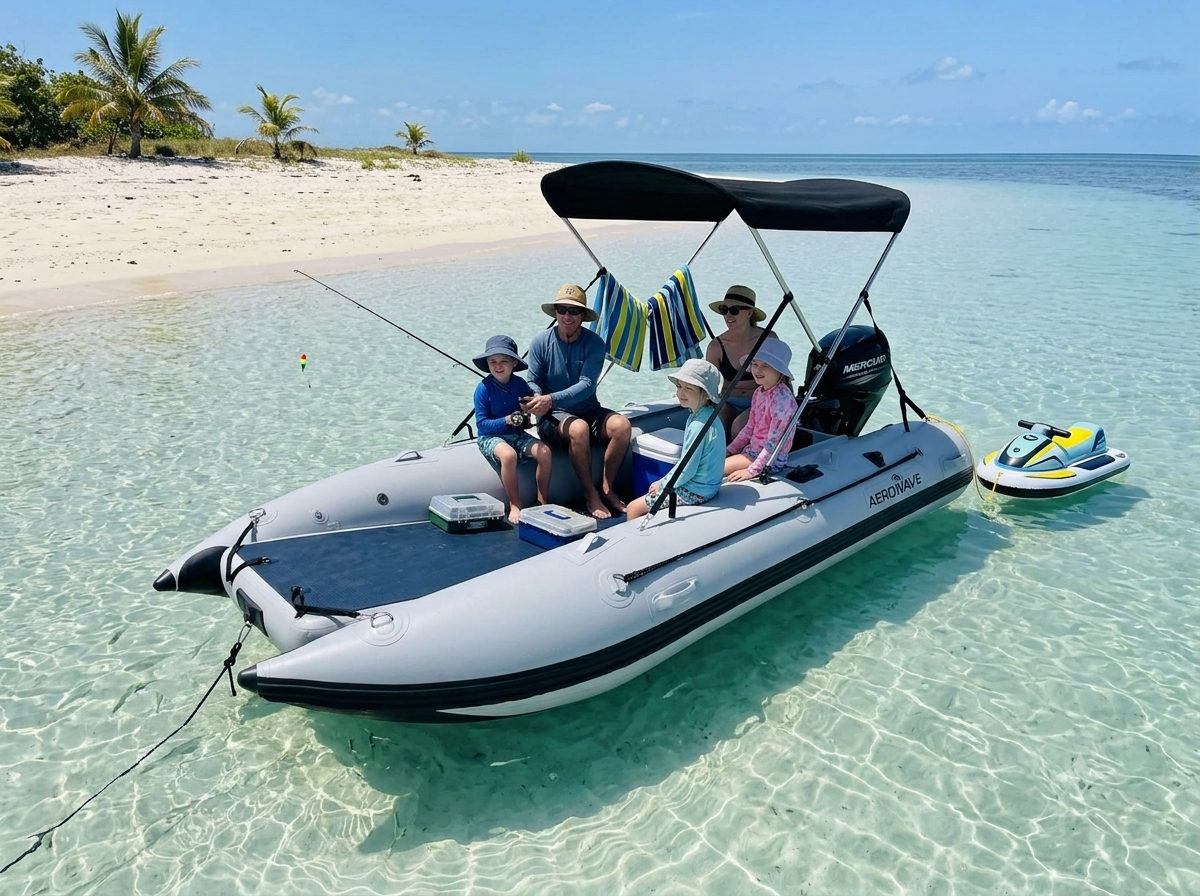
The WaveRunner 380 Series 3 is a premium 3.8m inflatable catamaran package built for Australian and worldwide families, fishing, and coastal day boating — ideal for snorkeling and spearfishing — offering serious stability and premium German Valmex® construction.
Free freight to United States · local taxes payable on arrival
Aerowave Viper 400 Sovereign
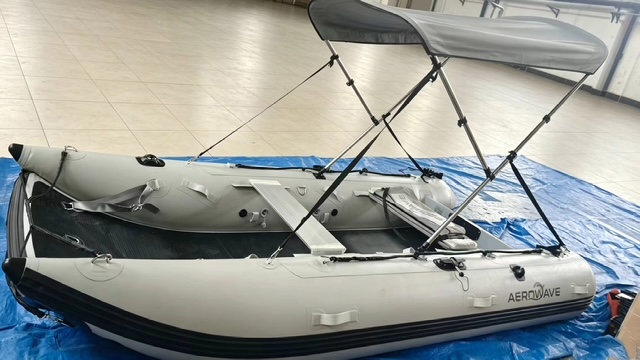
Flagship 4m enclosed-bow inflatable catamaran. German VALMEX® 7321 Heavy Plus 1.2mm commercial-grade fabric, 10 PSI high-pressure drop-stitch air deck floor with VALMEX non-slip surface, LockPro wheels, full Bimini and FREE express delivery Australia-wide included. Winter special — save $1,000 until 31 August 2026.
Free freight to United States · local taxes payable on arrival
Aerowave Viper 365 Open Bow
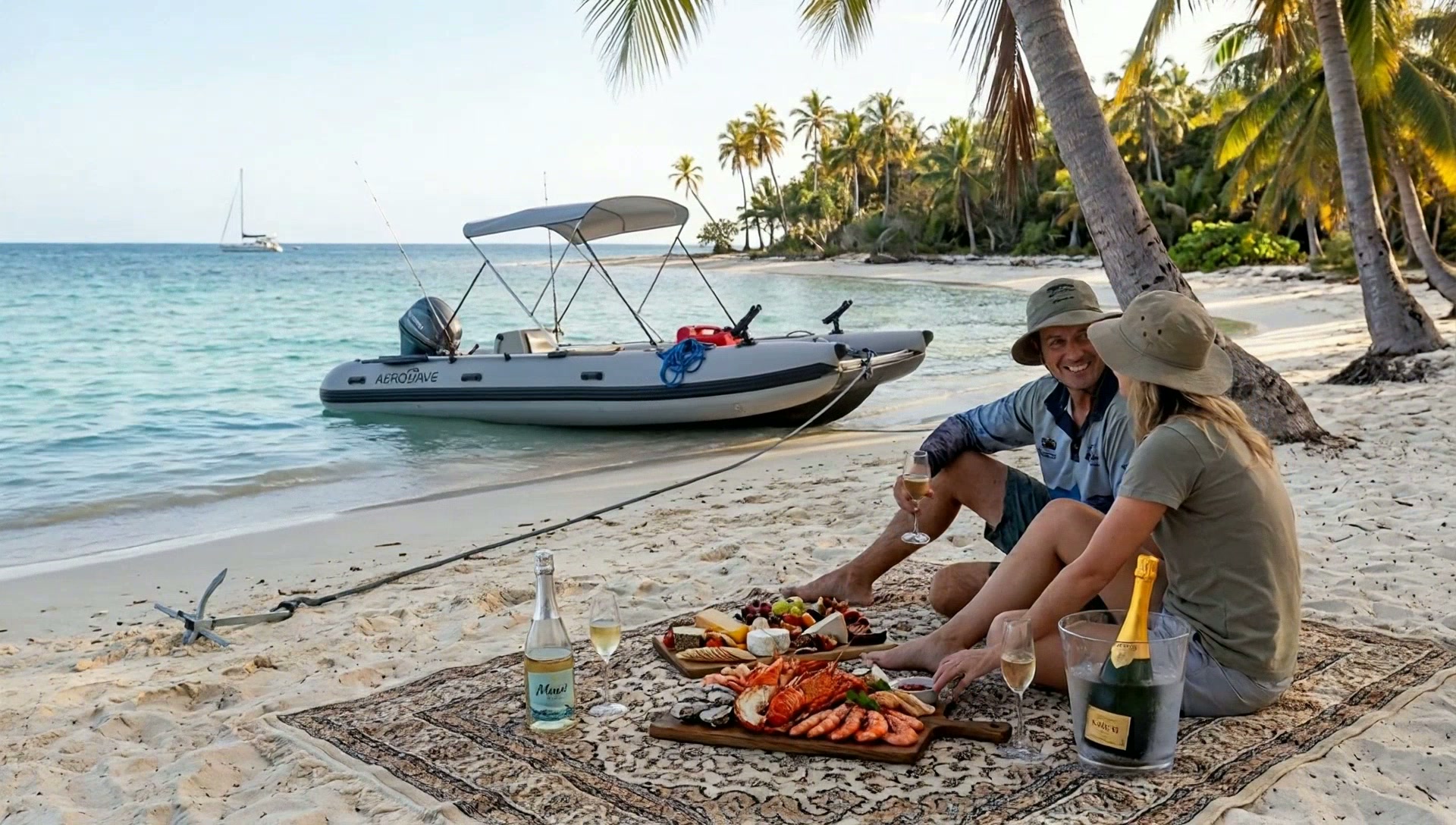
Premium 3.65m Inflatable catamaran — built the same way as our flagship Viper 400 sports boat, just 35cm shorter. German VALMEX® 7321 Heavy Plus 1.2mm commercial-grade fabric, 10 PSI high-pressure drop-stitch air deck floor with VALMEX non-slip surface, LockPro wheels, full Bimini and FREE express delivery Australia-wide included.
Free freight to United States · local taxes payable on arrival
Not sure which suits you? Talk to a real boat owner.
Before you spend a cent
Buying from Australia, delivered to United States
You have never heard of us, we are on the other side of the world, and the internet is full of fakes. Fair enough. Here is everything you would need to check us out, in one place — no forms, no chat bot.
Australian designed business
Easy Inflatables, Avoca Beach NSW 2251. ABN 96 856 548 613. International orders ship from our Hong Kong hub.
222 owner reviews, 4.8 average
Read them in full, good and bad, on our reviews page.
CE certified, 7-year hull warranty
ISO 6185-3 and EU Directive 2013/53/EU. Warranty honoured worldwide.
Tracked, insured, door to door
FREE freight to United States · local tax/duty on arrival.
- Who am I actually buying from?
- Easy Inflatables, Avoca Beach NSW 2251, Australia. ABN 96 856 548 613. Sean is the owner and skipper, Gary Stewart handles sales on +61 2 4335 1603, Karen Matthews handles email. The boats are Australian designed; international orders ship from our Hong Kong dispatch hub so your landed price stays competitive. Phone us before you pay a cent — a real person answers.
- Is this really an Australian product?
- Yes — Australian designed and engineered on the NSW Central Coast. Manufacturing is done offshore to our spec, and international orders ship direct from our Hong Kong dispatch hub. If we routed every boat through Australia first, the freight alone would roughly double or triple your cost for the same hull.
- What do I pay, and what is not included?
- The delivery and import terms depend on your country. EU, UK, New Zealand and named Asia/Pacific lanes include duty and tax; US freight is free but US buyers pay import charges on arrival. Other destinations show their terms before payment.
- How do I pay safely?
- Card through Stripe (Visa, Mastercard, Amex, Apple Pay, Google Pay) or bank transfer. Card payments carry your bank's own dispute protection. We never ask for crypto, gift cards or payment to a personal account.
- What if it arrives damaged?
- Every boat ships fully tracked and insured door to door. Photograph the carton and the boat on arrival and email us — transit damage is claimed and replaced through us, not left with you and the courier.
- Is the warranty real outside Australia?
- Yes. The 7-year hull warranty on 1.2 mm VALMEX Heavy Plus and Orca Hypalon hulls applies wherever you are. Replacement parts are held in Australia and at our overseas hub and go out by express courier to your door.
- Is the boat actually certified?
- All Aerowave catamarans are CE certified to ISO 6185-3 and EU Directive 2013/53/EU. Certification paperwork is supplied with the boat — ask and we will send it before you order.
Frequently asked questions
- Will a 3.3–4.0 m inflatable boat actually fit in a caravan boot?
- Yes, in most full-size vans. A quality 3.3–4.0 m inflatable packs into a hull bag around 1100 × 600 × 380 mm plus a floor bag of about 1150 × 350 × 200 mm. Measure your boot's interior depth — anything 380 mm or deeper will swallow an air-deck setup. Shallower lockers usually mean removing the floor bag and storing it under the bed.
- Can I inflate the boat from my caravan's house battery?
- Yes — that's the correct way to do it. Wire a 50 A Anderson plug to the house battery and the pump cycles a 3.3–4.0 m inflatable in 4–6 minutes. Avoid the tow vehicle's 12 V dash outlet (usually fused at 10–15 A) or a small inverter on the cigarette lighter; both will brown out at the final pressure stage.
- Do I need to register an inflatable boat used only at free camps and dams?
- Registration depends on the engine size and the state, not on where you camp. As a rough rule, in NSW, QLD, VIC, SA and WA, any inflatable powered by a motor (petrol or electric) is registrable above defined thresholds. Always check the maritime/transport authority for the state you're boating in — the rules differ by state and update each season.
- What's the lightest practical setup for a couple in their 70s?
- A 3.3 m air-deck inflatable with a 12 V pump and a 2.5 hp four-stroke. The heaviest single item is the hull bag at around 28 kg, which two people can carry comfortably and one person can drag on a tarp. The outboard sits around 13 kg and lives in a separate locker.
- Is an inflatable safe enough for a place like Lake Argyle or the Murray?
- Yes, in the right conditions. Premium inflatables in the 3.3–4.0 m range are CE-rated for protected inland waters and sheltered coastal use. The limiter is weather, not the hull — plan around the wind forecast, stay close to shore in big open dams, and carry the full safety kit. Most grey-nomad use sits well inside the boat's envelope.
Ready to set sail?
Premium German-fabric inflatable catamarans, built to order and delivered to your door. Talk to our team or browse the fleet.
Like this guide? Get the next one in your inbox.
Owner-tested tips, gear deep-dives and Aussie boating know-how — no spam.