Tender vs RIB vs Inflatable Catamaran: The Definitive 2024 Buyer's Guide
A deep dive comparison of traditional tenders, Rigid Inflatable Boats (RIBs), and modern inflatable catamarans. We analyse portability, stability, price, and performance to help you choose the perfect vessel.
🇺🇸 Boats shipping to United States
See landed prices in USD before you bounce.
Door-to-door delivery to United States in 7–14 days. Choose a boat, see local-currency pricing, or request a fixed landed quote from the sales team.
Choosing your vessel is the most critical decision in your boating life—far more than the brand, the dealer, or the outboard on the back.
Navigating the world of small, versatile watercraft can feel like charting unknown waters. You're faced with a baffling array of options, each promising freedom and adventure, yet fundamentally different in design and purpose. The three dominant players in this space are the traditional inflatable tender, the formidable Rigid Inflatable Boat (RIB), and the increasingly popular inflatable catamaran. Making the wrong choice isn't just a matter of buyer's remorse; it can mean owning a boat that's too cumbersome to use, too unstable for your liking, or too limited in its performance.
This guide cuts through the marketing noise to provide a definitive, honest comparison. We will dissect the DNA of each boat type—their construction, their on-water behaviour, their shocking differences in portability, and their true long-term cost. Forget the sales pitches. This is an engineering-led discussion for discerning buyers who want to understand the 'why' behind the design. By the end, you'll have a crystal-clear picture of which hull shape and construction format—be it a simple tender, a heavy-duty RIB, or a sophisticated inflatable catamaran—truly aligns with your unique Australian lifestyle.
The Classic Workhorse: What is a Traditional Inflatable Tender?
A traditional inflatable tender, often called a Soft Inflatable Boat (SIB), is likely the image that first comes to mind when you hear "inflatable boat". It's characterised by its simple monohull design—essentially a single, large U-shaped inflatable tube forming the sides and bow, with a flexible floor and a rigid transom at the stern for mounting an outboard.
These boats are the original portable solution. Their floors come in several varieties: some have removable wooden or aluminium slats, others use a low-pressure inflatable 'mattress' style floor, and more advanced models feature a high-pressure inflatable 'air deck' floor. A quality air deck, when inflated correctly to around 8–10 PSI, can create a surprisingly rigid platform to stand on, rivalling the feel of a solid floor.
Their primary, time-honoured use is as a 'tender' to a larger yacht or cruiser—a shuttle for moving people and provisions from the mothership to the shore, jetty, or a secluded beach. In this role, their light weight and ability to be deflated and stored in a locker are paramount. Beyond this, they serve as simple, accessible boats for calm-water fishing in estuaries, exploring quiet rivers, or as a fun platform for the kids in a sheltered harbour. Our own WaveRunner 380, for example, represents the premium end of this category, built for durability and stability within the traditional monohull format.
The key appeal lies in their simplicity and portability. Most can be packed down into one or two carry bags and comfortably fit in the boot of a family car or the storage compartment of a caravan. However, this portability comes with compromises. The conventional V-hull shape, whilst better than a flat bottom, can be prone to 'flexing' in chop and often delivers a wetter ride as spray is channelled up and over the tubes. Their stability, whilst generally good at rest compared to a hard-shell dinghy of similar size, is noticeably inferior to a twin-hull design.
The Heavyweight Champion: Understanding Rigid Inflatable Boats (RIBs)
A Rigid Inflatable Boat, or RIB, represents a significant step up in complexity, performance, and price. A RIB is a hybrid vessel that marries a solid, rigid hull—typically crafted from fibreglass or aluminium—with the familiar inflatable tubes of a SIB. The tubes are permanently bonded to the gunwales (the upper edges) of the rigid hull.
This fusion of technologies aims to deliver the best of both worlds. The deep-V rigid hull provides exceptional seakeeping capabilities, allowing the boat to slice cleanly through waves and chop at high speed, delivering a dry, comfortable ride that most SIBs simply cannot match. The inflatable tubes, meanwhile, provide immense stability (especially at rest) and act as a giant, built-in fender, making docking and coming alongside other vessels a stress-free affair. This combination has made RIBs the vessel of choice for military, police, and search-and-rescue operations worldwide.
For the recreational user, a RIB is an offshore weapon. It's a boat you can confidently take out of the harbour into open water, chasing fish or exploring coastlines. They can handle larger, more powerful outboards and often come with features like built-in seating, consoles, and storage lockers. However, the 'inflatable' part of the name is somewhat misleading when it comes to practicality. The rigid hull means a RIB is not a portable boat. It cannot be deflated, folded, and put in your car. It requires a dedicated boat trailer for transport and a garage, driveway, or hardstand for storage. This introduces a host of associated costs and complexities: trailer registration, maintenance, the need for a suitable tow vehicle, and the space to store it all.
In the debate of tender vs RIB vs inflatable catamaran, the RIB stands apart. It's less a competitor to the truly portable options and more of a smaller, more versatile alternative to a fully rigid fibreglass or aluminium fishing boat. If your boating life starts and ends at a boat ramp and you have the space and budget, a RIB is a superb, high-performance choice. But if you value portability above all else, a RIB is, by definition, out of the running.
The Modern Challenger: The Rise of the Inflatable Catamaran
The inflatable catamaran is the most significant evolution in portable boat design in decades. It takes the core concept of an inflatable boat—lightweight, packable, and user-friendly—and applies the advanced hydrodynamic principles of a twin-hull (catamaran) design.
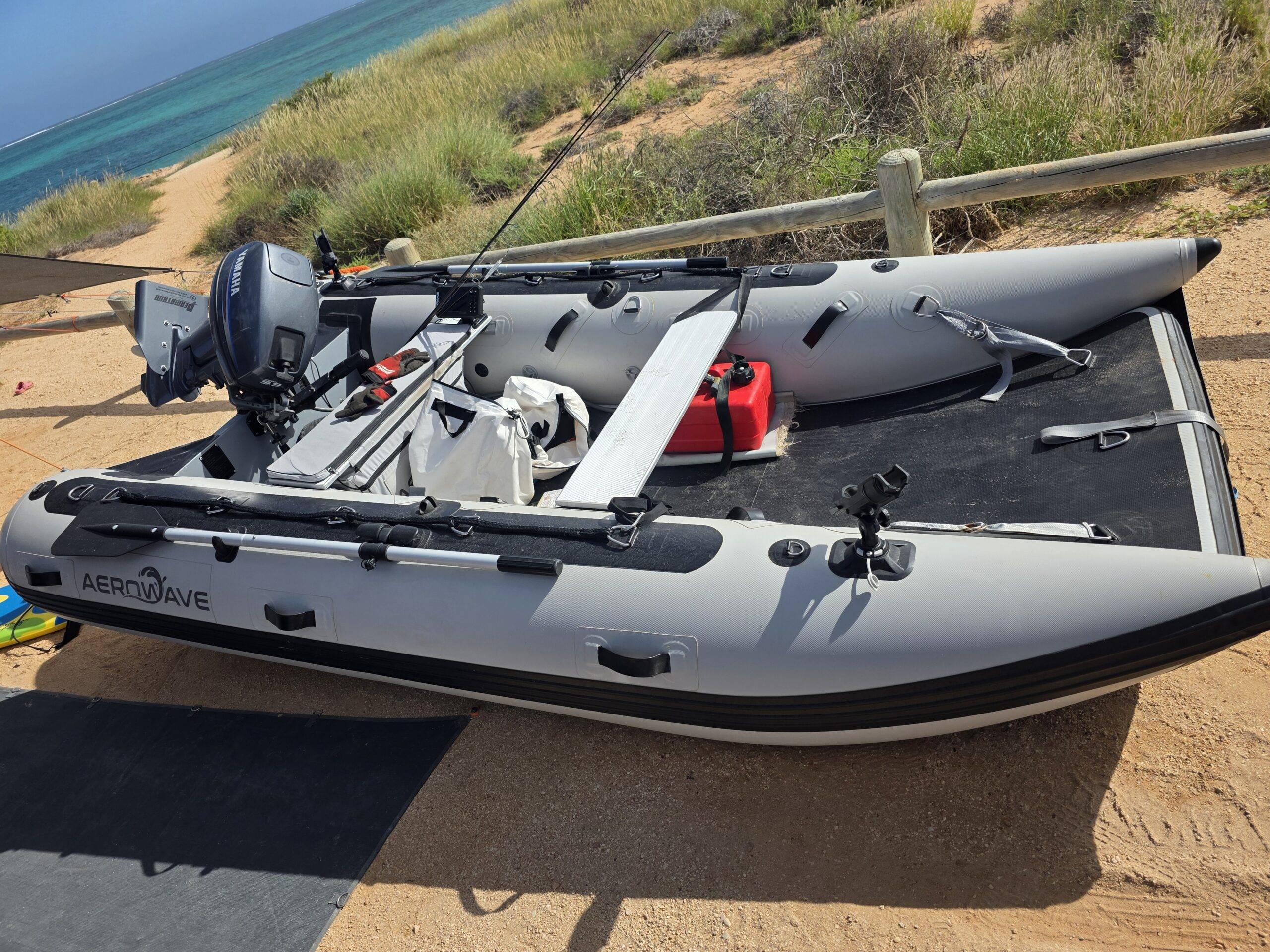
Structurally, an inflatable catamaran features two parallel, high-pressure inflatable tubes (the hulls or 'sponsons') connected by a sturdy deck platform and a solid transom. The magic happens in the space between the hulls: the tunnel. As the boat moves forward, this tunnel traps a cushion of air. This trapped air generates hydrodynamic lift, raising the majority of the hull out of the water. This dramatically reduces the wetted surface area—the part of the boat creating drag. The result? Startling efficiency. An inflatable catamaran requires significantly less power to achieve planning speed compared to a conventional V-hull inflatable of the same size and weight. This translates directly to better fuel economy and the ability to achieve higher speeds with a smaller, lighter, and more affordable outboard motor.
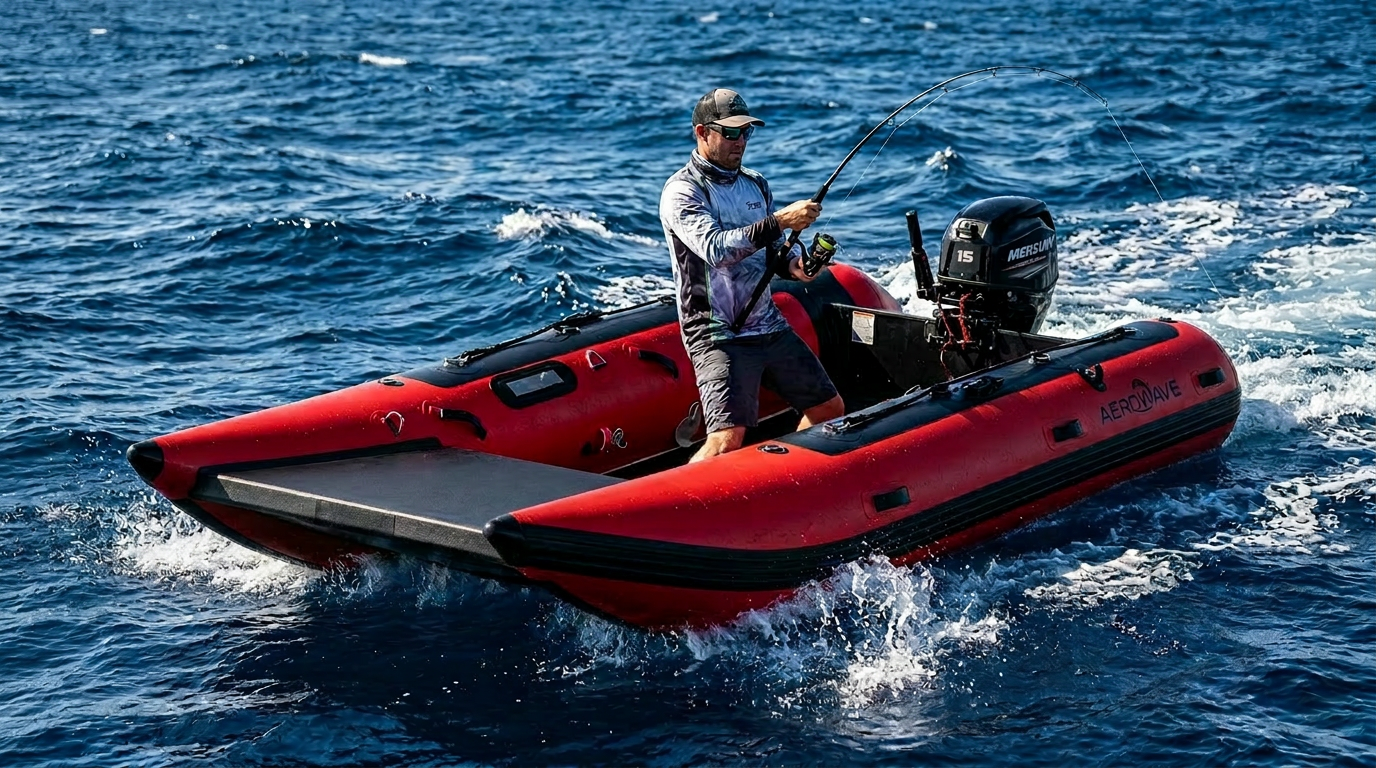
But the benefits don't stop there. The wide stance of the twin hulls provides a level of stability that is simply in a different league from any monohull. Whether you're standing on the edge to cast a line, helping a child climb aboard, or hauling a heavy dive bag over the side, the platform remains astonishingly level and predictable. This makes it an exceptionally safe and comfortable boat for families, anglers, and divers.
Models like our AeroCat series, built with 0.9mm German VALMEX® fabric, and the top-tier Aerowave Viper 400 Sovereign, constructed from an incredibly robust 1.2mm / 1500 GSM VALMEX® Heavy Plus material, showcase the potential of this design. They offer an open, customisable deck space, a remarkably dry ride (as spray is deflected downwards and outwards into the tunnel), and true portability. Despite their superior size and performance, they pack down into two bags, ready for the car boot, caravan, or yacht locker. They perfectly bridge the gap, offering performance that nips at the heels of a RIB, but with the genuine fold-away convenience of a traditional tender.
Head-to-Head: Tender vs RIB vs Inflatable Catamaran
Let's move from theory to a direct, practical comparison across the factors that matter most to a buyer. This is where the distinct character of each boat type truly comes into focus.
Comparison Table
| Feature | Traditional Tender (SIB) | Rigid Inflatable Boat (RIB) | Inflatable Catamaran (SIB) |
|---|---|---|---|
| Portability | Excellent. Folds into 1-2 bags. | None. Requires a trailer. | Excellent. Folds into 2 bags. |
| Stability | Good. Better than hard dinghy. | Very Good. Solid platform. | Exceptional. Unmatched stability. |
| Performance | Moderate. Limited by hull flex. | Excellent. Best in rough water. | Very Good. Highly efficient. |
| Dry Ride | Fair. Prone to spray in chop. | Excellent. Deep-V hull cuts spray. | Very Good. Tunnel deflects spray. |
| Storage | Minimal. Fits in a cupboard. | Significant. Needs garage/yard. | Minimal. Fits in a cupboard. |
| Assembly Time | 15-25 minutes | N/A (always ready on trailer) | 20-30 minutes |
| Shallow Draft | Very Good. | Good. | Exceptional. Can access very skinny water. |
| Cost (Initial) | Low (e.g. WaveRunner 380 $4,000) | High to Very High | Medium (e.g. AeroCat 380 $3,480 to Viper 400 Sovereign $5,995) |
| Running Cost | Low. Small outboard. | High. Larger outboard, trailer rego. | Very Low. Small outboard, efficient. |
| Best For | Tender duties, calm water, budget-conscious buyers. | Offshore performance, when portability is not a factor. | A versatile primary boat for fishing, family, and exploring where tender vs RIB vs inflatable catamaran performance and portability must co-exist. |
Performance and Handling
The RIB is the undisputed king in heavy seas. Its solid fibreglass or aluminium hull gives it the weight and rigidity to punch through significant chop with confidence. A tender's flexible hull will struggle here, leading to a jarring, wet ride. The inflatable catamaran sits in a clever middle ground. While not a specialist offshore racer like a deep-V RIB, its tunnel hull provides lift and cushioning, allowing it to handle choppy conditions far better than a tender. On calmer water, the cat's efficiency comes to the fore, getting on the plane faster and with less power than either of the other two.
Stability Unpacked
This is perhaps the catamaran's most compelling advantage. A traditional tender's stability is decent, but you are always aware you're in a small, light boat. A RIB is very stable, thanks to its heavy hull acting as ballast and the wide tubes. But the inflatable catamaran's stability is transformative. The sheer distance between the outer edges of the two hulls creates a massive footprint on the water, resisting rolling motion with incredible force. You can have two adults standing on one side of an AeroCat or Viper, and the boat barely lists. This is a game-changer for fishing, diving, or simply having kids and pets moving around the boat.
Portability: The Great Divide
This is the simplest part of the tender vs RIB vs inflatable catamaran debate. Both the tender and the inflatable catamaran are truly portable boats. The RIB is not. This single factor may decide it for you. Consider this checklist:
- Do you live in an apartment, townhouse, or home with no space for a trailer?
- Do you travel with a caravan, campervan or motorhome and want to take a boat with you?
- Do you want to avoid annual trailer registration, insurance, and maintenance costs?
- Do you want the freedom to launch a boat at a remote beach, not just a formal boat ramp?
- Do you own a larger boat and need a tender that can be stored onboard?
If you answered 'yes' to two or more of these questions, your decision is between a traditional tender and an inflatable catamaran. The RIB, for all its merits, simply doesn't fit your logistical needs.
Price and Long-Term Value
Initial purchase price is only one part of the equation. A basic, budget-import tender will be the cheapest entry point, but often at the cost of durability and performance. A premium tender like our WaveRunner 380 ($4,000) offers better materials and a 5-year warranty, representing a smarter long-term buy. A RIB is the most expensive option, not just in its high initial price but also in ongoing costs for a trailer, larger engine, and storage. The inflatable catamaran occupies the value sweet spot. Prices for our AeroCat series (e.g., AeroCat 380 at $3,480) are highly competitive with premium tenders, whilst offering vastly superior stability and performance. The flagship Viper 400 Sovereign Full Package ($5,995) offers near-RIB performance with full portability and a class-leading 7-year warranty, representing incredible value against a towed alternative.
Matching the Boat to Your Australian Adventure
The best boat is the one that gets used. Let's look at some common scenarios:
The Yachtie: Upgrading the Tender
For a ship-to-shore vessel, a basic tender works. But an inflatable catamaran like the AeroCat 330 ($2,910) is a revolutionary upgrade. Its superior stability makes boarding from the mothership safer, it can carry more people and gear in a single trip, and its performance transforms it from a simple ferry into a capable exploration vessel for discovering hidden bays and creeks once you've dropped anchor.
The Grey Nomad: Caravan & Camping Companion
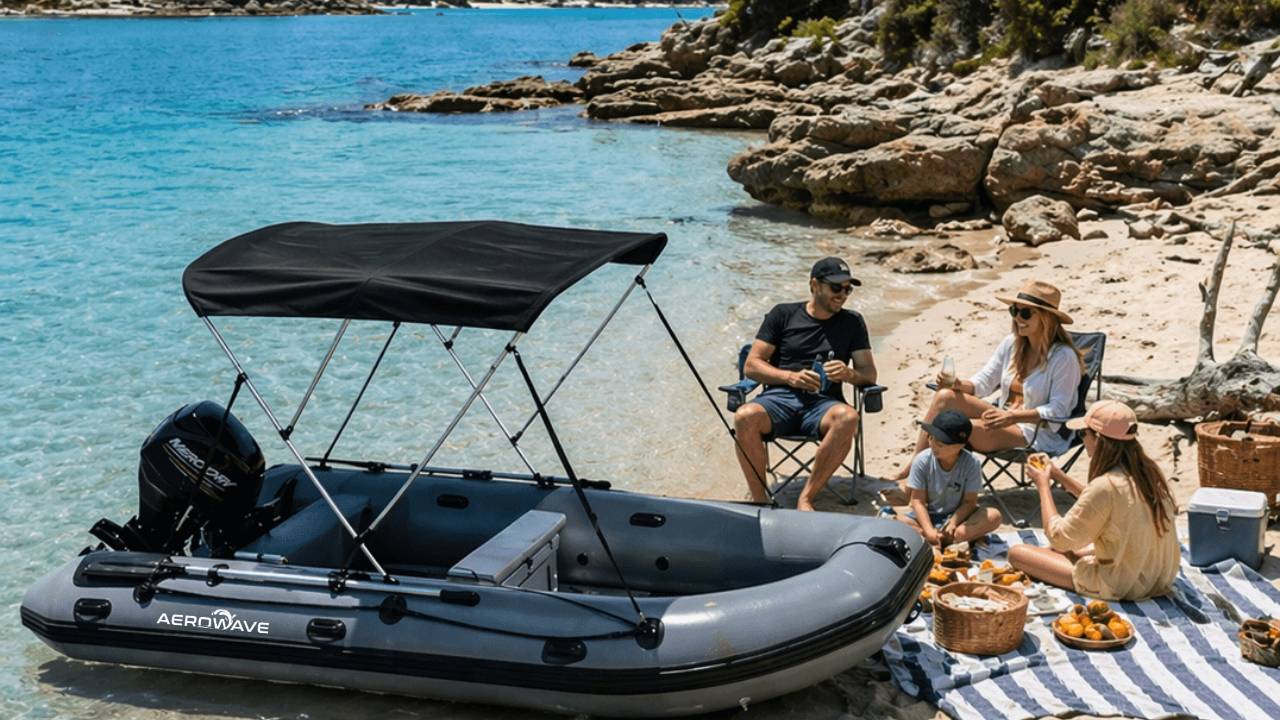
For those touring Australia, a boat must be portable, period. A RIB is an impossibility. The choice is between a tender and a cat. Whilst a tender is adequate for a quick paddle, an inflatable catamaran dramatically expands your horizons. It transforms a waterfront campsite into a base for serious fishing, crabbing, and exploring. It's stable enough to be a swimming platform for the grandkids and efficient enough to explore miles of waterway on a single tank of fuel. It packs away neatly, leaving plenty of room for all your other gear.
The Passionate Angler
For stand-up casting, stability is everything. Any sudden lurch can send you off balance. Here, the inflatable catamaran is the undisputed champion of the portable world. It provides a rock-solid platform that feels like a boat twice its size. The open deck layout can be customised with rod holders, fish finders, and chilly bins. Its shallow draft allows you to sneak into skinny water where prize fish hide, and its quiet electric or small 4-stroke outboard won't spook them. Many anglers are now choosing an inflatable catamaran as their sole fishing vessel, freeing them from the costs and limitations of a trailer boat.
The Heart of the Matter: Why German VALMEX® Fabric is Crucial
The single most important component of any soft inflatable boat is its fabric. This is where you should never compromise. Many budget boats use generic, often Chinese-made PVC. This material can look fine on the showroom floor, but it often suffers from poor UV resistance, becoming brittle and prone to seam failure after just a few seasons under the harsh Australian sun.
At Easy Inflatables, we exclusively use premium German-made VALMEX® fabric. This isn't just a brand name; it's a completely different class of material. VALMEX® is a highly engineered, multi-layered polymer fabric renowned for its exceptional strength, abrasion resistance, and, most critically, its world-class UV stability. It's the same class of material trusted in massive architectural structures and long-haul commercial trucks.
Our AeroCat range is built from tough 0.9mm / 1100 GSM VALMEX®, perfect for demanding recreational use. Our flagship Aerowave Viper 400 Sovereign uses an even more substantial 1.2mm / 1500 GSM VALMEX® Heavy Plus, a fabric so durable it allows us to offer a 7-year warranty. A boat built with VALMEX® can be realistically expected to have a service life of 10-12 years or more with basic care. A budget PVC boat might last a third of that. When you factor in the longevity and peace of mind, investing in a VALMEX® boat is one of the smartest financial decisions a boater can make.
The Bottom Line
When considering a tender vs RIB vs inflatable catamaran, there's no single 'best' boat—only the best boat for you. If raw, open-ocean performance is your only metric and portability is irrelevant, a RIB is a potent tool. If you need the most basic, lightest, and cheapest option for ferrying from a mooring to the beach, a traditional tender serves its purpose.
However, for the vast majority of Australian recreational boaters who need a versatile, capable, and genuinely portable vessel, the modern inflatable catamaran stands out as the clear winner. It masterfully blends the efficiency and stability of a twin-hull design with the pack-down convenience that made inflatable boats popular in the first place. It is, for many, the perfect compromise—a boat that asks for so little in storage and transport, yet gives back so much in performance, safety, and adventure on the water.
If you're still weighing your options, our expert team is here to help. We don't do hard selling; we offer honest advice based on decades of on-water experience. Give us a call at +61 2 4335 1603 or email sales@easyinflatables.com.au to discuss your specific needs. And remember, we offer FREE Economy Sea Freight (30–40 days) on all boat packages Australia-wide.
Related
Shop gear featured in this guide
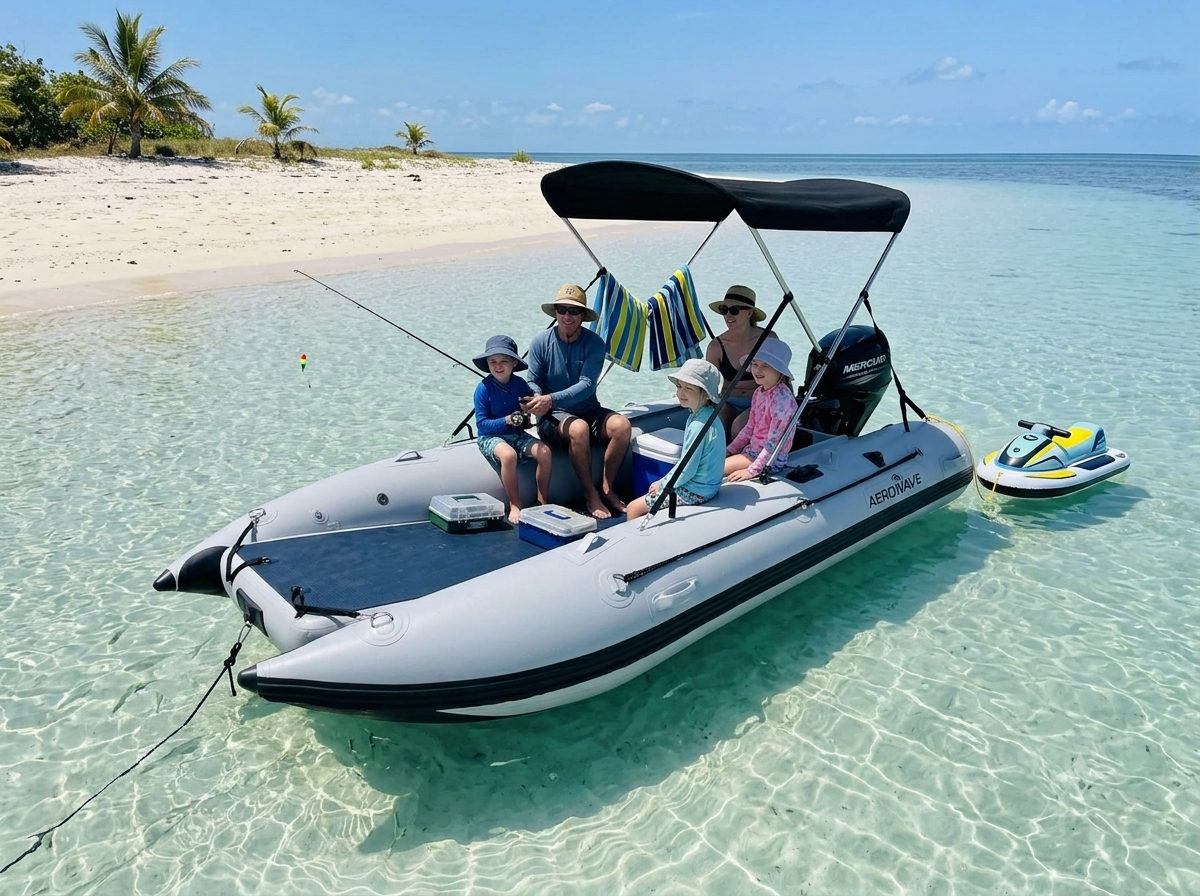
Aerowave WaveRunner 380 Series 3 Catamaran Package
The WaveRunner 380 Series 3 is a premium 3.8m inflatable catamaran package built for Australian and worldwide families, fishing, and coastal day boating — ideal for snorkeling and spearfishing — offering serious stability and premium German Valmex® construction.

Aerowave Viper 400 Sovereign
Flagship 4m enclosed-bow inflatable catamaran. German VALMEX® 7321 Heavy Plus 1.2mm commercial-grade fabric, 10 PSI high-pressure drop-stitch air deck floor with VALMEX non-slip surface, LockPro wheels, full Bimini and FREE express delivery Australia-wide delivery included. Winter special — save $1,000 until 31 August 2026.
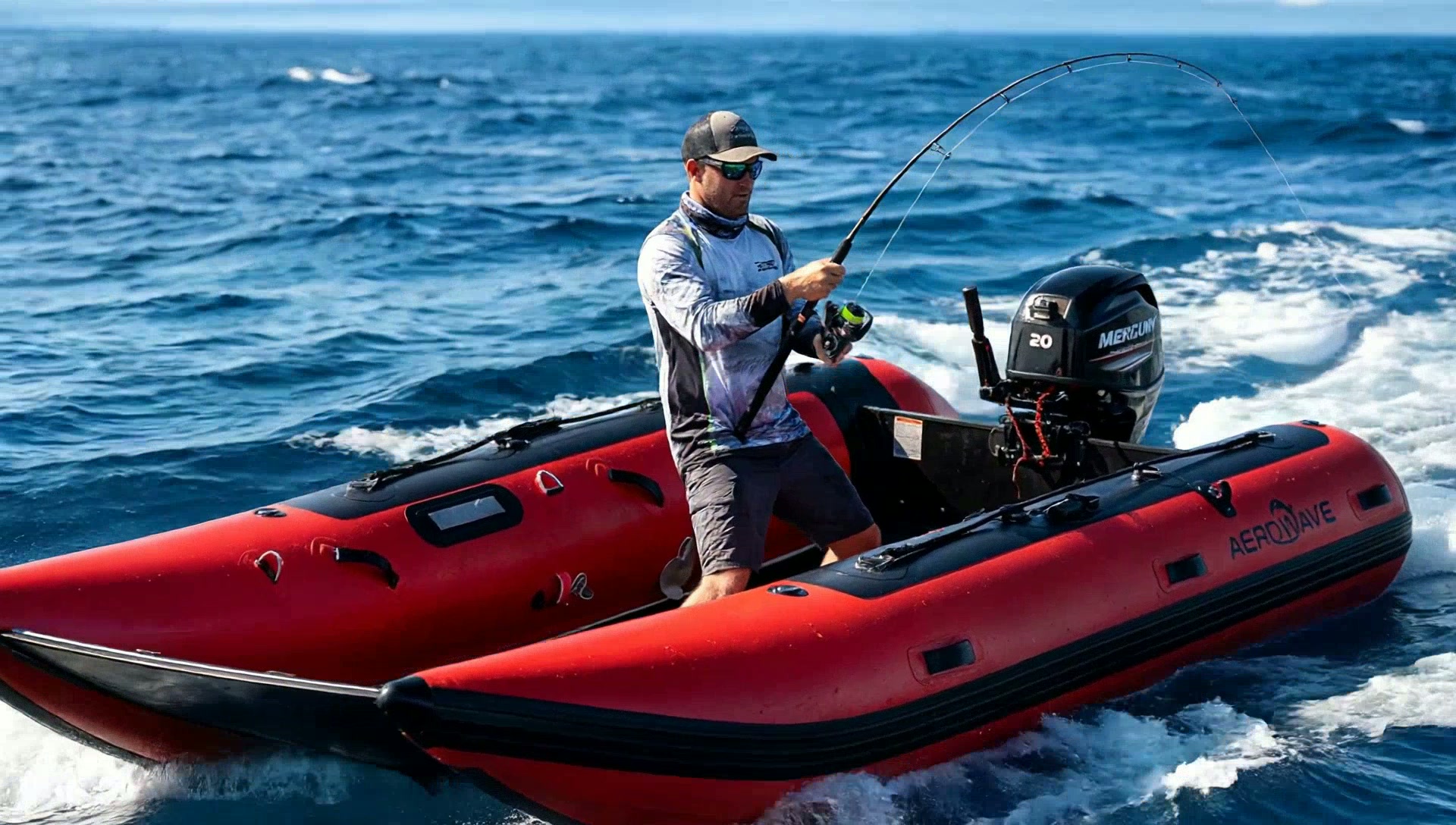
AeroWave AeroCat 360 Inflatable Catamaran
Same proven hull design, shape and look as our flagship Aerowave Viper catamarans — built lighter using 0.9mm Valmex® fabric instead of the Viper's 1.2mm. The AeroWave AeroCat 360 is our 3.6m inflatable catamaran built from 0.9mm Valmex® fabric — intentionally lighter than our 1.2mm Viper hulls so it folds smaller, packs lighter and is easy to handle solo. Twin-hull stability, 5-Year Warranty with global support and priced ~$500 below comparable 0.9mm imports.
Not sure which suits you? Talk to a real boat owner.
Frequently asked questions
- What's the real difference between PVC and VALMEX® fabric?
- The primary difference is durability and UV resistance. Standard PVC, common in budget boats, can degrade and become brittle under the Aussie sun. German-made VALMEX® is a premium layered polymer with superior UV inhibitors, providing a realistic lifespan of 10-12 years, compared to just 3-5 for many basic PVC boats.
- How fast will an inflatable catamaran go with a small outboard?
- Due to their efficient tunnel hull, an inflatable catamaran like an AeroCat 380 can plane easily and reach speeds of 25-30 km/h with just a 9.9hp outboard and two people. This is significantly faster and more efficient than a traditional V-hull tender with the same power.
- Are inflatable boats safe for families with children?
- Yes, particularly inflatable catamarans. Their exceptional stability makes them one of the safest platforms for a family, as they resist tipping and rolling far better than traditional boats. The large, soft tubes also provide a secure boundary and comfortable seating for little ones.
- Can I take my dog in an inflatable catamaran?
- Absolutely. High-quality fabric like the 1.2mm VALMEX® on our Viper series is extremely tough and resistant to punctures from dog claws. We recommend laying down a small marine carpet or mat for extra grip and protection, but the boat itself is more than robust enough.
- How difficult is it to repair a puncture?
- Repairing a puncture in a modern inflatable is straightforward and can be done permanently by the owner. All our boats come with a professional repair kit. The process involves cleaning the area, applying a specialist adhesive to both the patch and the boat, and pressing them together firmly.
- What size outboard motor do I need for an inflatable catamaran?
- The beauty of the catamaran design is its efficiency. A 3.8m model runs beautifully with a 9.9hp outboard, whilst a larger 4.0m model is perfectly matched with a 15-20hp. This is significantly less power (and weight, and cost) than a similar-sized RIB would require.
- What is the difference between a RIB and a SIB?
- A RIB (Rigid Inflatable Boat) has a solid fibreglass or aluminium hull, making it non-portable. A SIB (Soft Inflatable Boat) has a flexible, inflatable floor or air deck and can be completely deflated and folded for transport. Our inflatable tenders and catamarans are all SIBs.
- Which is better for fishing: an inflatable cat or a small tinny?
- An inflatable catamaran offers superior stability for stand-up casting compared to a typical aluminium dinghy ('tinny'). It is also quieter on the water and its soft tubes won't damage other boats. Critically, the inflatable catamaran is fully portable, unlike a tinny which always requires a trailer.
Ready to set sail?
Premium German-fabric inflatable catamarans with FREE Sea Freight or Express Air Delivery — your choice at cart. Talk to our team or browse the fleet.
Like this guide? Get the next one in your inbox.
Owner-tested tips, gear deep-dives and Aussie boating know-how — no spam.