Whale Watching by Inflatable Catamaran: A Charter Operator's Guide for NSW and QLD
Why inflatable catamarans are quietly taking over the small-group whale watching market on the east coast — fuel economy, approach distances, AMSA survey and the per-passenger maths.
At a glance
Why inflatable catamarans are quietly taking over the small-group whale watching market on the east coast — fuel economy, approach distances, AMSA survey and the per-passenger maths.
- Why whales prefer an inflatable catamaran
- The AMSA survey question
- The per-passenger maths
- Boat layout for paying passengers
What we'd put you in
Aerowave Viper 400 Sovereign
If you're reading about catamarans, this is the one we build most of.
US$3,167 USD
Delivered to your door, today's rate
- Free freight to United States · local taxes payable on arrival
- 7-year hull warranty
🇺🇸 Shipping to United States · landed price quoted in writing
Yes — we ship the Aerowave Viper 400 Sovereign to United States. Here's the landed price.
If you're reading about catamarans, this is the one we build most of.
Written for Australian readers — but the boat ships to you. We are an Australian builder and this article is written from Australian waters. That changes nothing about what you can order: the same hull, the same 7-year warranty and the same certification go out to United States every week.
Aerowave Viper 400 Sovereign
- Boat package (export price)
- US$3,726
- 15% tariff relief credit
- − US$559
- Express air freight to United States
- Included
- Import duty, taxes & customs clearance
- Payable on arrival
- Estimated landed, USD
- US$3,167
Indicative, converted at today's rate, before local duty and tax on arrival. Ask below and we'll put a fixed figure in writing, valid 30 days.
- 7-year hull warranty
- 1500 GSM / 1.2 mm VALMEX® Heavy Plus hull
- CE certified to ISO 6185-3 and EU Directive 2013/53/EU
- Door-to-door, tracked the whole way
Your price, delivered to your door — freight included.
We email the full PDF quote (spec, freight, finance, WavePay) to your inbox in under 60 seconds. No spam — one quote, one follow-up.
See it for yourself
Real boats. Real owners. Real people behind them.
Plenty of what you read online these days is generated. Check us out properly — the factory, the reviews and the owners are all one click away. Why we use AI, and how to check we’re real
How our boats are built
Walk the production line: thermo-welded seams, 1.2 mm VALMEX Heavy Plus hulls, over-pressure relief valves on every chamber.
See the buildGoogle Maps reviews
Real Australian owners, five stars, published on our Google Business Profile with the map — read them there, not just on our own site.
Open Google Maps reviewsOwner stories
Boats in use — offshore, on rivers, on rescue duty. Photos and words from the people who actually own them.
Read owner stories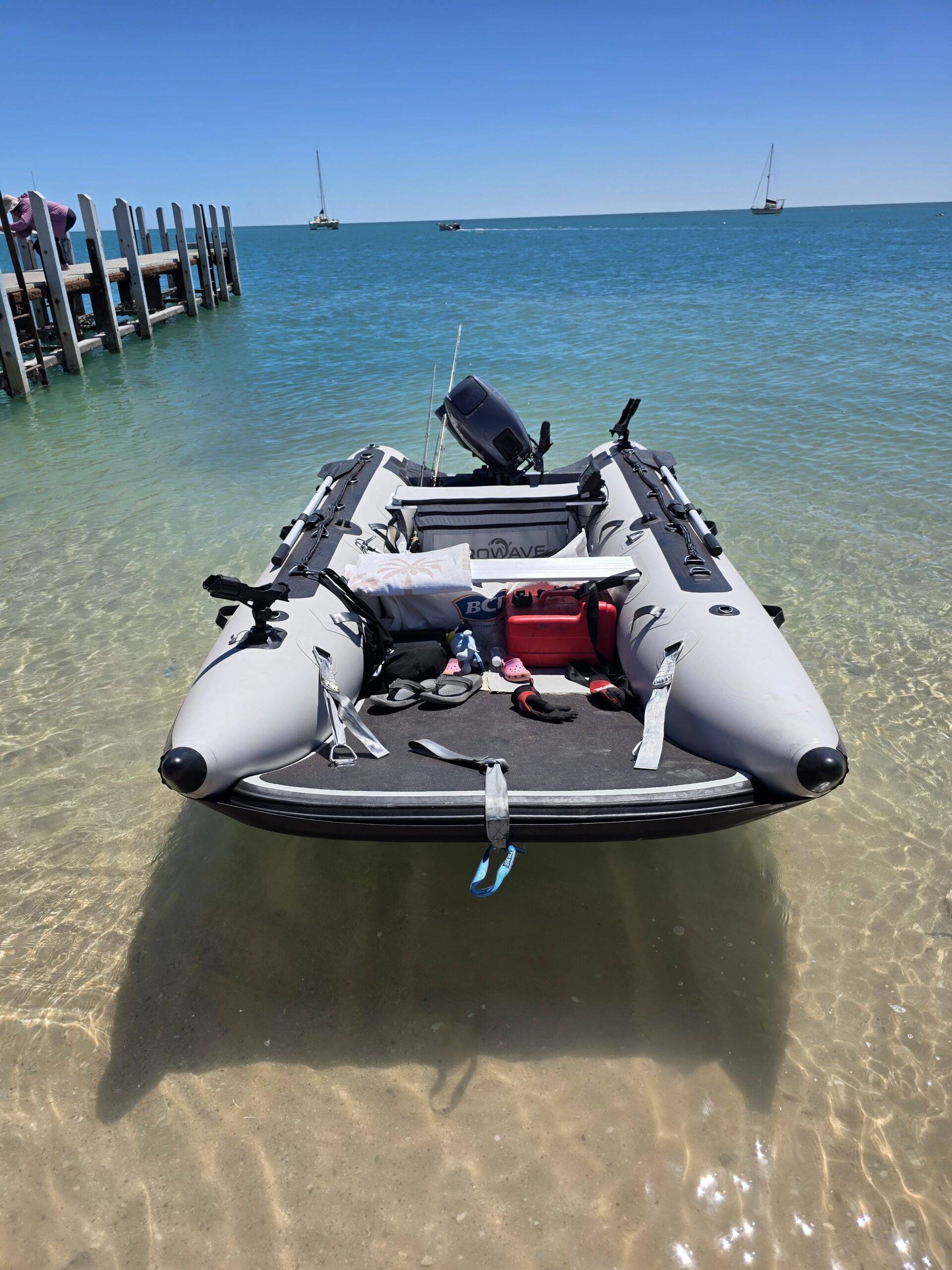
The east coast humpback migration is now the biggest single marine-tourism product in Australia — Hervey Bay alone moves over 80,000 paying passengers between July and October each year. Most of those passengers are still being loaded onto 20 m mono-hull cats that burn 90 L of diesel an hour and take 45 minutes to reach the whales.
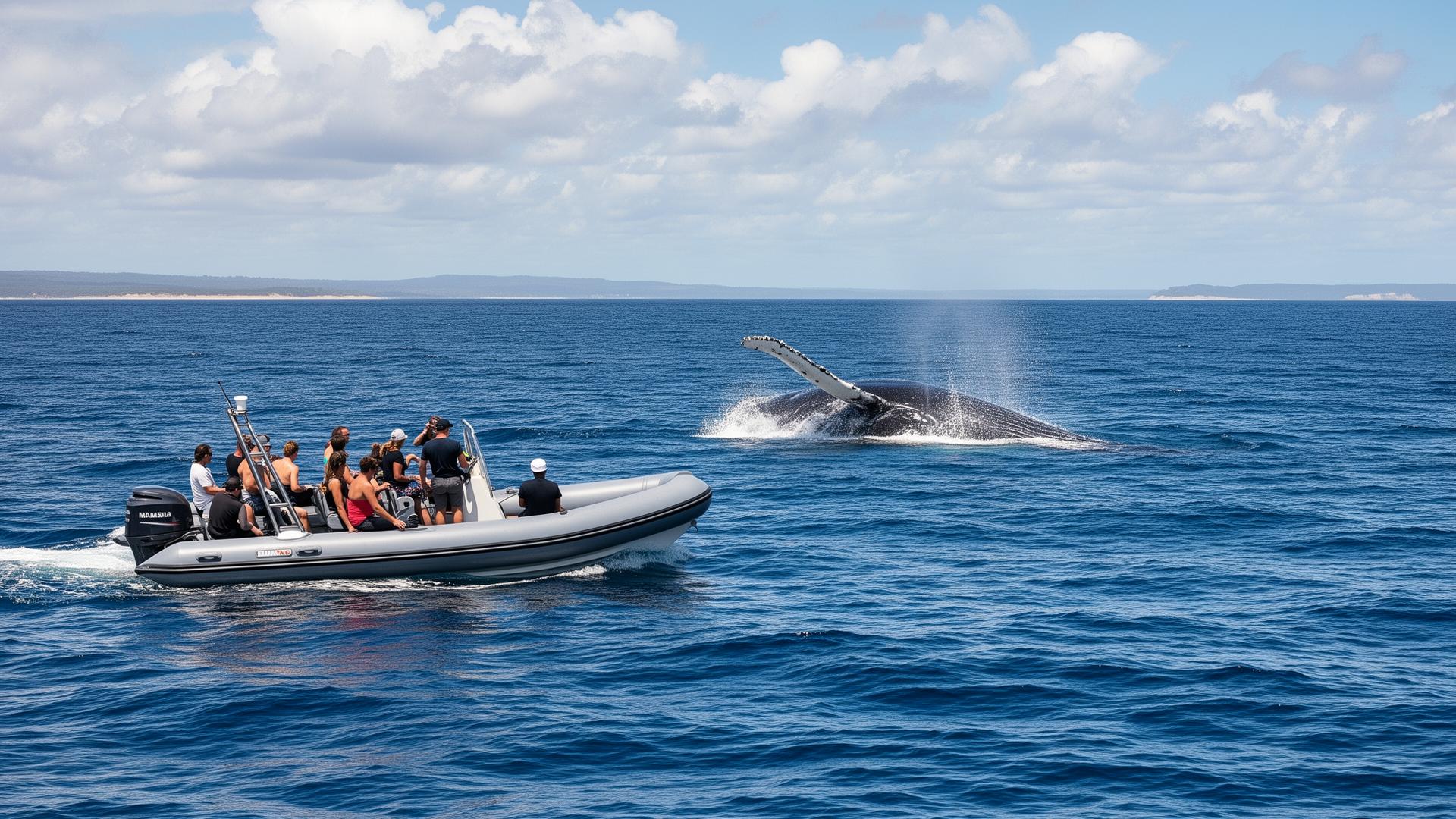
There is a quieter business model creeping up the coast: 6 to 12 passenger inflatable catamaran charters, running 90-minute trips at $120–$160 a head, departing every two hours from a sheltered ramp. The fuel bill is one-tenth of a big cat. The whales approach closer. And the boat fits on a tandem trailer.
If you are an operator weighing up a third hull, or a deckhand thinking about going out on your own, this guide is the brief we wish AMSA published.
Why whales prefer an inflatable catamaran
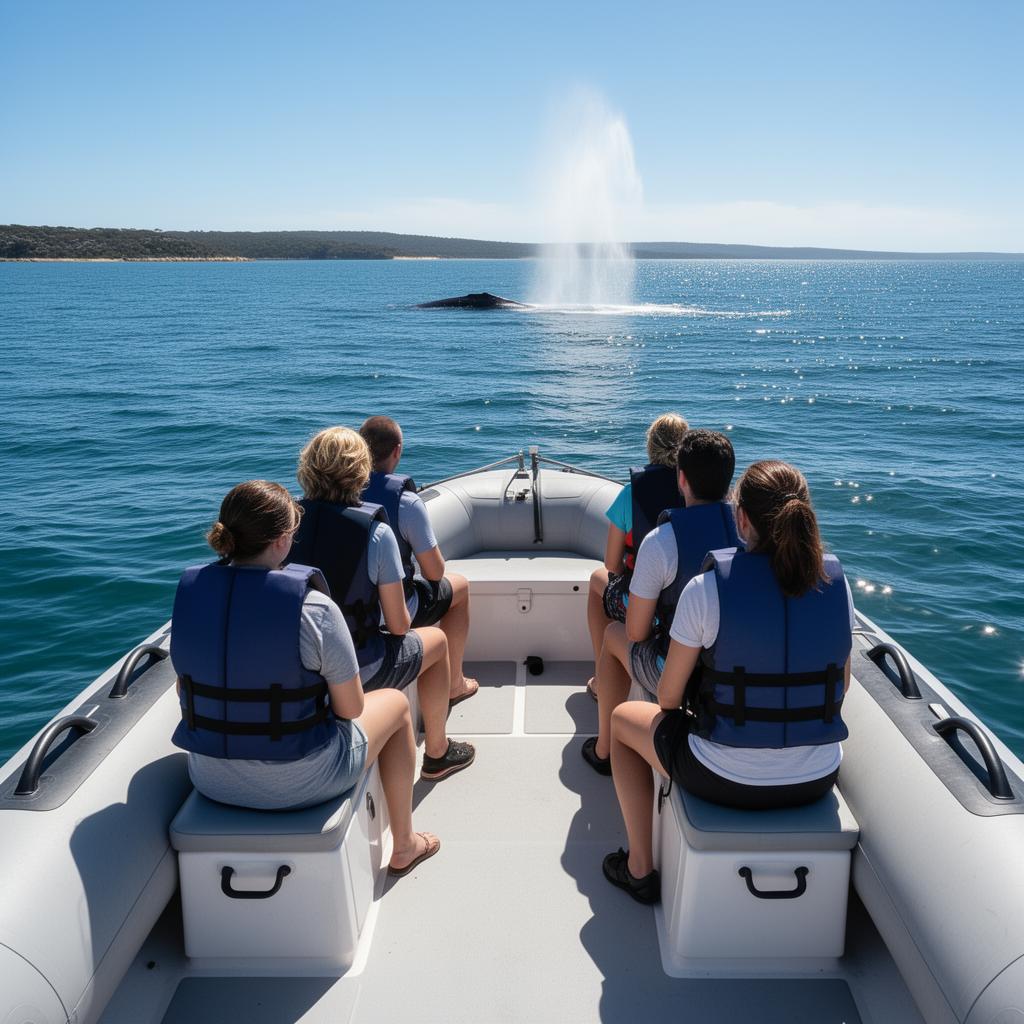
This is not marketing — it is documented. Two peer-reviewed studies (Stamation et al. 2010, Sprogis et al. 2020) tracked humpback responses to different vessel types and the pattern is consistent:
- Lower hull noise. Inflatable tubes absorb engine and slap noise. A 4 m cat at 5 knots puts roughly 10 dB less broadband noise into the water than an equivalent mono-hull at the same speed.
- Smaller silhouette. Whales habituate to a smaller boat faster. Approach distances reduce from the regulated 100 m down to the whale-initiated 30 m mugging that paying customers actually pay for.
- No wake echo. The twin-tube design produces a clean V-wake that dissipates within two boat lengths — whales do not associate it with a threat.
The practical outcome: operators in Mooloolaba and Coffs Harbour running 6-pax inflatables are getting whale-initiated approaches on roughly 65% of trips, versus 25% for the 80-pax boats out of the same harbour.
The AMSA survey question
This is the bit most prospective operators get wrong. You do not need to build a $400,000 survey vessel to take paying passengers whale watching.
Inflatable catamarans of 4 m and above can be surveyed for:
- Class 1E — passenger vessel, partially smooth waters, up to 12 passengers, daylight only.
- Class 2C — non-passenger commercial (research, film, dive support) up to 30 nm offshore.
Class 1E covers most east coast whale grounds (within 5 nm of the coast). The survey costs around $3,500–$6,000 first up, then $1,800/year. Compared to a hard-hull cat survey ($35,000+ first up), the savings fund a year of fuel.
You will need:
- A Marine Surveyor inspection (AMSA-accredited).
- Stability documentation — most reputable inflatable cat manufacturers will supply this. Ask before you buy. If they cannot supply it, walk away.
- Bilge pump, twin batteries, EPIRB, life jackets to SOLAS standard for every passenger, first aid kit, flares in date.
- A Coxswain Grade 1 (NC) qualification — 5 days of study, ~$1,800 at TAFE.
The per-passenger maths
Let us use realistic 2026 numbers from a Byron Bay operator running a 7 m inflatable catamaran with twin 60 hp 4-strokes.
| Line item | Per trip (6 pax, 90 min) |
|---|---|
| Revenue (6 × $140) | $840 |
| Booking platform fee (10%) | -$84 |
| Fuel (45 L @ $2.20) | -$99 |
| Deckhand (2 hr @ $38) | -$76 |
| Insurance, mooring, marketing (per trip allocation) | -$120 |
| Boat depreciation per trip | -$45 |
| Net per trip | $416 |
Run two trips a day, six days a week through the 16-week season: roughly $80,000 net to the operator across a single season, on a boat that cost $55,000 to put on the water. A 14 m mono-hull cat earning the same per-passenger needs to fill 120 seats a day just to cover depreciation.
The thing nobody tells new operators: the limiting factor is not demand, it is your back. Two trips a day, six days a week, for four months will physically wreck a single-operator setup. Plan for a second skipper rotation by year two.
Boat layout for paying passengers
A whale watching cat is not the same boat as a fishing cat. Strip the fishing gear out and think about the customer experience.
Seating: bench seats fore and aft of the console give every passenger a forward view. Avoid jockey seats — older passengers cannot get on and off them safely in any sea state.
Grab rails: stainless rails along both tubes, with non-slip tape every 300 mm. This is what your insurance assessor will check first. If a passenger goes overboard while standing for a photo, the rails are the difference between a claim and a lawsuit.
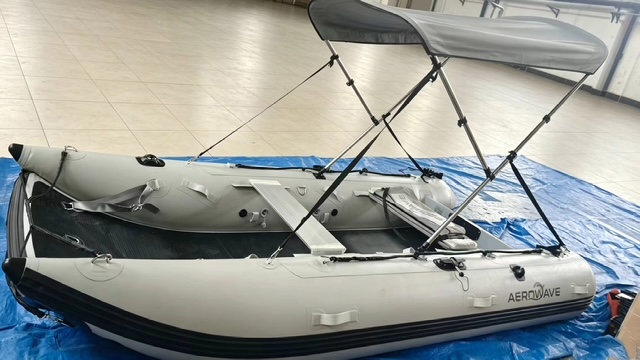
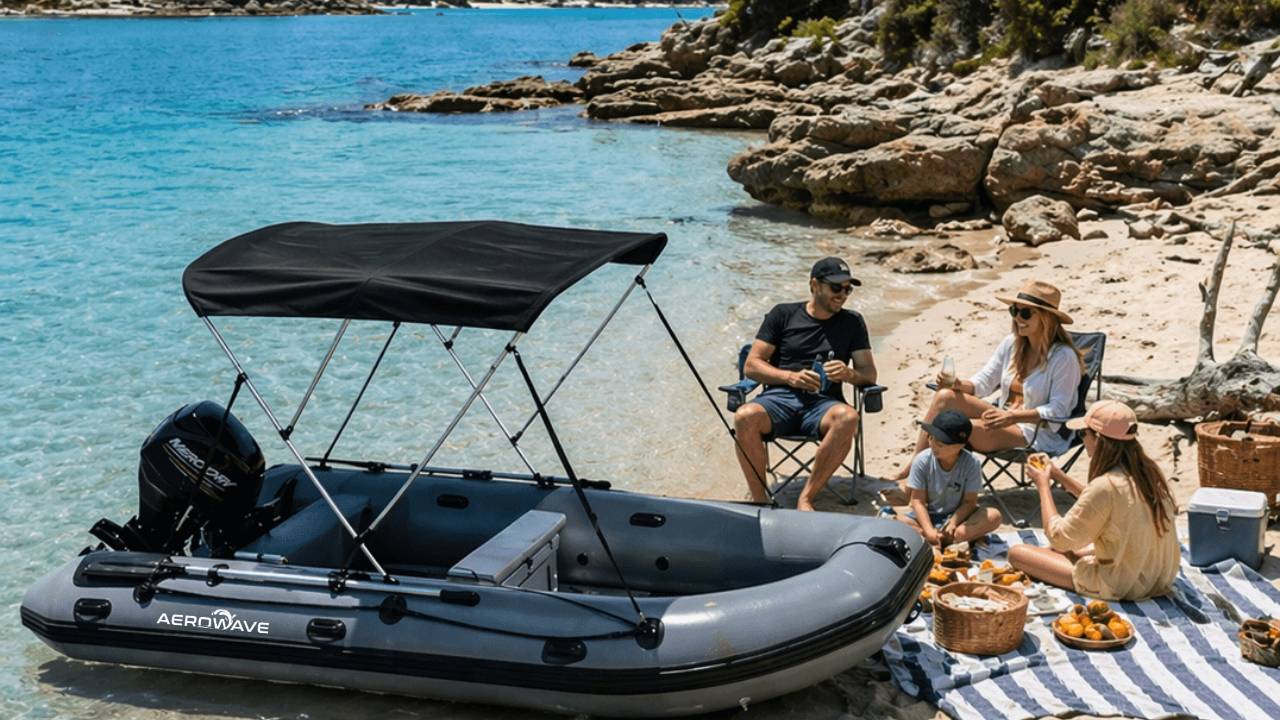
Shade: a Bimini top is non-negotiable for the QLD market — 90 minutes in unfiltered sun will lose you every TripAdvisor review you ever wanted. Our WaveRunner 380 ships with the grey Bimini included.
Camera platform: most passengers will hold up a phone. A small step on the leading tube gives photographers a clean shot over the bow without unbalancing the boat.
Toilet: for 90-minute trips, none required. For 3-hour offshore trips you legally need a holding tank — and at that point a bigger boat is the right call.
Approach rules every operator must know
The Australian National Whale and Dolphin Watching Guidelines are not advisory — they are state law in NSW, QLD, VIC and WA. Breach them once and your survey is at risk.
- 100 m caution zone: maintain at least 100 m from any whale.
- 300 m caution zone for calves: any pod with a calf gets a wider berth.
- No more than 3 vessels within the 300 m zone at any time.
- No approach from in front or directly behind — always parallel.
- If the whale approaches you, idle in neutral. Do not engage gear until the whale is more than 100 m away.
A whale-initiated approach is the gold standard, and it is the single reason small inflatable cats outperform larger boats commercially: a curious humpback will come to within 5 m of a quiet 6 m cat. They will not do that to a 20 m boat.
What kills these businesses
Three things, in order:
- Weather cancellations. Build a refund policy that gives credit, not cash, or you will spend half your season writing refunds. East coast operators average 22% cancellation across the season.
- Operator burnout. See the maths above. Hire a second skipper in year one, even if the numbers look tight.
- Buying the wrong boat. A 0.9 mm fabric tube will not survive a 16-week commercial season of UV and salt. Spec a 1.2 mm thermo-bonded hull and budget for tube replacement every five years rather than every two.
If you are sizing a boat specifically for charter, the Viper 400 Sovereign is the floor for legal 6-pax Class 1E operations; the Aerowave WaveRunner 380 is the value pick if you are starting with 4-pax dive-and-dolphin trips and growing into whales.
A note on noise and welfare
The marine tourism industry's social licence on whale watching is genuinely under threat in some jurisdictions. The best argument any of us have is that small, quiet inflatables produce dramatically less disturbance than the alternative. Filming your own approach distances and submitting them to your state agency is not paperwork — it is what keeps the industry running in 2030.
If you are building a charter business, the boat is the easy part. The real work is the AMSA paperwork, the booking funnel, and the second skipper. Once those are sorted, an inflatable catamaran is by some distance the highest-margin platform in Australian marine tourism today.
Weekend-Proof Score 17 questions · about 2 minutes
Will the boat you're about to buy survive an Australian summer?
Seventeen straight questions about where you'll use it, what you'll ask of it and the boat you're weighing up. You get a score out of 100, the exact weak points in your plan, and the one boat that genuinely fits.
Free · your result shows on screen · no email required
So which one is yours?
Pick how you'll actually use it and we'll take you straight to the right hull.
I want to fish it
Open bow, rod holders, deck space you can stand and cast from.
Viper Sport 400Family, diving and the beach
3.8 m Series 3 catamaran — low bow to climb back in wearing fins or a tank.
WaveRunner 380Tender / one-person launch
3.3 m hard-floor boat that packs into a bag and still takes a beach landing.
Viper 330Shop gear featured in this guide
Aerowave WaveRunner 380 Series 3 Catamaran Package
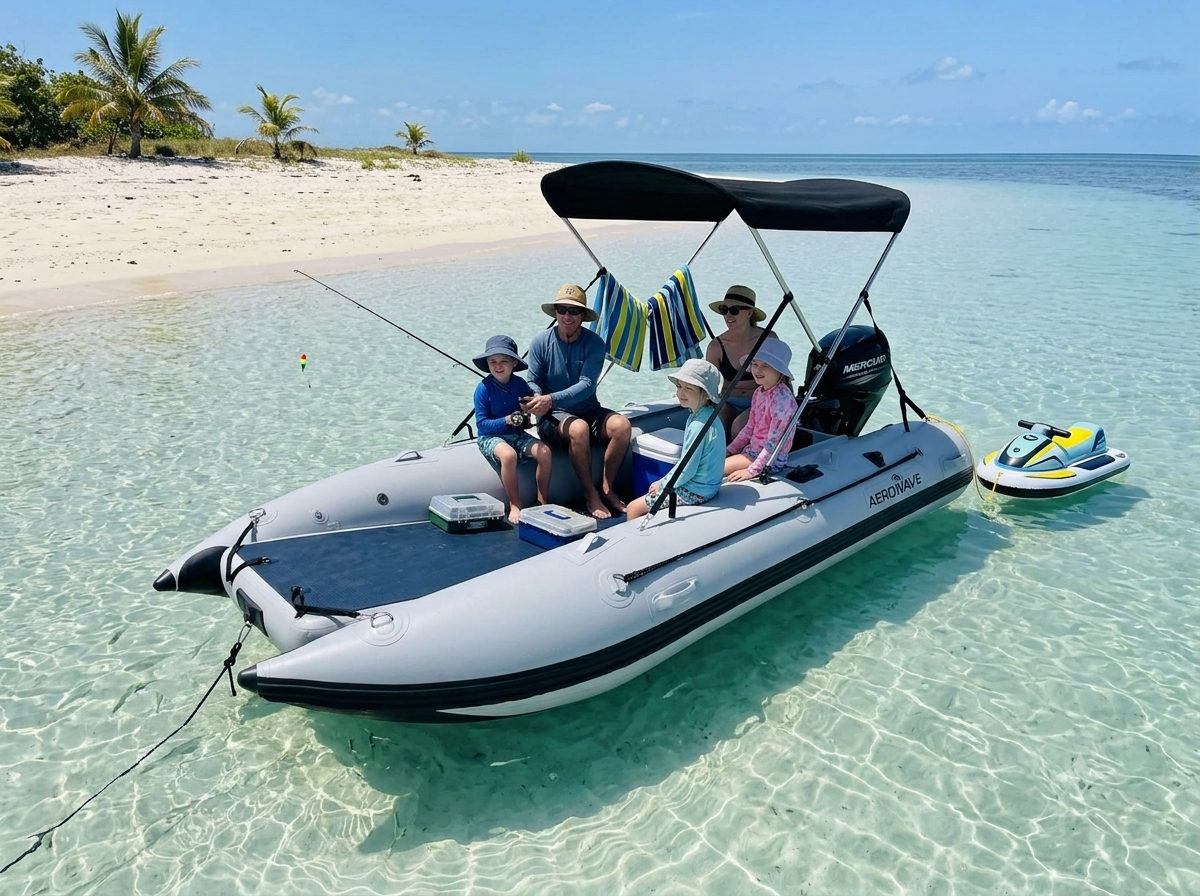
The WaveRunner 380 Series 3 is a premium 3.8m inflatable catamaran package built for Australian and worldwide families, fishing, and coastal day boating — ideal for snorkeling and spearfishing — offering serious stability and premium German Valmex® construction.
Free freight to United States · local taxes payable on arrival
Aerowave Viper 400 Sovereign
Flagship 4m enclosed-bow inflatable catamaran. German VALMEX® 7321 Heavy Plus 1.2mm commercial-grade fabric, 10 PSI high-pressure drop-stitch air deck floor with VALMEX non-slip surface, LockPro wheels, full Bimini and FREE express delivery Australia-wide included. Winter special — save $1,000 until 31 August 2026.
Free freight to United States · local taxes payable on arrival
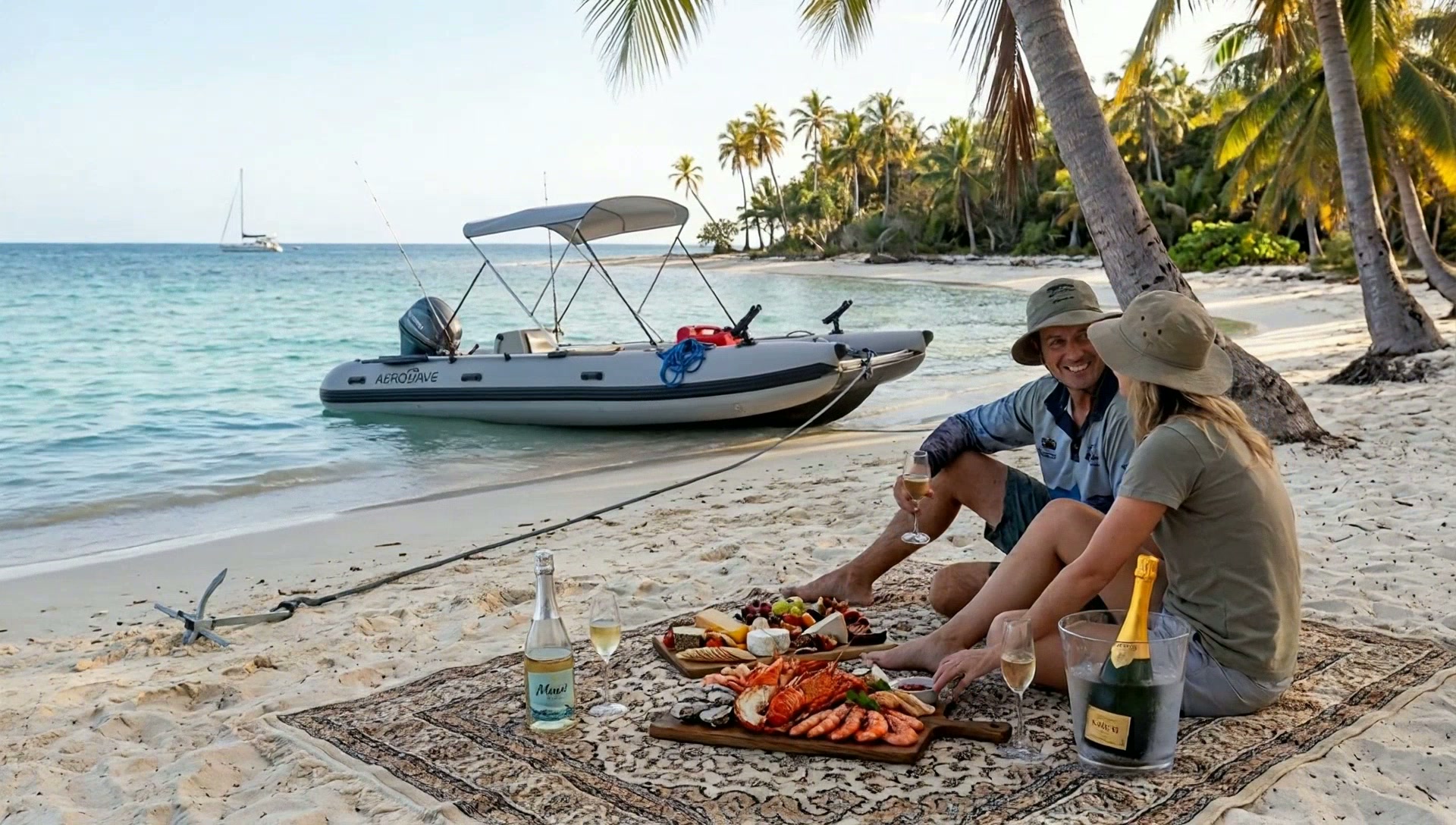
Aerowave Viper 365 Open Bow
Premium 3.65m Inflatable catamaran — built the same way as our flagship Viper 400 sports boat, just 35cm shorter. German VALMEX® 7321 Heavy Plus 1.2mm commercial-grade fabric, 10 PSI high-pressure drop-stitch air deck floor with VALMEX non-slip surface, LockPro wheels, full Bimini and FREE express delivery Australia-wide included.
Free freight to United States · local taxes payable on arrival
Not sure which suits you? Talk to a real boat owner.
Before you spend a cent
Buying from Australia, delivered to United States
You have never heard of us, we are on the other side of the world, and the internet is full of fakes. Fair enough. Here is everything you would need to check us out, in one place — no forms, no chat bot.
Australian designed business
Easy Inflatables, Avoca Beach NSW 2251. ABN 96 856 548 613. International orders ship from our Hong Kong hub.
222 owner reviews, 4.8 average
Read them in full, good and bad, on our reviews page.
CE certified, 7-year hull warranty
ISO 6185-3 and EU Directive 2013/53/EU. Warranty honoured worldwide.
Tracked, insured, door to door
FREE freight to United States · local tax/duty on arrival.
- Who am I actually buying from?
- Easy Inflatables, Avoca Beach NSW 2251, Australia. ABN 96 856 548 613. Sean is the owner and skipper, Gary Stewart handles sales on +61 2 4335 1603, Karen Matthews handles email. The boats are Australian designed; international orders ship from our Hong Kong dispatch hub so your landed price stays competitive. Phone us before you pay a cent — a real person answers.
- Is this really an Australian product?
- Yes — Australian designed and engineered on the NSW Central Coast. Manufacturing is done offshore to our spec, and international orders ship direct from our Hong Kong dispatch hub. If we routed every boat through Australia first, the freight alone would roughly double or triple your cost for the same hull.
- What do I pay, and what is not included?
- The delivery and import terms depend on your country. EU, UK, New Zealand and named Asia/Pacific lanes include duty and tax; US freight is free but US buyers pay import charges on arrival. Other destinations show their terms before payment.
- How do I pay safely?
- Card through Stripe (Visa, Mastercard, Amex, Apple Pay, Google Pay) or bank transfer. Card payments carry your bank's own dispute protection. We never ask for crypto, gift cards or payment to a personal account.
- What if it arrives damaged?
- Every boat ships fully tracked and insured door to door. Photograph the carton and the boat on arrival and email us — transit damage is claimed and replaced through us, not left with you and the courier.
- Is the warranty real outside Australia?
- Yes. The 7-year hull warranty on 1.2 mm VALMEX Heavy Plus and Orca Hypalon hulls applies wherever you are. Replacement parts are held in Australia and at our overseas hub and go out by express courier to your door.
- Is the boat actually certified?
- All Aerowave catamarans are CE certified to ISO 6185-3 and EU Directive 2013/53/EU. Certification paperwork is supplied with the boat — ask and we will send it before you order.
Frequently asked questions
- Can I legally charge passengers for a whale watching trip on an inflatable catamaran?
- Yes, provided the boat is in survey (typically Class 1E for inshore work) and the skipper holds at least a Coxswain Grade 1 Near Coastal qualification. AMSA accepts inflatable catamarans for survey when stability documentation is supplied by the manufacturer.
- How close can I legally approach a humpback whale in Australia?
- 100 metres from any whale, 300 metres if a calf is present. The whale may approach you closer of its own accord — if that happens, idle in neutral until the whale is more than 100 metres away before engaging gear.
- What size inflatable catamaran do I need for 6 paying passengers?
- A 4 metre hull is the legal minimum for Class 1E with 6 pax in most surveyors' assessments, but 4.8 metres or larger is recommended for comfort and weather margin. The Viper 400 Sovereign is the typical entry point for east coast operators.
- How long does an inflatable catamaran tube last in commercial whale watching service?
- A 1.2 mm thermo-bonded PVC hull will commonly run 5 to 8 seasons of 16 weeks intensive use before tube replacement. 0.9 mm fabric drops that to 2 to 3 seasons. UV is the killer — keep the boat covered when not in use.
- What does the AMSA survey for an inflatable catamaran actually cost?
- Roughly $3,500 to $6,000 for the initial survey, then $1,800 annually for renewal, plus your Coxswain qualification (~$1,800 at TAFE) and stability documentation from the manufacturer. Insurance for a 6-pax Class 1E operation runs $4,000 to $7,000 per year.
Ready to set sail?
Premium German-fabric inflatable catamarans, built to order and delivered to your door. Talk to our team or browse the fleet.
Like this guide? Get the next one in your inbox.
Owner-tested tips, gear deep-dives and Aussie boating know-how — no spam.