
Knowledge hub · durability
Where inflatable hulls actually wear out
Almost nobody loses a boat to a dramatic impact. They lose it to five years of small abrasions in the same five places. Here is where to look, what the damage means, and what more material changes.
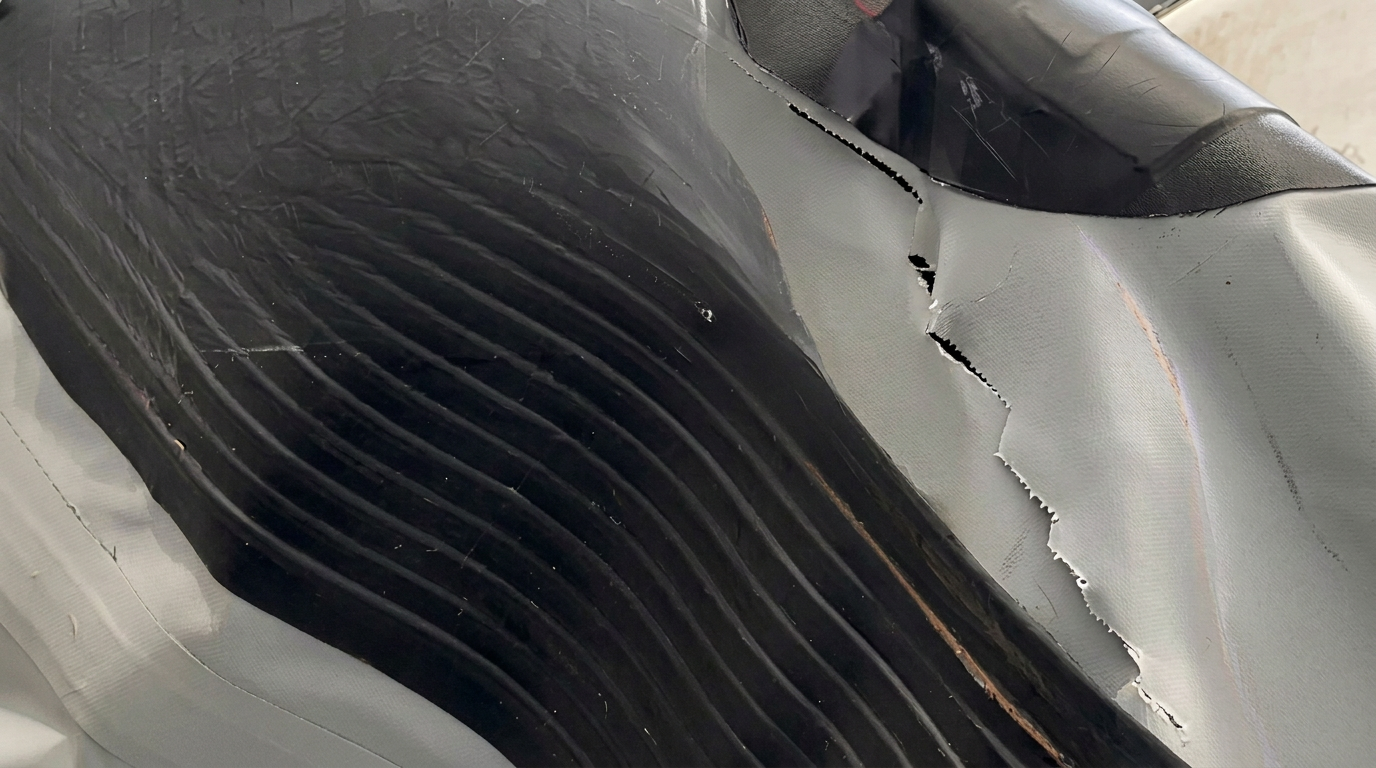
Abrasion is a subtraction problem
Every ramp, every beach pull-up and every mooring rub takes a small amount of coating off the hull. The scrim underneath is the strength of the fabric; the coating is what protects it from water, UV and salt. Once the coating is thin enough that the weave shows, the countdown starts, and a branch or an oyster edge finishes what the ramp began.
That is why thickness is not marketing. 1500 GSM / 1.2 mm German VALMEX Heavy Plus carries roughly a third more material than the 1100 decitex / 0.9 mm class in exactly the places that wear, and on the Viper and Sovereign hulls there is an extra protection layer bonded under the tubes and keel on top of that. The result is a realistic 10–12 year fabric life under normal Australian UV with proper care.
The AeroCat range is built on genuine 1100 decitex / 0.9 mm VALMEX because it packs smaller and is easier to handle solo. We publish that on the product page rather than hiding it, and we expect owners of those boats to be a little more careful on gravel.
The five wear zones
- 01
The keel line
Every beach landing and every gravel ramp is taken here first. Look for scuffing that runs fore and aft, and for any dulling that has become a flat spot.
- 02
Tube shoulders
Where the boat rubs against piles, pontoons and other boats. Growth on a mooring pile is effectively wet sandpaper.
- 03
Under the transom and rear cones
Dragging the stern up the sand is the single most common owner habit that shortens a hull's life. Wheels solve it entirely.
- 04
The sun side
UV does not scratch; it dries the coating out. A boat stored inflated on a pontoon ages on one side faster than the other.
- 05
Around fittings and D-rings
Rope chafe, gear stacked in the same spot, and the edges of a bimini frame all work at the same square centimetre for years.
Habits that add years
Use wheels, always
A launching wheel kit removes the single most damaging habit in inflatable boating — dragging the transom up the sand.
Rinse and dry before folding
Salt crystals are abrasive. Folding a salty, sandy boat grinds grit into the same creases every time.
Store out of direct sun
Under cover, or with a cover on. UV is the one form of wear that happens while the boat does nothing.
Pack down at working pressure, not rock hard
A drum-tight tube in the sun is a pressure problem as well as a fabric one. Relief valves handle the rest.
Straight answers
- What wears out an inflatable boat hull first?
- Abrasion on the underside and tube shoulders — gravel ramps, shell grit in sand, oyster edges, mooring piles with growth on them — combined with UV on the sun side. Impact damage is far rarer than steady wear.
- How can I tell if my hull is worn?
- Look for chalky or dull patches where the fabric used to be slightly waxy, scuffing along the keel and rubbing strake, colour fade on the side that faces the sun, and any area where the weave of the scrim is starting to show through the coating. Exposed scrim is the point to act.
- Does 1.2 mm fabric really make a difference to abrasion?
- Yes, because abrasion removes material. 1500 GSM / 1.2 mm VALMEX Heavy Plus carries roughly a third more material than the 1100 decitex / 0.9 mm class, in exactly the places a hull wears, and our Viper and Sovereign hulls also carry an extra protection layer bonded under the tubes and keel.
- How long should a hull last?
- Premium 1500 GSM / 1.2 mm VALMEX Heavy Plus has a realistic field life of 10–12 years under normal Australian UV with proper care. The lighter 0.9 mm class is a shorter-service-life fabric, typically 3–7 years depending on UV, storage and use.
- Can I upgrade my hull fabric later?
- No. Fabric is the one part of an inflatable you buy once, which is why we push people to settle it before the deposit. If you want more than 1.2 mm VALMEX, ORCA Hypalon — the RIB industry standard — is a A$1,900 upgrade at build time.