
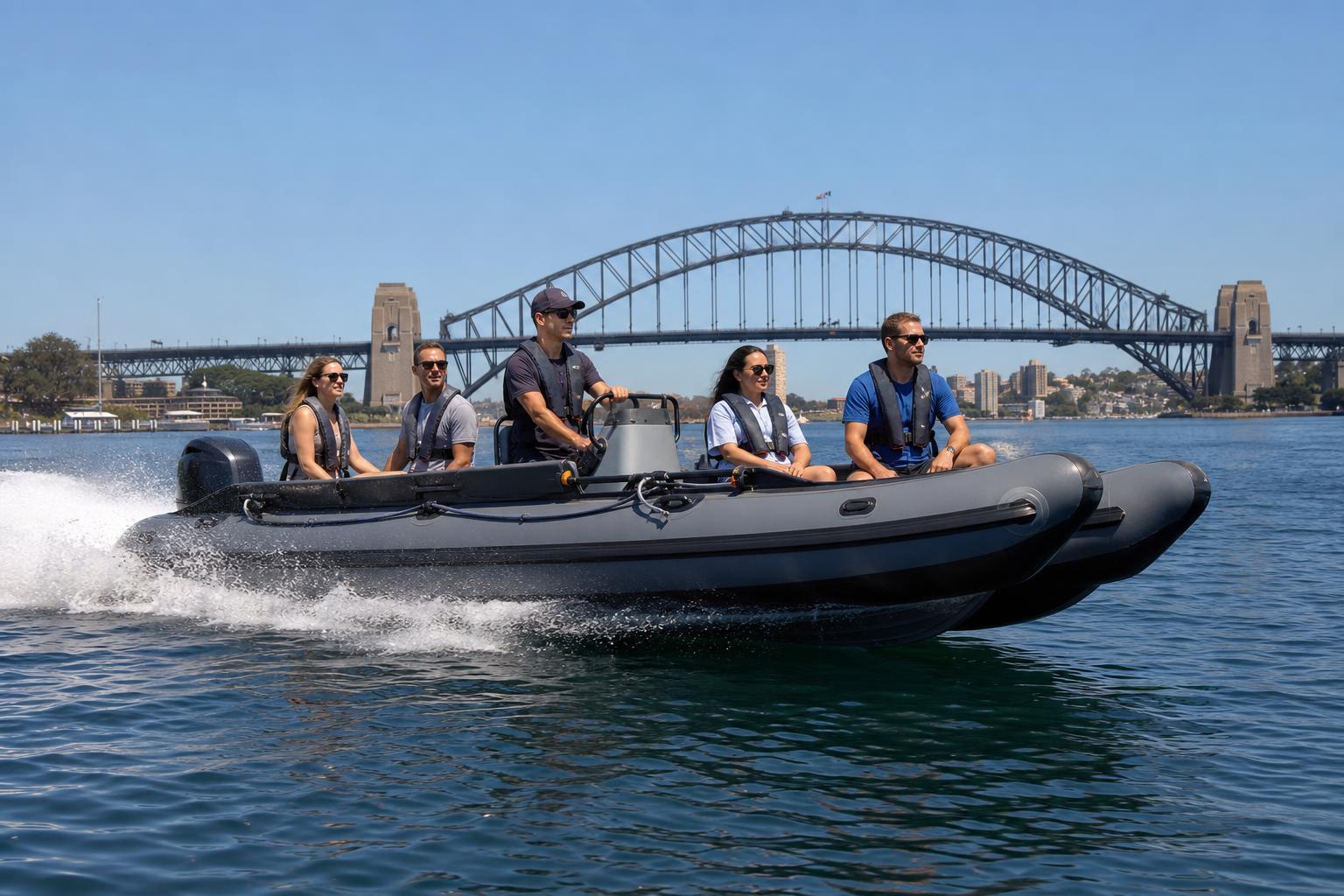
Why inflatable catamarans
Two hulls. One platform. Here's the engineering case for twin-tube inflatable catamarans — and exactly where they beat the single-hull RIB you might already own.
A traditional single-hull inflatable (RIB) plants one V-shape into the water and asks it to carry everything — passengers, fuel, eskies, gear. An inflatable catamaran splits that work across two parallel pontoon hulls connected by a rigid deck. The result is a wider, flatter, more stable platform that displaces less water, rides drier and carries more for the same hull length.
What twin hulls actually give you
Rock-solid stability at rest
Two widely spaced hulls give a much wider beam-to-waterline ratio than a single V. The boat barely rolls when someone stands on the gunwale — perfect for fishing, free-diving and helping kids on and off.
More usable deck
Because the tubes aren't curved across the floor, every centimetre of deck is flat and usable. A 3.8 m catamaran gives you noticeably more standing room than a 3.8 m RIB.
Shallow draft for sandbanks & skinny water
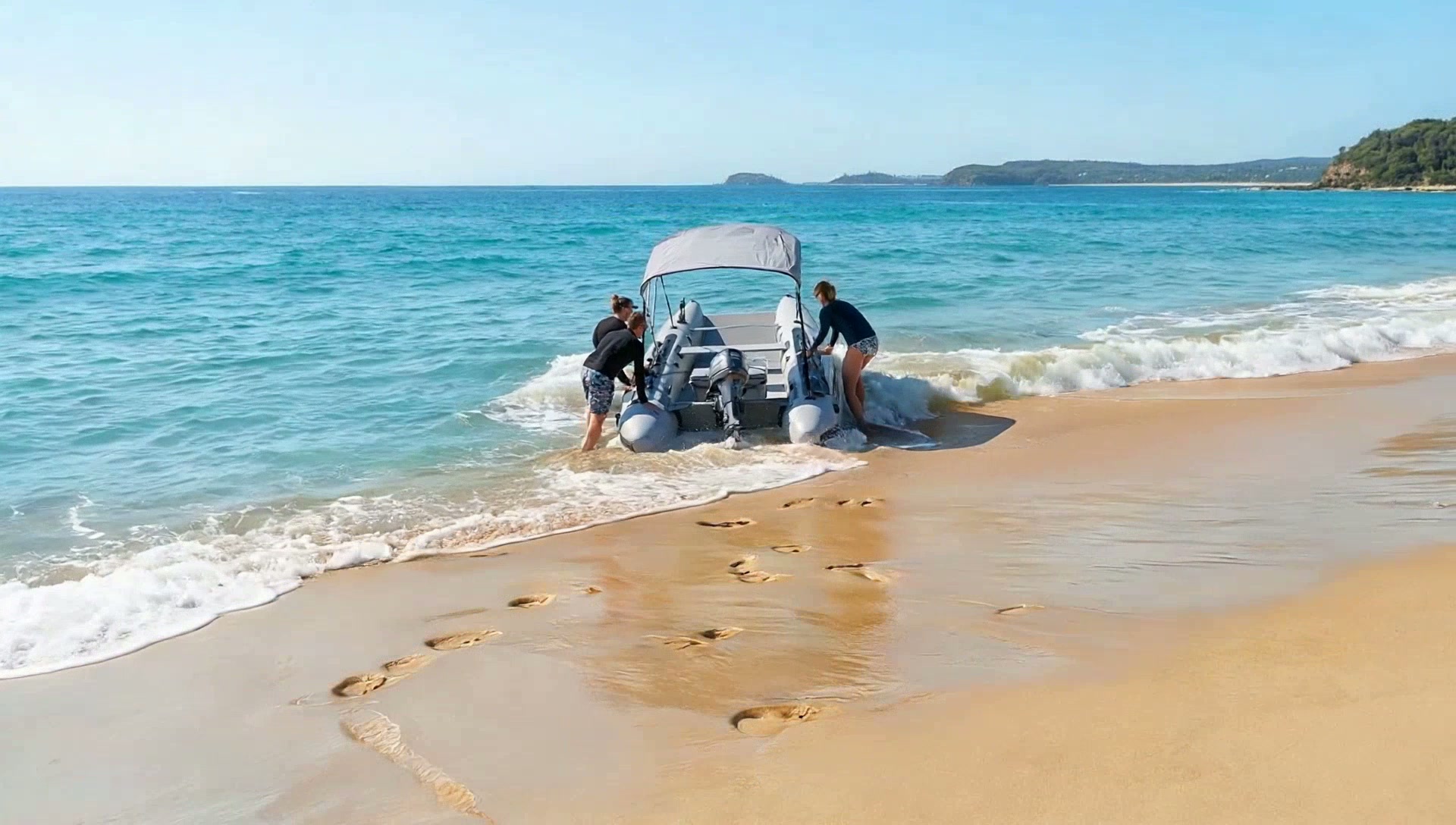
Twin pontoons displace water across a wider footprint, so the boat sits higher. You can run skinny water, beach launches and rocky ramps that would have a deep-V monohull bottoming out.
Dry, level ride into chop
The tunnel between the hulls compresses air and water on contact, cushioning slams. You don't get the spine-jarring bang that a single-hull RIB delivers when it lands flat in a short chop.
Built-in redundancy
Each pontoon is a multi-chamber air system. Even in the unlikely event of a major puncture, the opposite hull keeps the deck level and you keep heading home.
Higher payload for the same length
A twin-hull 3.8 m carries roughly 25–35% more rated load than a same-length monohull, because both hulls contribute buoyancy. More people, more fuel, more gear — same trailer.
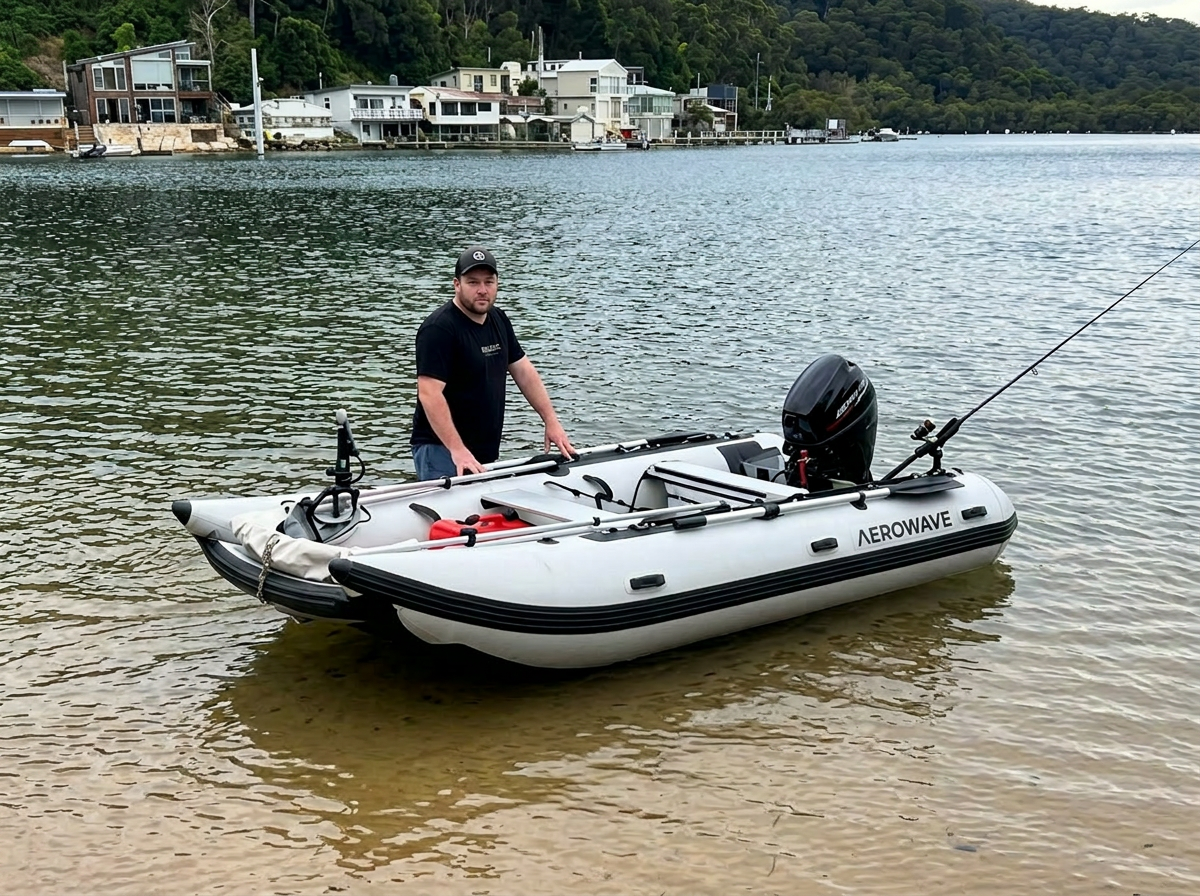
How an Aerowave catamaran is put together
- Two fully-welded VALMEX pontoon hulls, each with five sealed air chambers.
- Rigid composite or aluminium deck bonded across both pontoons for torsional stiffness.
- Wide, flat keel-line so the boat sits level on a trailer or beach.
- Heavy-duty reinforced bow tow eye and stern transom rated for the full HP range.
- Every hull CE-certified to ISO 6185-3 + EU Directive 2013/53/EU.
Why an Aerowave catamaran — or monohull
Plenty of brands sell inflatables. We're the ones answering the phone — and we're commercial skippers ourselves. Every Aerowave is specified by people who've spent real seasons running real boats commercially in Australian conditions. That changes what we ask the factory to build.
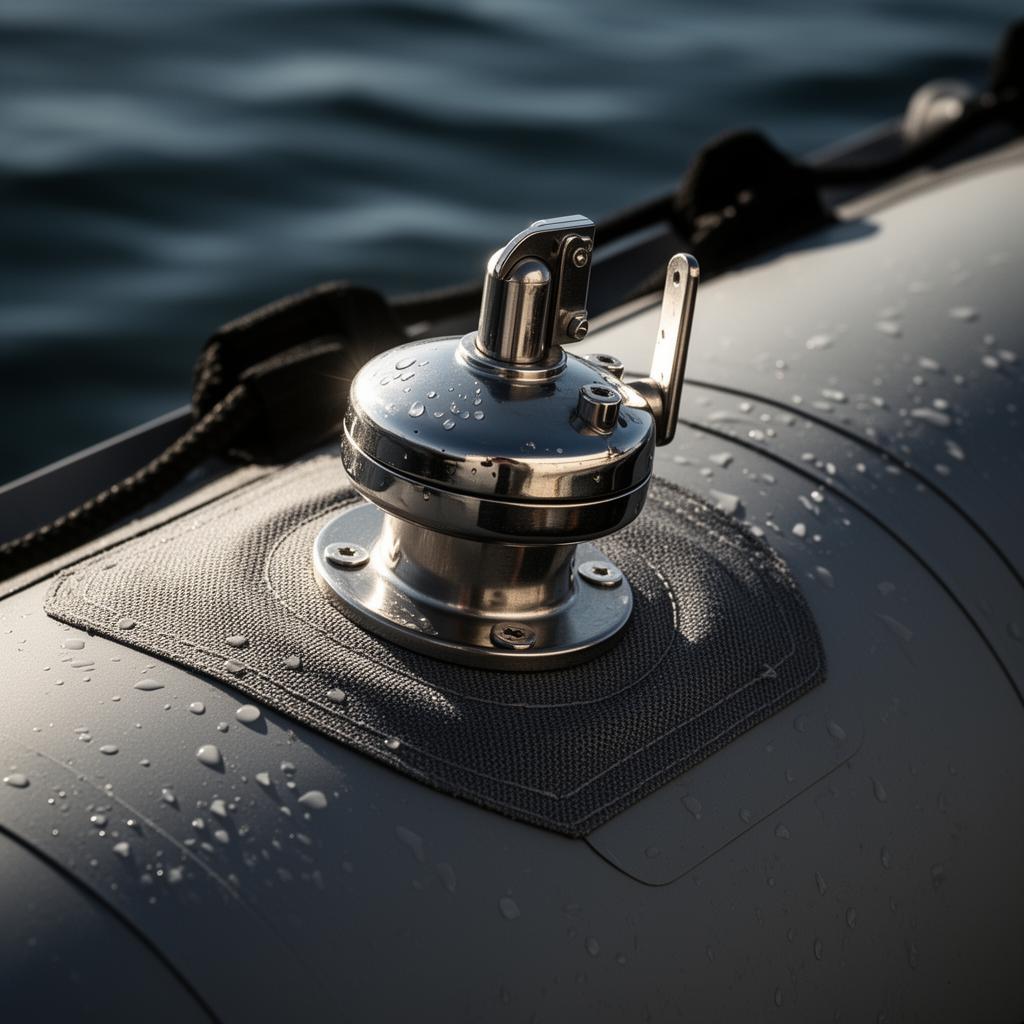
Over-inflation valves on every boat
We spec a stainless over-pressure relief valve into every chamber — standard, not optional. A boat left on a hot trailer in Aussie summer can hit pressures that pop seams on cheaper imports. Ours vent before that ever happens.
1.2 mm VALMEX hulls
German-engineered VALMEX coated fabric, 1.2 mm — not the 0.9 mm most competitors run. Rated 10–12 year UV and abrasion life in the Australian sun. You feel it in the way the tube holds shape and handles shell grit and barnacles.
Commercial-spec fittings
316 stainless D-rings, oversized bow tow eye, reinforced transom, double-glued rubbing strake. Same gear we'd fit to a hire-fleet boat doing 200 days a year.
Skipper-tested spec sheet
Tube diameter, deck height, transom angle, rubbing strake placement — every number on our spec sheet was argued out on the water, not in a brochure. If it wouldn't pass a survey, it doesn't ship.
CE certified, hull plate stamped
Every Aerowave hull carries a CE plate certifying it to ISO 6185-3 and EU Recreational Craft Directive 2013/53/EU. That's the gold-standard European marine certification — and it's audited, not self-claimed.
Australian after-sales
Spare valves, glue kits, replacement tubes, fabric patches and warranty — all stocked here, all dispatched same week. Buy from us once, you're not chasing an offshore reseller two years in.
What CE / ISO 6185-3 actually means for you
You'll see "CE" stamped on a lot of boats. What you want to look for is the standard behind the CE mark. For powered inflatables that's ISO 6185-3 — the international standard for inflatable boats over 8 kW — combined with EU Directive 2013/53/EU, the Recreational Craft Directive that governs every powered pleasure craft sold into Europe. Every Aerowave catamaran and monohull is certified to both.
What the manufacturer has to prove
- Burst-pressure testing — chambers held at 3× working pressure without failure.
- Seam peel and shear strength tested per ISO 1421 on aged samples.
- Stability and freeboard verified under maximum rated load.
- Transom and tow-eye tested to full thrust of the maximum-rated outboard.
- UV, salt-fog and abrasion cycling on the hull fabric.
- Multi-chamber buoyancy: the boat must stay afloat with any one chamber deflated.
- Owner's manual, hull plate, rated capacities and design category all independently audited.
What that means for you, the owner
- The rated person and HP numbers on your hull plate are real, not marketing.
- Insurance and survey: a CE plate to ISO 6185-3 is accepted documentation worldwide.
- Resale: a certified hull is worth more on the second-hand market than an unmarked one.
- Peace of mind: a third-party notified body has signed off the design — not the factory's own QA.
- A clear path to state Boat Code certification (the AU state step is separate, but starts from your CE plate).
Plenty of cheap imports carry a "CE" sticker that points to nothing auditable. Always ask for the ISO standard and the notified body number. Ours: every Aerowave ships with the full Declaration of Conformity in the manual.
Catamaran or monohull — which Aerowave?
Both are CE-certified, both run the same 1.2 mm VALMEX hulls and the same over-pressure valves. The hull shape is the deciding factor.
AeroCat & Viper Sovereign
- Best stability at rest — fishing, diving, families.
- Maximum usable deck per metre of length.
- Shallow draft, level beach landings.
- Drier, flatter ride through chop.
- Higher payload, more passengers.
Custom-made Sports Series monohulls
- Custom-built to your spec — length, transom, console, fit-out.
- Deep-V offshore hull — drives through chop and wind.
- Performance hull shape — top-end speed and tight handling.
- Built to commercial / survey-ready standards.
- Same CE / ISO 6185-3 certification.
The honest version
We sell both — we'll never push you onto a catamaran you don't need. Our custom-made Sports Series monohulls are the right call when you want a deep-V offshore hull built to your spec for serious open-water performance. If you're carrying real people and real gear in mixed conditions though, the twin-hull AeroCat or Viper Sovereign catamaran is the boat that pays you back every weekend.
More on inflatable catamarans
The rest of our inflatable catamaran guides — sizing, hull fabric, portability and the full Australian range.
See it for yourself
Real boats. Real owners. Real people behind them.
Plenty of what you read online these days is generated. Check us out properly — the factory, the reviews and the owners are all one click away. Why we use AI, and how to check we’re real
How our boats are built
Walk the production line: thermo-welded seams, 1.2 mm VALMEX Heavy Plus hulls, over-pressure relief valves on every chamber.
See the buildGoogle Maps reviews
Real Australian owners, five stars, published on our Google Business Profile with the map — read them there, not just on our own site.
Open Google Maps reviewsOwner stories
Boats in use — offshore, on rivers, on rescue duty. Photos and words from the people who actually own them.
Read owner stories