Aerowave Sport Series Offshore: When a Deep-V Monohull Beats a Catamaran
We love our inflatable catamarans, but in certain offshore conditions, a classic deep-V monohull is king. Explore the Aerowave Sport Series Offshore and learn why.
🇺🇸 Boats shipping to United States
See landed prices in USD before you bounce.
Door-to-door delivery to United States in 7–14 days. Choose a boat, see local-currency pricing, or request a fixed landed quote from the sales team.
In the world of inflatable boats, the catamaran often reigns supreme for stability and efficiency. But when the wind picks up and the swell turns nasty, the game changes. This is where a deep-V monohull truly earns its salt.
At Easy Inflatables, we’ve built our reputation on the exceptional performance of our inflatable catamarans like the Aerowave Viper and AeroCat. Their twin-hull design offers incredible stability at rest, a shallow draft, and impressive efficiency. For 90% of boaties enjoying estuaries, harbours, and coastal cruising, a catamaran is the logical, superior choice. But what about the other 10%? The dedicated offshore fishos, the divers heading to remote reefs, and the adventurers who won't let a bit of whitecap stand in their way?
For them, the conversation shifts from twin hulls to a singular, time-tested design: the deep-V monohull. It may seem counterintuitive for a company known for its cats to champion a monohull, but honesty and performance are our guiding principles. The reality is, certain conditions demand a different tool. This is the definitive guide to understanding why our Aerowave Sport Series Offshore models, like the WaveRunner 380, are not just an alternative, but the optimal choice for serious rough-water work.
The Physics of Choppy Water: Monohull vs. Catamaran
To understand why one hull excels over the other, you must first grasp how each interacts with the water, particularly when it's not flat. It's a fascinating lesson in hydrodynamics that has a direct impact on your comfort and safety offshore.
The Monohull's Deep-V Advantage
A deep-V monohull is designed with a sharp, pronounced V-shape at the bow that tapers back towards the stern. Think of it as a knife's edge. When this hull encounters a wave, it doesn't slap or pound against the surface. Instead, it cleaves through it. The deep V-section at the front parts the water, and the length of the keel helps maintain directional stability, preventing the boat from being easily pushed sideways by wind or waves (a phenomenon known as broaching).
The key benefit here is a softer, more predictable ride in head seas (waves coming from the front). The hull uses its shape and displacement to cushion the impact, lifting the bow and settling back down with less jarring force. The larger inflatable tubes act as massive shock absorbers and provide immense secondary stability if the boat is pushed hard over in a turn or by a beam sea (waves from the side).
The Catamaran's Tunnel Hull Dynamics
Our inflatable catamarans, by contrast, feature two narrower hulls (sponsons) connected by a deck. Between these sponsons is a 'tunnel' of air. On relatively calm water, this is a brilliant design. The boat packs air into the tunnel, creating a cushion that provides lift, reduces wetted surface area, and increases speed and fuel efficiency. The wide stance of the two hulls gives it peerless stability at rest – a massive plus for casting, diving, or just relaxing.
However, in confused, choppy seas, this can present challenges. The two narrow hulls can react to waves independently. In a steep, short-period chop, one hull can be rising on a wave crest while the other is dropping into a trough, leading to a quicker, sometimes less comfortable motion. Furthermore, as the boat moves faster into head seas, waves can forcefully impact the underside of the deck in the tunnel, a phenomenon known as 'tunnel slap' or 'sneezing', which can be loud and wet. While our designs minimise this, it's an inherent trait of the hull form in certain conditions.
The Aerowave Sport Series Offshore Advantage: A Deep Dive
Understanding the physics is one thing; seeing how it's applied in a premium build is another. The Aerowave Sport Series Offshore isn't just any inflatable tender. It’s an engineered system designed specifically to conquer challenging marine environments. Let's break down the core components.
Aggressive Deadrise and Large Tube Diameter
The WaveRunner 380, our flagship monohull, features a very sharp entry and a significant V-shape (deadrise) that carries well aft. This isn't the gentle, rounded bow of a cheap beach toy. It's an aggressive design intended to cut, not bounce. Coupled with this is a generous tube diameter. These large tubes serve three critical functions:
- Dryness: They act as massive reverse chines, deflecting spray down and away from the boat's interior.
- Buoyancy: They provide enormous reserve buoyancy, allowing the boat to carry heavy loads of dive gear, fishing equipment, or passengers safely.
- Stability: While a deep-V has less primary (at-rest) stability than a flat-bottom or a catamaran, the large tubes provide exceptional secondary stability. The boat feels incredibly secure when heeled over.
The Rigid, Interlocking Aluminium Floor
This is perhaps the single most important feature for offshore performance, and it deserves its own detailed section. Unlike a high-pressure air deck, a rigid aluminium floor provides uncompromising stiffness. When the hull is slamming into waves at 20 knots, the last thing you want is the floor flexing beneath your feet. An aluminium floor system locks the entire boat's structure together – keel, tubes, and transom – into one solid, unyielding unit. This rigidity is what allows the deep-V keel to do its job effectively, transferring the forces of wave impacts through the hull structure rather than having them absorbed by a flexing floor. It creates a feeling of being 'in' the boat, not 'on' it.
When the Monohull Excels: Key Use Cases for the Aerowave Sport Series Offshore
So, when should you seriously consider a WaveRunner 380 over one of our highly-regarded catamarans?
-
Offshore Spearos and Divers: You're launching through surf or punching out through a harbour entrance into open water. You're carrying heavy gear (tanks, weight belts, spearguns). The deep-V's ability to maintain a comfortable, predictable ride in a 1-metre swell is paramount. The rigid floor provides a stable, non-slip platform for gearing up and handling heavy equipment.
-
Exposed Water Fishing: You fish in large bays like Port Phillip or Moreton Bay, or coastal waters where the wind can whip up a nasty chop in minutes. You need to run 5-10 nautical miles to your spot and get back safely if the weather turns. The monohull's seakeeping ability provides a massive confidence boost.
-
Tender for a Larger Vessel: If your mothership is moored in an exposed roadstead or you regularly shuttle crew and supplies in less-than-ideal conditions, the deep-V offers a drier, safer ride. Its ability to track straight in a following sea (waves from behind) is also superior, making for less stressful journeys back to the big boat.
-
Safety & Rescue Support: For sailing clubs or patrol situations, the predictability and rough-water handling of the Aerowave Sport Series Offshore makes it a dependable workhorse when conditions deteriorate.
Floor Construction: The Unsung Hero of Offshore Performance
A boat's floor is its spine. It dictates how the boat feels, handles, and performs under load and stress. While our high-pressure air decks (used in models like the AeroCat) are exceptionally rigid for their weight and convenience, a sectional aluminium floor offers a different level of structural integrity for offshore work.
The Aluminium Advantage
Our WaveRunner 380 uses a marine-grade, anodised aluminium floor system. The sections are precisely cut to interlock with each other and are held in place by stringers along the sides. This creates a single, unified deck that is incredibly strong and stiff. The benefits are tangible:
- Unmatched Rigidity: It provides the firmest possible platform, maximising the hull's performance and providing a secure footing. No flex, no bounce.
- Durability: It's resistant to punctures from dropped sinkers, knives, or spear tips. It can handle the abrasion of dive tanks and eskies being dragged across it day after day.
- Load Distribution: It distributes weight evenly across the hull, which helps the boat plane correctly and handle predictably, especially with an uneven load.
The Air Deck Compromise
High-pressure air decks, which we use in our catamarans, are a marvel of modern engineering. Inflated to 8-10 PSI, they are surprisingly firm and offer huge advantages in weight and pack-down size. For most applications, they are fantastic. However, in the specific context of offshore wave-punching, they have inherent limitations. Even the best air deck will have a small amount of 'give' or flex when the hull slams down off a wave. This minute flex can dissipate some of the energy that would otherwise be used to cleave the next wave, very slightly softening the boat's response. For the ultimate in offshore tenacity, solid is always better.
A Quick Comparison: Is a Deep-V Monohull Right For You?
Use this checklist to see if your boating style aligns with the strengths of the Aerowave Sport Series Offshore.
- Do I regularly boat in open water with wind chop over 0.5 metres?
- Is punching through waves to get to a destination a common part of my trips?
- Do I prioritise a soft ride into a head sea over at-rest stability?
- Do I carry heavy, sharp, or abrasive gear like dive tanks, anchors, or fishing gaffs?
- Is my primary concern safety and predictability when the weather turns foul?
- Do I value a feeling of solid, unyielding structure underfoot?
- Am I willing to accept a slightly longer setup time in exchange for ultimate rigidity?
If you ticked four or more of these boxes, a deep-V monohull like the WaveRunner 380 is likely a better fit for you than an inflatable catamaran.
Comparing Our Premium Inflatables
Choosing the right boat isn't about 'good' versus 'bad', but about matching the right tool to the job. Here's how the WaveRunner 380 stacks up against our catamarans.
| Feature | WaveRunner 380 (Monohull) | AeroCat 380 (Catamaran) | Viper 400 (Catamaran) |
|---|---|---|---|
| Hull Type | Deep-V Monohull | Tunnel Hull Catamaran | High-Performance Catamaran |
| Best For | Offshore chop, wave-piercing | All-round stability, efficiency | Speed, carrying capacity, stability |
| Floor Type | Sectional Aluminium | High-Pressure Air Deck (8 PSI) | High-Pressure Air Deck (10 PSI) |
| Primary Use | Aerowave Sport Series Offshore, rough water | Estuary, harbour, coastal cruising | Demanding coastal, heavy loads |
| Fabric | 1.2mm VALMEX® Heavy Plus | 0.9mm VALMEX® | 1.2mm VALMEX® Heavy Plus |
| Warranty | 5-Year Fabric Warranty | 5-Year Fabric Warranty | 7-Year Sovereign Warranty |
| Price Guide | From $4,000 | From $3,480 | From $5,995 (Full Package) |
As the table shows, the WaveRunner 380's DNA is fundamentally different. It's purpose-built with a heavier fabric and a rigid floor, sacrificing some of the lightweight convenience of the AeroCat for uncompromised offshore muscle.
Powering Your Offshore Adventures
Pairing the right motor with the WaveRunner 380 is crucial to unlocking its performance. The boat's 380mm transom is standard short-shaft height, compatible with a huge range of portable outboards. While specifications vary, a monohull of this size and capability performs brilliantly with modern, reliable four-strokes like the ones from our partner, Hidea.
A 15hp to 20hp four-stroke is the sweet spot. This provides ample power to get the hull on plane quickly, even with two or three adults and gear, and offers enough torque to power through the back of waves without bogging down. The efficiency of a modern 4-stroke also means you can carry less fuel for a given range, which is a major safety and convenience factor when you're miles from the ramp.
Build Quality & Materials: The Easy Inflatables Difference
Whether it's a monohull or a catamaran, all our premium boats are united by a commitment to world-class materials and construction. The WaveRunner 380 is constructed from the same top-tier 1.2mm VALMEX® Heavy Plus fabric (1500 GSM) found on our flagship Viper Sovereign. This German-made material is widely acknowledged as the best in the world for inflatable structures, resistant to UV degradation, abrasion, and petro-chemicals.
Unlike budget imports that rely on cheaper, glued PVC, our boats feature thermo-welded seams. This process fuses the material together at a molecular level, a bond that is stronger than the fabric itself. It’s why we can confidently state a 10–12 year lifespan for the fabric and back the WaveRunner with a comprehensive 5-year fabric warranty. This level of quality is non-negotiable for a boat designed for serious use.
Practical Considerations: Beyond the Ride
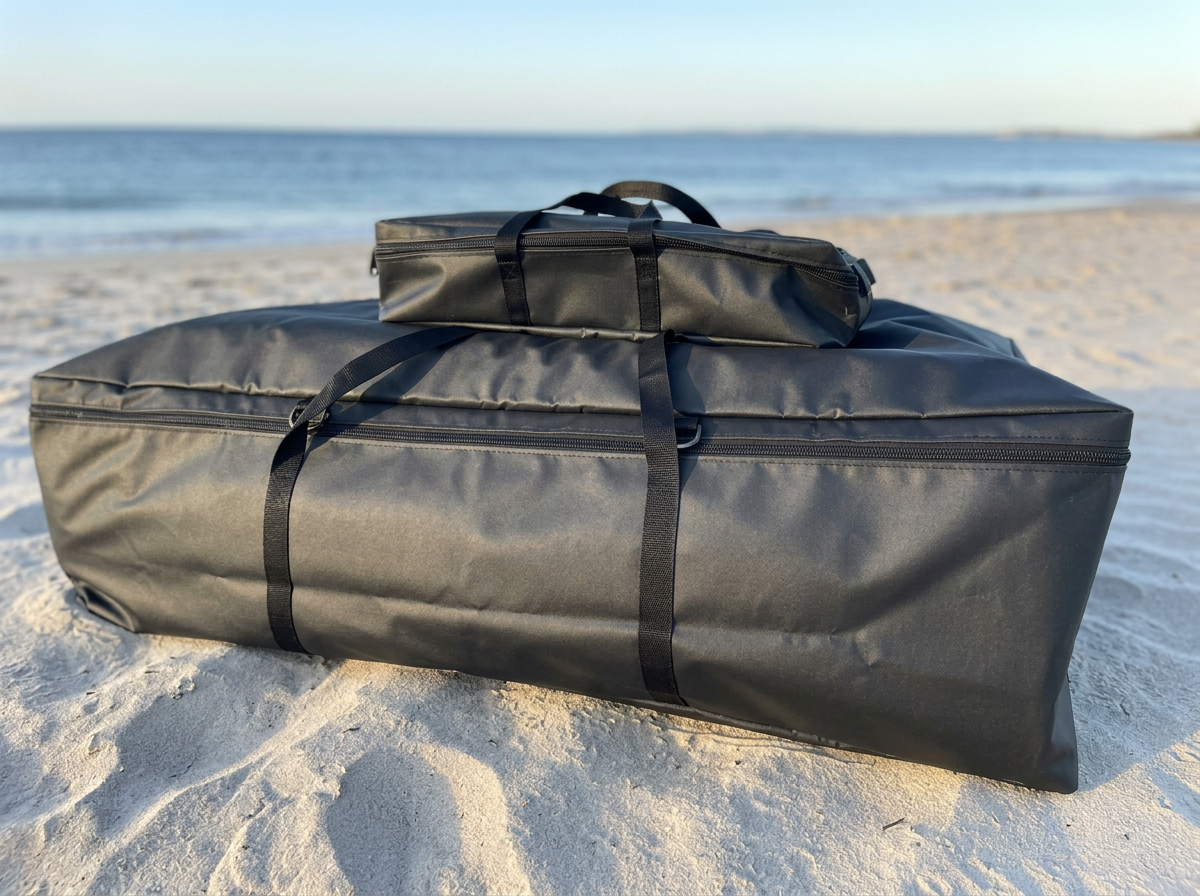
Despite its heavy-duty construction, the Aerowave Sport Series Offshore is still a highly portable boat. The entire package—hull, floorboards, oars, and pump—can be packed down into two bags and transported in the back of a wagon, ute, or large SUV. Assembly is straightforward, though the rigid floor takes a few minutes longer to install than inflating an air deck. For most owners, the process takes around 20-25 minutes from arriving at the ramp to being ready to launch.
This portability is a game-changer compared to rigid-hull alternatives of similar capability. There's no need for a trailer, no registration fees in many states (check your local regulations), and no need for a dedicated parking space. You can store your offshore weapon in a garage or apartment storage cage. This convenience, combined with the included express courier delivery (7-14 days door-to-door, all included in the boat price), makes owning a truly capable boat more accessible than ever.
The Bottom Line
The inflatable catamaran is, for most people, the pinnacle of versatile, stable, and efficient boating. We stand by our AeroCat and Viper ranges as the best in their class. However, for the dedicated minority who face down wind, chop, and swell as a matter of course, the focused design of a deep-V monohull offers a superior solution.
The Aerowave Sport Series Offshore, exemplified by our WaveRunner 380, provides a softer, more confidence-inspiring ride when heading into rough seas. Its rigid aluminium floor and heavy-duty VALMEX® construction create a solid, dependable platform for the most demanding users. If your adventures start where the calm water ends, it's time to look beyond the cats and embrace the cleaving power of the V.
Related
Shop gear featured in this guide
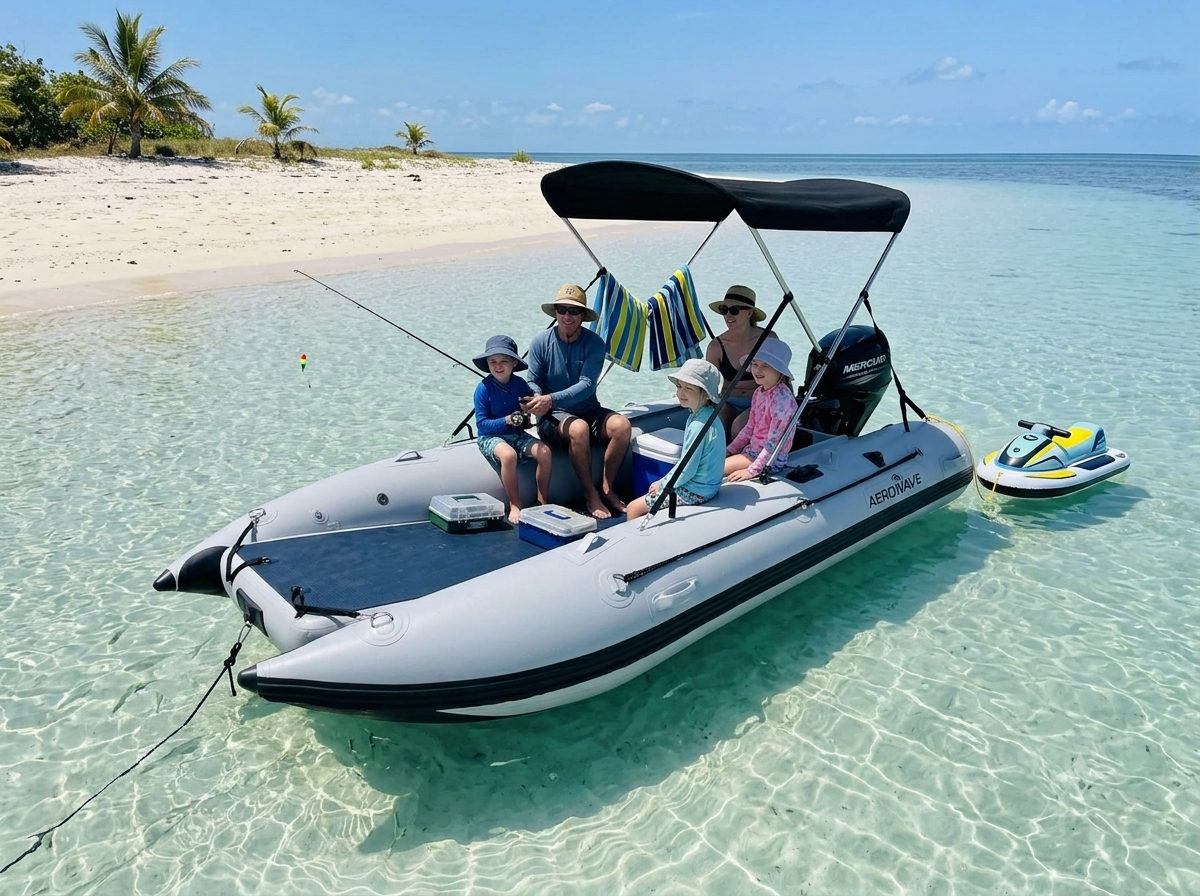
Aerowave WaveRunner 380 Series 3 Catamaran Package
The WaveRunner 380 Series 3 is a premium 3.8m inflatable catamaran package built for Australian and worldwide families, fishing, and coastal day boating — ideal for snorkeling and spearfishing — offering serious stability and premium German Valmex® construction.
Aerowave Viper 400 Sovereign
Flagship 4m enclosed-bow inflatable catamaran. German VALMEX® 7321 Heavy Plus 1.2mm commercial-grade fabric, 10 PSI high-pressure drop-stitch air deck floor with VALMEX non-slip surface, LockPro wheels, full Bimini and FREE express delivery Australia-wide delivery included. Winter special — save $1,000 until 31 August 2026.
AeroWave AeroCat 360 Inflatable Catamaran
Same proven hull design, shape and look as our flagship Aerowave Viper catamarans — built lighter using 0.9mm Valmex® fabric instead of the Viper's 1.2mm. The AeroWave AeroCat 360 is our 3.6m inflatable catamaran built from 0.9mm Valmex® fabric — intentionally lighter than our 1.2mm Viper hulls so it folds smaller, packs lighter and is easy to handle solo. Twin-hull stability, 5-Year Warranty with global support and priced ~$500 below comparable 0.9mm imports.
Not sure which suits you? Talk to a real boat owner.
Frequently asked questions
- Is the Aerowave Sport Series Offshore monohull less stable than an inflatable catamaran?
- At rest, yes. A catamaran's twin hulls provide superior initial stability, making it feel like a solid platform. However, the monohull's large tubes provide excellent secondary stability, meaning it's incredibly difficult to capsize and feels very secure once underway or in rough water.
- What is the real-world benefit of an aluminium floor over a high-pressure air floor?
- In offshore conditions, the key benefit is total rigidity. An aluminium floor locks the hull structure together, allowing the deep-V keel to perform optimally by cutting through waves. It also offers superior durability against punctures from sharp, heavy gear like dive tanks or anchors.
- How difficult is it to assemble the WaveRunner 380 with its aluminium floor?
- It takes about 10 minutes longer than one of our air-deck catamarans. Once you've done it a couple of times, the process becomes routine. Most owners can go from packed bags to water-ready in 20-25 minutes. The trade-off in setup time is well worth the on-water performance benefits.
- What size outboard motor is best for the Aerowave Sport Series Offshore?
- For a model like the WaveRunner 380, a 15-20hp short-shaft 4-stroke outboard is the ideal match. This provides excellent power-to-weight for quick planing and the torque needed to handle offshore conditions. We can advise on pairing with our range of Hidea outboards.
- Can a monohull handle a following sea as well as a catamaran?
- Yes, and often better. The deep keel on a monohull acts like a rudder, helping the boat track straight when being pushed by waves from behind. This reduces the tendency to 'broach' or wander, making for a more relaxing and safer ride down-swell.
- How does the WaveRunner 380's German VALMEX® fabric compare to cheaper PVC boats?
- There is no comparison in terms of longevity and durability. Our 1.2mm VALMEX® is highly resistant to UV rays, abrasion, and chemicals, with a real-world lifespan of 10-12 years. Cheaper PVC boats often degrade in the harsh Australian sun within 3-5 years, becoming brittle and prone to seam failure.
- Does the price of the WaveRunner 380 include delivery?
- Yes, all our boat prices, including the WaveRunner 380 at $4,000, include express courier delivery via partners like DHL, FedEx, or UPS. You can expect your boat to arrive door-to-door within 7-14 days of ordering.
Ready to set sail?
Premium German-fabric inflatable catamarans with express courier delivery included in the price — 7–14 days door-to-door. Talk to our team or browse the fleet.
Like this guide? Get the next one in your inbox.
Owner-tested tips, gear deep-dives and Aussie boating know-how — no spam.