The Ultimate Guide to an Inflatable Boat on the Australian Coast
Australia's sun and salt demand a tougher boat. Discover the essential fabrics, hardware, and designs you need for a safe and long-lasting inflatable on our stunning coast.
At a glance
Australia's sun and salt demand a tougher boat. Discover the essential fabrics, hardware, and designs you need for a safe and long-lasting inflatable on our stunning coast.
- What Makes the Australian Coast so Hard on Inflatable Boats?
- The Unseen Killer: UV Radiation
- Saltwater Corrosion: More Than Just Rust
- Heat, Humidity, and Pressure
What we'd put you in
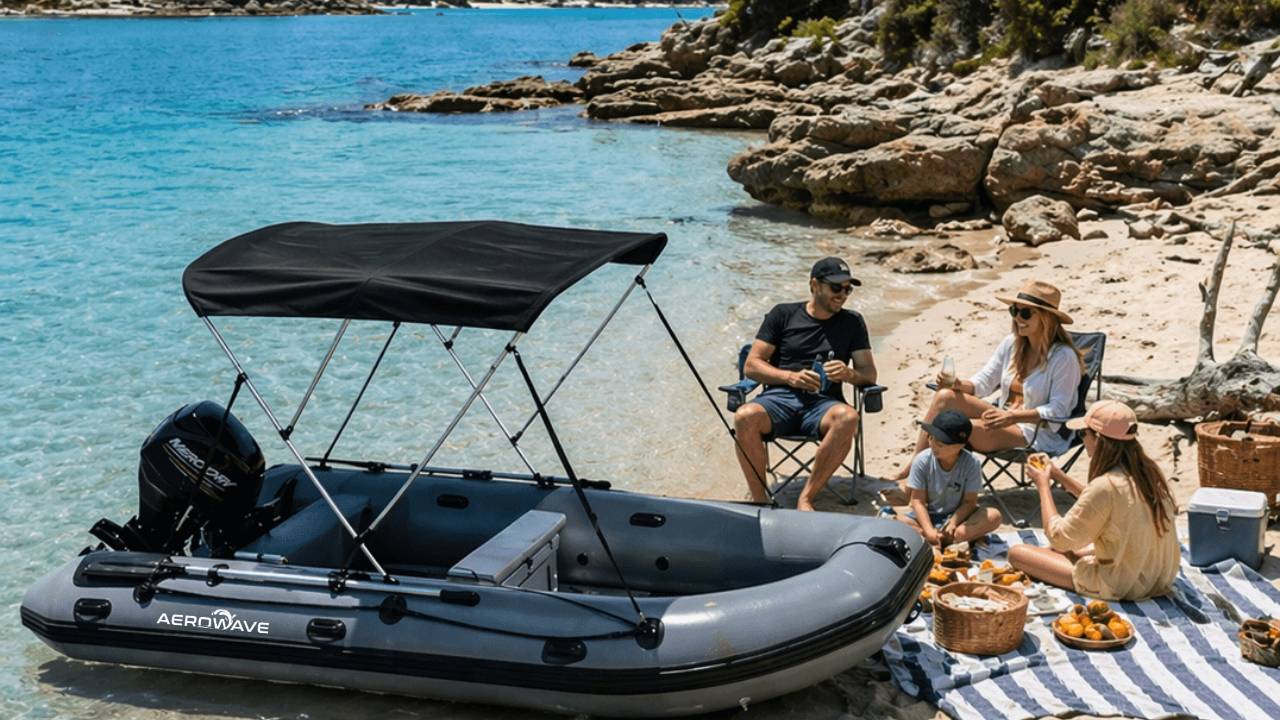
Aerowave Viper 400 Sovereign
Our best-selling boat: 4.0 m, 1.2 mm VALMEX hull, 7-year hull warranty.
US$3,167 USD
Delivered to your door, today's rate
- Free freight to United States · local taxes payable on arrival
- 7-year hull warranty
🇺🇸 Shipping to United States · landed price quoted in writing
Yes — we ship the Aerowave Viper 400 Sovereign to United States. Here's the landed price.
Our best-selling boat: 4.0 m, 1.2 mm VALMEX hull, 7-year hull warranty.
Written for Australian readers — but the boat ships to you. We are an Australian builder and this article is written from Australian waters. That changes nothing about what you can order: the same hull, the same 7-year warranty and the same certification go out to United States every week.
Aerowave Viper 400 Sovereign
- Boat package (export price)
- US$3,726
- 15% tariff relief credit
- − US$559
- Express air freight to United States
- Included
- Import duty, taxes & customs clearance
- Payable on arrival
- Estimated landed, USD
- US$3,167
Indicative, converted at today's rate, before local duty and tax on arrival. Ask below and we'll put a fixed figure in writing, valid 30 days.
- 7-year hull warranty
- 1500 GSM / 1.2 mm VALMEX® Heavy Plus hull
- CE certified to ISO 6185-3 and EU Directive 2013/53/EU
- Door-to-door, tracked the whole way
Your price, delivered to your door — freight included.
We email the full PDF quote (spec, freight, finance, WavePay) to your inbox in under 60 seconds. No spam — one quote, one follow-up.
See it for yourself
Real boats. Real owners. Real people behind them.
Plenty of what you read online these days is generated. Check us out properly — the factory, the reviews and the owners are all one click away. Why we use AI, and how to check we’re real
How our boats are built
Walk the production line: thermo-welded seams, 1.2 mm VALMEX Heavy Plus hulls, over-pressure relief valves on every chamber.
See the buildGoogle Maps reviews
Real Australian owners, five stars, published on our Google Business Profile with the map — read them there, not just on our own site.
Open Google Maps reviewsOwner stories
Boats in use — offshore, on rivers, on rescue duty. Photos and words from the people who actually own them.
Read owner storiesTo conquer the Australian coast, your inflatable boat needs more than just air; it needs armour against our sun and salt.
Australia is a boating paradise. From the sheltered estuaries of the Hawkesbury to the coral fringes of the Ningaloo Reef, our coastline offers a lifetime of adventure. For accessing these incredible places, an inflatable boat is a master key, unlocking remote beaches, shallow creeks, and offshore islands that are simply out of reach for traditional rigid-hull vessels. But our paradise has a dark side: it is one of the most punishing marine environments on Earth.
The combination of intense ultraviolet (UV) radiation, corrosive saltwater, and high ambient heat creates a trifecta of destructive forces that will mercilessly expose any weakness in a boat's construction. A budget-grade inflatable boat bought online might look the part on day one, but after a few seasons of Aussie sun and salt, it can become a brittle, leaky, and dangerous liability. Choosing the right inflatable boat for the Australian coast isn't about finding the cheapest option; it's about investing in specific materials and design features engineered to survive and thrive here.
This guide is the definitive resource for any Aussie boater considering an inflatable. We'll cut through the marketing jargon and dive deep into the technical details that separate a boat that lasts two seasons from one that will give you 10-12 years of faithful service. We'll cover fabrics, hardware, hull design, and the essential maintenance that will protect your investment and keep you safe on the water.
What Makes the Australian Coast so Hard on Inflatable Boats?
Before we look at solutions, it’s crucial to understand the enemy. The challenges of the Australian marine environment are unique and severe. A boat designed for a European lake or a North American summer simply isn't built for what our coast throws at it.
The Unseen Killer: UV Radiation
Australia sits under a thin part of the ozone layer, resulting in some of the highest levels of UV radiation in the world. This invisible force is the primary enemy of all polymer-based materials, which includes the fabric of your inflatable boat. UV radiation works by breaking down the molecular bonds in plastics and synthetic rubbers. On an inflatable boat, this manifests as:
- Fading and Discolouration: The first sign of UV damage. While cosmetic, it indicates that deeper structural degradation has begun.
- Brittleness: The plasticisers that keep the fabric flexible are leached out, making the material stiff and prone to cracking, especially when folded for storage.
- Loss of Tensile Strength: The fabric becomes weaker and more susceptible to punctures and abrasions that it would have previously shrugged off.
- Adhesive Failure: On glued boats, UV radiation and the associated heat can soften and weaken the glue holding the seams, transom, and accessories together, leading to catastrophic failure.
Saltwater Corrosion: More Than Just Rust
Saltwater is a powerful electrolyte, dramatically accelerating corrosion. While we often think of rust on steel, the effects on a boat are more complex. When dissimilar metals are in contact in saltwater (like an aluminium fitting with a stainless steel bolt), it creates a battery-like effect called galvanic corrosion, where the less noble metal is rapidly eaten away.
For an inflatable boat, this means every single piece of hardware is under constant attack:
- D-Rings and Lifting Points: Low-grade stainless steel or, worse, chrome-plated steel will quickly show signs of tea-staining (rust) and pitting, weakening these critical safety points.
- Valves: Internal springs and components can seize or corrode, leading to slow leaks or valve failure.
- Transom Fittings: Bolts and plates securing the engine mount must be of the highest quality to prevent corrosion that could compromise the entire transom structure.
- Zippers and Fasteners: Zips on bow bags or storage covers will seize and break if they aren't marine-grade nylon or corrosion-resistant metal.
Heat, Humidity, and Pressure
The Australian sun doesn't just radiate UV; it bakes. A dark-coloured boat left on a trailer in the sun can see its tube surface temperatures soar. This has two major effects:
- Increased Air Pressure: According to Charles's Law, as gas heats up, its pressure increases. The air inside your boat's tubes can increase in pressure by several PSI on a hot day. A well-made boat with quality valves and strong seams can handle this, but a budget boat can literally burst at the seams.
- Accelerated Chemical Breakdown: Heat acts as a catalyst for both UV degradation and adhesive breakdown. The glue on poorly made boats can turn soft and gooey, causing seams to peel apart. This is a common and terminal failure mode for many budget imports.
What Fabric is Best for an Inflatable Boat on the Australian Coast?
This is arguably the most important question. The hull fabric is the single biggest factor in your boat's lifespan and durability. The market is dominated by two main types: PVC (Polyvinyl Chloride) and Hypalon (a brand name for CSM). However, not all PVC is created equal.
The Myth of 'PVC vs. Hypalon'
For decades, the standard advice was that Hypalon was the only choice for tropical conditions due to its superior UV resistance. While true in the past, modern PVC technology has changed the game. High-end, multi-layered, polymer-coated PVC fabrics, specifically those from reputable European manufacturers, now offer outstanding UV resistance and durability, often at a better price point.
The real distinction isn't PVC vs. Hypalon, but premium fabric vs. budget fabric. A cheap, single-layer PVC from an unknown factory is no match for the Australian sun. But a premium, heavy-duty fabric like VALMEX®, made by Mehler Texnologies in Germany, is a different beast entirely. It's engineered with specific chemical formulations and top coatings to resist UV damage, abrasion, and pollution.
Understanding Fabric Specifications: GSM and Decitex
When you see specs like '1100 GSM' or '1500 GSM', it refers to Grams per Square Metre. This is the weight, and therefore the thickness and density, of the fabric. A higher GSM generally means a tougher, more puncture-resistant material.
- 1100 GSM / 0.9 mm: This is a high-quality standard for premium recreational inflatable boats. It offers an excellent balance of durability and manageable weight. The Easy Inflatables AeroCat range uses this 1100 GSM VALMEX® fabric, providing fantastic performance.
- 1500 GSM / 1.2 mm: This is a seriously heavy-duty material, often used in commercial or military applications. It offers a significant step up in abrasion and puncture resistance, ideal for boaters exploring rocky coastlines or demanding offshore conditions. Our flagship Aerowave Viper range is built with this exceptional 1500 GSM VALMEX® Heavy Plus fabric, making it one of the toughest SIBs on the market.
The Most Critical Component: Welded vs. Glued Seams
This is a non-negotiable feature for any inflatable boat on the Australian coast. A boat's seams are its weakest link. There are two ways to join them:
- Gluing: The traditional method. Overlapping fabric is joined with a polyurethane-based adhesive. The problem? As discussed, high heat and UV radiation degrade this glue over time, causing it to fail.
- Thermo-welding (or Hot Air Welding): A far superior process where the fabric seams are fused together using high heat and pressure. This creates a permanent, monolithic bond that is actually stronger than the fabric itself. A welded seam will not come apart due to heat or age.
All Aerowave and AeroCat boats feature thermo-welded seams. For the harsh Australian climate, this is not a luxury; it's a fundamental requirement for longevity and safety.
Which Hardware and Fittings Can Withstand Saltwater?
After the fabric, the quality of the 'little things' makes a huge difference. A boat with world-class fabric can still be let down by corroding hardware. Here's a breakdown of what to look for.
| Feature | Gold Standard (For Aussie Coast) | Acceptable Alternative | Avoid at All Costs |
|---|---|---|---|
| D-Rings / Tie-Downs | Marine Grade 316 Stainless Steel | High-impact, UV-stabilised Nylon | Chrome-plated steel, 304 Stainless |
| Transom Plate/Bolts | Marine Grade 316 Stainless Steel | Heavily anodised marine aluminium | Standard galvanised or plated steel |
| Valves | High-pressure leafield-style valves | Reputable Halkey-Roberts style valves | Unbranded, generic plastic valves |
| Floor | High-Pressure (8-10 PSI) Air Deck | Anodised Aluminium Panels | Low-pressure air floor, untreated plywood |
| Accessories (Zips) | Heavy-duty YKK-style nylon zips | - | Standard metal zips |
Marine Grade 316 Stainless Steel is the hero here. It contains molybdenum, an element that dramatically increases its resistance to chloride corrosion from saltwater. Cheaper 'stainless steel' (often 304 grade) lacks this and will develop tea-staining and pitting surprisingly quickly. Insist on 316 for all critical load-bearing components.
How Hull Design Impacts Performance in Coastal Chop
Australia's coastal waters are rarely glass-calm. A boat's ability to handle wind chop and ocean swell is paramount for both safety and comfort. This is where hull design becomes critical.
Inflatable Catamaran vs. V-Hull Monohull
Traditional inflatable boats have a single V-shaped hull. This design is simple and effective in calm water. However, the inflatable catamaran design, as seen in the Aerowave Viper, AeroCat, and WaveRunner 380 series, offers several distinct advantages in typical Aussie coastal conditions:
- Exceptional Stability: With two widely-spaced hulls, a catamaran is inherently more stable at rest and underway. This is a game-changer for fishing, diving, or when loading family and gear.
- A Softer, Drier Ride: The tunnel between the hulls traps a cushion of air. As the boat moves forward, this aerated water provides lift, softening the ride through chop. It also dramatically reduces spray, keeping occupants and gear drier.
- Greater Efficiency: The twin hulls have less wetted surface area for their length, meaning less drag. This allows the boat to plane more easily with less horsepower, improving fuel economy and range.
For anyone serious about using their inflatable boat on the Australian coast, the catamaran design is a superior platform.
The Indispensable High-Pressure Air Deck
Forget the mushy, low-pressure air floors of old. Modern premium inflatables use a high-pressure drop-stitch air deck, inflated to a rock-solid 8-10 PSI. This technology, used in all our models, creates a floor that is as rigid as a wooden panel but with a fraction of the weight and assembly time. This rigidity is essential for performance, as it allows the hull to maintain its intended shape in rough water, providing a predictable and responsive ride.
The Essential Maintenance Routine for a Coastal Inflatable Boat
A quality inflatable is tough, but it's not indestructible. A simple but consistent maintenance routine is the best way to ensure you get the full 10–12 year lifespan from your premium VALMEX® fabric and protect your outboard and hardware.
Here is your non-negotiable, post-trip checklist every single time you use your boat in saltwater:
- Thorough Freshwater Rinse: As soon as you get home, give the entire boat, including the underside, transom, and all fittings, a comprehensive rinse with fresh water. Don't forget the trailer if you use one.
- Wash with a pH-Neutral Boat Soap: Use a dedicated inflatable boat cleaner or a gentle, pH-neutral car wash soap. This will remove the salt residue and grime that a simple rinse can leave behind. Avoid harsh chemicals, bleach, or abrasive cleaners.
- Rinse Again: A second, thorough rinse is crucial to remove all traces of soap.
- Dry Completely: Towel dry the boat or let it air-dry completely in the shade. Storing a boat while it's still wet, especially folded in its bag, is the number one cause of mould and mildew, which can permanently stain the fabric.
- Apply a UV Protectant: Once dry, apply a high-quality UV protectant spray (like 303 Aerospace Protectant) to all exposed tube surfaces. This is like sunscreen for your boat and is the single best thing you can do to combat UV degradation. Reapply every 3-4 weeks during peak season.
- Flush Your Outboard: Run the engine with a freshwater flushing attachment ('earmuffs') for 5-10 minutes to clear salt from the internal cooling passages. This is critical for engine longevity. A Hidea 4-stroke, like any marine engine, needs this care.
- Check Tyre Pressures: If your boat is on a trailer, don't forget to rinse the wheels and check your tyre pressures.
Are Inflatable Boats Safe for Coastal and Offshore Use?
This is a common and valid question. When properly constructed, an inflatable boat is one of the safest vessels on the water. Their legendary use by surf life-saving clubs and military special forces is a testament to their seaworthiness.
Safety comes from a few key features:
- Multiple Air Chambers: All quality inflatables, including the entire Aerowave range, have multiple independent air chambers (e.g., the Viper 400 has 5 main chambers plus the air deck). In the unlikely event of a major puncture, only one chamber will deflate, and the boat will remain afloat and stable enough to get you home.
- Inherent Buoyancy: The large volume of the air tubes provides immense positive buoyancy, making the boat virtually unsinkable, even when completely swamped with water.
- CE Certification: Look for boats certified to ISO 6185 standards. This international standard dictates strict requirements for buoyancy, stability, and construction quality, ensuring the boat meets a high safety benchmark.
- Tough Fabric: A thick, heavy-duty fabric like the 1.2 mm VALMEX® on the Viper series provides a high degree of puncture resistance from fishing hooks, submerged branches, or rocky landings.
The Bottom Line
Choosing an inflatable boat for the Australian coast is a decision that should be driven by engineering, not just price. Our environment is relentless, and it will quickly expose poor materials and weak construction. By prioritising a premium, German-made VALMEX® fabric, thermo-welded seams, 316 stainless steel hardware, and a proven catamaran hull design, you are investing in a vessel that will provide years of safe, reliable, and enjoyable service.
Don't let a budget import turn your boating dream into a coastal nightmare. A well-chosen, high-quality inflatable isn't just a boat; it's your ticket to the very best of Australia. If you have questions about which model is right for your specific needs, our team of experienced boaters is here to help. Contact us on +61 2 4335 1603 or at sales@easyinflatables.com.au.
Related
Weekend-Proof Score 17 questions · about 2 minutes
Will the boat you're about to buy survive an Australian summer?
Seventeen straight questions about where you'll use it, what you'll ask of it and the boat you're weighing up. You get a score out of 100, the exact weak points in your plan, and the one boat that genuinely fits.
Free · your result shows on screen · no email required
So which one is yours?
Pick how you'll actually use it and we'll take you straight to the right hull.
I want to fish it
Open bow, rod holders, deck space you can stand and cast from.
Viper Sport 400Family, diving and the beach
3.8 m Series 3 catamaran — low bow to climb back in wearing fins or a tank.
WaveRunner 380Tender / one-person launch
3.3 m hard-floor boat that packs into a bag and still takes a beach landing.
Viper 330Shop gear featured in this guide
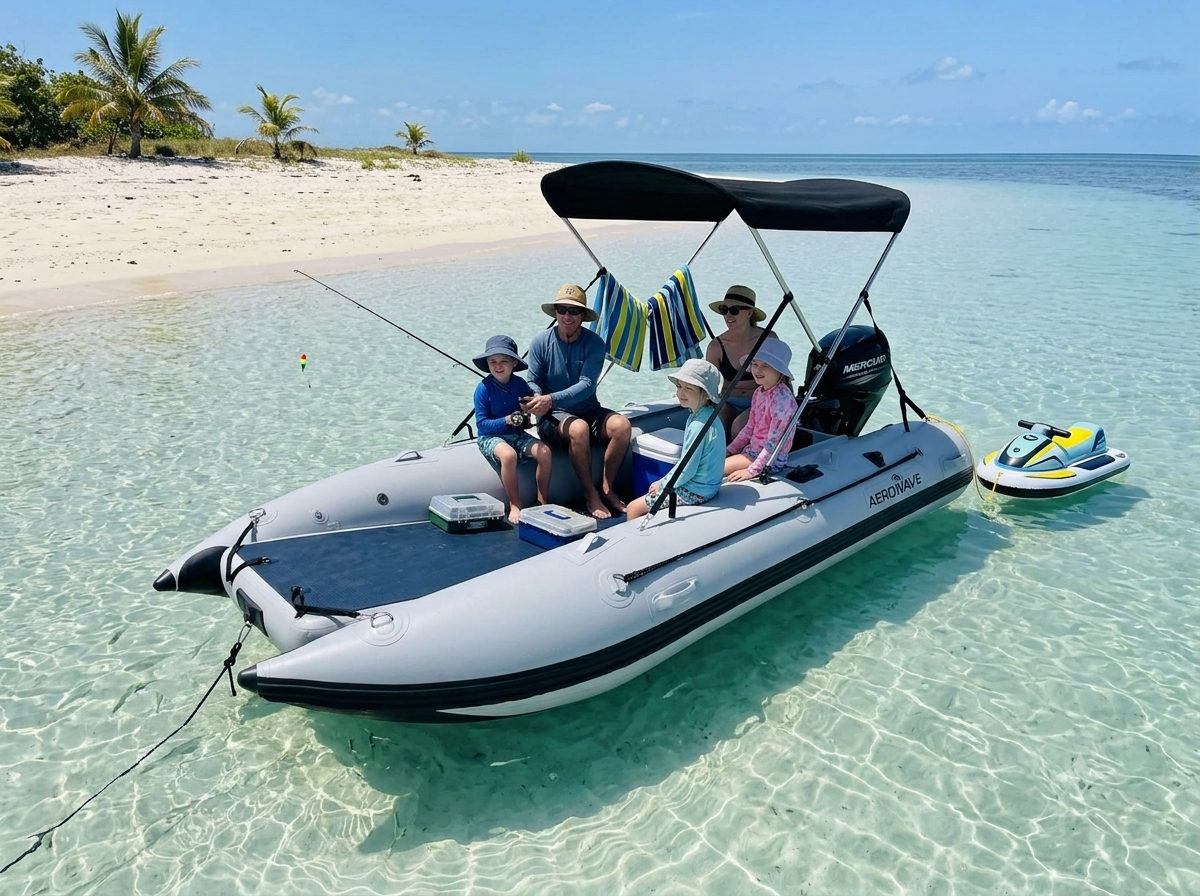
Aerowave WaveRunner 380 Series 3 Catamaran Package
The WaveRunner 380 Series 3 is a premium 3.8m inflatable catamaran package built for Australian and worldwide families, fishing, and coastal day boating — ideal for snorkeling and spearfishing — offering serious stability and premium German Valmex® construction.
Free freight to United States · local taxes payable on arrival
Aerowave Viper 400 Sovereign
Flagship 4m enclosed-bow inflatable catamaran. German VALMEX® 7321 Heavy Plus 1.2mm commercial-grade fabric, 10 PSI high-pressure drop-stitch air deck floor with VALMEX non-slip surface, LockPro wheels, full Bimini and FREE express delivery Australia-wide included. Winter special — save $1,000 until 31 August 2026.
Free freight to United States · local taxes payable on arrival
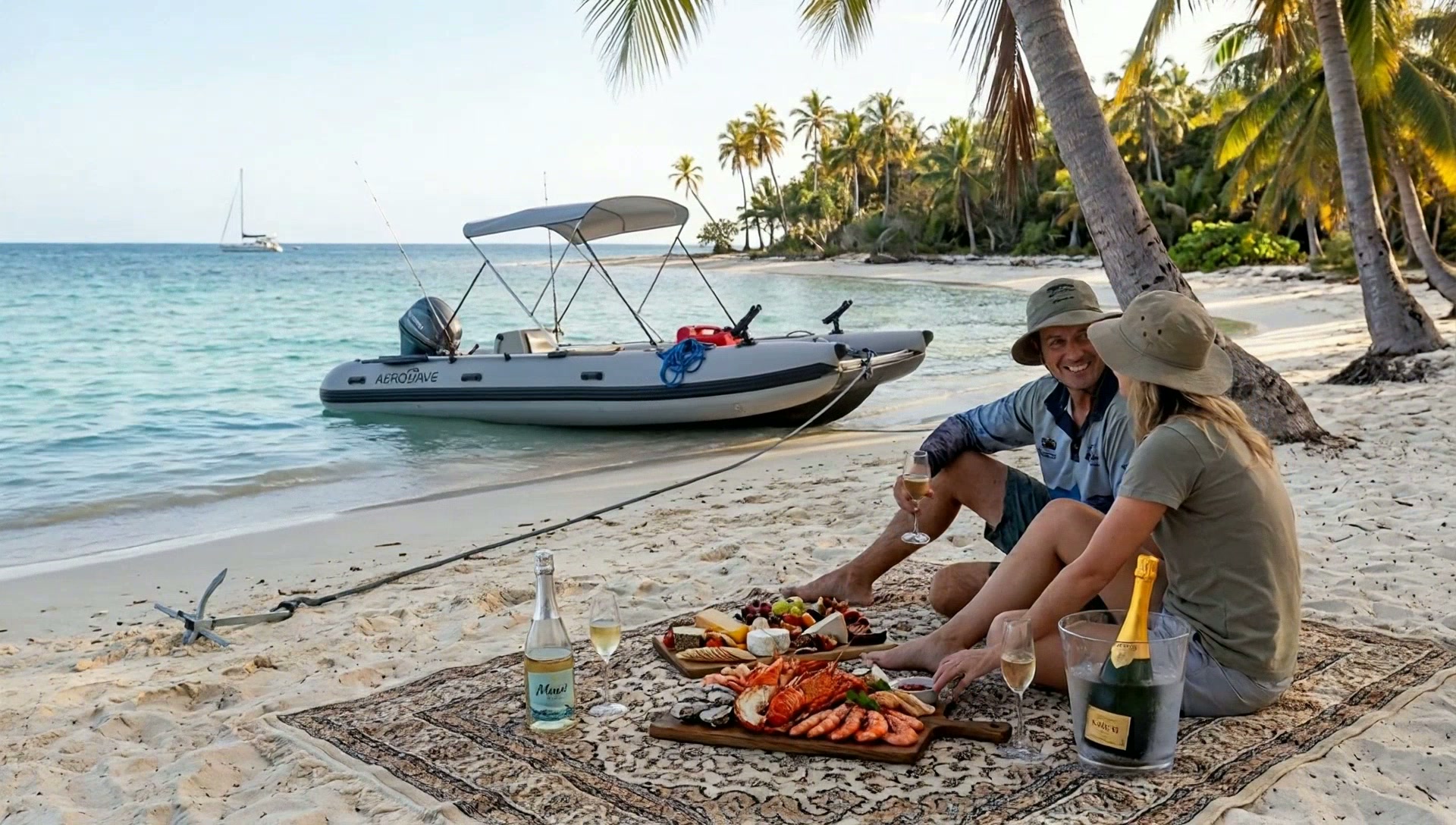
Aerowave Viper 365 Open Bow
Premium 3.65m Inflatable catamaran — built the same way as our flagship Viper 400 sports boat, just 35cm shorter. German VALMEX® 7321 Heavy Plus 1.2mm commercial-grade fabric, 10 PSI high-pressure drop-stitch air deck floor with VALMEX non-slip surface, LockPro wheels, full Bimini and FREE express delivery Australia-wide included.
Free freight to United States · local taxes payable on arrival
Not sure which suits you? Talk to a real boat owner.
Before you spend a cent
Buying from Australia, delivered to United States
You have never heard of us, we are on the other side of the world, and the internet is full of fakes. Fair enough. Here is everything you would need to check us out, in one place — no forms, no chat bot.
Australian designed business
Easy Inflatables, Avoca Beach NSW 2251. ABN 96 856 548 613. International orders ship from our Hong Kong hub.
222 owner reviews, 4.8 average
Read them in full, good and bad, on our reviews page.
CE certified, 7-year hull warranty
ISO 6185-3 and EU Directive 2013/53/EU. Warranty honoured worldwide.
Tracked, insured, door to door
FREE freight to United States · local tax/duty on arrival.
- Who am I actually buying from?
- Easy Inflatables, Avoca Beach NSW 2251, Australia. ABN 96 856 548 613. Sean is the owner and skipper, Gary Stewart handles sales on +61 2 4335 1603, Karen Matthews handles email. The boats are Australian designed; international orders ship from our Hong Kong dispatch hub so your landed price stays competitive. Phone us before you pay a cent — a real person answers.
- Is this really an Australian product?
- Yes — Australian designed and engineered on the NSW Central Coast. Manufacturing is done offshore to our spec, and international orders ship direct from our Hong Kong dispatch hub. If we routed every boat through Australia first, the freight alone would roughly double or triple your cost for the same hull.
- What do I pay, and what is not included?
- The delivery and import terms depend on your country. EU, UK, New Zealand and named Asia/Pacific lanes include duty and tax; US freight is free but US buyers pay import charges on arrival. Other destinations show their terms before payment.
- How do I pay safely?
- Card through Stripe (Visa, Mastercard, Amex, Apple Pay, Google Pay) or bank transfer. Card payments carry your bank's own dispute protection. We never ask for crypto, gift cards or payment to a personal account.
- What if it arrives damaged?
- Every boat ships fully tracked and insured door to door. Photograph the carton and the boat on arrival and email us — transit damage is claimed and replaced through us, not left with you and the courier.
- Is the warranty real outside Australia?
- Yes. The 7-year hull warranty on 1.2 mm VALMEX Heavy Plus and Orca Hypalon hulls applies wherever you are. Replacement parts are held in Australia and at our overseas hub and go out by express courier to your door.
- Is the boat actually certified?
- All Aerowave catamarans are CE certified to ISO 6185-3 and EU Directive 2013/53/EU. Certification paperwork is supplied with the boat — ask and we will send it before you order.
Frequently asked questions
- How long do inflatable boats last in Australia?
- The lifespan depends entirely on the fabric quality. A budget PVC boat might last only 2-4 years in the Australian sun. A premium boat made with high-quality, UV-stabilised German VALMEX® fabric, like those from Easy Inflatables, has a design life of 10-12 years with proper care.
- Can I leave my inflatable boat in the sun?
- It is strongly advised not to. Prolonged exposure to Australia's intense UV radiation is the primary cause of fabric degradation. When not in use, store your boat in the shade or use a high-quality, breathable boat cover. Regularly applying a UV protectant spray is also essential.
- Is PVC or Hypalon better for the Australian sun?
- While Hypalon has a traditional reputation for UV resistance, modern premium PVCs have closed the gap. A high-end, multi-layer PVC like VALMEX® is specifically engineered with advanced coatings that provide excellent UV protection and durability, often with the advantage of having welded seams, which is a major benefit over glued Hypalon.
- Are inflatable catamarans better than V-hulls in choppy water?
- For typical coastal chop, inflatable catamarans generally offer a superior ride. The tunnel between the twin hulls traps air, creating a cushioning effect that softens impacts. They are also exceptionally stable at rest and underway, and produce less spray, resulting in a drier and more comfortable experience.
- How much does a quality inflatable boat cost in Australia?
- Prices vary by size and features. A quality inflatable tender might start around $3,000-$3,500. Larger, more capable coastal boats like the Aerowave WaveRunner 380 package for $4,745, or a top-of-the-line Aerowave Viper 400 package with a Hidea 20HP motor for $9,385, represent an investment in heavy-duty materials and long-term durability.
- Do I need to register an inflatable boat in Australia?
- Registration rules vary by state. Generally, any boat powered by any type of engine, regardless of size, must be registered. You should always check the specific requirements with your local state maritime authority (e.g., Transport for NSW, Maritime Safety Queensland) before heading out.
- What is the difference between welded and glued seams?
- Glued seams use an adhesive to bond overlapping fabric, which can degrade and fail over time with exposure to heat and UV. Thermo-welded seams use heat to physically fuse the fabric together, creating a permanent bond that is stronger than the material itself. For the Australian climate, welded seams are far superior for longevity and safety.
- How do I clean my inflatable boat after use in saltwater?
- Always rinse the entire boat thoroughly with fresh water. Then, wash it with a pH-neutral boat soap to remove all salt residue, followed by another freshwater rinse. Allow it to dry completely in the shade before storing to prevent mould and mildew.
Ready to set sail?
Premium German-fabric inflatable catamarans, built to order and delivered to your door. Talk to our team or browse the fleet.
Like this guide? Get the next one in your inbox.
Owner-tested tips, gear deep-dives and Aussie boating know-how — no spam.