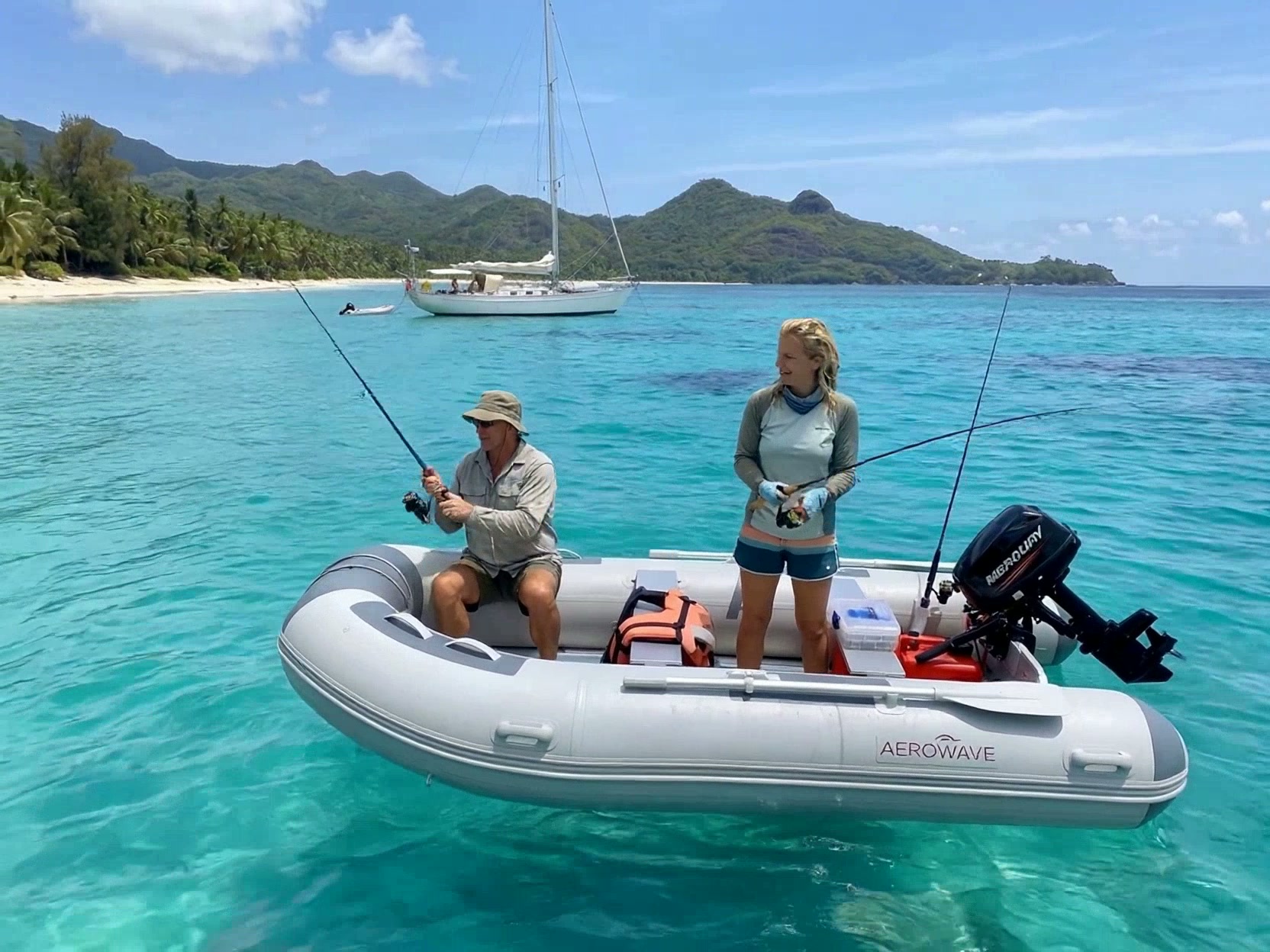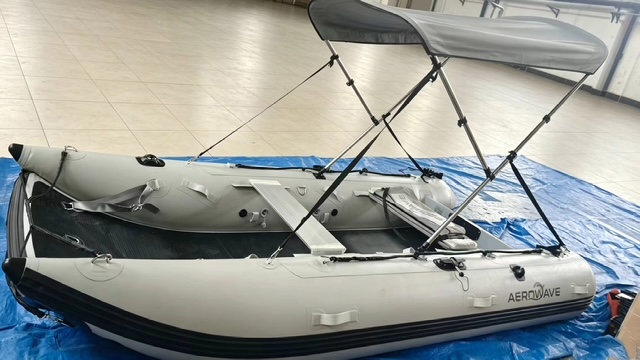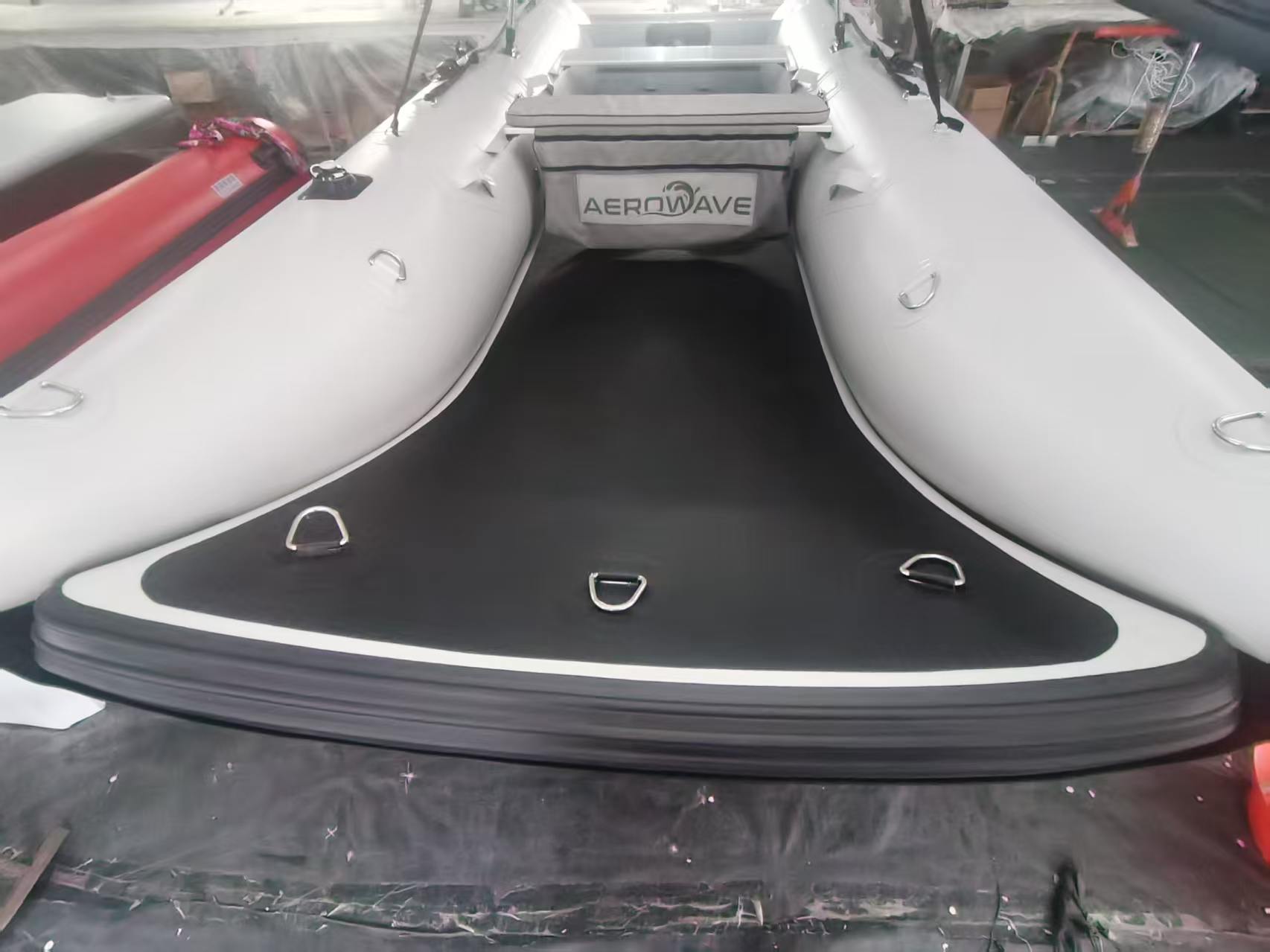
Air Deck vs Aluminium Floor Inflatable Boats: The Definitive Guide
Struggling to choose between an air deck vs aluminium floor? Our expert guide dives deep into rigidity, weight, and performance to help you make the right choice for your next boat.
At a glance
Struggling to choose between an air deck vs aluminium floor? Our expert guide dives deep into rigidity, weight, and performance to help you make the right choice for your next boat.
- What is an Inflatable Boat Floor, Really?
- The Case for High-Pressure Air Deck Floors
- The Technology: How Drop-Stitch Creates Hardness
- The Unbeatable Advantage: Portability and Weight
What we'd put you in
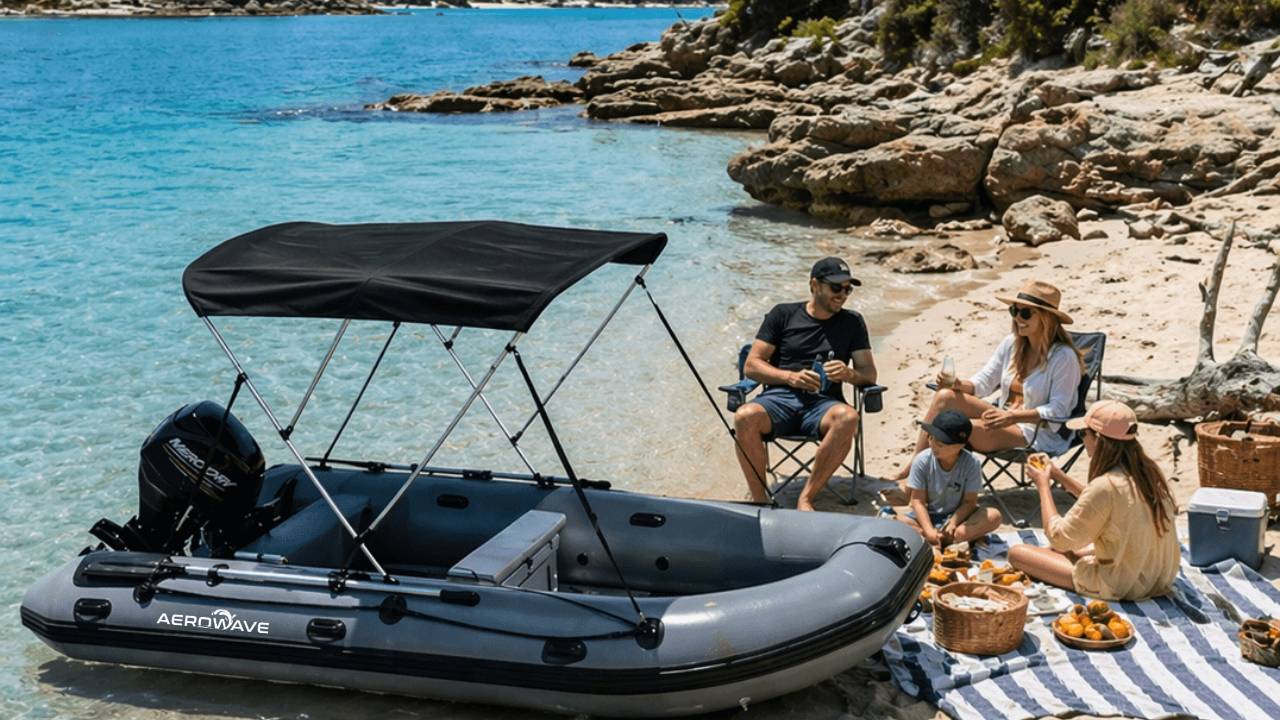
Aerowave Viper 400 Sovereign
Same capability as a small hard boat — without the trailer, the ramp or the rego.
US$3,167 USD
Delivered to your door, today's rate
- Free freight to United States · local taxes payable on arrival
- 7-year hull warranty
🇺🇸 Shipping to United States · landed price quoted in writing
Yes — we ship the Aerowave Viper 400 Sovereign to United States. Here's the landed price.
Same capability as a small hard boat — without the trailer, the ramp or the rego.
Aerowave Viper 400 Sovereign
- Boat package (export price)
- US$3,726
- 15% tariff relief credit
- − US$559
- Express air freight to United States
- Included
- Import duty, taxes & customs clearance
- Payable on arrival
- Estimated landed, USD
- US$3,167
Indicative, converted at today's rate, before local duty and tax on arrival. Ask below and we'll put a fixed figure in writing, valid 30 days.
- 7-year hull warranty
- 1500 GSM / 1.2 mm VALMEX® Heavy Plus hull
- CE certified to ISO 6185-3 and EU Directive 2013/53/EU
- Door-to-door, tracked the whole way
Your price, delivered to your door — freight included.
We email the full PDF quote (spec, freight, finance, WavePay) to your inbox in under 60 seconds. No spam — one quote, one follow-up.
See it for yourself
Real boats. Real owners. Real people behind them.
Plenty of what you read online these days is generated. Check us out properly — the factory, the reviews and the owners are all one click away. Why we use AI, and how to check we’re real
How our boats are built
Walk the production line: thermo-welded seams, 1.2 mm VALMEX Heavy Plus hulls, over-pressure relief valves on every chamber.
See the buildGoogle Maps reviews
Real Australian owners, five stars, published on our Google Business Profile with the map — read them there, not just on our own site.
Open Google Maps reviewsOwner stories
Boats in use — offshore, on rivers, on rescue duty. Photos and words from the people who actually own them.
Read owner storiesChoosing your boat's floor is the single most important decision you'll make, defining its performance, portability, and purpose.
When you're in the market for a new inflatable boat, the conversation quickly turns to the floor. It’s the great debate that divides seasoned boaties and newcomers alike: should you go for a modern high-pressure air deck or a traditional sectional aluminium floor? The choice seems simple on the surface, but the implications for your weekends on the water are massive. This decision dictates not just how your boat feels underfoot, but how you transport it, how quickly you can get on the water, and ultimately, how and where you use it.
The internet is awash with conflicting advice, often from sellers pushing a single type of boat or from forum arguments dating back a decade. The technology has changed, and what was true about air decks five years ago is ancient history today. We're here to cut through the noise. This isn't a sales pitch; it's a definitive, fair-dinkum guide to the air deck vs aluminium floor debate, grounded in materials science, hydrodynamics, and years of real-world experience on Australian waters. We’ll explore the engineering behind each system, their practical pros and cons, and help you determine which floor is genuinely right for your boating life.
What is an Inflatable Boat Floor, Really?
Before we pit these two technologies against each other, it’s crucial to understand what a floor system actually does. It's far more than just a platform to stand on. The floor of a soft inflatable boat (SIB) is a critical structural component, responsible for three key tasks:
- Providing Longitudinal Rigidity: It prevents the boat from flexing like a banana as it moves through waves. This rigidity is essential for the hull to perform as designed and to handle engine thrust effectively.
- Creating a Stable Platform: It gives you a flat, secure surface for standing, moving around, casting a line, or loading gear. Its stability directly impacts your confidence and safety on the water.
- Defining Hull Shape: In many monohull designs, the floor works in conjunction with an inflatable keel tube to create a V-shape in the hull, which helps the boat cut through chop and track straight.
In the early days of inflatable boats, floors were rudimentary—often just wooden slats rolled into the boat's fabric. These 'slat floor' tenders are still sold by budget importers but offer poor rigidity and are only suitable for slow, short trips across a calm harbour. The next evolution was the sectional hard floor, typically made from marine-grade plywood or, more recently, aluminium. For decades, this was the only way to achieve true rigidity in a portable boat. But then, a new technology emerged that changed everything: the high-pressure drop-stitch air deck.
The Case for High-Pressure Air Deck Floors
When people hear 'air floor', they often picture a flimsy, bouncy surface like a pool toy. A modern high-pressure air deck is a world away from this. It is a sophisticated piece of engineering that delivers near-rigid performance in an incredibly lightweight and portable package. This technology has become the new standard in premium recreational inflatables, and for good reason.
The Technology: How Drop-Stitch Creates Hardness
The magic behind a high-pressure air deck is a material technology called 'drop-stitch' construction. Imagine two durable layers of fabric, in our case premium German VALMEX®, separated by a few inches. These two layers are connected by tens of thousands of incredibly fine, high-tensile polyester threads. When the chamber is deflated, the material is soft and can be rolled up. But when you pump air into it, these threads are pulled taut, allowing the deck to inflate to an exceptionally high pressure without ballooning in the middle.
The result is a flat, incredibly strong, and uniformly rigid surface. Standard air decks in quality boats inflate to around 8–10 PSI. However, top-tier models like our Aerowave Viper 400 feature an advanced 15cm thick drop-stitch floor rated to a massive 12 PSI. At this pressure, the floor feels as hard as a sheet of plywood underfoot. You can walk on it, jump on it, and stand on it to cast a line with complete confidence. The structural integrity comes not from bulky materials, but from tension and air pressure—a far more elegant engineering solution.
This is all encased in the same robust fabric as the rest of the boat. The Aerowave Viper, for instance, uses a 1.2mm, 1500 GSM VALMEX® Heavy Plus fabric, a material with a proven lifespan of 10–12 years, ensuring the floor is just as tough as the main tubes.
The Unbeatable Advantage: Portability and Weight
Here is where the air deck leaves aluminium in its wake. The single greatest benefit is portability. An entire air deck boat—hull, floor, and all—can be deflated, rolled up, and packed into one or two carry bags. For an aluminium floor boat, the hull is packed into one bag, and the heavy, awkward floor panels and side stringers are in another. This is a game-changer for a huge number of Australian boaties:
- Caravanners & Campers: An air deck boat like the AeroCat or WaveRunner 380 can be stored in the back of the 4WD or in a caravan locker, taking up minimal space. An aluminium floor package is often too heavy and bulky for this kind of travel.
- Apartment Dwellers: You can store your boat in a cupboard or on a balcony. Try that with several heavy aluminium planks.
- Single-Handed Setup: One person can easily carry the bags to the water's edge and assemble the boat. Setting up an aluminium floor, especially locking in the side stringers, can be a frustrating, muscle-straining job that often requires two people.
The weight saving is significant. The floor itself can be 50–60% lighter than its aluminium equivalent. This translates to a lighter total package, making it easier to carry to the water, easier to launch, and allowing the use of a smaller, lighter outboard engine.
On-Water Performance and Comfort
While an aluminium floor is fractionally more rigid in absolute terms, a 12 PSI air deck is so firm that the difference is negligible for 99% of recreational uses. In fact, the air deck offers several distinct performance advantages.
Firstly, comfort. The air-filled deck has a natural dampening effect, absorbing small vibrations and the slap of water against the hull. This makes for a noticeably quieter and smoother ride, reducing fatigue on longer journeys. An aluminium floor, by contrast, transmits every vibration and noise directly to your feet. After a few hours on a choppy bay, the difference is profound. The air deck is also kinder on your knees and back and doesn't get scorching hot in the sun or freezing cold in winter like bare metal does.
Secondly, safety. The air deck itself is a massive buoyancy chamber. In the unlikely event of the main tubes being compromised, the floor provides a huge amount of additional flotation.
The Case for Sectional Aluminium Floors
While we believe the air deck is superior for most recreational users, the sectional aluminium floor still has its place. For decades, it was the only option for a serious portable boat, and it continues to be favoured in certain commercial and heavy-duty applications. It is the definition of a workhorse.
The 'Gold Standard' for Rigidity
The undisputed selling point of an aluminium floor is its absolute, uncompromising rigidity. It is constructed from several interlocking, marine-grade aluminium panels that are laid into the bottom of the boat. These are then locked into place by a pair of aluminium 'stringers' that run along the sides, creating immense tension and a truly solid deck. The feeling is identical to being in a small rigid-hull or 'tinnie'.
This ultimate rigidity is beneficial in specific scenarios. If you're a diver regularly hauling heavy tanks with sharp edges over the side, or a commercial crabber dropping and retrieving pots, the tough, unyielding surface of aluminium is confidence-inspiring. You can drag heavy eskies, fuel tanks, and sharp-edged equipment across it with less fear of damage compared to any fabric surface. For pure, brute-strength utility, it’s hard to beat.
The Weight and Assembly Penalty
This rigidity comes at a significant cost: weight and complexity. The aluminium floor panels and stringers are heavy. A floor for a 3.8-metre boat can easily weigh over 25 kilograms on its own, with individual panels being awkward and cumbersome to handle. The entire boat package is often too heavy for one person to manage comfortably.
Assembly is the other major hurdle. While it gets easier with practice, installing an aluminium floor can be a frustrating puzzle. You have to lay the panels in the partially inflated boat in the correct sequence. The final, and most difficult, step is prying the side stringers into place. This often requires considerable force, sometimes using the paddle as a lever, and can be a real struggle, especially on a cold day when the boat's fabric is less pliable.
This process makes spontaneous trips to the water less likely. The thought of wrestling with heavy, cold metal panels is a significant deterrent compared to simply rolling out a boat and switching on an electric pump.
Durability and Maintenance
Aluminium is undoubtedly a tough material. It resists punctures from sharp objects far better than any fabric. However, it's not indestructible. A heavy impact can dent or bend a floor panel, potentially compromising the fit and making assembly even more difficult. While marine-grade aluminium is corrosion-resistant, it is not corrosion-proof. If you use the boat in saltwater, meticulous rinsing of the panels, stringers, and especially the channels they sit in, is essential to prevent oxidisation and seizure over time.
Another consideration is that sand and grit can get trapped between the panels and the hull fabric. Over time, this can act like sandpaper, causing abrasion to the inside of your boat's main tubes. An air deck, being a single, sealed unit, doesn't have this problem.
Air Deck vs Aluminium Floor: A Head-to-Head Comparison
To make the choice clearer, let's break down the key differences in a direct comparison table. We're comparing a modern, premium 12 PSI air deck (as found in the Aerowave Viper) against a typical sectional aluminium floor.
| Feature | High-Pressure Air Deck (12 PSI) | Sectional Aluminium Floor |
|---|---|---|
| Rigidity | Extremely rigid, feels like a hard floor. 9/10. | The absolute benchmark for rigidity. 10/10. |
| Portability & Storage | Excellent. Entire boat rolls into one or two manageable bags. | Poor. Requires multiple heavy, bulky bags. Difficult to store. |
| Assembly Time & Ease | Fast & Easy. 15-20 mins with an electric pump. Single person. | Slow & Difficult. 25-40 mins. Often requires two people. |
| Weight | Significantly lighter. Easier to carry and launch. | Very heavy. The floor alone can be 25kg+. |
| On-Water Comfort | Superior. Quieter, absorbs vibration, comfortable underfoot. | Harsh. Transmits noise and vibration. Can be hot/cold. |
| Durability | Tough VALMEX® fabric is abrasion/puncture resistant. | Excellent against impact/sharp objects, but can dent and corrode. |
| Maintenance | Simple rinse and dry. No moving parts to corrode. | Requires meticulous rinsing to prevent corrosion and seizure. |
| Best For | Recreational users, travellers, families, fishers. | Heavy commercial use, divers, users prioritising utility over all else. |
| Air deck vs aluminium floor verdict | The modern choice for superior all-round performance. | The traditional choice for maximum brute-force rigidity. |
Beyond the Floor: How Hull Design Changes the Equation
It's a mistake to consider the floor in isolation. The floor's performance is directly tied to the boat's underlying hull design. This is where many comparisons fall short, as they often assume a traditional V-hull monohull design for both floor types.
Monohull Tenders vs. Inflatable Catamarans
Many boats offered with aluminium floors are generic, imported monohull tenders. In these designs, the floor's rigidity is paramount because it's working hard to create and maintain the V-shape of the hull. A flimsy floor would lead to a boat that flops and performs poorly.
Now, consider a modern inflatable catamaran like the Aerowave Viper or AeroCat. These boats derive their stability and performance from two widely spaced, large-diameter tubes (sponsons). The 'deck' area is the platform between these two hulls. The catamaran design is inherently stable and rigid. The job of the floor is simply to create a solid, flat platform connecting the two hulls, not to create the hull shape itself.
This makes a high-pressure air deck the perfect partner for a catamaran hull. It provides all the necessary platform rigidity without adding the excessive weight of an aluminium floor, which would compromise the cat's natural efficiency and shallow draft. The synergy is undeniable: the lightweight, efficient catamaran hull is paired with a lightweight, user-friendly air deck floor, creating a package that outperforms traditional designs in nearly every respect.
Even in our premium monohull, the WaveRunner 380, the advanced air deck works with an inflatable keel to form a highly effective deep-V hull, offering sharp wave-cutting ability without the weight penalty of metal plates.
Real-World Scenarios: Which Floor Is Right For You?
Let's move from theory to practice. Your personal boating style, storage situation, and transport methods will be the ultimate deciding factors. Use this checklist to see which camp you fall into.
You should choose a HIGH-PRESSURE AIR DECK if:
- You are a caravanner, camper, or traveller who needs a boat that packs down small and light.
- You live in an apartment or have limited storage space at home.
- You value quick, easy, single-person setup and pack-down for spontaneous trips.
- You want to get on the water in under 20 minutes, not 40.
- Your primary use is family fun, fishing, and exploring bays, estuaries, and coastal waters.
- On-water comfort, a quieter ride, and a deck that's friendly on bare feet and knees are important to you.
- You want to maximise performance and efficiency, using a smaller, more economical outboard like a Hidea 4-stroke.
- You are excited by modern, high-performance designs like inflatable catamarans.
You might still consider a SECTIONAL ALUMINIUM FLOOR if:
- Your primary use is commercial, like a work boat for a marina or construction site.
- You regularly transport extremely heavy, sharp, or abrasive gear like dive tanks, commercial crab pots, or construction materials.
- You need the absolute maximum rigidity possible and are willing to sacrifice portability, comfort, and ease of use to get it.
- Your boat will be left assembled for an entire season on a dock or trailer.
- You have a ute or trailer dedicated to transport and always have a second person to help with setup.
The Bottom Line
For decades, choosing a serious inflatable meant accepting the compromise of a heavy, cumbersome aluminium floor. That era is over. The advancement of high-pressure drop-stitch technology, combined with superior fabrics like the German VALMEX® used in our boats, has changed the game. A modern 12 PSI air deck delivers a level of rigidity that is more than sufficient for almost any recreational activity, from stand-up casting to spirited coastal cruising.
When you factor in the colossal advantages in weight, portability, assembly speed, and on-water comfort, the choice becomes clear. For the vast majority of Australian recreational boaters, the high-pressure air deck is not just a viable alternative; it is the superior choice. It opens up a world of possibilities for travellers, families, and anyone who values convenience as much as performance.
At Easy Inflatables, we specialise in these next-generation inflatable boats. From the premium Aerowave Viper catamaran to the versatile AeroCat and WaveRunner series, our entire range is built around the benefits of high-performance air decks and advanced hull designs. If you're ready to experience the modern standard of portable boating, give us a call on +61 2 4335 1603 or email sales@easyinflatables.com.au. We'd be happy to discuss your specific needs and help you find the perfect package, delivered express to your door anywhere in Australia.
Related
Weekend-Proof Score 17 questions · about 2 minutes
Will the boat you're about to buy survive an Australian summer?
Seventeen straight questions about where you'll use it, what you'll ask of it and the boat you're weighing up. You get a score out of 100, the exact weak points in your plan, and the one boat that genuinely fits.
Free · your result shows on screen · no email required
So which one is yours?
Pick how you'll actually use it and we'll take you straight to the right hull.
I want to fish it
Open bow, rod holders, deck space you can stand and cast from.
Viper Sport 400Family, diving and the beach
3.8 m Series 3 catamaran — low bow to climb back in wearing fins or a tank.
WaveRunner 380Tender / one-person launch
3.3 m hard-floor boat that packs into a bag and still takes a beach landing.
Viper 330Shop gear featured in this guide
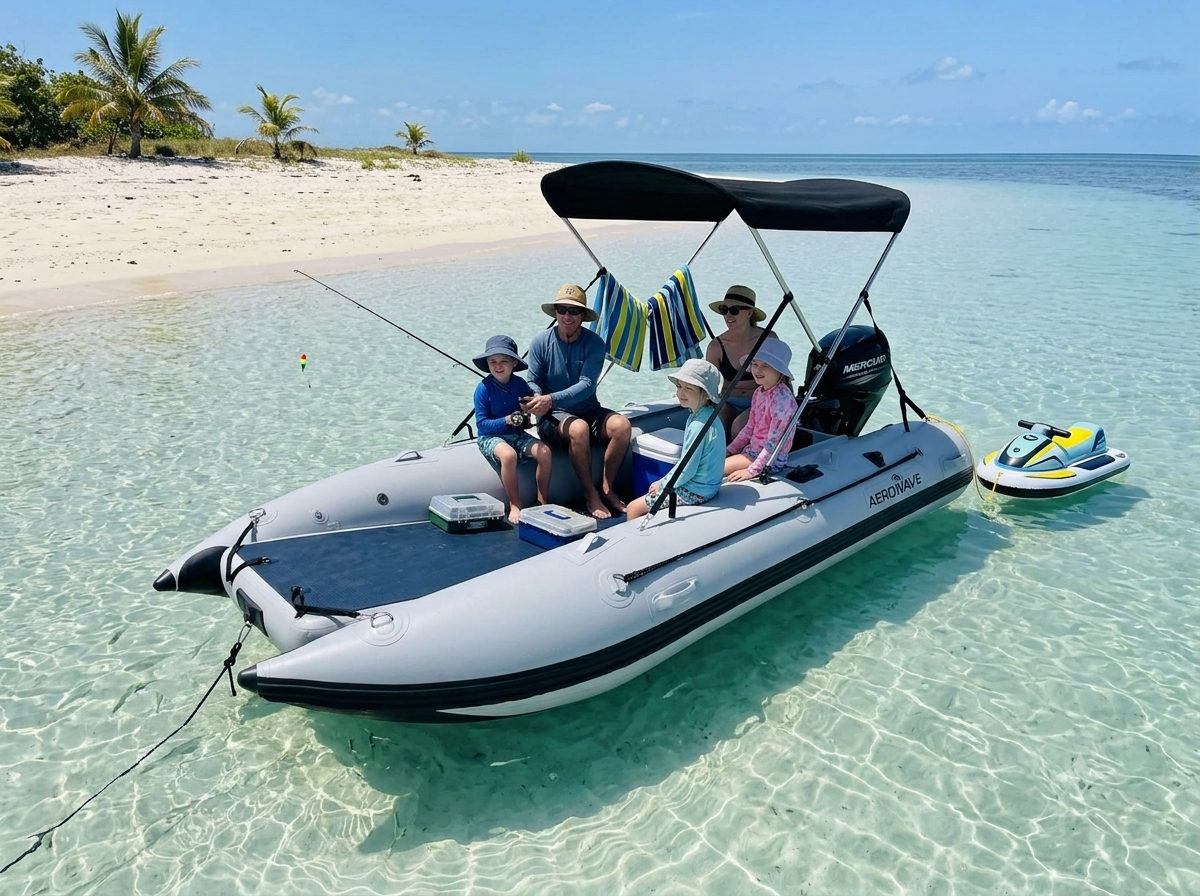
Aerowave WaveRunner 380 Series 3 Catamaran Package
The WaveRunner 380 Series 3 is a premium 3.8m inflatable catamaran package built for Australian and worldwide families, fishing, and coastal day boating — ideal for snorkeling and spearfishing — offering serious stability and premium German Valmex® construction.
Free freight to United States · local taxes payable on arrival
Aerowave Viper 400 Sovereign
Flagship 4m enclosed-bow inflatable catamaran. German VALMEX® 7321 Heavy Plus 1.2mm commercial-grade fabric, 10 PSI high-pressure drop-stitch air deck floor with VALMEX non-slip surface, LockPro wheels, full Bimini and FREE express delivery Australia-wide included. Winter special — save $1,000 until 31 August 2026.
Free freight to United States · local taxes payable on arrival
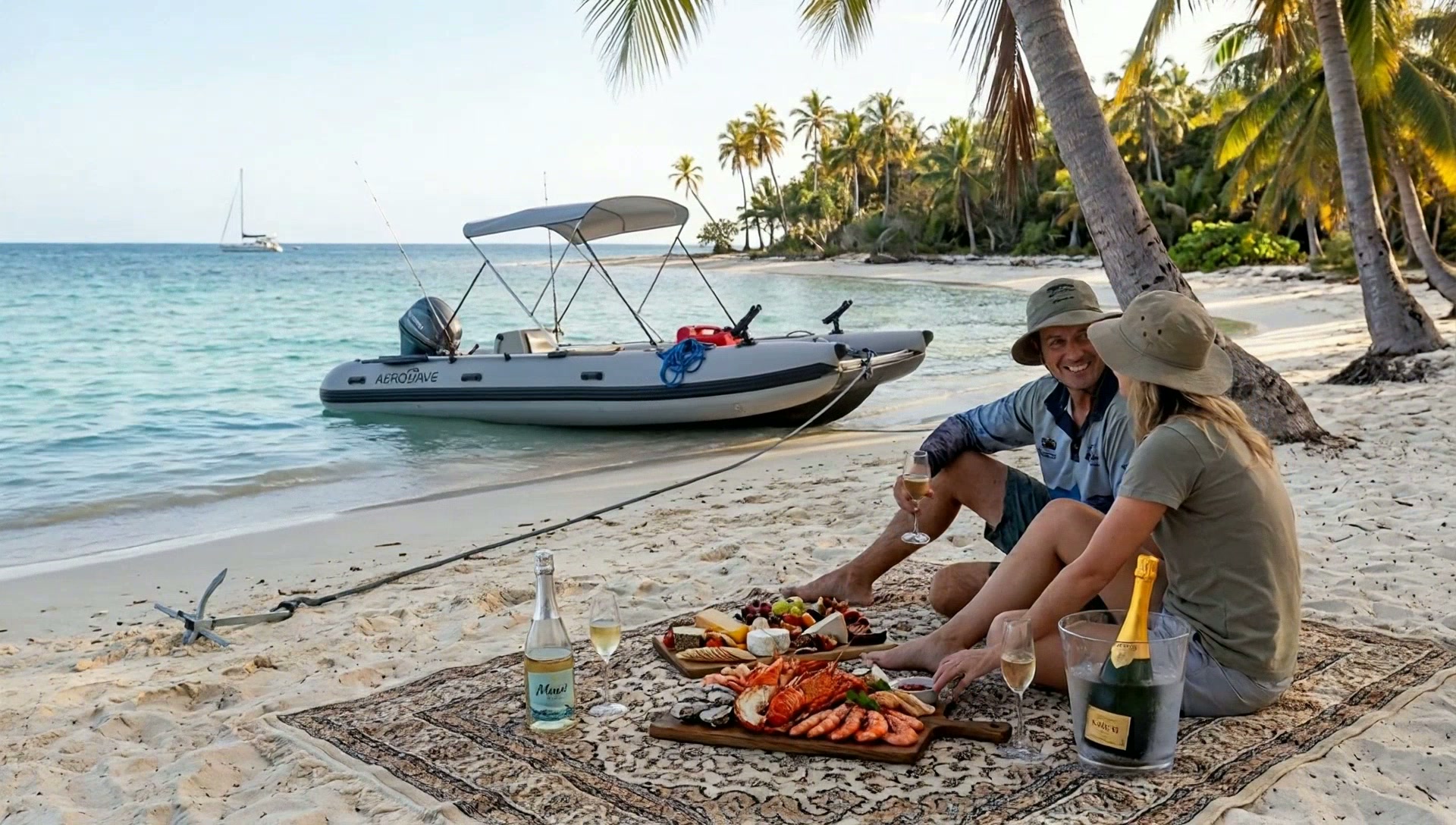
Aerowave Viper 365 Open Bow
Premium 3.65m Inflatable catamaran — built the same way as our flagship Viper 400 sports boat, just 35cm shorter. German VALMEX® 7321 Heavy Plus 1.2mm commercial-grade fabric, 10 PSI high-pressure drop-stitch air deck floor with VALMEX non-slip surface, LockPro wheels, full Bimini and FREE express delivery Australia-wide included.
Free freight to United States · local taxes payable on arrival
Not sure which suits you? Talk to a real boat owner.
Before you spend a cent
Buying from Australia, delivered to United States
You have never heard of us, we are on the other side of the world, and the internet is full of fakes. Fair enough. Here is everything you would need to check us out, in one place — no forms, no chat bot.
Australian designed business
Easy Inflatables, Avoca Beach NSW 2251. ABN 96 856 548 613. International orders ship from our Hong Kong hub.
222 owner reviews, 4.8 average
Read them in full, good and bad, on our reviews page.
CE certified, 7-year hull warranty
ISO 6185-3 and EU Directive 2013/53/EU. Warranty honoured worldwide.
Tracked, insured, door to door
FREE freight to United States · local tax/duty on arrival.
- Who am I actually buying from?
- Easy Inflatables, Avoca Beach NSW 2251, Australia. ABN 96 856 548 613. Sean is the owner and skipper, Gary Stewart handles sales on +61 2 4335 1603, Karen Matthews handles email. The boats are Australian designed; international orders ship from our Hong Kong dispatch hub so your landed price stays competitive. Phone us before you pay a cent — a real person answers.
- Is this really an Australian product?
- Yes — Australian designed and engineered on the NSW Central Coast. Manufacturing is done offshore to our spec, and international orders ship direct from our Hong Kong dispatch hub. If we routed every boat through Australia first, the freight alone would roughly double or triple your cost for the same hull.
- What do I pay, and what is not included?
- The delivery and import terms depend on your country. EU, UK, New Zealand and named Asia/Pacific lanes include duty and tax; US freight is free but US buyers pay import charges on arrival. Other destinations show their terms before payment.
- How do I pay safely?
- Card through Stripe (Visa, Mastercard, Amex, Apple Pay, Google Pay) or bank transfer. Card payments carry your bank's own dispute protection. We never ask for crypto, gift cards or payment to a personal account.
- What if it arrives damaged?
- Every boat ships fully tracked and insured door to door. Photograph the carton and the boat on arrival and email us — transit damage is claimed and replaced through us, not left with you and the courier.
- Is the warranty real outside Australia?
- Yes. The 7-year hull warranty on 1.2 mm VALMEX Heavy Plus and Orca Hypalon hulls applies wherever you are. Replacement parts are held in Australia and at our overseas hub and go out by express courier to your door.
- Is the boat actually certified?
- All Aerowave catamarans are CE certified to ISO 6185-3 and EU Directive 2013/53/EU. Certification paperwork is supplied with the boat — ask and we will send it before you order.
Frequently asked questions
- How hard is a high-pressure air deck, really?
- It’s incredibly hard. A premium air deck inflated to 12 PSI, like the one in our Aerowave Viper, feels as rigid as a timber plank underfoot. The drop-stitch technology creates a remarkably stable and solid platform that you can stand and walk on with complete confidence.
- Can you put fishing hooks through an air deck?
- It's highly unlikely with normal, careful use. The premium 1.2mm VALMEX® fabric is exceptionally tough and puncture-resistant. While you should always be careful with sharp objects, a dropped hook is very unlikely to cause a puncture.
- How long does it take to inflate an air deck boat?
- With a good quality electric pump, you can inflate a boat like the AeroCat 380, including the floor and tubes, in about 15-20 minutes. The process is straightforward and can easily be done by one person, getting you on the water much faster than with an aluminium floor boat.
- Is an aluminium floor better for bigger outboards?
- Not necessarily. The boat's maximum engine rating is determined by the transom's strength and the hull's design, not the floor type. In fact, because air deck boats are lighter and often more efficient (especially catamarans), they can achieve excellent performance with smaller, lighter, and more economical outboards.
- Does an air deck lose pressure when it gets cold?
- Yes, all inflatables are subject to the laws of physics. If you inflate your boat in the warm sun and the air or water temperature drops, the air inside will contract, causing a slight pressure loss. It’s good practice to check and top up the pressure if needed.
- What is the lifespan of a high-pressure air deck?
- The lifespan of the air deck is the same as the boat itself. Our boats are made from premium German VALMEX® fabric, which has a proven lifespan of 10-12 years or more with proper care, such as rinsing after use and storing it out of direct UV radiation.
- Can I stand up to cast on an air deck?
- Absolutely. The rigidity of a high-pressure air deck provides a very stable platform for fishing. This stability is even more pronounced on our inflatable catamarans like the Viper and AeroCat, whose twin-hull design makes them one of the most stable casting platforms available.
- Is an aluminium floor boat cheaper?
- Not necessarily. A boat's price is primarily determined by the quality of the fabric (e.g., premium VALMEX® vs. cheap PVC), the construction method (welded vs. glued seams), and overall design. A cheap, low-quality boat with an aluminium floor will be less expensive than a premium air deck boat, but it will not perform as well or last as long.
Ready to set sail?
Premium German-fabric inflatable catamarans, built to order and delivered to your door. Talk to our team or browse the fleet.
Like this guide? Get the next one in your inbox.
Owner-tested tips, gear deep-dives and Aussie boating know-how — no spam.