
The Definitive Guide to the Best Inflatable Boat for Australian Families
Looking for the best inflatable boat for your family? This guide covers safety, stability, size, and why a premium SIB is the ultimate choice for Aussie waters.
Our recommendation
Aerowave Viper 400 Sovereign
1.2 mm fabric is about 33% thicker than common 0.9 mm fabric: more material between your boat and the water for everyday rubbing and knocks during beach launches. Careful handling still matters.
Length
4.0m / 13'1"
Beam
1.80m / 71"
Tube Diameter
51cm
Bare Boat Weight (without Bimini & wheel kit)
66kg / 145lbs
Finding a boat that's safe for your kids, stable enough for Mum and Dad, and easy enough for a solo launch isn't a dream—it's a checklist.
Choosing the right boat for your family is one of the most rewarding decisions you can make. It’s about more than just a vessel; it’s about unlocking a lifestyle of weekends spent exploring hidden coves, teaching the kids to fish, and creating memories that a landlocked life simply can't offer. For years, the choice for many Australian families was a tippy aluminium tinnie or a cumbersome fibreglass boat that demanded a heavy-duty tow vehicle, a dedicated marina berth, and a bottomless maintenance budget. The dream often felt out of reach.
Today, the modern premium inflatable boat—specifically a soft inflatable boat, or SIB—has completely changed the game. Forget the flimsy pool toys of the past. We’re talking about high-tech, military-grade vessels engineered for stability, safety, and incredible versatility. A high-quality SIB is the key that unlocks our stunning waterways for everyday Australian families, providing a platform that’s more practical, affordable, and arguably more fun than any rigid-hull alternative.
This guide is the definitive resource for any Australian family considering an inflatable boat. We’ll cut through the marketing fluff and give you the honest, practical advice you need, covering everything from hull design and material science to engine matching and essential accessories. We’ll show you what to look for, what to avoid, and how to select the perfect inflatable boat for your family's adventures.
Why is an Inflatable Boat Perfect for Family Adventures?
The advantages of a modern SIB for family use are immense, extending far beyond simply being 'easier'. They represent a fundamental shift in how families can access and enjoy the water.
Firstly, there's the unparalleled portability and storage. Most Australian families don't have a spare acre to store a 6-metre fibreglass boat. A premium inflatable, like an Aerowave AeroCat or Viper, packs down into one or two heavy-duty bags that can be stored in a garage, a shed, or even the back of a large SUV. This means no marina fees, no driveway-hogging trailers, and the freedom to launch from virtually any beach or boat ramp in the country. You can take your holiday house with you.
Secondly, the inherent safety features are a massive drawcard for parents. The large-diameter tubes act as giant, built-in fenders, making coming alongside a jetty or another boat a gentle, stress-free affair—no more screaming “watch the gelcoat!” as the kids try to help. The low freeboard and soft tubes also make it incredibly easy for children (and adults) to climb back aboard after a swim. Try that with the high, hard sides of a tinnie. With multiple independent air chambers, a premium SIB is virtually unsinkable, providing a level of buoyancy and peace of mind that is hard to match.
Finally, there's the ride quality. The inflatable tubes absorb chop and vibration, delivering a softer, drier ride than a comparable-sized aluminium boat, which can slam and bang in even a light swell. This comfort factor is crucial on longer trips, ensuring the kids are happy and the crew isn’t exhausted by the time you reach your destination. Add a shallow draft that lets you nose right up onto the beach, and you have the ultimate platform for family exploration.
What's Better for Families: An Inflatable Catamaran or a Monohull?
This is one of the most important questions a family can ask. The answer hinges on your priorities: ultimate stability and space, or traditional handling and tender duties. Both are excellent choices, but they excel in different areas.
The Case for the Inflatable Catamaran
For pure family boating, the inflatable catamaran design is a revelation. By splitting the hull into two separate inflatable tubes (sponsons), the boat gains a level of lateral stability that is simply staggering. You can have two adults and a child all standing on one side of an Aerowave Viper or AeroCat, and the boat barely lists. This is a game-changer for families with young, active children who aren't known for sitting still.
The catamaran design also creates a tunnel of air between the hulls, which cushions the ride in chop. Instead of slamming, the boat glides over the waves, providing a much smoother and drier experience. This tunnel also helps the boat plane more easily with less horsepower, improving fuel efficiency. The wide, flat deck area on models like the Aerowave WaveRunner 380 or the Viper 400 Open Bow provides enormous internal volume, feeling more like a much larger boat. There's ample room for kids, an Esky, fishing gear, and beach toys without everyone feeling cramped.
The Case for the Inflatable Monohull
Traditional inflatable monohulls, like the Aerowave Swift Tender series, still have a strong place. Their V-hull design, formed by a high-pressure inflatable keel, provides responsive, predictable handling that many boaters are familiar with. They lean into turns like a rigid boat, which can be a more intuitive feel for some skippers.
Monohulls are often lighter for a given length and can be slightly quicker to assemble. They are a superb choice as a highly capable tender for a larger yacht or cruiser, or for families who prioritise nimble handling and a classic ride over the expansive deck space and rock-solid stability of a catamaran. For short hops from a mother ship to the beach, or for exploring calm rivers and estuaries, a quality monohull like the Swift Tender 290 is a fantastic, versatile option.
Family Boat Hull Comparison: Catamaran vs. Monohull
| Feature | Inflatable Catamaran (e.g., Aerowave Viper, AeroCat) | Inflatable Monohull (e.g., Aerowave Swift Tender) |
|---|---|---|
| Stability at Rest | Exceptional. The gold standard for family safety. | Very good, but less stable than a catamaran. |
| Ride in Chop | Softer and drier. Air tunnel cushions the ride. | Good, but can be firmer and wetter in chop. |
| Internal Space | Massive. Wide, flat deck offers huge usable area. | Good, but the V-hull shape reduces flat floor space. |
| Planing Efficiency | Excellent. Planes easily with less horsepower. | Good. Requires slightly more power to get on the plane. |
| Handling | Extremely stable, turns flat. Very predictable. | Agile and responsive. Leans into turns like a rigid boat. |
| Best For | The ultimate inflatable boat for families; fishing, coastal exploring, group outings. | Tender duties, calm water exploration, solo skippers. |
For most families looking for a primary vessel for day trips, the catamaran is the superior choice. The gains in stability, space, and ride comfort directly translate to a safer, more enjoyable day on the water for everyone, especially those with small children.
What Makes an Inflatable Boat Genuinely Safe for Kids?
When you're putting your family on the water, safety isn't just a feature—it's everything. Not all inflatable boats are created equal, and the difference between a cheap import and a premium, well-engineered SIB is night and day. Here’s what truly matters.
Fabric Quality and Construction
The heart of any inflatable boat is its fabric. This is where you absolutely cannot compromise. Budget boats use cheap, single-layer PVC that degrades quickly under Australian UV, becoming brittle and prone to seam failure within a few seasons.
A top-tier family inflatable will be made from heavy-duty, multi-layered German VALMEX®. This is a high-tech composite material, not just simple PVC. For example, the Aerowave Viper series uses an incredibly robust 1500 GSM / 1.2 mm VALMEX® Heavy Plus fabric (as does the WaveRunner 380), while the AeroCat series uses a still-premium 1100 decitex / 0.9 mm VALMEX®. This material is specifically designed for extreme marine environments, offering superior resistance to UV radiation, abrasion, salt, and fuel spills. The seams on these boats are meticulously welded (thermo-welded), not just glued, creating a bond that is stronger than the material itself. This construction ensures a reliable lifespan of 10-12 years, even with regular use in our harsh climate.
Multiple Air Chambers
Every reputable inflatable boat, as mandated by CE certification (ISO 6185-3), must have multiple independent air chambers. This is a critical safety feature. An Aerowave Viper 400, for instance, has at least five main chambers in the tubes plus additional chambers for the air deck and keel/tunnel floor. This means that in the highly unlikely event of a puncture to one chamber, the rest of the boat remains fully inflated and buoyant, allowing you to return safely to shore. A boat with only one or two chambers presents an unacceptable risk for family use.
High-Pressure Air Deck
The floor of the boat is just as important as the tubes. Modern high-end SIBs use a high-pressure 'air deck' floor. This isn't a soft, bouncy castle floor; it's a sophisticated drop-stitch construction that inflates to a rock-solid 8-10 PSI. When fully inflated, it's rigid enough to stand, walk, and cast from, providing a stable platform underfoot. This rigidity is crucial for the boat's overall performance and handling, effectively forming the 'chassis' of the vessel. A flimsy, low-pressure floor will feel spongy and unsafe, and it will allow the boat to flex and wallow in waves, compromising performance and safety.
The Family Inflatable Boat Safety Checklist
When evaluating any inflatable boat for your family, run through this non-negotiable checklist:
- [ ] Fabric: Is it a name-brand, multi-layer composite like German VALMEX®? Ask for the specific GSM (Grams per Square Metre) and thickness (mm) rating. Anything under 1000 GSM / 0.9 mm should be a red flag for a primary family boat.
- [ ] Seams: Are they thermo-welded or glued? Welded seams are far superior and last longer.
- [ ] Air Chambers: How many independent chambers are there? Look for at least 3+1 (three in the tubes, one for the floor). Premium models have more.
- [ ] Air Deck: Is it a high-pressure (8-10 PSI) drop-stitch floor? Press on it. It should feel as hard as a paddleboard.
- [ ] Transom: Is it solid marine-grade plywood or composite, properly sealed and bonded to the tubes? It needs to handle the force of a modern 4-stroke outboard.
- [ ] Certification: Is the boat CE Certified to ISO 6185-3 standards? This is the international benchmark for the design and construction of inflatable boats.
How Big of an Inflatable Boat Does My Family Need?
Choosing the right size is a balance between capacity, portability, and intended use. Going too small will lead to a cramped, wet, and frustrating experience, while going too big can make launching and handling more difficult than necessary.
For a typical family of three or four (two adults, one or two small children), the sweet spot is generally between 3.6 metres and 4.0 metres. A boat in this range offers enough internal space for everyone to be comfortable, plus room for an Esky, dry bags, and fishing gear.
-
The 3.6-3.8 Metre Class (e.g., Aerowave AeroCat 365, WaveRunner 380): This is an ideal all-rounder size. A boat like the Aerowave WaveRunner 380 Series 3 (A$4,945) is incredibly versatile. It's large enough for a family of four for a day trip, stable enough for fishing, and can be comfortably powered by a 15HP outboard. It remains manageable for a single person to set up and launch.
-
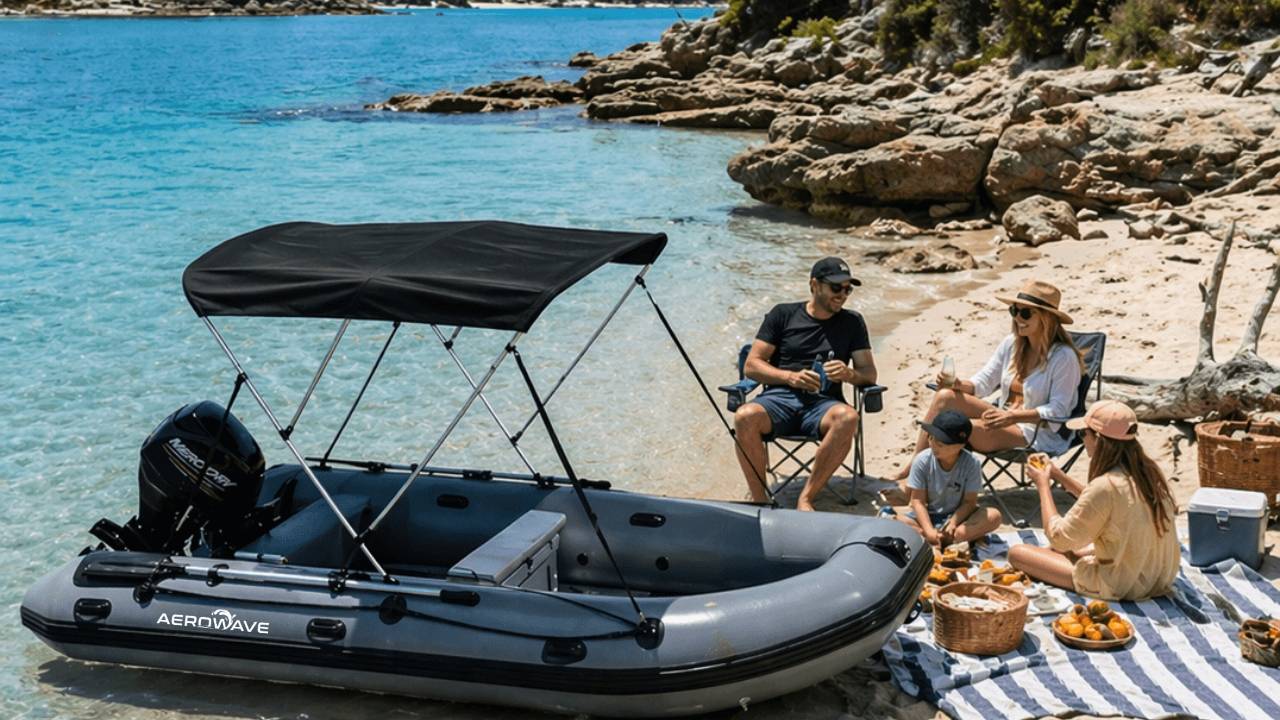
The 4.0-4.5 Metre Class (e.g., Aerowave AeroCat 400, Viper 400/430/450): If you have a family of five, regularly take friends out, or just want more space to stretch out, stepping up to this class is a wise move. The Aerowave Viper 400 Open Bow (A$5,995 in a Sports Package) is a flagship family vessel. The extra length and beam translate directly into more usable deck space and a greater payload capacity. These boats can handle more power (typically 20-30HP) and offer an even smoother ride in open water. The open bow design on the Viper series is particularly family-friendly, providing easy access to the front of the boat and a great spot for kids to sit while at rest.
It's always better to have slightly more boat than you think you need. A boat that feels spacious with two people can feel very crowded once you add two kids, life jackets, an Esky, a beach tent, and everything else that comes with a family day out.
Powering Your Family Inflatable Boat
A great hull needs a great engine. For family use, a modern 4-stroke outboard is the only sensible choice. They are significantly quieter, more fuel-efficient, and produce far fewer emissions than older 2-stroke engines. The quiet operation is a huge bonus for family comfort—you can actually have a conversation while underway without shouting.
When matching an outboard to your boat, always adhere to the maximum horsepower rating shown on the boat's capacity plate. However, you don't always need the maximum power. The goal is to have enough power to get the boat on the plane easily with a typical family load.
-
For 3.6m - 3.8m boats: A 9.9HP or 15HP 4-stroke, like a Hidea, is a perfect match. A 15HP will provide spirited performance and get a family of four on the plane without straining. The Aerowave WaveRunner 380 + Hidea 15HP 4-Stroke Package (A$8,189) is a perfectly balanced, turn-key solution.
-
For 4.0m - 4.3m boats: A 20HP or 25HP 4-stroke is ideal. A 20HP engine offers a fantastic blend of power, weight, and fuel economy. The Aerowave Viper 400 Open Bow + Hidea 20HP package (A$9,785) creates a fast, stable, and capable coastal explorer for a family of four or five.
Remember that a catamaran hull, due to its efficiency, can often achieve the same performance with slightly less power than a monohull of the same length, saving you weight and fuel.
Must-Have Accessories for the Ultimate Family Day on the Water
With the boat and motor sorted, a few key accessories will elevate your family's comfort and safety from good to great.
-
Bimini Top: In Australia, this is non-negotiable. A quality Bimini provides crucial shade from the harsh sun, protecting your family's skin and preventing heat exhaustion. It can extend your time on the water by hours and is the single most important comfort accessory you can buy.
-
Waterproof Bow Bag: Keeping towels, phones, wallets, and car keys dry is essential. A dedicated waterproof bow bag, like the Aerowave Viper Sovereign Bow Bag (A$250), fits perfectly into the bow area, providing secure, dry storage that’s easily accessible.
-
Launch Wheels: A set of heavy-duty transom-mounted wheels allows one person to easily move the fully inflated boat (with the outboard attached) from the car to the water's edge. This eliminates heavy lifting and makes beach launching an absolute breeze.
-
Rod Holders: Even if you're not a die-hard angler, a few rod holders are incredibly useful for trolling a lure for flathead on the way home or simply keeping the kids' fishing rods safely out of the way when not in use.
-
A Quality Boat Bag: Protecting your investment when it's packed away is crucial. A purpose-made, heavy-duty boat bag, like the Australian-made Aerowave Heavy-Duty Boat Bag (A$299), will protect the fabric from scrapes and scuffs during transport and storage, significantly extending its life.
The Bottom Line
Finding the best inflatable boat for an Australian family comes down to prioritising what really matters: uncompromising safety, rock-solid stability, and practical, usable space. Forget the paper-thin specs of budget imports and the hassles of rigid hulls. A premium inflatable catamaran, constructed from high-grade German VALMEX® fabric and sized between 3.8 and 4.3 metres, represents the pinnacle of family boating today.
It’s a vessel that offers the stability to keep kids safe, the comfort to keep everyone happy, and the portability to open up a world of adventure on our incredible coastline and waterways. By investing in quality from the outset, you're not just buying a boat; you're buying years of hassle-free memories. If you'd like to discuss the right model and package for your family, give our team a call on +61 2 4335 1603 or email us at sales@easyinflatables.com.au. We're boaters and parents, and we're here to help.
Frequently asked questions
- Are inflatable boats good in choppy water?
- Yes, premium inflatable boats, especially catamarans, are excellent in choppy water. The inflatable tubes absorb shock, and a catamaran's air tunnel cushions the ride, making it much smoother and drier than a comparable aluminium tinnie, which tends to slam and bang.
- How long does a quality inflatable boat last in Australia?
- A high-quality inflatable boat made from German VALMEX® fabric has a lifespan of 10-12 years, even in the harsh Australian climate. Cheaper PVC boats often fail in just 2-3 seasons due to UV degradation. Proper care, cleaning, and storage are key to longevity.
- What is the safest type of inflatable boat for a family?
- The inflatable catamaran is widely considered the safest type for families due to its exceptional stability. The twin-hull design resists tipping far more than a monohull, providing a very secure platform for children and adults moving around the boat.
- Can you put a dog in an inflatable boat?
- Absolutely. The fabric used in premium inflatables like the Aerowave series is extremely tough and puncture-resistant. A dog's claws pose no threat. It's a good idea to put down a small mat or piece of marine carpet for their comfort and to help with grip.
- Do I need a boat licence for an inflatable boat in Australia?
- Yes, in every state and territory in Australia, you need a marine licence to operate any boat, including an inflatable, if it is powered by an engine. The rules apply regardless of the boat's size or type.
- How many people can fit in a 4m inflatable boat?
- A 4-metre inflatable boat like the Aerowave Viper 400 typically has a legal capacity of 6-7 adults. For comfortable family day trips, this size is ideal for two adults and up to three children, with plenty of room for gear.
- Is it hard to assemble an inflatable boat?
- No, a modern inflatable boat is straightforward to assemble. With a good electric pump, you can inflate the boat in about 10-15 minutes. The entire process of unbagging, inflating, and attaching the engine can be done by one person in under 30 minutes with a little practice.
- What is VALMEX® fabric and why is it important?
- VALMEX® is a high-tech, multi-layered PVC composite material made in Germany. It's considered the gold standard for inflatable boats due to its superior strength, UV resistance, and longevity. Unlike cheap PVC, it doesn't become brittle and ensures your boat will have a lifespan of 10-12 years.
Finance this boat from $31/week
Estimate only — powered by Australian Motorcycle & Marine Finance (AMMF).
Paid upfront (AUD)
$705
10% of price
Term
5 years
60 monthly repayments
Comparison rate
9.95% p.a.
Subject to AMMF approval
Weekly
$31
Monthly
$135
Amount financed
$6,340
Indicative only. Actual repayments depend on your AMMF credit assessment, term, fees and the balloon you select. Talk to AMMF for a personalised quote on Aerowave Viper 400 Sovereign.
Like this guide? Get the next one in your inbox.
Owner-tested tips and Aussie boating know-how — no spam.
Ready when you are
Build your Viper 400 Sovereign in under 3 minutes.
1500 GSM / 1.2 mm VALMEX® hull. Five-year limited hull warranty plus two years of extended limited structural hull cover, subject to conditions. Free freight to United States · taxes included, nothing to pay on arrival.
delivered to your door
See it for yourself
Real boats. Real owners. Real people behind them.
Plenty of what you read online these days is generated. Check us out properly — the factory, the reviews and the owners are all one click away. Why we use AI, and how to check we’re real
How our boats are built
Walk the production line: thermo-welded seams, 1.2 mm VALMEX Heavy Plus hulls, over-pressure relief valves on every chamber.
See the buildGoogle Maps reviews
Real Australian owners, five stars, published on our Google Business Profile with the map — read them there, not just on our own site.
Open Google Maps reviewsOwner stories
Boats in use — offshore, on rivers, on rescue duty. Photos and words from the people who actually own them.
Read owner stories
Aerowave Viper 400 Sovereign
US$5,368 USD · delivered to your door