
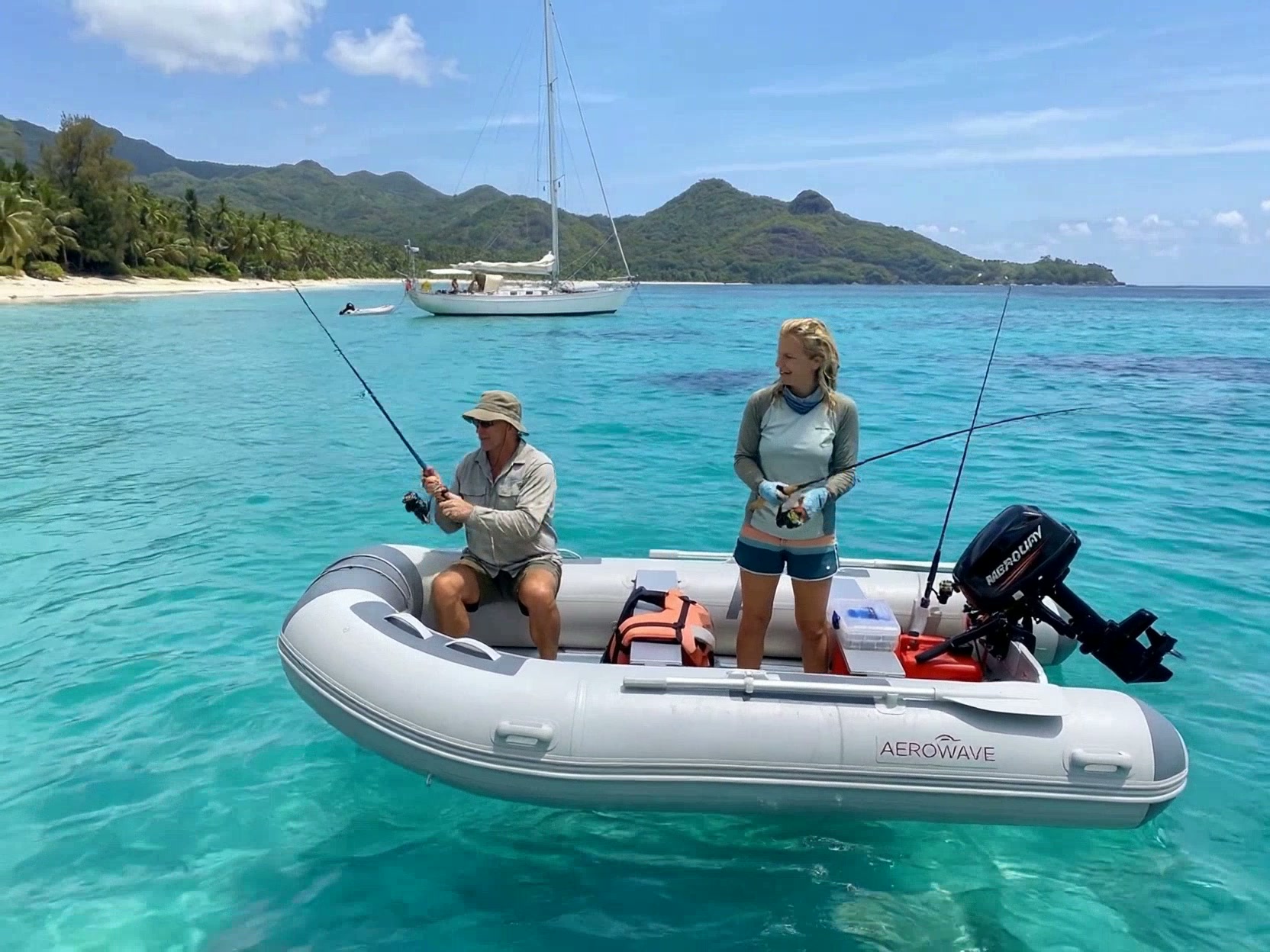
Davit-Mounted Tenders: Weight Limits, Lifting Points and Setup
How to check yacht davit weight limits, inflatable tender lifting points, balance and outboard weight before you hang a tender on the stern.
Our recommendation
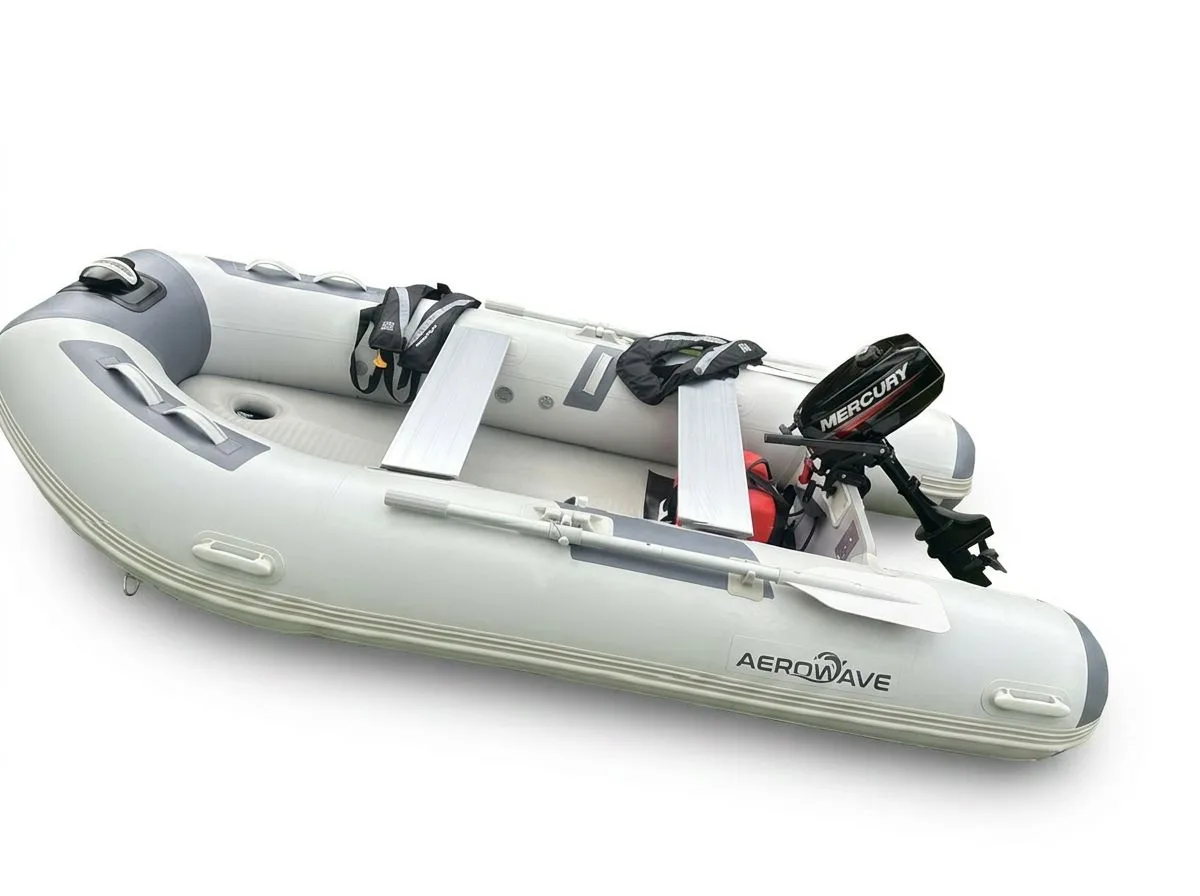
Aerowave Swift Tender 290 SI
Length
290cm / 9'6"
Width
152cm / 4'11"
Tube diameter
42cm
Chambers
3+1
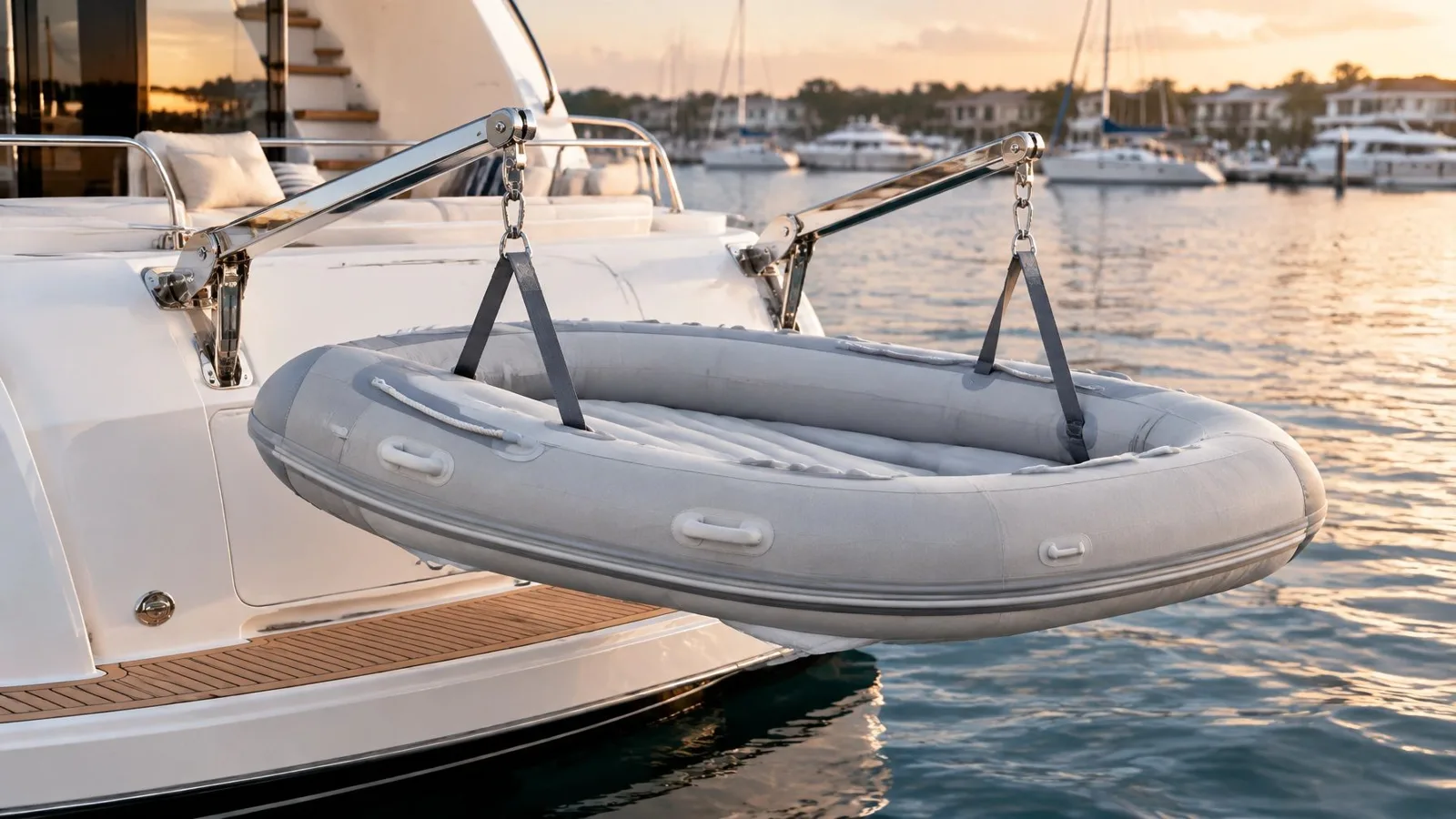
A davit-mounted tender keeps the swim platform clear and makes ship-to-shore trips easier to manage. But a tidy installation is only the beginning. Before lifting, you need to know the complete suspended weight, confirm the davit’s capacity for its actual configuration, and use lifting points designed for the tender.
For a soft-hull inflatable, those details matter. The tubes are buoyancy chambers, not a substitute for reinforced lifting attachments. Here’s what to check before choosing a davit tender or hoisting one aboard.
Safety first: Davit and tender manufacturers’ instructions take priority. This guide is general information, not an installation or lifting plan. Have the yacht’s mounting structure and the lifting arrangement checked by a qualified marine professional.
How yacht davits work
A davit moves a tender between the water and the yacht’s deck, platform or stowage position. Depending on the installation, it may use a pair of lifting arms, a crane, or a powered hoist and sling arrangement. The lifting line runs through blocks or a winch, allowing the load to be raised and lowered under control.
Systems are commonly operated in one of three ways:
- Manual: A person operates a line, tackle or winch. This can suit a lighter tender, but requires controlled handling and clear communication.
- Electric: An electric winch or hoist does the lifting. It reduces manual effort, but does not change the system’s load rating.
- Hydraulic: A hydraulic crane or davit can offer controlled movement and greater reach. Its capacity still depends on the specific crane, boom extension and operating position.
A capacity figure is not a promise that the davit can lift that weight in every position. Check the rating plate and load chart for the installed system, including any limits at the planned outreach. The yacht’s rail, deck, transom, backing plates and fixings also need to be suitable for the loads.
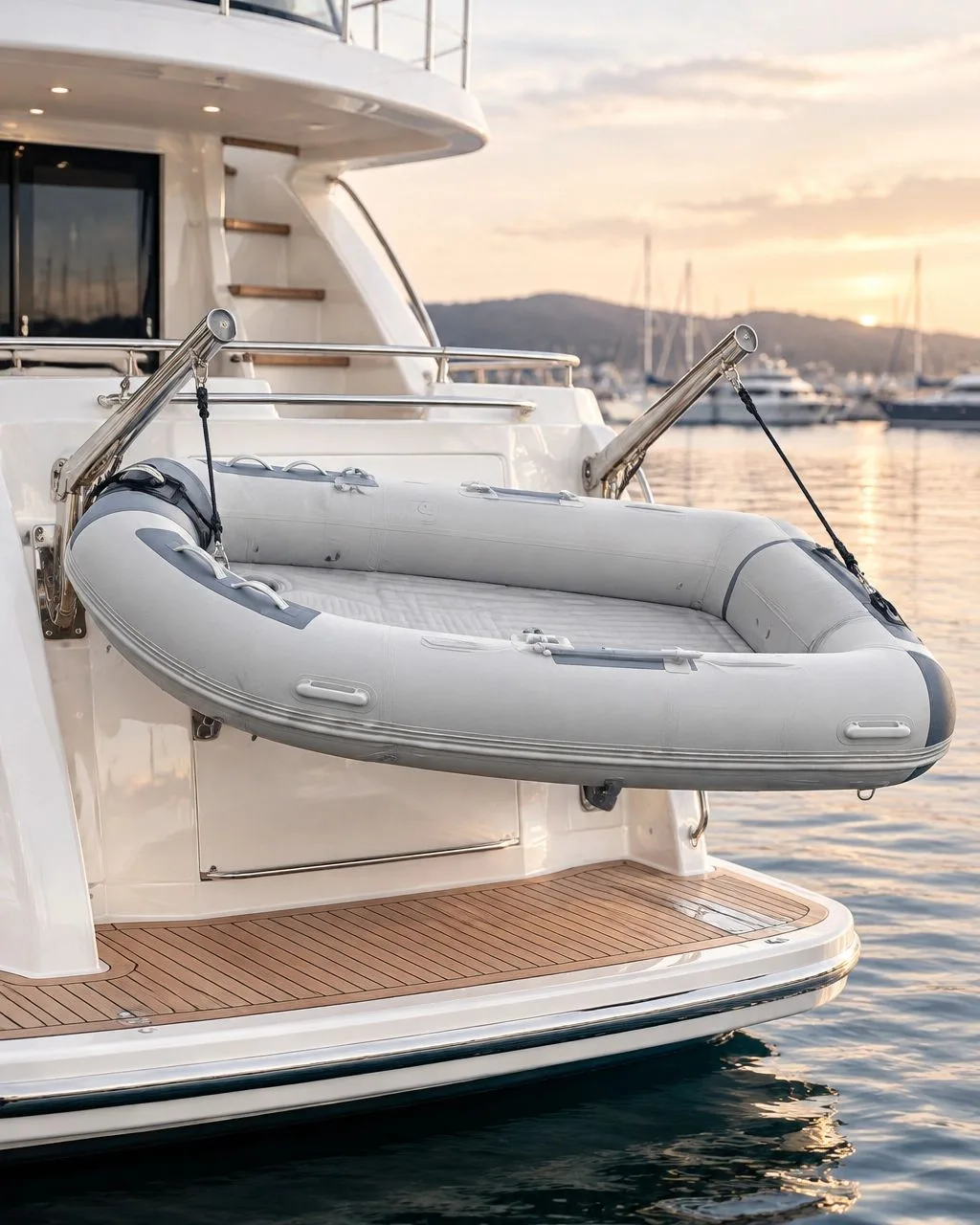
Yacht davit weight limit: calculate the whole load
The relevant figure is the tender’s ready-to-lift weight, not just the advertised hull weight. Add the outboard, fuel and tank, battery, lifting sling or yoke, and any equipment that will remain aboard during the lift. Water trapped in the tender counts too.
Then compare that total with the davit’s rated capacity, taking account of any per-arm limit. With a two-arm system, the load is not necessarily split perfectly in half: the position of the lifting points and the tender’s balance affect how the weight is shared.
For context, published capacities vary between davit models and arms. Installation instructions commonly give separate total and per-arm limits, and tell you to include the boat, motor, fuel tank and miscellaneous gear. Always use the instructions and markings for your actual davit.
A useful pre-purchase calculation is:
Tender hull + outboard + fuel + battery + gear + lifting equipment = suspended load
If you cannot confirm the actual weight, weigh the fully equipped tender or use conservative figures from its manufacturers. Do not assume the hull’s stated net weight includes the engine or accessories.
Tender lifting points on soft-hull inflatables
A soft-hull inflatable must be lifted from its manufacturer-approved attachments. Correctly positioned, reinforced lifting points help transfer the load into the boat’s structure. A convenient handle or ring is not automatically a lifting point.
Davit manufacturers commonly specify low, inboard attachments for an inflatable tender: aft points low on the inside of the transom area, and bow points inside the boat. Some systems give model-specific placement guidance, including positioning bow points back from the bow. Follow the tender and davit manufacturers’ instructions rather than treating any measurement as universal.
Never lift a tender from its floor, removable floorboards, grab handles, oarlocks, or exterior towing rings unless the manufacturer explicitly identifies that fitting for lifting. The soft-hull tender floor is not a structural lifting attachment. Davit makers also warn against lifting from external D-rings that are intended for other purposes.
A RIB is different: it has a rigid hull that may have manufacturer-designed lifting eyes integrated into the structure. Those cannot be assumed to exist, or be appropriate, on a soft-hull inflatable. In either case, use only the lifting arrangement approved for that particular boat.
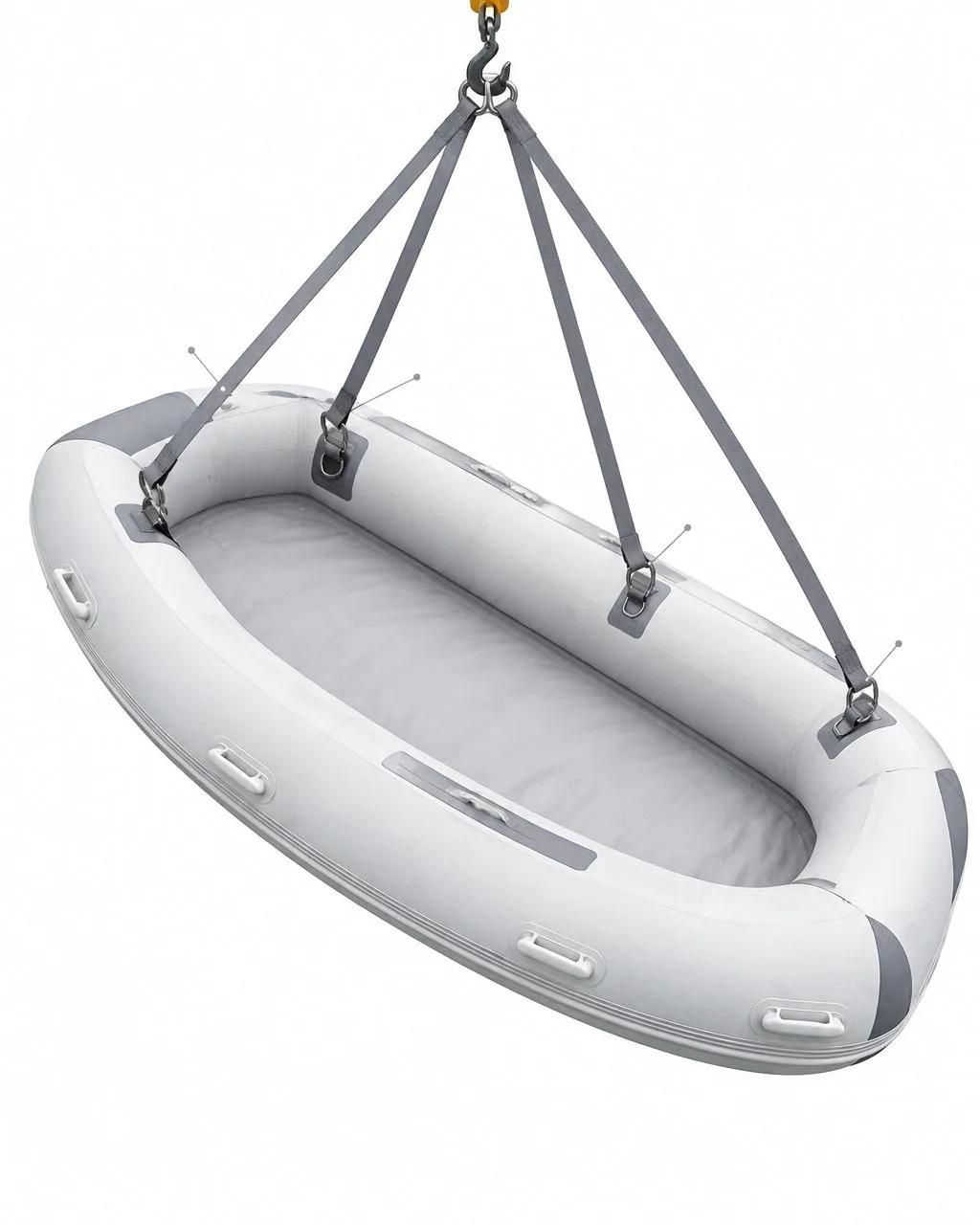
Illustrative only. Attachment points, sling geometry and hardware must match the tender and davit manufacturers’ approved instructions.
Easy Inflatables’ Tender Series manual says that optional davit lifting rings must be bonded to the buoyancy tubes, not the Air Deck floor, and directs owners to request the correct lifting-ring kit. Before ordering, confirm in writing that the model, fittings and proposed davit arrangement are compatible.
Balance and trim when hoisting
A tender should rise evenly and remain level. A bow- or stern-heavy load can place disproportionate force on one attachment point, and a tender that tilts may swing or snag as it clears the water.
Before lifting:
- Remove passengers and loose gear.
- Drain water from the tender and check that no water is pooling inside.
- Remove the drain plug if the tender has one and its instructions call for it during hoisting.
- Stow or secure loose equipment, and make sure the lifting lines are clear.
- Raise the tender only a short distance first. Stop and check its balance, attachment points, davits and yacht structure before continuing.
Keep people clear of the suspended load and the area beneath it. Do not allow the tender to swing freely. Once stowed, secure it using the restraint method specified by the davit maker. A stabilising bar may prevent davit arms from rotating, but may not prevent the tender itself from moving.
What about the outboard?
The outboard can add substantial weight at the stern, where it may also alter trim and reduce clearance. If you intend to hoist with the motor fitted, include its full weight and confirm that the tender, davit, fittings and yacht structure are all approved for that arrangement. Check the motor’s position and clearance throughout the lift.
If the system is not rated for the tender with the engine aboard, or the manufacturer’s instructions require its removal, take the outboard off and secure it separately. Don’t rely on a davit’s headline rating or a visual guess.
Davits, deck stowage or towing?
Davit stowage offers convenient access and keeps the tender ready for short shore transfers. It also exposes the tender to sun and movement, so inspect restraints and contact points regularly. Protective tube chaps may help reduce wear and UV exposure on a davit-stored tender; see Aerowave Tube Chaps.
Deck stowage can be a better choice for a passage when the tender and outboard can be secured appropriately. It takes up deck space, and the yacht’s arrangement must support the load.
Towing can be practical in suitable conditions, but it is not a universal alternative to stowage. Follow the tender and yacht manufacturers’ guidance, and consider weather, sea state and passage conditions.
For rougher passages, check the davit manufacturer’s limits on carrying a tender on the arms. Some instructions caution that pitching and rolling can create dynamic loads beyond those of a static lift.
Is the Swift Tender 290 SI davit-compatible?
The Aerowave Swift Tender 290 SI is a 2.9 m soft-hull inflatable tender with a listed net weight of 52 kg. That figure is the starting point, not the suspended weight with an outboard and equipment aboard.
Davit lifting points belong on the buoyancy tubes, never the Air Deck floor. Talk to us about the correct lifting kit and attachment layout before you buy. Setup takes about 15 minutes once you’re familiar with the process.
Explore the Tender Series, browse accessories, or request a free written quote.
Davit-compatibility checklist before you buy
Before selecting a davit-mounted tender, confirm:
- Dry weight: What is the tender’s stated weight, and what does it exclude?
- Fully equipped load: What will the boat, motor, fuel, battery, gear and lifting equipment weigh together?
- Davit rating: What is the rated capacity in the planned configuration and at the required outreach?
- Per-arm limits: Are there individual arm limits as well as an overall rating?
- Lifting points: Does the tender have manufacturer-approved reinforced lifting points, in the correct positions?
- Beam and clearance: Will the tender fit between the arms and clear the yacht’s platform, rails and fittings?
- Storage plan: Will it be carried on davits, secured on deck or towed for your intended use?
- Outboard handling: Will the motor remain fitted, or be removed and stowed separately?
- Installation: Has a qualified person checked the mounting structure, fasteners and reinforcement?
A compatible setup is more than a tender that happens to fit between two arms. It is a considered match between the fully equipped load, approved lifting points, davit rating and yacht structure, with the boat supported, balanced and restrained as its makers intend.
Frequently asked questions
- How do I work out the weight on my davits?
- Add the tender's net weight, outboard, fuel, battery, safety gear and anything normally left aboard, then compare it with the davit's rated capacity and any per-arm limit.
- What does the Swift Tender 290 SI weigh?
- Its listed net weight is 52 kg. That excludes the outboard, fuel and equipment, which must be added for the suspended weight.
- Where should lifting points go on an inflatable tender?
- On the buoyancy tubes, never the Air Deck floor. Talk to us about the correct lifting kit and layout before purchase.
- Should the outboard stay on the tender on davits?
- Only if the davit rating, balance and the maker's instructions allow it. Removing the motor reduces the suspended load considerably.
- How do I keep a tender level when hoisting?
- Position the lifting points to suit the tender's centre of gravity, including the motor and fuel, and adjust strop lengths so it hangs level and clear of the yacht.
- Davits, deck stowage or towing?
- Davits suit frequent shore trips, deck or locker stowage suits passages and occasional use, and towing suits short sheltered hops only.
Finance this boat from $14/week
Estimate only — powered by Australian Motorcycle & Marine Finance (AMMF).
Paid upfront (AUD)
$320
10% of price
Term
5 years
60 monthly repayments
Comparison rate
9.95% p.a.
Subject to AMMF approval
Weekly
$14
Monthly
$61
Amount financed
$2,879
Indicative only. Actual repayments depend on your AMMF credit assessment, term, fees and the balloon you select. Talk to AMMF for a personalised quote on Aerowave Swift Tender 290 SI.
Like this guide? Get the next one in your inbox.
Owner-tested tips and Aussie boating know-how — no spam.
Ready when you are
Build your Swift Tender 290 SI in under 3 minutes.
1500 GSM / 1.2 mm VALMEX® hull. Five-year limited hull warranty. Free freight to United States · taxes included, nothing to pay on arrival.
delivered to your door
See it for yourself
Real boats. Real owners. Real people behind them.
Plenty of what you read online these days is generated. Check us out properly — the factory, the reviews and the owners are all one click away. Why we use AI, and how to check we’re real
How our boats are built
Walk the production line: thermo-welded seams, 1.2 mm VALMEX Heavy Plus hulls, over-pressure relief valves on every chamber.
See the buildGoogle Maps reviews
Real Australian owners, five stars, published on our Google Business Profile with the map — read them there, not just on our own site.
Open Google Maps reviewsOwner stories
Boats in use — offshore, on rivers, on rescue duty. Photos and words from the people who actually own them.
Read owner stories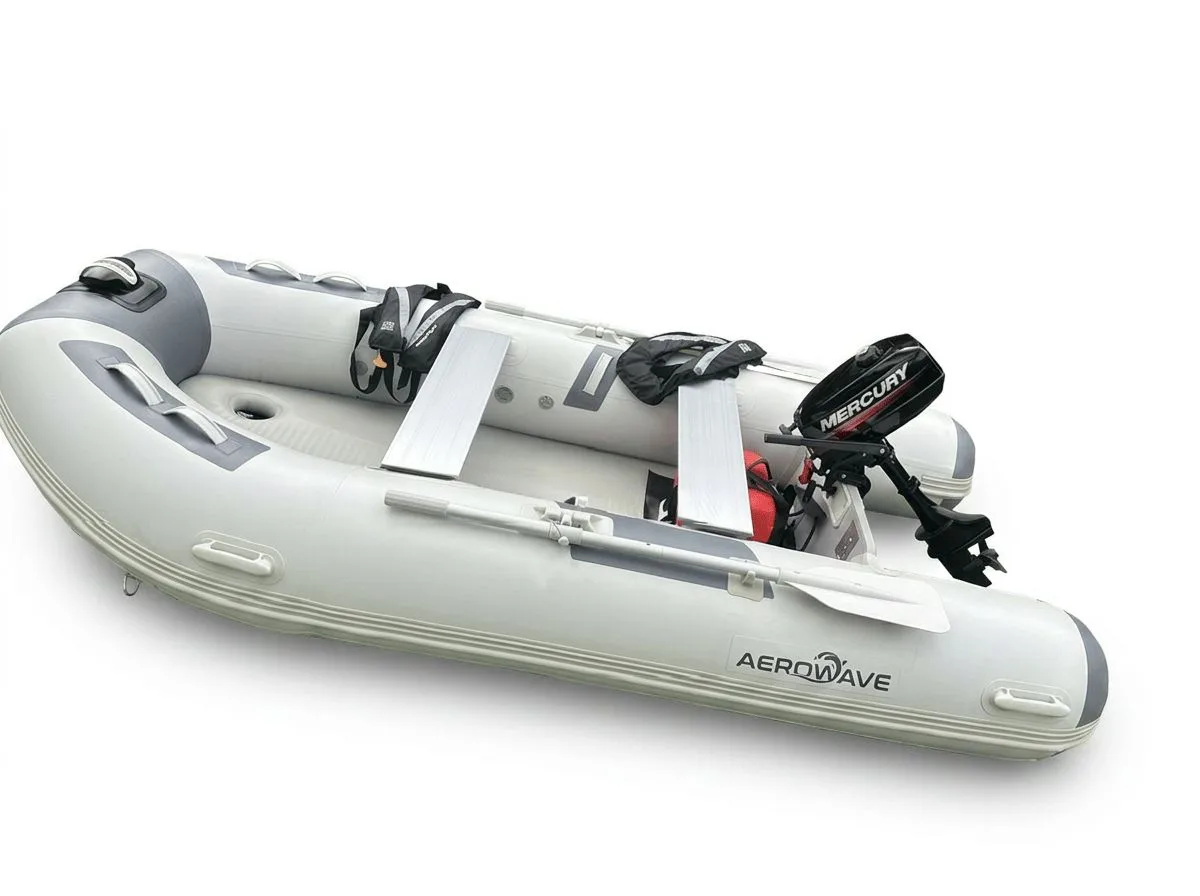
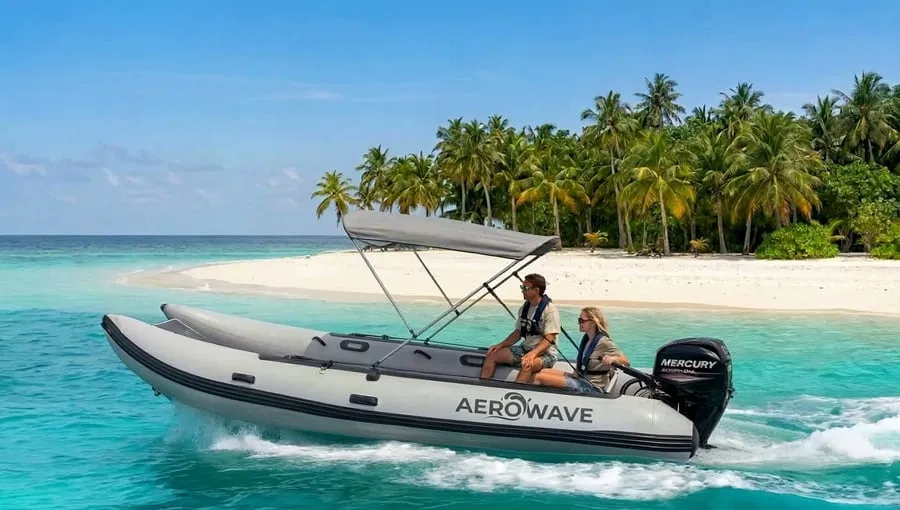
Aerowave Swift Tender 290 SI
US$2,279 USD · delivered to your door