Buying an Inflatable Boat in Australia: 10 Questions to Ask Before You Pay
Your definitive guide to buying an inflatable boat in Australia. Learn the critical questions to ask about fabric, warranties, and hidden costs to make a smart, long-term investment in your boating lifestyle.
At a glance
Your definitive guide to buying an inflatable boat in Australia. Learn the critical questions to ask about fabric, warranties, and hidden costs to make a smart, long-term investment in your boating lifestyle.
- 1. What Is This Boat Actually Made From?
- Fabric Thickness and Density (GSM)
- 2. How Are the Seams Joined?
- 3. What's the Real Story with the Warranty?
What we'd put you in
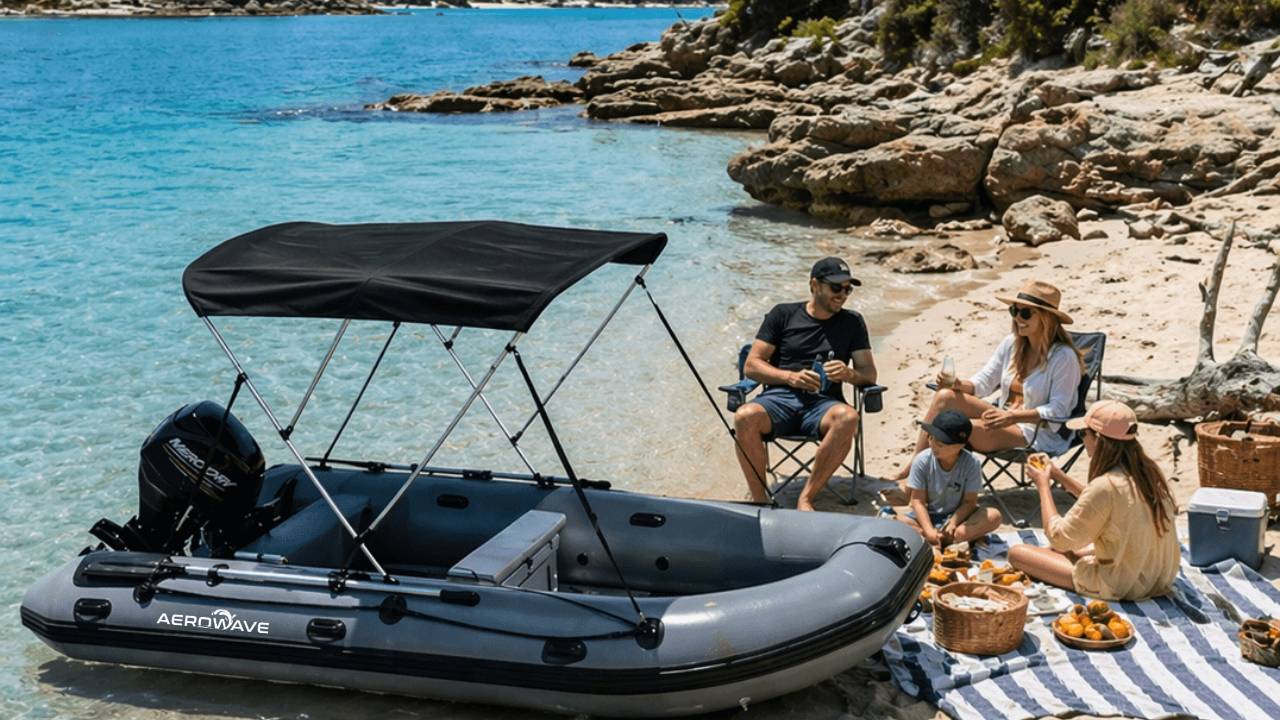
Aerowave Viper 400 Sovereign
Our best-selling boat: 4.0 m, 1.2 mm VALMEX hull, 7-year hull warranty.
US$3,167 USD
Delivered to your door, today's rate
- Free freight to United States · local taxes payable on arrival
- 7-year hull warranty
🇺🇸 Shipping to United States · landed price quoted in writing
Yes — we ship the Aerowave Viper 400 Sovereign to United States. Here's the landed price.
Our best-selling boat: 4.0 m, 1.2 mm VALMEX hull, 7-year hull warranty.
Written for Australian readers — but the boat ships to you. We are an Australian builder and this article is written from Australian waters. That changes nothing about what you can order: the same hull, the same 7-year warranty and the same certification go out to United States every week.
Aerowave Viper 400 Sovereign
- Boat package (export price)
- US$3,726
- 15% tariff relief credit
- − US$559
- Express air freight to United States
- Included
- Import duty, taxes & customs clearance
- Payable on arrival
- Estimated landed, USD
- US$3,167
Indicative, converted at today's rate, before local duty and tax on arrival. Ask below and we'll put a fixed figure in writing, valid 30 days.
- 7-year hull warranty
- 1500 GSM / 1.2 mm VALMEX® Heavy Plus hull
- CE certified to ISO 6185-3 and EU Directive 2013/53/EU
- Door-to-door, tracked the whole way
Your price, delivered to your door — freight included.
We email the full PDF quote (spec, freight, finance, WavePay) to your inbox in under 60 seconds. No spam — one quote, one follow-up.
See it for yourself
Real boats. Real owners. Real people behind them.
Plenty of what you read online these days is generated. Check us out properly — the factory, the reviews and the owners are all one click away. Why we use AI, and how to check we’re real
How our boats are built
Walk the production line: thermo-welded seams, 1.2 mm VALMEX Heavy Plus hulls, over-pressure relief valves on every chamber.
See the buildGoogle Maps reviews
Real Australian owners, five stars, published on our Google Business Profile with the map — read them there, not just on our own site.
Open Google Maps reviewsOwner stories
Boats in use — offshore, on rivers, on rescue duty. Photos and words from the people who actually own them.
Read owner storiesGetting your first boat should be a moment of pure excitement, not a minefield of hidden costs and buyer's remorse.
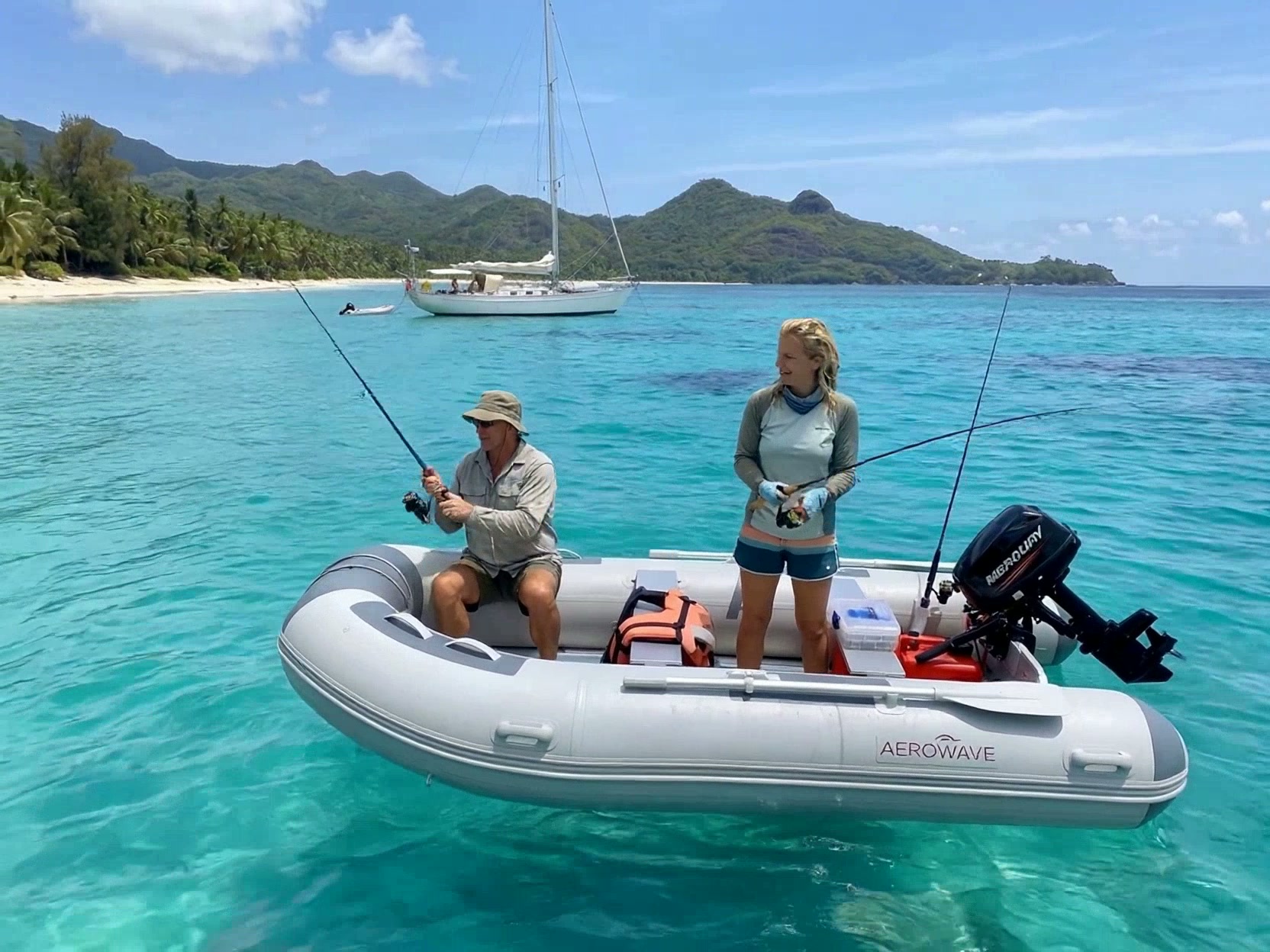
There's a unique freedom that comes with owning a boat in Australia. It’s the ability to escape the crowds, discover a secluded beach for a family picnic, or find that perfect fishing spot just beyond the jetty. For many, an inflatable boat is the perfect key to unlocking these experiences. They're portable, versatile, and surprisingly capable, removing the major barriers of storage, towing, and slip fees that come with rigid-hull alternatives.
However, the growing popularity of inflatables has flooded the market, making the process of buying an inflatable boat in Australia more confusing than ever. A quick search reveals a bewildering array of brands, prices, and claims. The risk for a first-time buyer is accidentally purchasing a low-quality 'boat-shaped object' that disappoints on the water and fails within a few seasons, instead of a trusted vessel that provides years of enjoyment.
This guide is your antidote to that confusion. We've compiled the ten most important questions you need to ask any inflatable boat supplier before you part with your money. Armed with this knowledge, you can cut through the marketing fluff, identify true quality, and invest with confidence.
1. What Is This Boat Actually Made From?
This is, without question, the most important question. The fabric is the boat. Everything else is secondary. You'll primarily encounter two types of materials in the inflatable boat market: PVC (Polyvinyl Chloride) and premium composite fabrics, like German-made VALMEX®.
Many budget imports use basic, single-layer PVC. While it's cheap to produce, it's notoriously susceptible to UV radiation. In the harsh Australian sun, PVC becomes brittle, the plasticisers leach out, and the material can crack and fail in as little as 2-3 years. It's a material best suited for pool toys, not serious marine craft.
In contrast, a premium material like VALMEX® is a multi-layer technical fabric. It’s not just PVC; it's a polyester base scrim coated in specific PVC layers with a final acrylic lacquer for maximum UV and abrasion protection. This sophisticated construction gives it a realistic lifespan of 10 to 12 years, even in demanding environments. It's a professional-grade material trusted in commercial and rescue applications, and it's what we use across our Aerowave range.
Fabric Thickness and Density (GSM)
Don't stop at the material type; ask for the specs. Fabric is measured in thickness (millimetres) and density (grams per square metre, or GSM).
- Thickness (mm): A thicker material generally offers more puncture and abrasion resistance. Look for a minimum of 0.9mm for a quality recreational boat. Our AeroCat models use a robust 0.9mm VALMEX®, which translates to 1100 GSM.
- Density (GSM): This tells you the weight and, by extension, the sheer amount of material used. Higher GSM means a denser, tougher fabric. For heavy-duty applications, you want something even more substantial. Our flagship Aerowave Viper 400, for instance, is built from an incredibly tough 1.2mm VALMEX® Heavy Plus fabric, tipping the scales at 1500 GSM.
When you see a boat advertised at a surprisingly low price, it's often because the manufacturer has used a thin, low-density PVC that simply won't last.
2. How Are the Seams Joined?
A boat is only as strong as its weakest point, and on an inflatable, that's the seams. There are two methods for joining fabric panels: gluing and welding.
Glued Seams: This is the common method for basic PVC boats. An adhesive is applied to bond the overlapping material. The major drawback is that the glue itself degrades over time, especially when exposed to heat and humidity—a constant in the Australian boating climate. A glued seam can literally come apart on a hot day, leading to a catastrophic failure.
Welded Seams: High-quality fabrics like VALMEX® are designed to be welded. This process (either thermo-welding or high-frequency welding) uses heat to fuse the material panels together, creating a permanent chemical bond. A welded seam is actually stronger than the material itself. It doesn't rely on a secondary substance like glue, so it can't degrade or delaminate over time.
For Australian conditions, welded seams are not a luxury; they are a fundamental requirement for safety and longevity. Always ask a supplier: "Are the seams glued or welded?" If they can't give you a clear answer, walk away.
3. What's the Real Story with the Warranty?
A long warranty can look impressive, but the devil is always in the detail. A "10-year warranty" from an unknown overseas seller with no Australian presence is effectively worthless. You need to dig deeper.
Who Backs the Warranty?
Is the warranty provided by an Australian-registered company with an ABN, a local phone number, and a physical address? Or is it a faceless entity on a marketplace platform? If something goes wrong, you need a clear and simple path to resolution. You need to be able to pick up the phone and speak to someone who understands the product and is empowered to help.
At Easy Inflatables, we're a registered Australian business. You can call us on +61 2 4335 1603 or email us at sales@easyinflatables.com.au. We stand behind our products because our reputation depends on it.
What Does It Actually Cover?
Read the fine print. Many warranties are limited to "manufacturing defects" on the seams only, and for a very short period. They often exclude the fabric itself, especially damage from UV exposure, which is the number one killer of inflatable boats in Australia.
A confident supplier who uses premium materials will offer a comprehensive warranty that covers both the seams and the fabric against defects and degradation. For example, we offer a 7-year warranty on our premium Viper Sovereign boats and a 5-year warranty on the WaveRunner series. This reflects our confidence in the German VALMEX® fabric and our welded-seam construction.
4. What Is the Total Landed Cost and Delivery Time?
This is a huge trap for first-time buyers. You see a boat online for an attractive price, but that price is often just the beginning of the story. Many other inflatable boat suppliers, particularly those shipping from overseas, leave you to deal with the expensive and complicated logistics.
The seemingly low price doesn't include:
- International Sea Freight: Can cost hundreds or even thousands of dollars and take 2-3 months.
- Port Fees & Handling Charges: A series of charges once the boat arrives in an Australian port.
- Customs Clearance & Duties: Fees for processing your import.
- GST: 10% added to the total value of the boat and the shipping cost.
- Domestic Freight: Getting the boat from the port to your doorstep.
Suddenly, your "bargain" boat costs 50% more than you expected, and you've waited a quarter of a year for it. At Easy Inflatables, we believe in transparent pricing. The price you see on our website—for example, $5,995 for the Viper 400 Sovereign Full Package or $3,480 for the AeroCat 380—is the total price. It includes express courier delivery (via DHL, FedEx, or UPS) direct to your door, anywhere in Australia, typically within 7-10 days. There are no hidden shipping fees, no customs forms to fill out, and no GST surprises. It's the simplest, fastest way to get on the water.
Your Pre-Purchase Delivery Checklist:
Before buying from any supplier, ask these specific questions:
- Is shipping to my postcode included in the price?
- Does the price include GST?
- Who handles customs clearance, and are there any fees I need to pay?
- What is the shipping method (sea freight or air courier)?
- What is the realistic door-to-door delivery timeframe?
5. The Truth About Air Decks and Rigidity
The floor of an inflatable boat is its backbone. It dictates the boat's performance, stability, and overall feel. Most modern, high-quality inflatables use a high-pressure 'air deck'. This floor is made from 'drop-stitch' fabric, which consists of two layers of fabric held together by thousands of fine threads. When inflated, it becomes incredibly rigid.
The key is the pressure. A low-quality air deck might only inflate to 3-5 PSI. This results in a spongy, flexible floor that wastes energy, feels unstable to stand on, and compromises the boat's handling.
A high-quality air deck, like those used in our Aerowave and WaveRunner models, inflates to 8–10 PSI. At this pressure, the floor becomes rock-solid, providing a firm and stable platform that feels akin to a traditional hard floor. You can stand, walk, and cast a fishing line with confidence. This rigidity is essential for getting the boat to plane correctly and for efficient performance. It's the difference between a wobbly pool toy and a serious watercraft.
6. Will My Outboard Motor Fit?
This is a simple but critical technical detail that often trips up new buyers. Outboard motors come in different shaft lengths, primarily "short shaft" (typically 15 inches) and "long shaft" (20 inches). The boat's transom (the rigid board at the back where the motor mounts) must be the correct height for the motor.
Using a short shaft motor on a long shaft transom will cause the propeller to cavitate and perform poorly. Using a long shaft motor on a short shaft transom will create excessive drag and spray.
Almost all portable inflatable boats, including our entire range, are designed with a transom height of around 380mm (15 inches). This is the industry standard for short shaft outboards, like the popular and reliable Hidea 4-stroke range we offer. When buying a boat and motor, whether as a package or separately, always confirm that the transom height matches the motor's required shaft length.
7. Buying an Inflatable Boat in Australia: Catamaran vs. Monohull
When you think of an inflatable, you probably picture a classic V-shaped monohull. This is a great, versatile design, embodied by our WaveRunner 380 ($4,000). However, one of the most significant innovations in portable boats is the inflatable catamaran.
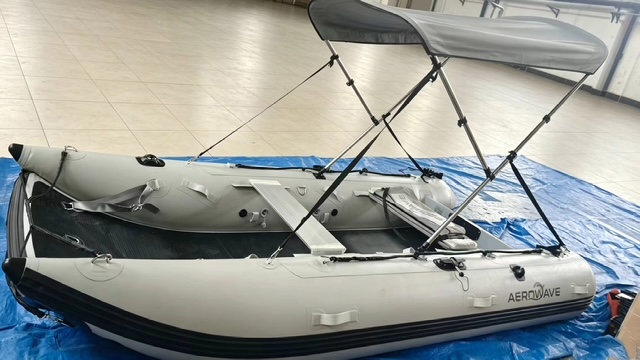
Models like our AeroCat and Aerowave Viper feature two parallel inflatable hulls. This design offers several distinct advantages over a traditional monohull.
Stability and Space
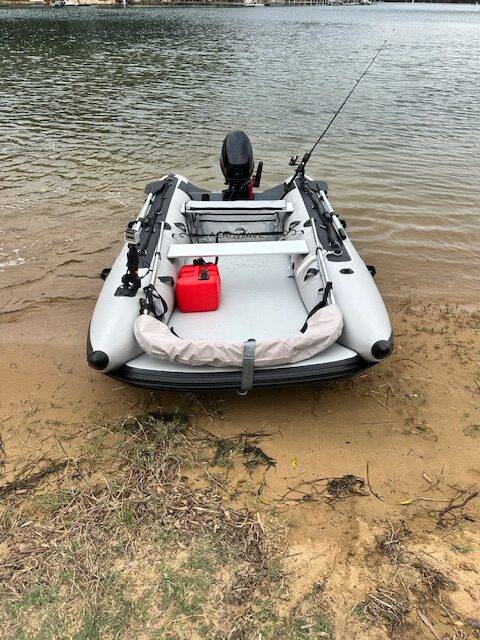
The wide stance of the twin hulls gives inflatable catamarans exceptional lateral stability. They are significantly less 'tippy' when you move around, making them a superior platform for activities like stand-up fishing, pulling cray pots, or having kids and a dog on board. The open-plan design, often with a raised floor between the hulls, also provides more usable, flat deck space compared to a monohull of the same length.
Performance and Efficiency
The tunnel between the two hulls traps a cushion of air as the boat moves forward. This reduces hydrodynamic drag, allowing the boat to get on the plane faster and with less power. This means you can use a smaller, lighter, and more fuel-efficient outboard motor to achieve the same performance. An AeroCat 330 ($2,910) can plane easily with just a 5hp motor and one person, a feat that would be difficult for a comparable monohull.
To help you decide, here’s a comparison:
| Feature | Inflatable Catamaran (e.g., AeroCat/Viper) | Inflatable Monohull (e.g., WaveRunner) | Rigid-Hull Alternative (Tinnie) |
|---|---|---|---|
| Stability | Exceptional | Very Good | Good |
| Portability | Excellent (fits in car boot) | Excellent (fits in car boot) | Poor (requires trailer) |
| Efficiency | Excellent (planes with less power) | Good | Moderate |
| Deck Space | Very Good (open, flat design) | Good | Good |
| Ride Comfort | Excellent (cushions chop) | Good | Harsh (slams in chop) |
| Best Use Case | Fishing, diving, family exploring | Tender, all-rounder, harbour cruising | Fishing, utility |
| Aussie Buying Consideration | The most stable and efficient portable option for exploring diverse waterways. A top choice when buying an inflatable boat Australia-wide. | The classic, versatile portable boat. A perfect tender for a larger vessel. | Durable, but requires storage, a trailer, and a boat ramp. |
8. What About After-Sales Support and Spare Parts?
Your relationship with a boat seller shouldn't end the moment your payment is processed. A boat is a system with various components: valves, oars, seats, repair kits, and more. What happens in two years if you lose a valve cap, damage an oar lock, or need advice on a repair?
If you bought from a faceless marketplace or a generic import company, you'll likely be on your own. They don't carry spare parts and lack the specialist knowledge to provide meaningful support.
Dealing with a dedicated inflatable boat specialist means you have a partner for the life of your boat. A reputable Australian supplier will have a full inventory of spare parts on hand and the expertise to guide you through any maintenance or repair questions. This long-term support is a crucial part of the value proposition when investing in a quality boat.
9. Are There Finance Options Available?
A premium inflatable boat is an investment. Prices for a quality package, like our WaveRunner 380 at $4,000 or the top-tier Viper 400 Sovereign Full Package at $5,995, can be a significant upfront cost.
While some buyers prefer to pay in full, the availability of financing can make a higher-quality boat much more accessible. Spreading the cost over time can allow you to get the better, safer, and more durable boat you really want, rather than settling for a cheaper option that you might regret later.
It's a worthwhile question to ask any seller if this is a factor for you. A professional business will often have partnerships with finance providers to make the purchasing process smoother.
10. The Bottom Line
Buying an inflatable boat is an investment in freedom, fun, and a unique Australian lifestyle. To make that investment a smart one, you need to prioritise quality and transparency. The smartest money is spent on superior materials like German VALMEX®, proven construction techniques like welded seams, and a stable, efficient design like an inflatable catamaran.
Always choose a reputable Australian supplier who is transparent about the total cost, includes fast delivery, backs their product with a genuine local warranty, and is available for support long after the sale. It's the simple difference between buying a boat that could last you a decade or more, and buying a disposable product that ends up in landfill after two seasons. Your time on the water is precious; make sure your boat is up to the task.
If you have more questions, we're here to answer them. Give our team of boating enthusiasts a call on +61 2 4335 1603 or email sales@easyinflatables.com.au. No hard sell, just honest advice to help you get on the water.
Related
Weekend-Proof Score 17 questions · about 2 minutes
Will the boat you're about to buy survive an Australian summer?
Seventeen straight questions about where you'll use it, what you'll ask of it and the boat you're weighing up. You get a score out of 100, the exact weak points in your plan, and the one boat that genuinely fits.
Free · your result shows on screen · no email required
So which one is yours?
Pick how you'll actually use it and we'll take you straight to the right hull.
I want to fish it
Open bow, rod holders, deck space you can stand and cast from.
Viper Sport 400Family, diving and the beach
3.8 m Series 3 catamaran — low bow to climb back in wearing fins or a tank.
WaveRunner 380Tender / one-person launch
3.3 m hard-floor boat that packs into a bag and still takes a beach landing.
Viper 330Shop gear featured in this guide
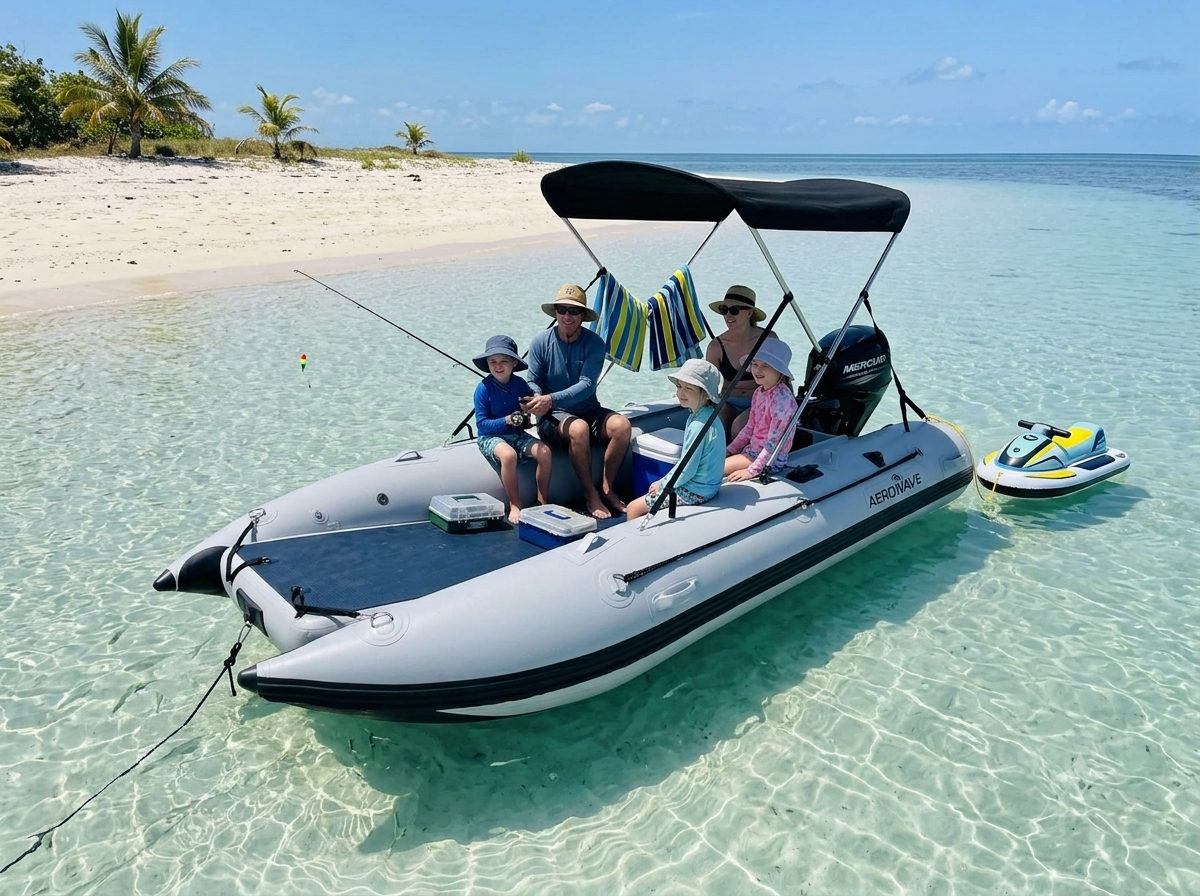
Aerowave WaveRunner 380 Series 3 Catamaran Package
The WaveRunner 380 Series 3 is a premium 3.8m inflatable catamaran package built for Australian and worldwide families, fishing, and coastal day boating — ideal for snorkeling and spearfishing — offering serious stability and premium German Valmex® construction.
Free freight to United States · local taxes payable on arrival
Aerowave Viper 400 Sovereign
Flagship 4m enclosed-bow inflatable catamaran. German VALMEX® 7321 Heavy Plus 1.2mm commercial-grade fabric, 10 PSI high-pressure drop-stitch air deck floor with VALMEX non-slip surface, LockPro wheels, full Bimini and FREE express delivery Australia-wide included. Winter special — save $1,000 until 31 August 2026.
Free freight to United States · local taxes payable on arrival
Aerowave Viper 365 Open Bow
Premium 3.65m Inflatable catamaran — built the same way as our flagship Viper 400 sports boat, just 35cm shorter. German VALMEX® 7321 Heavy Plus 1.2mm commercial-grade fabric, 10 PSI high-pressure drop-stitch air deck floor with VALMEX non-slip surface, LockPro wheels, full Bimini and FREE express delivery Australia-wide included.
Free freight to United States · local taxes payable on arrival
Not sure which suits you? Talk to a real boat owner.
Before you spend a cent
Buying from Australia, delivered to United States
You have never heard of us, we are on the other side of the world, and the internet is full of fakes. Fair enough. Here is everything you would need to check us out, in one place — no forms, no chat bot.
Australian designed business
Easy Inflatables, Avoca Beach NSW 2251. ABN 96 856 548 613. International orders ship from our Hong Kong hub.
222 owner reviews, 4.8 average
Read them in full, good and bad, on our reviews page.
CE certified, 7-year hull warranty
ISO 6185-3 and EU Directive 2013/53/EU. Warranty honoured worldwide.
Tracked, insured, door to door
FREE freight to United States · local tax/duty on arrival.
- Who am I actually buying from?
- Easy Inflatables, Avoca Beach NSW 2251, Australia. ABN 96 856 548 613. Sean is the owner and skipper, Gary Stewart handles sales on +61 2 4335 1603, Karen Matthews handles email. The boats are Australian designed; international orders ship from our Hong Kong dispatch hub so your landed price stays competitive. Phone us before you pay a cent — a real person answers.
- Is this really an Australian product?
- Yes — Australian designed and engineered on the NSW Central Coast. Manufacturing is done offshore to our spec, and international orders ship direct from our Hong Kong dispatch hub. If we routed every boat through Australia first, the freight alone would roughly double or triple your cost for the same hull.
- What do I pay, and what is not included?
- The delivery and import terms depend on your country. EU, UK, New Zealand and named Asia/Pacific lanes include duty and tax; US freight is free but US buyers pay import charges on arrival. Other destinations show their terms before payment.
- How do I pay safely?
- Card through Stripe (Visa, Mastercard, Amex, Apple Pay, Google Pay) or bank transfer. Card payments carry your bank's own dispute protection. We never ask for crypto, gift cards or payment to a personal account.
- What if it arrives damaged?
- Every boat ships fully tracked and insured door to door. Photograph the carton and the boat on arrival and email us — transit damage is claimed and replaced through us, not left with you and the courier.
- Is the warranty real outside Australia?
- Yes. The 7-year hull warranty on 1.2 mm VALMEX Heavy Plus and Orca Hypalon hulls applies wherever you are. Replacement parts are held in Australia and at our overseas hub and go out by express courier to your door.
- Is the boat actually certified?
- All Aerowave catamarans are CE certified to ISO 6185-3 and EU Directive 2013/53/EU. Certification paperwork is supplied with the boat — ask and we will send it before you order.
Frequently asked questions
- How long does a quality inflatable boat last?
- A premium boat made from German VALMEX® fabric, like our Aerowave models, has a realistic lifespan of 10-12 years with proper care. Cheaper PVC boats often only last 2-4 seasons in the harsh Australian sun before the material becomes brittle.
- Do I need to register an inflatable boat in Australia?
- This varies by state. Generally, if you fit a motor of a certain horsepower (e.g., over 4kW or 5hp in NSW), you will need to register the boat. Always check with your local state maritime authority for the most current regulations.
- What size outboard motor do I need for an inflatable?
- This depends on the boat model and your use. Our inflatable catamarans are very efficient and perform brilliantly with smaller 4-stroke outboards. For most of our models, a 6hp to 9.9hp motor is ample, providing excellent performance and fuel economy.
- Can I transport an inflatable boat on a roof rack?
- Absolutely. While our boats pack down into bags that fit in a car boot, you can also transport them fully or partially inflated on a suitable roof rack. This can save setup time at the boat ramp if you're making frequent short trips.
- How difficult is it to patch a puncture?
- Patching a high-quality VALMEX® boat is straightforward and creates a permanent, reliable repair. We provide a comprehensive repair kit and instructions. The key is proper surface preparation and using the correct two-part adhesive designed for the fabric.
- What is VALMEX® fabric?
- VALMEX® is a premium, multi-layer composite material engineered in Germany. It features a strong polyester base fabric coated with specialised PVC layers and a protective acrylic finish. It is world-renowned for its extreme durability, UV resistance, and air tightness, making it the gold standard for high-quality inflatable boats.
- How long does delivery take for an Easy Inflatables boat?
- We include express courier delivery with all boat purchases at no extra cost. Your new boat will arrive at your door anywhere in Australia within 7-10 days, with no hidden charges for shipping or GST.
Ready to set sail?
Premium German-fabric inflatable catamarans, built to order and delivered to your door. Talk to our team or browse the fleet.
Like this guide? Get the next one in your inbox.
Owner-tested tips, gear deep-dives and Aussie boating know-how — no spam.