Marine Boat Stereo Systems: A Buyer's Guide for 2026
A lot of inflatable boat owners reach the same point. The boat is sorted, the outboard is reliable, the Bimini is doing its job, and the family day on the water already feels good. Then you realise one upgrade would make…
At a glance
A lot of inflatable boat owners reach the same point. The boat is sorted, the outboard is reliable, the Bimini is doing its job, and the family day on the water already feels good. Then you realise one upgrade would make…
- Setting the Scene for Your On-Water Soundtrack
- Why small-boat audio needs a different mindset
- What owners usually get wrong
- The Core Components of a Marine Audio System
What we'd put you in
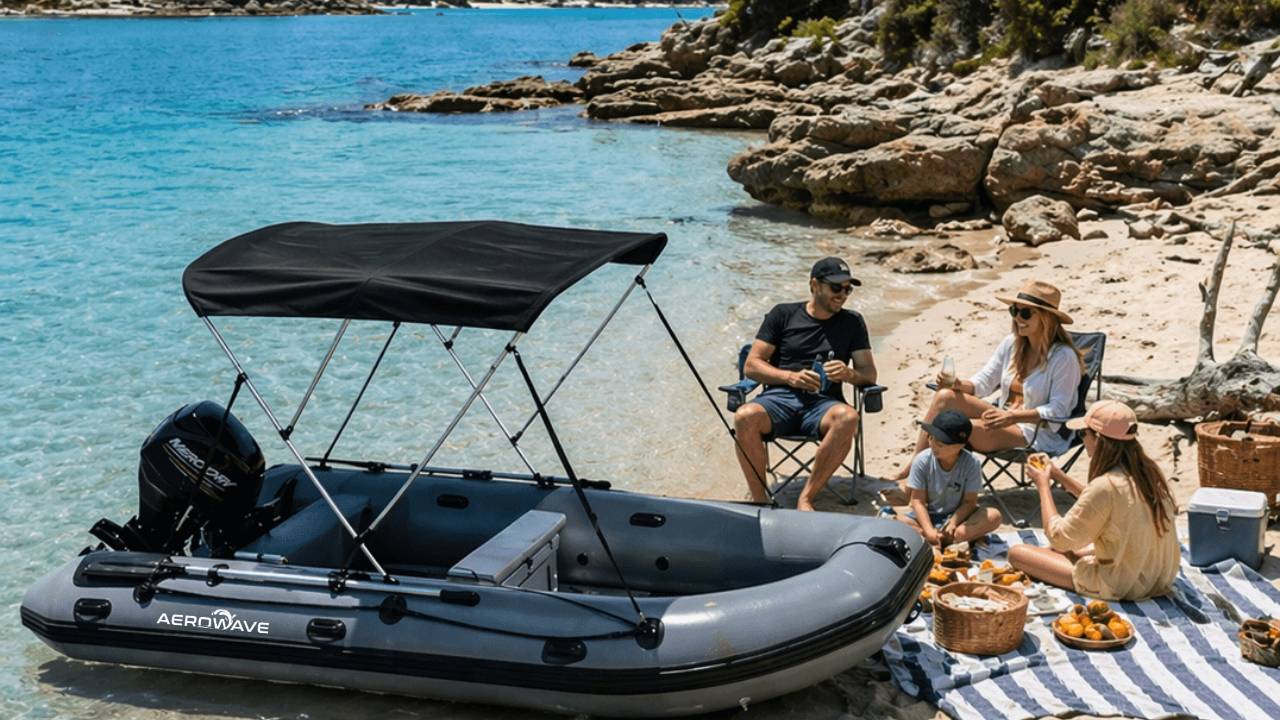
Aerowave Viper 400 Sovereign
Our best-selling boat: 4.0 m, 1.2 mm VALMEX hull, 7-year hull warranty.
US$3,167 USD
Delivered to your door, today's rate
- Free freight to United States · local taxes payable on arrival
- 7-year hull warranty
🇺🇸 Shipping to United States · landed price quoted in writing
Yes — we ship the Aerowave Viper 400 Sovereign to United States. Here's the landed price.
Our best-selling boat: 4.0 m, 1.2 mm VALMEX hull, 7-year hull warranty.
Aerowave Viper 400 Sovereign
- Boat package (export price)
- US$3,726
- 15% tariff relief credit
- − US$559
- Express air freight to United States
- Included
- Import duty, taxes & customs clearance
- Payable on arrival
- Estimated landed, USD
- US$3,167
Indicative, converted at today's rate, before local duty and tax on arrival. Ask below and we'll put a fixed figure in writing, valid 30 days.
- 7-year hull warranty
- 1500 GSM / 1.2 mm VALMEX® Heavy Plus hull
- CE certified to ISO 6185-3 and EU Directive 2013/53/EU
- Door-to-door, tracked the whole way
Your price, delivered to your door — freight included.
We email the full PDF quote (spec, freight, finance, WavePay) to your inbox in under 60 seconds. No spam — one quote, one follow-up.
See it for yourself
Real boats. Real owners. Real people behind them.
Plenty of what you read online these days is generated. Check us out properly — the factory, the reviews and the owners are all one click away. Why we use AI, and how to check we’re real
How our boats are built
Walk the production line: thermo-welded seams, 1.2 mm VALMEX Heavy Plus hulls, over-pressure relief valves on every chamber.
See the buildGoogle Maps reviews
Real Australian owners, five stars, published on our Google Business Profile with the map — read them there, not just on our own site.
Open Google Maps reviewsOwner stories
Boats in use — offshore, on rivers, on rescue duty. Photos and words from the people who actually own them.
Read owner storiesA lot of inflatable boat owners reach the same point. The boat is sorted, the outboard is reliable, the Bimini is doing its job, and the family day on the water already feels good. Then you realise one upgrade would make the whole setup feel more complete. Clean, reliable music that survives spray, sun, beach launches, and daily pack-down.
That matters more in Australia than many people think. The recreational boating sector generated approximately AUD 15.3 billion in 2022-23, and marine audio adoption has risen by an estimated 25% annually since 2020 across the nation’s 600,000+ registered recreational vessels, driven by family outings and coastal adventures, according to this market report on marine stereo systems in Australia.
On a portable tender, RIB, or inflatable catamaran, the stereo decision is different from a fibreglass runabout. Space is tighter. Battery reserve matters more. Mounting options are limited. A bad install can turn a neat boat into a rattly tangle of cable and brackets.
Good marine boat stereo systems solve those problems without making the boat harder to launch, harder to clean, or harder to enjoy. The right setup gives you background music at anchor, clear sound during a slow troll, and enough output to cut through wind and engine noise on the run home. Even the small details help the atmosphere. Owners who like to personalise the look of their rig often add practical visual touches as well, such as a Lake Life Pontoon Boat decal for an esky, gear box, or tender accessory panel.
If you are still weighing up whether a portable boat suits your boating style at all, this breakdown of the benefits of buying an inflatable boat is a useful starting point before you commit to accessories and electronics.
Setting the Scene for Your On-Water Soundtrack
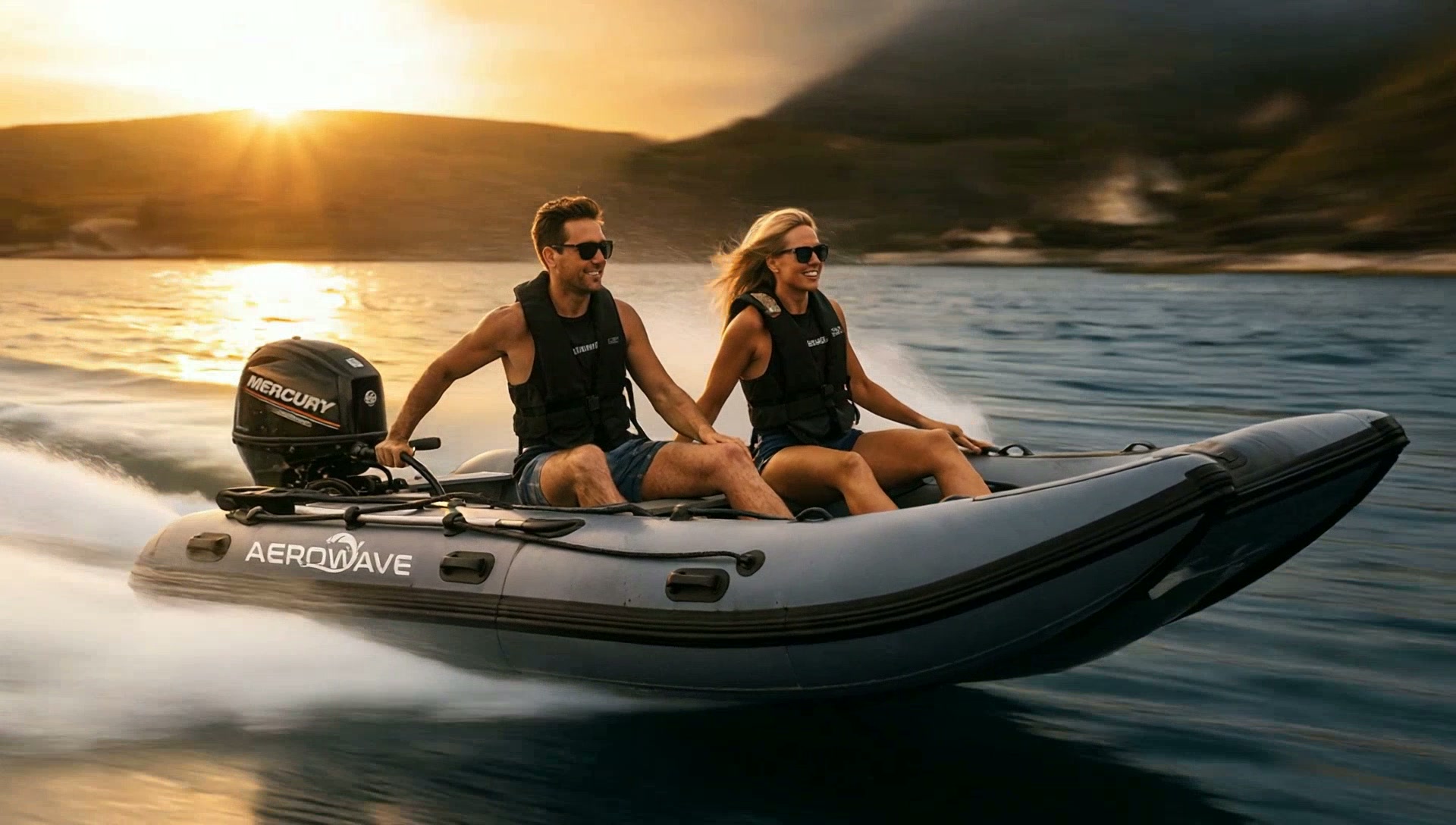
A family heads out on a calm bay in a small inflatable. The kids are settled. Someone is sorting snacks. The skipper is not chasing nightclub volume. They just want music that stays clear while moving between the ramp, the beach, and a quiet anchorage.
That is the primary use case for most small-boat audio. Not tower speakers, not oversized sub boxes, not a complex helm full of gear. Just a compact system that works every trip.
On inflatables, sound is part of comfort. It changes the feel of a beach lunch, a slow cruise along the shoreline, or an early morning run before the fishing starts. It also has to live with practical limits that bigger boats can hide with locker space and larger battery banks.
Why small-boat audio needs a different mindset
Inflatables ask more from every component. A receiver cannot just sound good. It has to resist spray. Speakers cannot just be loud. They need to hold up under UV and salt. Wiring has to stay tidy and protected because there are fewer cavities to hide mistakes.
The upside is simple. Small boats respond well to simple systems.
A compact stereo that is installed neatly and powered properly will usually outperform an oversized system that drains the battery and gets in the way.
What owners usually get wrong
The most common mistake is buying by headline power alone. On an inflatable, that often leads to bulky gear, poor mounting choices, and disappointing real-world sound.
The second mistake is treating the boat like a car. Open air changes everything. Wind and engine noise do not care what the box says on the shelf. Sensible component matching matters more.
The Core Components of a Marine Audio System
Marine boat stereo systems are easier to choose once you strip them back to five parts. Think of the setup as a chain. If one link is weak, the whole system feels average.
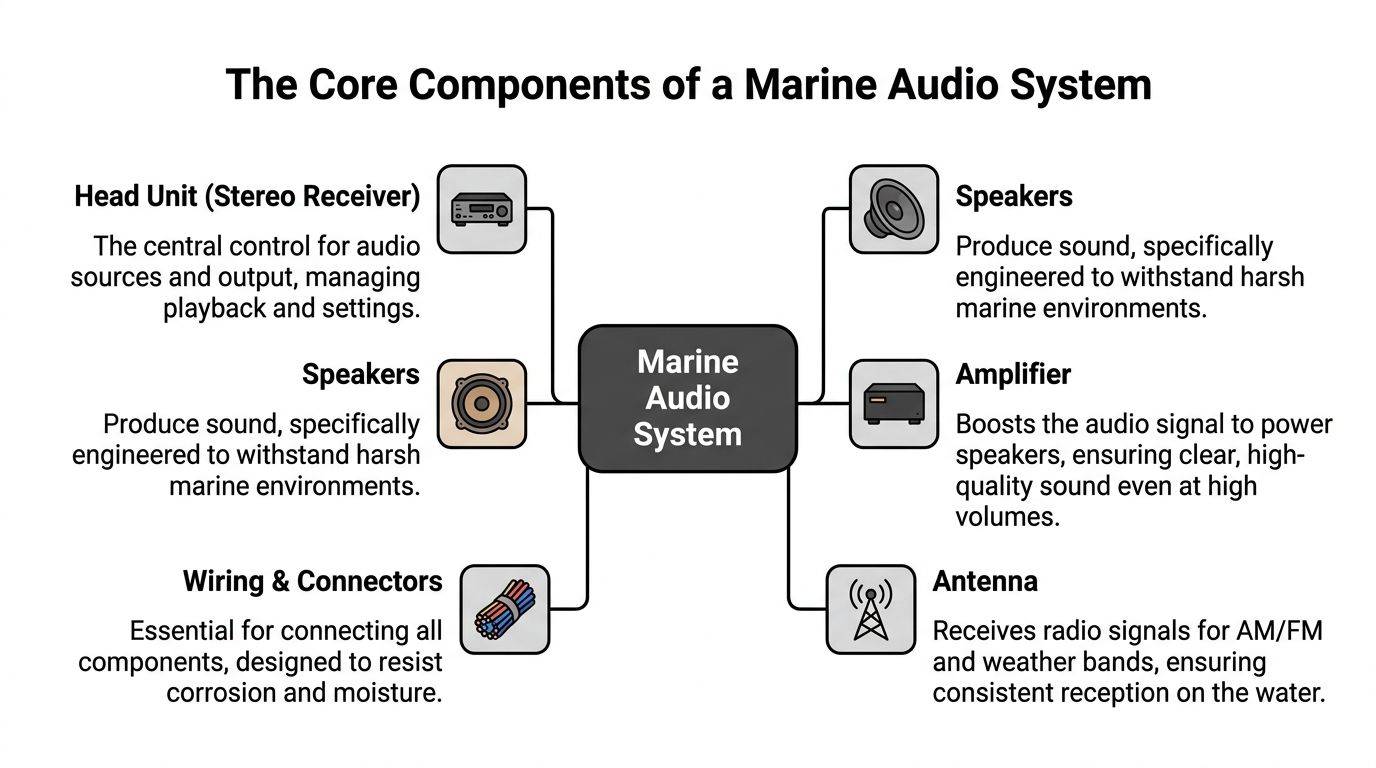
The head unit
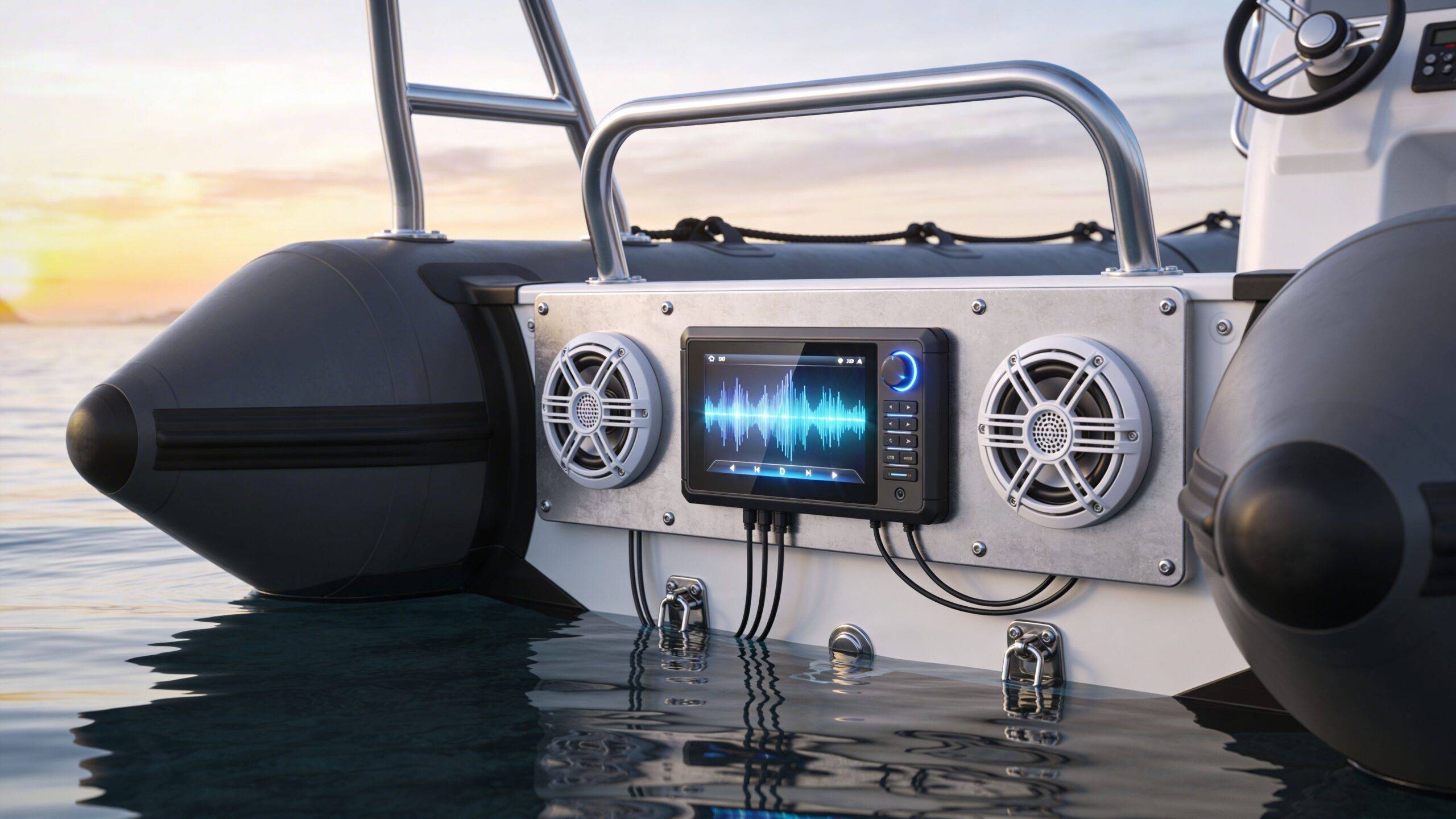
The head unit, also called the marine receiver, is the control centre. It handles source selection, Bluetooth pairing, volume, and zone control if your system supports it.
For small inflatables, compact digital media receivers make more sense than bulky old-style units. They take less room, keep the dash or console cleaner, and remove parts you are unlikely to use on the water.
What matters most:
- Marine sealing: The face and controls need to cope with spray and wash-down.
- Readable display: You want a screen you can see in daylight.
- Simple controls: Big buttons beat fiddly menus when the boat is moving.
- Built-in amplification: On many inflatables, this is enough on its own.
The speakers
Speakers do the hard work. On a small open boat, they must project clearly across wind, wave noise, and engine note.
Marine speakers are not just normal speakers with a different badge. The good ones use materials that resist sun exposure, corrosion, and moisture. That matters in Australian conditions, where a clean-looking speaker can still fail early if the internal parts are not protected.
A practical speaker choice starts with these questions:
| Question | Why it matters on an inflatable |
|---|---|
| Where will it mount | Tubes, consoles, seat boxes, and transoms all limit size and angle |
| How exposed is it | More exposure means more importance on sealing and corrosion resistance |
| How efficient is it | Efficient speakers sound better with modest power |
| How easy is replacement | Portable boats benefit from gear that is simple to service |
The amplifier
An amplifier adds output and control. It is the muscle in the system.
On a larger boat, an amp is often an obvious choice. On a compact inflatable, it is optional. Extra gear means extra weight, extra wiring, extra current draw, and one more item to mount somewhere sensible.
That is why many owners are better served by a strong receiver and efficient speakers first. If the system still needs more volume or better headroom, a compact marine amp becomes the next step.
Add an amplifier to fix a real shortfall in sound. Do not add one because a generic boat-audio guide says every system needs it.
Wiring and connectors
Wiring rarely gets attention until it causes trouble. On inflatables, bad wiring shows up fast. Corrosion, loose joints, poor routing, and unprotected connections are what turn a good system into an unreliable one.
Use marine-grade cable, proper terminals, and sealed joins. Keep runs tidy and supported. A neat loom is not cosmetic. It prevents chafe, vibration damage, and maddening intermittent faults.
If you are also reviewing power options, this guide to a marine battery and charger is worth reading before you finalise current draw and charging habits.
The antenna
Many small-boat owners stream audio and ignore radio until the day they want local reception offshore or around the harbour. If radio matters to you, the antenna still deserves thought.
Mount it where it will not foul movement, snag covers, or become one more fragile item to break during transport. Portable boats reward low-drama rigging.
Choosing the Right Gear for Your Inflatable Boat
For most small inflatables, the right audio system is not the biggest one. It is the system that matches the hull, the way you boat, and the way you pack the boat away.
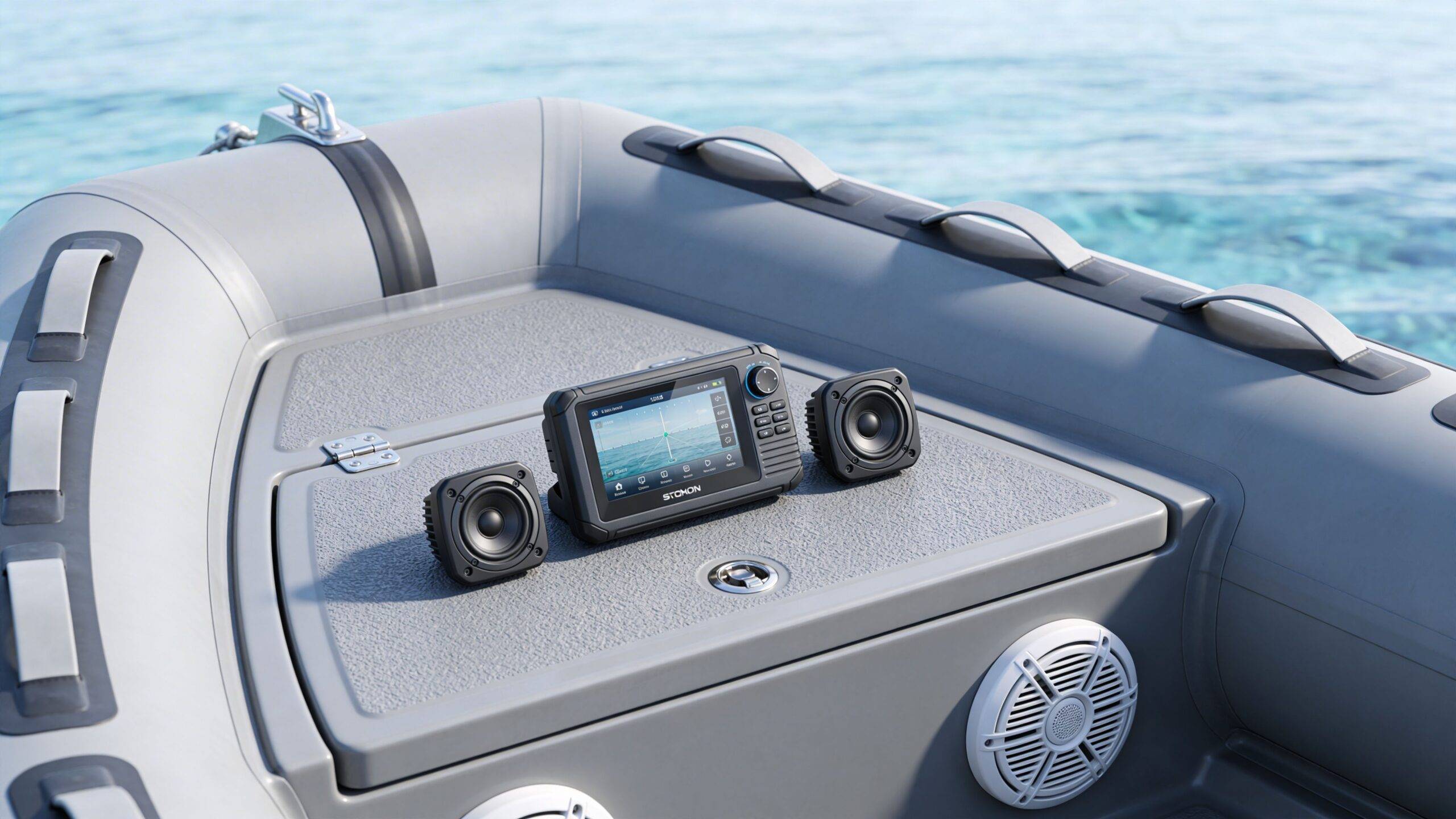
A useful benchmark exists for this category. For small inflatable boats up to 6m, a compact two-speaker system is often optimal, using 6.5-inch speakers with at least 90dB sensitivity and a marine receiver with IP66 certification and 25-28 watts RMS x 4 channels, according to Mr Boats’ guide to marine audio systems.
That one sentence saves many buyers from overbuilding.
Receiver choices that make sense
For inflatables, the best receiver is usually one of two styles.
Compact digital media receiver
This is the cleanest choice for most portable boats. No disc slot. Smaller body. Less wasted space.
It suits owners who stream from a phone, want Bluetooth, and care more about reliability than extra legacy features. It is especially useful if the receiver has to fit into a small console, side box, or transom-mounted pod.
Traditional single-DIN unit
A single-DIN receiver can still work well if your console already suits it. The drawback is packaging. On many inflatables, the extra depth creates more hassle than benefit.
If room is tight, every extra centimetre behind the panel matters.
Speaker style matters more on inflatables
A fibreglass boat often gives you flat panels and cavities. Inflatables usually do not. That changes the speaker conversation immediately.
Flush-mount speakers
These look tidy and integrated when you have a real panel to cut into. A small console, seat box, or custom dash pod can suit them well.
They are a poor match if you are tempted to cut into parts of the boat that should remain simple, strong, and easy to maintain.
Pod or box speakers
These make a lot of sense on inflatables. They can mount to rails, consoles, or brackets without major surgery. They are easier to reposition and easier to remove if the boat is stored in a bag or moved on a trailer.
The compromise is appearance. Some owners prefer the cleaner look of flush mounting. On a practical boat, though, pod speakers often win.
Sensitivity beats brute force
On the water, speaker sensitivity can matter more than chasing raw watt figures. Efficient speakers make better use of modest amplifier power. That is exactly what you want when battery capacity is limited.
A speaker with the right sensitivity and a sensible mounting angle often sounds better than a supposedly more powerful unit that is pointed at your knees or buried in the wrong position.
Many inflatable setups improve quickly with one simple change. Aim the speakers at the listening area, not just at the nearest spare surface.
Do you need an amplifier
Often, no.
Built-in amplification is enough for casual cruising, beach days, and family use if the speakers are efficient and well mounted. This keeps the install lighter, simpler, and easier on the battery.
An external amp becomes worthwhile when:
- You run at speed often: Wind and engine noise make headroom more important.
- You want four speakers: The receiver may struggle to keep clarity once more load is added.
- You care about cleaner output at higher volume: Extra control can matter more than extra loudness.
- You use the boat for fishing and social use: Quiet background audio at anchor and stronger projection underway can benefit from an amp.
A poor reason to add an amplifier is ego. On a tender or small inflatable catamaran, oversized amplification often creates more problems than enjoyment.
Here is a practical comparison.
| Setup style | Best for | Trade-off |
|---|---|---|
| Receiver plus two speakers | Families, tenders, beach use, simple cruising | Limited upgrade headroom |
| Receiver plus four speakers | Larger inflatables with more seating area | More wiring and placement challenges |
| Receiver plus compact amp and speakers | Frequent running, anglers, owners wanting cleaner output | More battery demand and more install complexity |
A good accessory plan helps the whole boat work together. If you are outfitting beyond audio at the same time, these nifty inflatable boat accessories you must have can help you think about layout before holes are drilled and brackets are fixed.
Match the system to the day you typically have
A family tender has different priorities from a fishing RIB.
For family cruising, simple controls and tidy speaker placement matter most. For anglers, the key issue is often low-speed clarity without chewing through battery reserve. For beach campers and travelling owners, removable or compact gear can matter more than ultimate output.
This walkthrough shows the sort of compact setups many owners gravitate toward once they stop trying to copy larger boats.
What works and what does not
What works
- A compact head unit with Bluetooth
- Two quality marine speakers placed with intention
- Sensible current draw
- Mounting that does not interfere with boarding, rod work, or pack-down
What does not
- Giant speaker boxes that steal deck space
- Cheap automotive gear exposed to spray
- Random wire routing along wear points
- Amp-heavy systems on a small battery with no charging plan
Power and Mounting Solutions for Inflatables
Success or failure for most small-boat stereo projects often hinges on this. The audio gear may be good, but if power and mounting are wrong, the owner ends up with flat batteries, loose hardware, or a system that is annoying to live with.
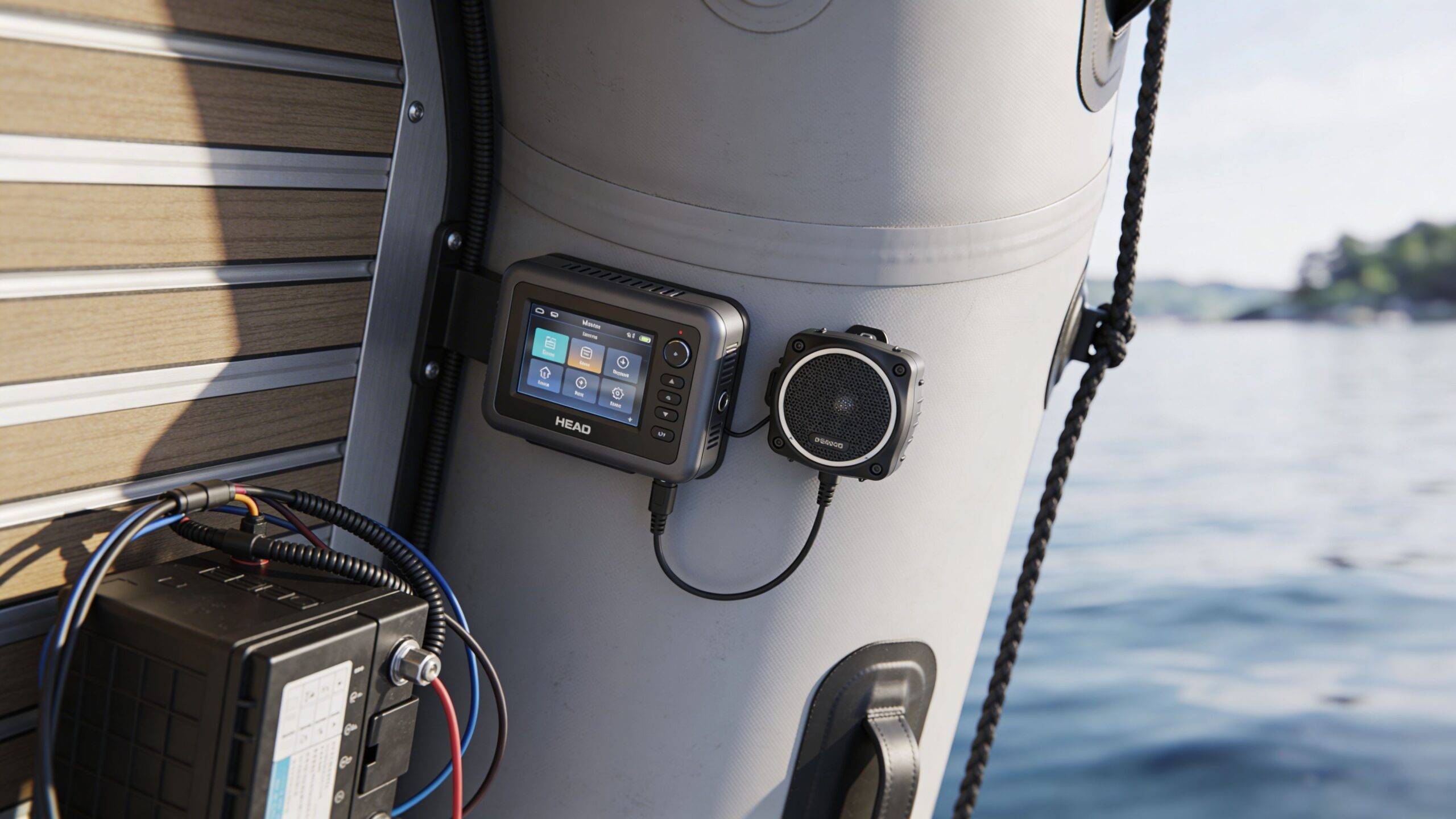
The compliance side matters too. For small vessels, AMSA compliance requires IPX6+ waterproofing and corrosion-resistant grounding, and surveys of inflatable owners in NSW found 35% cited electrical integration failures as a major issue, as noted in this marine audio installation article. That should push every buyer away from shortcuts.
Power choices that suit portable boats
On a trailer boat with heaps of storage, adding battery capacity is easier. On an inflatable, you have to think like a packer.
Three common approaches work.
Dedicated marine battery in a battery box
This is the most balanced option for many owners. A separate battery keeps the stereo load isolated and makes the system easier to service.
It also gives you one contained unit to secure, remove, and recharge. That is useful for people who store the boat in a garage or transport it in an SUV.
If you need a practical enclosure, a proper battery box for marine use is far better than improvising with loose straps and exposed terminals.
Shared 12V source
Some owners tap into an existing boat circuit or battery already supporting other gear. It can work, but the system has to be fused correctly and planned carefully.
This approach is less forgiving on portable inflatables because one battery may already have multiple jobs.
Portable power station
This suits some low-draw setups, especially where owners want easy removal and no permanent electrical system. The drawback is fitment, charging routine, and making sure the outputs and connectors are appropriate for marine use.
Mounting on an inflatable without making a mess
Inflatables punish lazy mounting. There is less dead space to hide bulky boxes and fewer places where a bad bracket can go unnoticed.
Good mounting starts with the actual structure available.
Use the aluminium transom intelligently
An aluminium transom is a strong, useful anchor point for selected components or brackets. It often makes more sense than trying to hang everything off softer or more exposed areas.
That does not mean loading it up with every item you bought. Keep weight balanced. Keep controls accessible. Keep cables protected where they pass through or around edges.
Small consoles solve a lot of problems
A compact console or equipment pod creates order fast. It gives the receiver a proper home, keeps the front of the boat uncluttered, and allows cleaner cable runs to speakers and battery.
On a practical inflatable, a small console can do more than improve appearance. It centralises electronics and makes the entire system easier to remove, inspect, and maintain.
Rail and bracket mounts are often better than cutting
Many inflatable owners get better long-term results from clamp, rail, or bracket-mounted speakers than from trying to force flush-mount hardware into a layout that does not suit it.
That is especially true for:
- Portable family boats: Easy removal matters.
- Fishing setups: Rod access and movement paths must stay clear.
- Boat-in-a-bag users: Anything protruding or fragile becomes a transport issue.
If a mounting idea looks great in the shed but makes beach launching, folding, or cleaning harder, it is the wrong idea for an inflatable.
Wiring needs a plan before anything gets fixed
Inflatables have fewer hidden runs, so every wire route should be chosen on purpose. Follow existing lines where possible. Support cable so it cannot flap, chafe, or sit in pooled water. Leave enough slack for movement, but not enough to snag feet or gear.
A clean inflatable install usually shares these traits:
| Good practice | Why it helps |
|---|---|
| Wires follow existing structural lines | Less clutter and lower snag risk |
| Connections are sealed | Better resistance to salt and spray |
| Fusing is close to the power source | Better protection if a fault occurs |
| Equipment can be reached without disassembly | Easier fault-finding and maintenance |
Keep the stereo in proportion to the boat
This is the core synthesis point. On inflatables, power choice, mounting style, and equipment size are not separate decisions. They are one decision.
A compact receiver, efficient speakers, a protected battery source, and mounts that respect the boat’s portability usually produce the best owner experience. The system sounds good, survives longer, and does not compromise the very reason people buy an inflatable in the first place.
Installation Overview and Essential Maintenance
A clean install is mostly won before the first hole is drilled. Owners get into trouble when they mount first and think later.
Start with layout, not tools
Set every component in place without fixing anything. Sit in the boat. Move around it. Open hatches or bags. Check where feet land, where rods move, where the phone sits while charging, and where water is likely to run.
If the receiver is hard to see, the speakers fire into the wrong area, or the battery box blocks movement, change the plan now.
Build the wiring around reliability
Use marine-grade wire and sealed connectors. On a small boat, there is nowhere for poor workmanship to hide for long.
The basic sequence is straightforward:
- Position the power source where it stays secure and dry enough for the conditions.
- Run fused power first so the main circuit is protected from the start.
- Route speaker cable cleanly along protected paths.
- Make sealed terminations and support them so vibration does not work them loose.
- Test before final fastening so faults are easy to trace.
Treat every connection like it will see salt
Because it will.
Salt, spray, and humidity attack the tiny points first. A stereo can appear fine from the outside while the trouble is building inside a terminal, fuse holder, or grounding point.
The neatest-looking install is not always the best one. The best one is the install you can inspect, service, and trust after repeated wash-downs and beach launches.
A simple maintenance routine prevents expensive failures
Marine boat stereo systems last longer when owners do small jobs regularly instead of one major fix after a failure.
Use this checklist after outings and during storage periods:
- Freshwater rinse exposed gear: Remove salt residue from speaker grilles, housings, and nearby brackets.
- Inspect terminals and fuse holders: Look for early corrosion, discolouration, or looseness.
- Check cable support points: Vibration can wear insulation where ties or clips sit.
- Protect contacts with suitable marine products: This helps reduce corrosion at vulnerable points.
- Cover or remove exposed electronics when practical: Portable boats benefit from gear that can be shielded between trips.
If the boat itself needs attention too, this guide to inflatable boat maintenance made simple is a useful companion read because audio longevity often depends on the same habits that protect the rest of the rig.
Know when to stop and call a marine electrician
A high-level install is manageable for many owners. A complicated electrical layout, multiple charging sources, or a system with expanded accessories can justify professional help.
That is not a failure. It is often the smarter decision if the boat is used often, stored outdoors, or expected to remain trouble-free through regular saltwater use.
Your Marine Stereo Checklist and Easy Inflatables Pairings
The best buying decisions for marine boat stereo systems come from restraint. Buy the system your inflatable can support well, not the one that looks most impressive on a shelf tag.
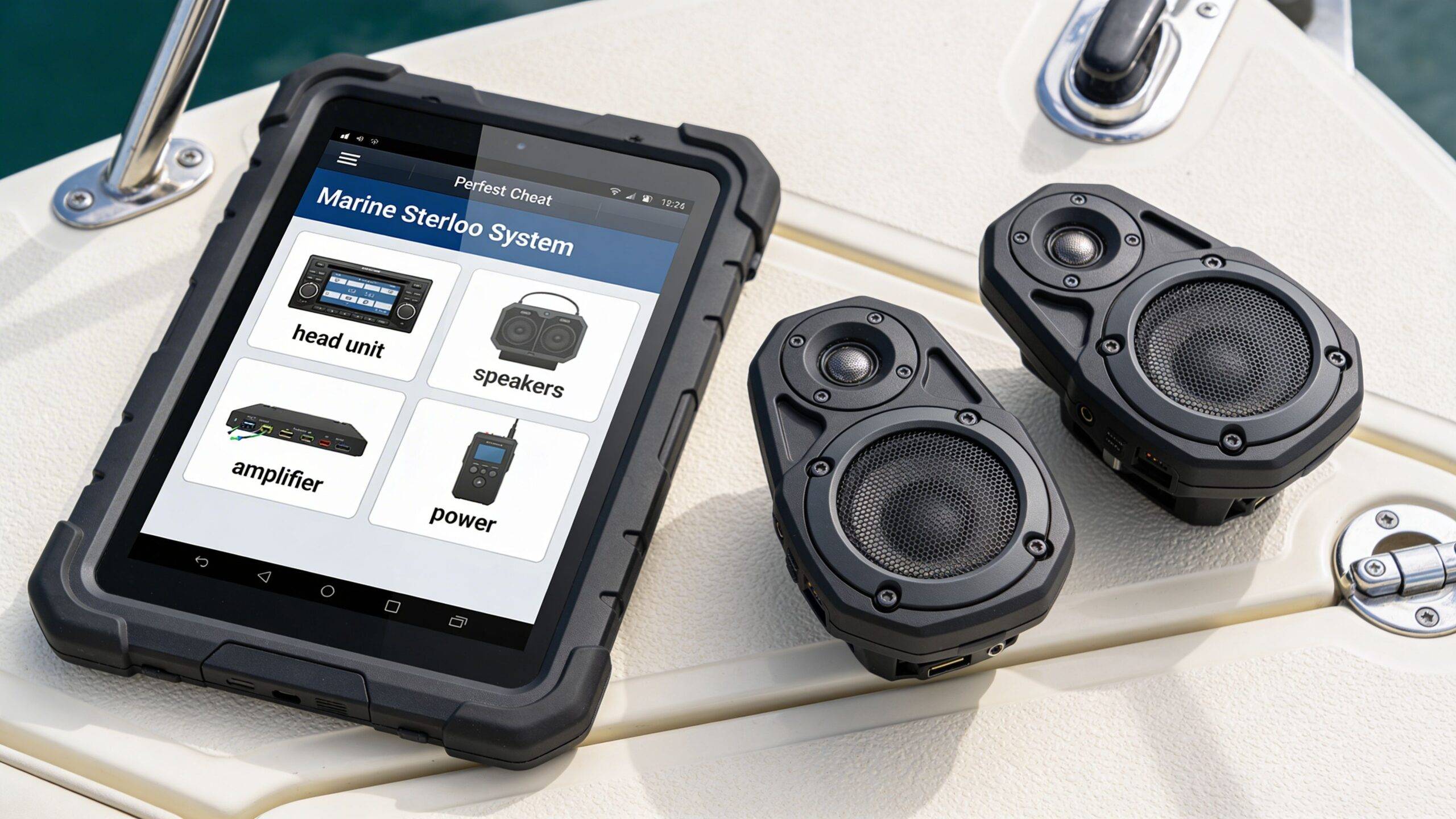
For buyers looking ahead, there is also a clear direction in newer gear. Emerging trends for 2026 include app-controlled WiFi audio systems such as the Fusion Apollo series, which can sync music across multiple boats, and Australian tender trials showed improved audio clarity at low trolling speeds (10-15kts), according to this video covering the trend. That is especially relevant for anglers and tender owners who care about clarity without moving to a large amp-heavy install.
The shortlist that keeps buyers out of trouble
Use this as a pre-purchase filter.
- Choose marine-rated gear only: Receivers, speakers, and hardware should be built for spray, UV, and salt exposure.
- Prioritise efficient speakers: On a small open boat, speaker sensitivity matters as much as headline power.
- Keep the footprint compact: If a component needs a lot of structure, depth, or storage you do not have, it is the wrong component.
- Check mounting before buying: A great speaker with no sensible mounting location is not a bargain.
- Plan the power source early: Audio should never be an afterthought added to an already stretched electrical setup.
- Buy for the way the boat is used: Family cruising, fishing, tender work, and beach camping all favour slightly different layouts.
Pairings that suit real inflatable use
Not every owner needs the same rig. A few combinations make practical sense.
Tender and yacht support setup
A compact digital receiver and two well-placed marine speakers suit this role. The aim is clean sound, low fuss, and minimal intrusion into boarding and gear handling.
This type of setup benefits from simple controls and easy wash-down.
Family inflatable catamaran setup
A slightly larger layout can justify four speakers if there is proper seating spread and the mounting positions are solid. A small console helps bring order to the install.
The key is keeping the deck clear. Family boats need room to move more than they need oversized audio.
Fishing RIB setup
A receiver with straightforward phone control and speakers aimed for low-speed clarity is often the smart play. Anglers usually value battery discipline, less clutter, and equipment that does not interfere with rod work.
Newer app-based control is particularly attractive in this context because the helm and cockpit stay cleaner.
The best stereo upgrade is the one that makes the boat more enjoyable without making any other part of ownership harder.
Final buyer’s checklist
Before you commit, confirm these points:
| Check | What you want |
|---|---|
| Receiver type | Compact, marine-rated, easy to read and control |
| Speaker choice | Marine-built, efficient, sized appropriately for the hull |
| Power plan | Fused, secure, realistic for your boating day |
| Mounting plan | Solid, tidy, and compatible with portability |
| Wiring method | Protected, sealed, and serviceable |
| Use case | Matched to family cruising, fishing, camping, or tender duty |
For inflatable owners, that checklist beats chasing fashion every time. The right marine stereo turns a capable boat into a more enjoyable one. It should feel integrated, not bolted on as an afterthought.
If you want a portable boat that is easy to outfit properly from the start, Easy Inflatables offers inflatable boats, RIBs, yacht tenders, inflatable catamarans, accessories, and practical support for building a rig that works effectively on Australian water.
Explore the Aerowave range
Weekend-Proof Score 17 questions · about 2 minutes
Will the boat you're about to buy survive an Australian summer?
Seventeen straight questions about where you'll use it, what you'll ask of it and the boat you're weighing up. You get a score out of 100, the exact weak points in your plan, and the one boat that genuinely fits.
Free · your result shows on screen · no email required
So which one is yours?
Pick how you'll actually use it and we'll take you straight to the right hull.
I want to fish it
Open bow, rod holders, deck space you can stand and cast from.
Viper Sport 400Family, diving and the beach
3.8 m Series 3 catamaran — low bow to climb back in wearing fins or a tank.
WaveRunner 380Tender / one-person launch
3.3 m hard-floor boat that packs into a bag and still takes a beach landing.
Viper 330Shop gear featured in this guide
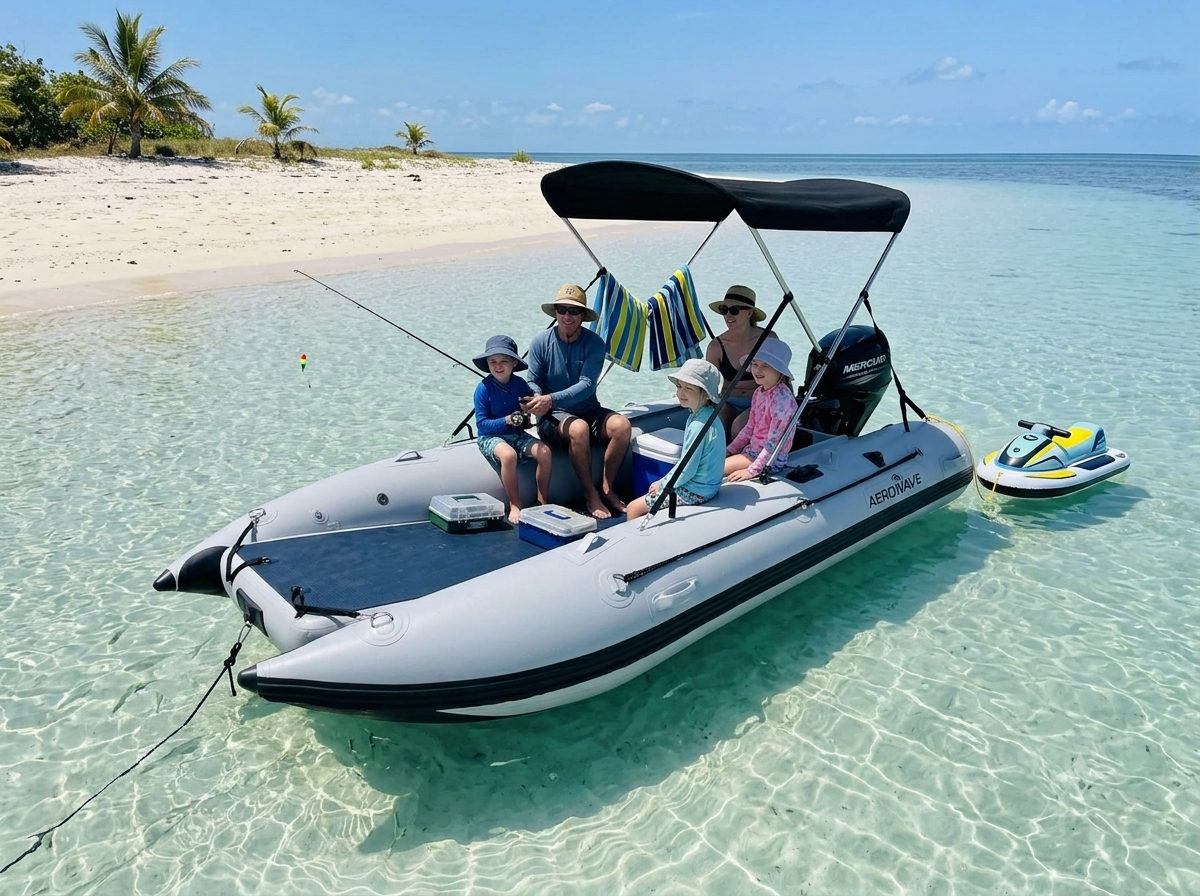
Aerowave WaveRunner 380 Series 3 Catamaran Package
The WaveRunner 380 Series 3 is a premium 3.8m inflatable catamaran package built for Australian and worldwide families, fishing, and coastal day boating — ideal for snorkeling and spearfishing — offering serious stability and premium German Valmex® construction.
Free freight to United States · local taxes payable on arrival
Aerowave Viper 400 Sovereign
Flagship 4m enclosed-bow inflatable catamaran. German VALMEX® 7321 Heavy Plus 1.2mm commercial-grade fabric, 10 PSI high-pressure drop-stitch air deck floor with VALMEX non-slip surface, LockPro wheels, full Bimini and FREE express delivery Australia-wide included. Winter special — save $1,000 until 31 August 2026.
Free freight to United States · local taxes payable on arrival
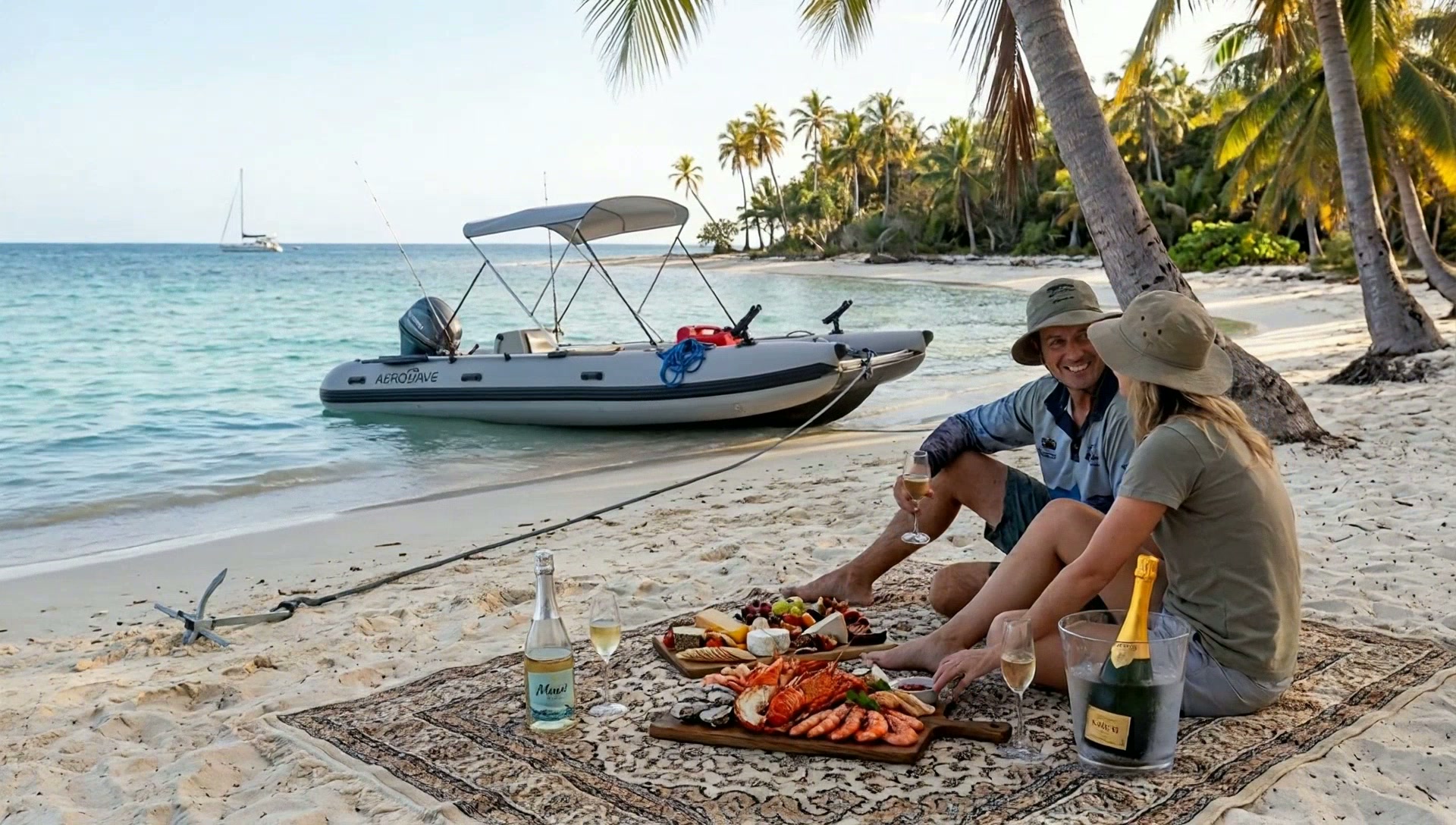
Aerowave Viper 365 Open Bow
Premium 3.65m Inflatable catamaran — built the same way as our flagship Viper 400 sports boat, just 35cm shorter. German VALMEX® 7321 Heavy Plus 1.2mm commercial-grade fabric, 10 PSI high-pressure drop-stitch air deck floor with VALMEX non-slip surface, LockPro wheels, full Bimini and FREE express delivery Australia-wide included.
Free freight to United States · local taxes payable on arrival
Not sure which suits you? Talk to a real boat owner.
Before you spend a cent
Buying from Australia, delivered to United States
You have never heard of us, we are on the other side of the world, and the internet is full of fakes. Fair enough. Here is everything you would need to check us out, in one place — no forms, no chat bot.
Australian designed business
Easy Inflatables, Avoca Beach NSW 2251. ABN 96 856 548 613. International orders ship from our Hong Kong hub.
222 owner reviews, 4.8 average
Read them in full, good and bad, on our reviews page.
CE certified, 7-year hull warranty
ISO 6185-3 and EU Directive 2013/53/EU. Warranty honoured worldwide.
Tracked, insured, door to door
FREE freight to United States · local tax/duty on arrival.
- Who am I actually buying from?
- Easy Inflatables, Avoca Beach NSW 2251, Australia. ABN 96 856 548 613. Sean is the owner and skipper, Gary Stewart handles sales on +61 2 4335 1603, Karen Matthews handles email. The boats are Australian designed; international orders ship from our Hong Kong dispatch hub so your landed price stays competitive. Phone us before you pay a cent — a real person answers.
- Is this really an Australian product?
- Yes — Australian designed and engineered on the NSW Central Coast. Manufacturing is done offshore to our spec, and international orders ship direct from our Hong Kong dispatch hub. If we routed every boat through Australia first, the freight alone would roughly double or triple your cost for the same hull.
- What do I pay, and what is not included?
- The delivery and import terms depend on your country. EU, UK, New Zealand and named Asia/Pacific lanes include duty and tax; US freight is free but US buyers pay import charges on arrival. Other destinations show their terms before payment.
- How do I pay safely?
- Card through Stripe (Visa, Mastercard, Amex, Apple Pay, Google Pay) or bank transfer. Card payments carry your bank's own dispute protection. We never ask for crypto, gift cards or payment to a personal account.
- What if it arrives damaged?
- Every boat ships fully tracked and insured door to door. Photograph the carton and the boat on arrival and email us — transit damage is claimed and replaced through us, not left with you and the courier.
- Is the warranty real outside Australia?
- Yes. The 7-year hull warranty on 1.2 mm VALMEX Heavy Plus and Orca Hypalon hulls applies wherever you are. Replacement parts are held in Australia and at our overseas hub and go out by express courier to your door.
- Is the boat actually certified?
- All Aerowave catamarans are CE certified to ISO 6185-3 and EU Directive 2013/53/EU. Certification paperwork is supplied with the boat — ask and we will send it before you order.
Ready to set sail?
Premium German-fabric inflatable catamarans, built to order and delivered to your door. Talk to our team or browse the fleet.
Like this guide? Get the next one in your inbox.
Owner-tested tips, gear deep-dives and Aussie boating know-how — no spam.