Are Inflatable Boats Safe for Open Water? An Honest 2026 Answer
Short answer: yes, when the boat is built to CE 6185-3, uses genuine VALMEX®, and is skippered with a bit of sea sense. Here's the long, honest answer.
At a glance
Short answer: yes, when the boat is built to CE 6185-3, uses genuine VALMEX®, and is skippered with a bit of sea sense. Here's the long, honest answer.
- What "open water" actually means
- The three things that determine safety
- Factor 1: The fabric
- Factor 2: The construction
What we'd put you in
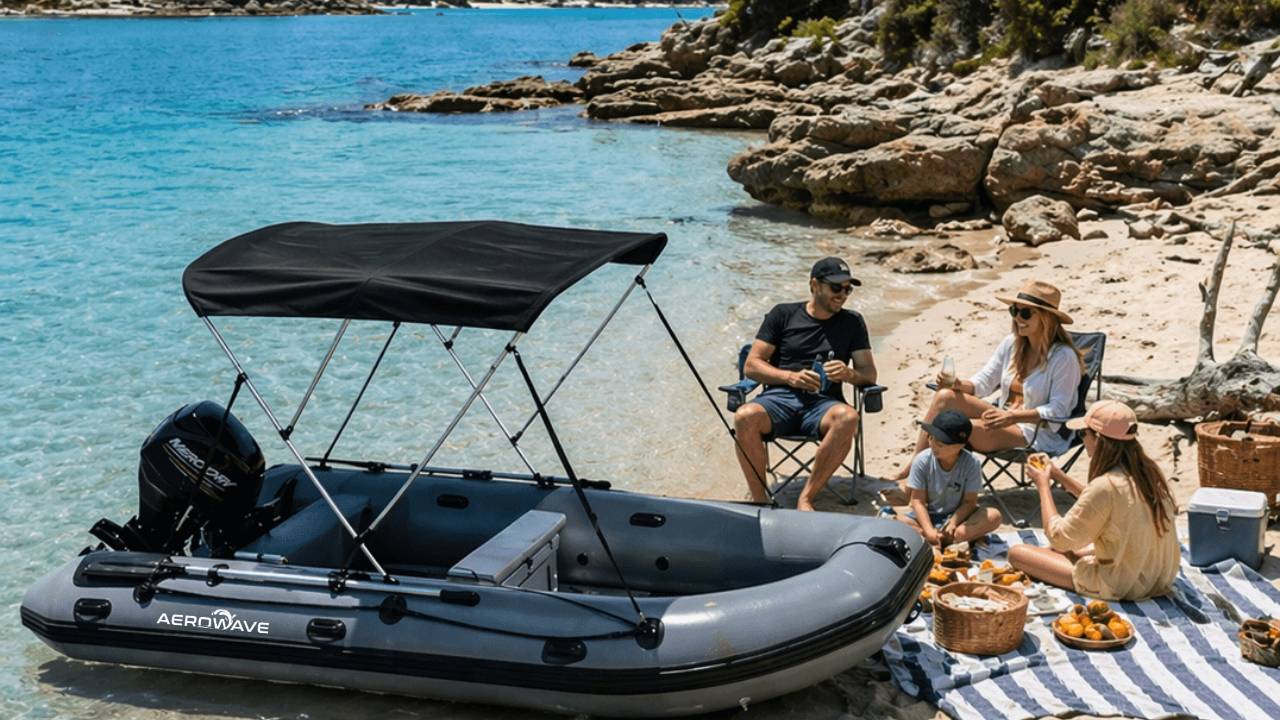
Aerowave Viper 400 Sovereign
Our best-selling boat: 4.0 m, 1.2 mm VALMEX hull, 7-year hull warranty.
US$3,167 USD
Delivered to your door, today's rate
- Free freight to United States · local taxes payable on arrival
- 7-year hull warranty
🇺🇸 Shipping to United States · landed price quoted in writing
Yes — we ship the Aerowave Viper 400 Sovereign to United States. Here's the landed price.
Our best-selling boat: 4.0 m, 1.2 mm VALMEX hull, 7-year hull warranty.
Aerowave Viper 400 Sovereign
- Boat package (export price)
- US$3,726
- 15% tariff relief credit
- − US$559
- Express air freight to United States
- Included
- Import duty, taxes & customs clearance
- Payable on arrival
- Estimated landed, USD
- US$3,167
Indicative, converted at today's rate, before local duty and tax on arrival. Ask below and we'll put a fixed figure in writing, valid 30 days.
- 7-year hull warranty
- 1500 GSM / 1.2 mm VALMEX® Heavy Plus hull
- CE certified to ISO 6185-3 and EU Directive 2013/53/EU
- Door-to-door, tracked the whole way
Your price, delivered to your door — freight included.
We email the full PDF quote (spec, freight, finance, WavePay) to your inbox in under 60 seconds. No spam — one quote, one follow-up.
See it for yourself
Real boats. Real owners. Real people behind them.
Plenty of what you read online these days is generated. Check us out properly — the factory, the reviews and the owners are all one click away. Why we use AI, and how to check we’re real
How our boats are built
Walk the production line: thermo-welded seams, 1.2 mm VALMEX Heavy Plus hulls, over-pressure relief valves on every chamber.
See the buildGoogle Maps reviews
Real Australian owners, five stars, published on our Google Business Profile with the map — read them there, not just on our own site.
Open Google Maps reviewsOwner stories
Boats in use — offshore, on rivers, on rescue duty. Photos and words from the people who actually own them.
Read owner storiesAre Inflatable Boats Safe for Open Water? An Honest 2026 Answer
There is a version of this question people ask because they genuinely want to know, and a version they ask because a family member is worried. Both deserve a straight answer from someone who actually builds boats for a living.
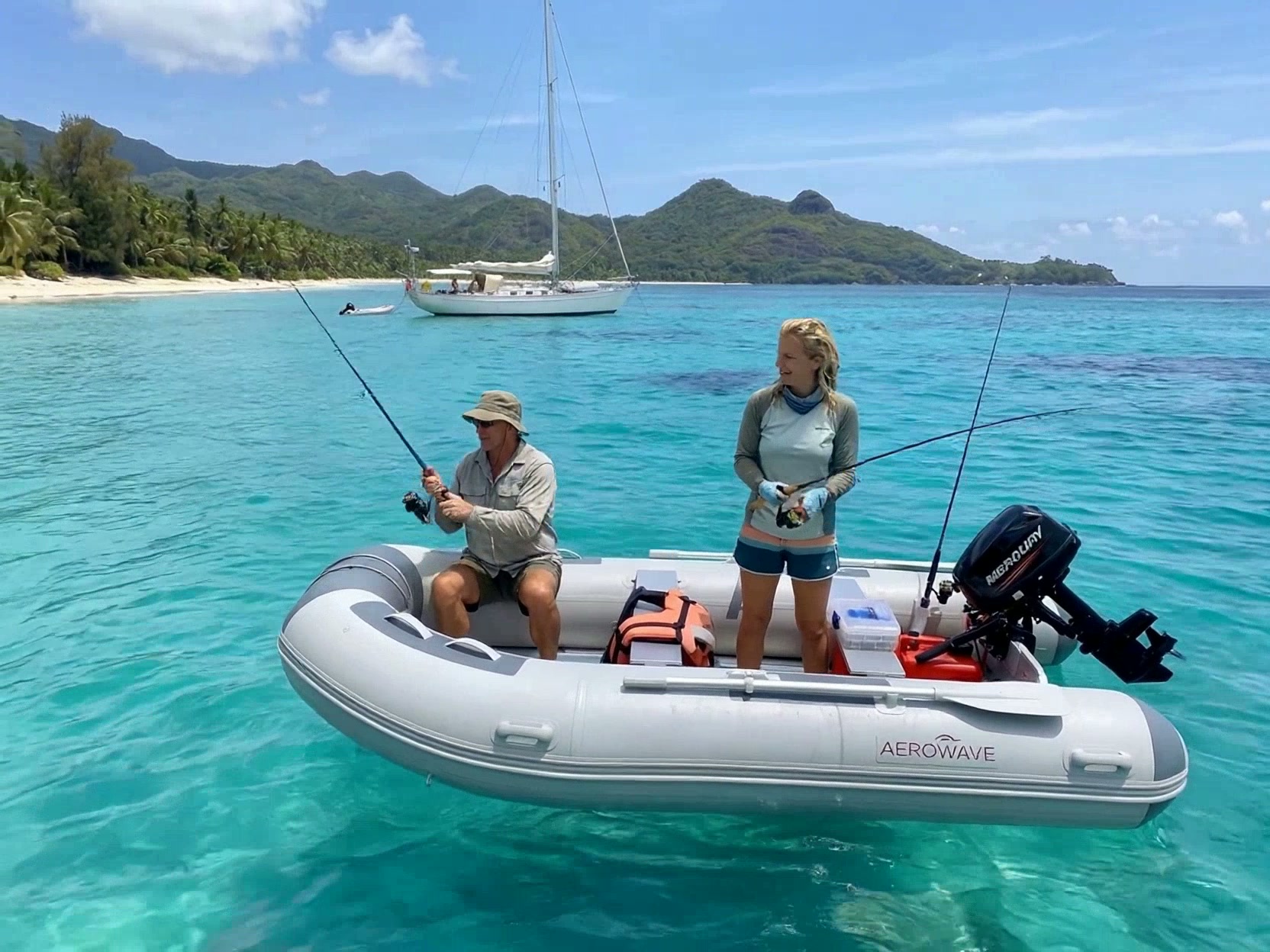
So — are inflatable boats safe for open water? Yes. When they are built correctly and skippered sensibly, a modern inflatable boat is one of the most forgiving, buoyant and stable craft you can put under your feet. That "when" carries a lot of weight though, and this article unpacks it properly.
We build the Aerowave range out of Australia and ship worldwide. We are not going to sit here and tell you every inflatable on the market is offshore-capable, because they are not. What we will do is walk you through, in plain English, exactly what separates a boat that belongs offshore from one that belongs in a swimming pool — and what you can do as a skipper to keep the safety equation stacked in your favour.
What "open water" actually means
The phrase gets used loosely, so let's define it. "Open water" is anywhere you can no longer step off onto dry land in seconds: sheltered bays, coastal inshore, exposed estuaries, big lakes with fetch, and — for boats rated for it — genuine offshore work up to a few nautical miles out.
The international standard that governs how inflatable and rigid-inflatable boats are rated for this is ISO 6185-3 (Boats — Inflatable Boats — Part 3: Boats with a maximum motor power of 15 kW and greater), paired with the EU Recreational Craft Directive 2013/53/EU. Together, they slot every certified boat into a CE Design Category:
- Category A – ocean
- Category B – offshore
- Category C – inshore (up to Beaufort 6, wave height up to 2 m)
- Category D – sheltered waters
Every Aerowave catamaran and monohull we build is CE certified to ISO 6185-3 and 2013/53/EU. The design category is stamped on the certification plate riveted to the transom. That is not marketing text — it is the answer to the "is this boat safe out here?" question, and the first thing an experienced skipper looks for.
The three things that determine safety
Once you strip away the noise, three factors decide whether an inflatable boat is safe in open water:
- The fabric — what the hull is made of.
- The construction — how the chambers and seams are engineered.
- The skipper — the human decisions made before and during the trip.
Get all three right and you have a boat category that has been trusted by navies, coast guards, rescue services and commercial operators for more than half a century. Get any of them wrong and no boat on earth will save you.
Factor 1: The fabric
There is a widely used shorthand in the industry: "PVC boats." That covers a huge quality range, and it is where most safety debates start.
The bottom shelf is generic 0.9 mm Chinese PVC — thin, brittle after a few Australian summers, prone to chalking, delamination and micro-punctures. Real-world service life is often three to seven years. It is fine for a lake tender used a dozen times a year. It is not what you want under you 12 nautical miles offshore.
At the top of the market sits VALMEX® — a German technical textile built on a woven high-tenacity polyester scrim coated with plasticised PVC. Every Aerowave hull is built on this fabric. Our premium boats use 1.2 mm VALMEX® Heavy Plus, which is 33 % thicker than the 0.9 mm VALMEX® you will see quoted by comparable brands. Real-world service life sits in the 10–12 year band, and the fabric is genuinely resistant to UV, salt spray, fuel, and the shellfish, rocks and coral you will inevitably meet in an actual boating life.
Fabric matters because in open water, every fibre of the hull is your safety envelope. It is not a decorative panel — it is the boat.
Factor 2: The construction
You can hand-build a perfectly capable boat out of the world's best fabric and still make it unsafe by cutting corners on how the pieces are joined together.
The two questions to ask any builder are simple.
How many independent air chambers does the hull have? Anything intended for open water should have at least three. Every Aerowave hull has three or more, sealed off from each other so a puncture in one leaves the rest intact. This is the single most important safety feature on an inflatable: it is why the boats do not "sink" in the way a rigid hull can. Even fully deflating one chamber, the boat continues to float level enough to be motored home.
How are the seams joined? There are two techniques. Glued seams rely on adhesive chemistry that ages, especially in UV. Welded (thermobonded) seams fuse the two panels into a single piece of material — the joint becomes as strong as the fabric itself. Every Aerowave seam is welded. Where it counts most — the tube-to-hull junction and the transom-to-tube bond — that welded construction is what keeps water on the outside of the boat when you take a beam sea at three metres a second.
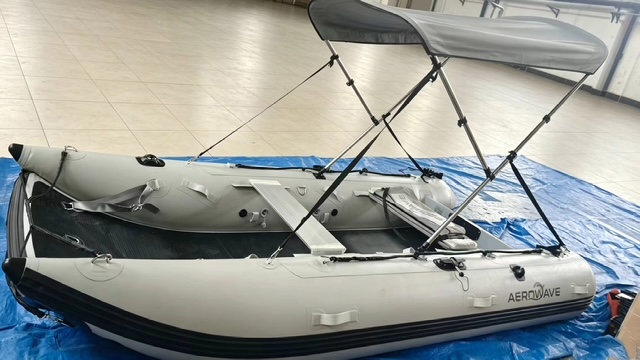
Add to that the modern touches: reinforced transom plates rated for the boat's maximum horsepower, over-pressure relief valves so the tubes cannot burst if left in the sun, high-buoyancy air-deck or aluminium floors that stiffen the running surface, and grab lines around the perimeter for man-overboard recovery.
None of this is optional on an open-water boat. It is baseline.
Factor 3: The skipper
Here is the uncomfortable truth: the majority of serious incidents involving small boats — inflatable or otherwise — come back to skipper decisions, not equipment failure. The boat did what it was designed to do; the person driving it asked more of it than the conditions allowed.
You do not need to be ex-Navy to skipper a small boat safely offshore. You do need to internalise five habits.
Know your boat's design category and stay inside it. If your certification plate says Category C, the boat is not intended for Category B conditions. Not on the day the forecast says "well, it's only borderline."
Read the weather like it matters, because it does. BOM MetEye, Willy Weather, a dedicated marine forecast — plural sources, checked the night before and again on the ramp. Wind against tide is the single condition most often underestimated by weekend boaters.
File a trip plan. Someone ashore knows where you launched, where you're going, when you'll be back. This one habit has saved more lives than any piece of gear.
Carry the safety kit and know how to use it. PFDs on, not stowed. An EPIRB registered to you. Flares in date. VHF on Channel 16. A paddle or oars. An anchor with 30 metres of rode. A bailer. A mobile in a dry bag. If you cannot pass your own pre-departure check, don't leave the ramp.
Fuel plus one-third. Plan your day to use two-thirds of your fuel and land back with the last third untouched. Weather changes, tides change, engines occasionally cough. Reserve fuel is a safety system.
What actually goes wrong (and why it rarely involves the hull)
We have been building and shipping inflatable boats for years, and we hear the incident stories firsthand from owners and dealers. The list is instructive.
- Skipper ran out of fuel because he didn't check the tank.
- Weather turned and the crew tried to punch home into a rising sea instead of anchoring in the lee of an island for two hours.
- The boat was left inflated in 45 °C summer sun with the over-pressure valves shut — a preventable equipment failure that has nothing to do with the fabric.
- No PFDs, no EPIRB, no plan.
We could count on one hand the incidents in the last decade that came back to a hull or a seam. That is not because we're lucky — it is because the technology is genuinely mature.
Where Aerowave boats sit on this map
Every boat we build is designed for real Australian and international open-water conditions, not a marketing brochure. The Aerowave Viper range is Category C rated to ISO 6185-3, built on 1.2 mm VALMEX® Heavy Plus, with three or more welded chambers, over-pressure valves, reinforced transoms and grab lines fitted as standard. The WaveRunner 380 is our purpose-built family and fishing catamaran with a wider stance and a shallower draft, designed for confident inshore work. The Sport Series monohulls are configured for the tender and day-boat market and rated accordingly.
Not every boat we sell is intended for a 12 nm offshore run in a rising 15-knot southerly — nor should it be. What you get from us is a truthful design category, honest fabric spec, and a builder who will tell you if the boat you're looking at is right for the water you plan to use it in. If it isn't, we will point you at one that is.
The bottom line
Are inflatable boats safe for open water? When the boat is built to ISO 6185-3, sits on genuine VALMEX® fabric, uses welded seams and multiple independent chambers, and is skippered by someone who respects the forecast and carries the kit — yes. Emphatically, yes. Rescue services and defence forces around the world stake their crews on exactly this design.
The other 5 % of the time, the boat is not the problem.
If you want to see the certification plate, the fabric spec sheet, or the design category for any Aerowave hull before you buy, ask us. We will send it. That is what a real builder does.
Every one of these principles is baked into how we build, spec, warranty and support the Aerowave range from our Australian workshop. It is not a checklist we lifted from a marketing agency — it is how boats stay safe.
Ready to look further
- Read the Aerowave Viper 400 Open Bow spec and design-category detail.
- Browse the WaveRunner 380 for family and inshore fishing.
- See our full Safety and Compliance page including CE certification and Boat Code process.
The 10-point open-water checklist (screenshot this)
- Check the forecast twice — BOM coastal waters forecast plus a wind app. Look at wind and swell period; a 1.5 m swell at 12 seconds is comfortable, at 5 seconds it is not.
- Pressure up properly. Chambers to spec (8–10 PSI on our catamarans), floor to spec. A soft boat is a slow, wet, unpredictable boat.
- PFD on every body, worn — not stowed.
- Kill-cord clipped to the skipper. Every trip, no exceptions.
- Two ways to call for help — VHF plus a phone in a waterproof pouch; EPIRB once you're beyond sheltered water.
- Fuel: one third out, one third back, one third in reserve.
- Tell someone your plan — launch point, return time, number aboard.
- Anchor, rode and a sea anchor/drogue aboard and accessible.
- Bail and drain gear — bung in, drains clear, hand bailer aboard.
- Know your out. Before you leave the ramp, name the two closest lee shores you could shelter behind.
Australian rules worth knowing before you launch
Design category tells you what the boat can handle. State law tells you what you must carry. In NSW, Queensland, Victoria, SA, WA, Tasmania and the NT, safety-equipment requirements change based on whether you are operating in enclosed or open waters, and offshore distance bands add flares, EPIRB and additional PFD requirements. Registration thresholds also differ by state — most jurisdictions trigger registration on engine power or hull length, so check your state authority before fitting a bigger outboard.
Our Safety & Compliance page sets out the CE certification we hold and the separate state registration step owners handle themselves. If you are still learning to read the water before you commit, the companion guide on reading beach conditions is the practical version of this article.
Catamaran or monohull for open water?
Both work. They fail differently, which is the useful part:
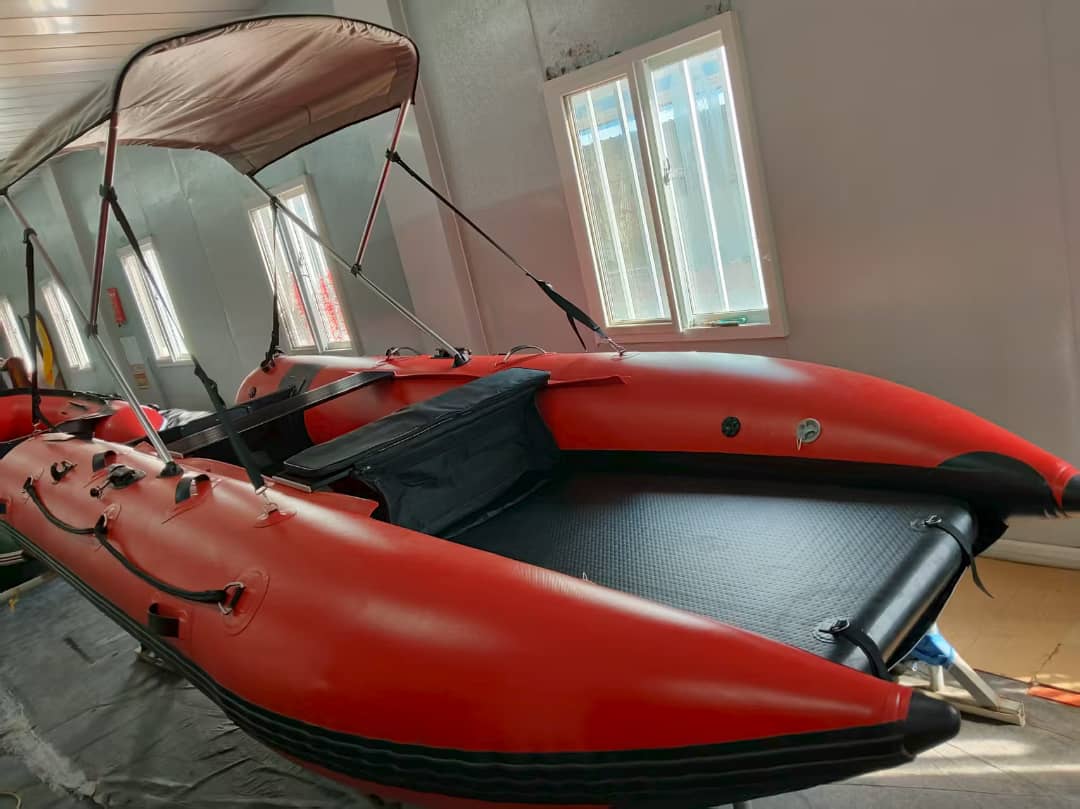
- Inflatable catamaran (AeroCat, Viper, WaveRunner) — two long buoyancy tubes and a tunnel between them. Enormous static stability, dry ride at moderate speed, shallow draft, planes early on small horsepower. Best for estuaries, bays, inshore reef work, beach launching.
- Deep-V monohull (Sport Series Offshore) — cuts chop rather than bridging it, holds a line in a beam sea, better in a genuinely lumpy short-period swell. Best for exposed coastal runs.
If most of your boating is bays, rivers and inshore reef with the occasional coastal hop, a catamaran on 1.2 mm fabric is the more forgiving choice. If you are punching out through consistent swell most weekends, look at the deep-V.
Talk to a human before you buy the wrong boat
Tell us the water you actually use — the ramp, the run, the worst day you would take it out on — and we will tell you which boat is rated for it. If none of ours is, we will say so. Call +61 2 4335 1603 or browse the full boat range.
Weekend-Proof Score 17 questions · about 2 minutes
Will the boat you're about to buy survive an Australian summer?
Seventeen straight questions about where you'll use it, what you'll ask of it and the boat you're weighing up. You get a score out of 100, the exact weak points in your plan, and the one boat that genuinely fits.
Free · your result shows on screen · no email required
So which one is yours?
Pick how you'll actually use it and we'll take you straight to the right hull.
I want to fish it
Open bow, rod holders, deck space you can stand and cast from.
Viper Sport 400Family, diving and the beach
3.8 m Series 3 catamaran — low bow to climb back in wearing fins or a tank.
WaveRunner 380Tender / one-person launch
3.3 m hard-floor boat that packs into a bag and still takes a beach landing.
Viper 330Shop gear featured in this guide
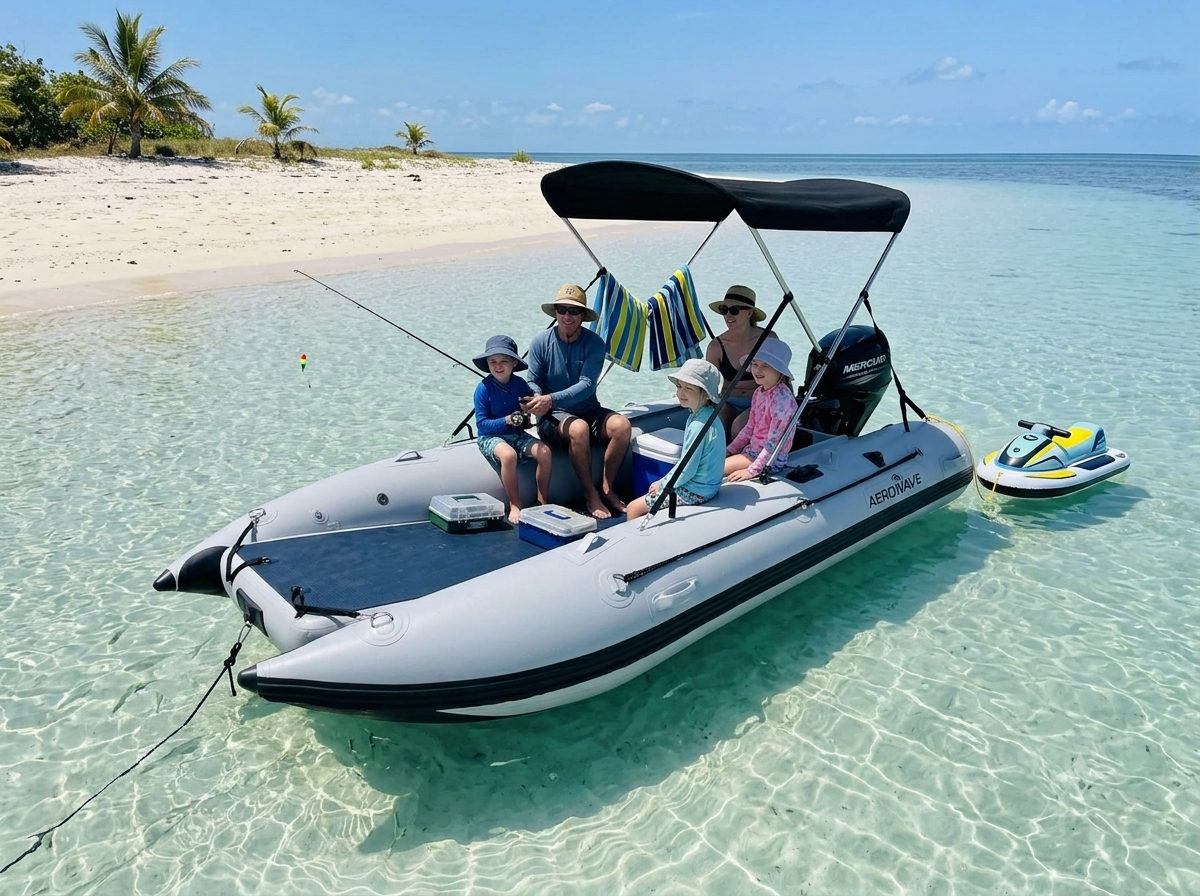
Aerowave WaveRunner 380 Series 3 Catamaran Package
The WaveRunner 380 Series 3 is a premium 3.8m inflatable catamaran package built for Australian and worldwide families, fishing, and coastal day boating — ideal for snorkeling and spearfishing — offering serious stability and premium German Valmex® construction.
Free freight to United States · local taxes payable on arrival
Aerowave Viper 400 Sovereign
Flagship 4m enclosed-bow inflatable catamaran. German VALMEX® 7321 Heavy Plus 1.2mm commercial-grade fabric, 10 PSI high-pressure drop-stitch air deck floor with VALMEX non-slip surface, LockPro wheels, full Bimini and FREE express delivery Australia-wide included. Winter special — save $1,000 until 31 August 2026.
Free freight to United States · local taxes payable on arrival
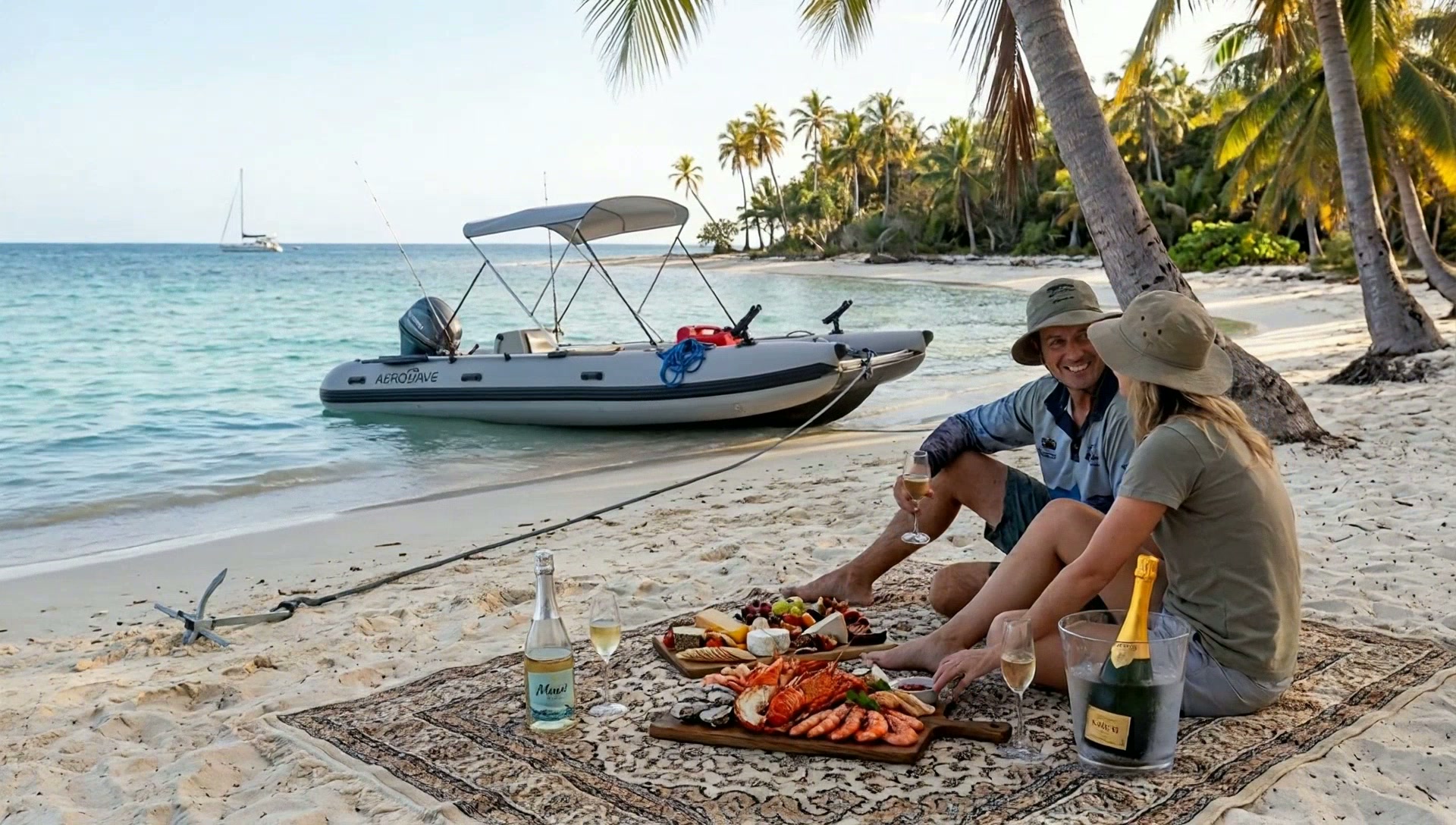
Aerowave Viper 365 Open Bow
Premium 3.65m Inflatable catamaran — built the same way as our flagship Viper 400 sports boat, just 35cm shorter. German VALMEX® 7321 Heavy Plus 1.2mm commercial-grade fabric, 10 PSI high-pressure drop-stitch air deck floor with VALMEX non-slip surface, LockPro wheels, full Bimini and FREE express delivery Australia-wide included.
Free freight to United States · local taxes payable on arrival
Not sure which suits you? Talk to a real boat owner.
Before you spend a cent
Buying from Australia, delivered to United States
You have never heard of us, we are on the other side of the world, and the internet is full of fakes. Fair enough. Here is everything you would need to check us out, in one place — no forms, no chat bot.
Australian designed business
Easy Inflatables, Avoca Beach NSW 2251. ABN 96 856 548 613. International orders ship from our Hong Kong hub.
222 owner reviews, 4.8 average
Read them in full, good and bad, on our reviews page.
CE certified, 7-year hull warranty
ISO 6185-3 and EU Directive 2013/53/EU. Warranty honoured worldwide.
Tracked, insured, door to door
FREE freight to United States · local tax/duty on arrival.
- Who am I actually buying from?
- Easy Inflatables, Avoca Beach NSW 2251, Australia. ABN 96 856 548 613. Sean is the owner and skipper, Gary Stewart handles sales on +61 2 4335 1603, Karen Matthews handles email. The boats are Australian designed; international orders ship from our Hong Kong dispatch hub so your landed price stays competitive. Phone us before you pay a cent — a real person answers.
- Is this really an Australian product?
- Yes — Australian designed and engineered on the NSW Central Coast. Manufacturing is done offshore to our spec, and international orders ship direct from our Hong Kong dispatch hub. If we routed every boat through Australia first, the freight alone would roughly double or triple your cost for the same hull.
- What do I pay, and what is not included?
- The delivery and import terms depend on your country. EU, UK, New Zealand and named Asia/Pacific lanes include duty and tax; US freight is free but US buyers pay import charges on arrival. Other destinations show their terms before payment.
- How do I pay safely?
- Card through Stripe (Visa, Mastercard, Amex, Apple Pay, Google Pay) or bank transfer. Card payments carry your bank's own dispute protection. We never ask for crypto, gift cards or payment to a personal account.
- What if it arrives damaged?
- Every boat ships fully tracked and insured door to door. Photograph the carton and the boat on arrival and email us — transit damage is claimed and replaced through us, not left with you and the courier.
- Is the warranty real outside Australia?
- Yes. The 7-year hull warranty on 1.2 mm VALMEX Heavy Plus and Orca Hypalon hulls applies wherever you are. Replacement parts are held in Australia and at our overseas hub and go out by express courier to your door.
- Is the boat actually certified?
- All Aerowave catamarans are CE certified to ISO 6185-3 and EU Directive 2013/53/EU. Certification paperwork is supplied with the boat — ask and we will send it before you order.
Frequently asked questions
- Are inflatable boats actually safe in the open ocean?
- A modern inflatable built to ISO 6185-3 with multiple independent air chambers, welded seams and heavy-plus fabric is genuinely offshore-capable within its stated design category. What sinks people is exceeding the rated conditions, running out of fuel, or skipping basic pre-departure checks — not the boat itself.
- What happens if one chamber punctures at sea?
- Every Aerowave hull has three or more independent chambers. If one is compromised, the remaining chambers keep the boat floating with reserve buoyancy, level enough to motor or drift home. That is exactly what the multi-chamber design is for.
- Can VALMEX® fabric handle UV, salt and rocks?
- Yes. Our 1.2 mm VALMEX® Heavy Plus is the same class of technical textile used in commercial ribs, defence tenders and life-raft hulls. Real-world service life is 10–12 years with routine rinsing and dry storage.
- Do I need special training to skipper one offshore?
- You need whatever your state requires — a Recreational Skipper's Ticket or equivalent — plus the same weather-awareness any small boat demands. The hull doesn't remove the need for seamanship.
- What safety gear should I carry?
- PFDs for every person, an EPIRB or PLB, VHF, flares within date, a paddle, a bailer, an anchor with adequate rode, and a mobile in a dry bag. Log a trip plan with someone ashore.
- How rough is too rough for an inflatable?
- Stay inside the boat's CE design category and your own experience. For a Category C hull, that generally means winds up to about 20 knots and significant wave heights up to roughly 2 metres. When in doubt, don't launch.
- Are inflatables safer than an aluminium tinnie in the same conditions?
- Different, not lesser. An inflatable's reserve buoyancy and soft tubes give it enormous stability and forgiveness in a beam sea. A tinnie is stiffer and drier upwind. Match the tool to the water.
Ready to set sail?
Premium German-fabric inflatable catamarans, built to order and delivered to your door. Talk to our team or browse the fleet.
Like this guide? Get the next one in your inbox.
Owner-tested tips, gear deep-dives and Aussie boating know-how — no spam.