Best Inflatable Boat for Lakes vs Rivers: How to Choose in 2026
Two very different bodies of water want two different boats. This guide breaks down draft, chop, portability and hull shape so you match the boat to the water.
At a glance
Two very different bodies of water want two different boats. This guide breaks down draft, chop, portability and hull shape so you match the boat to the water.
- Start with the water, not the boat
- What lakes want
- What rivers want
- The hull-shape decision, in plain English
What we'd put you in
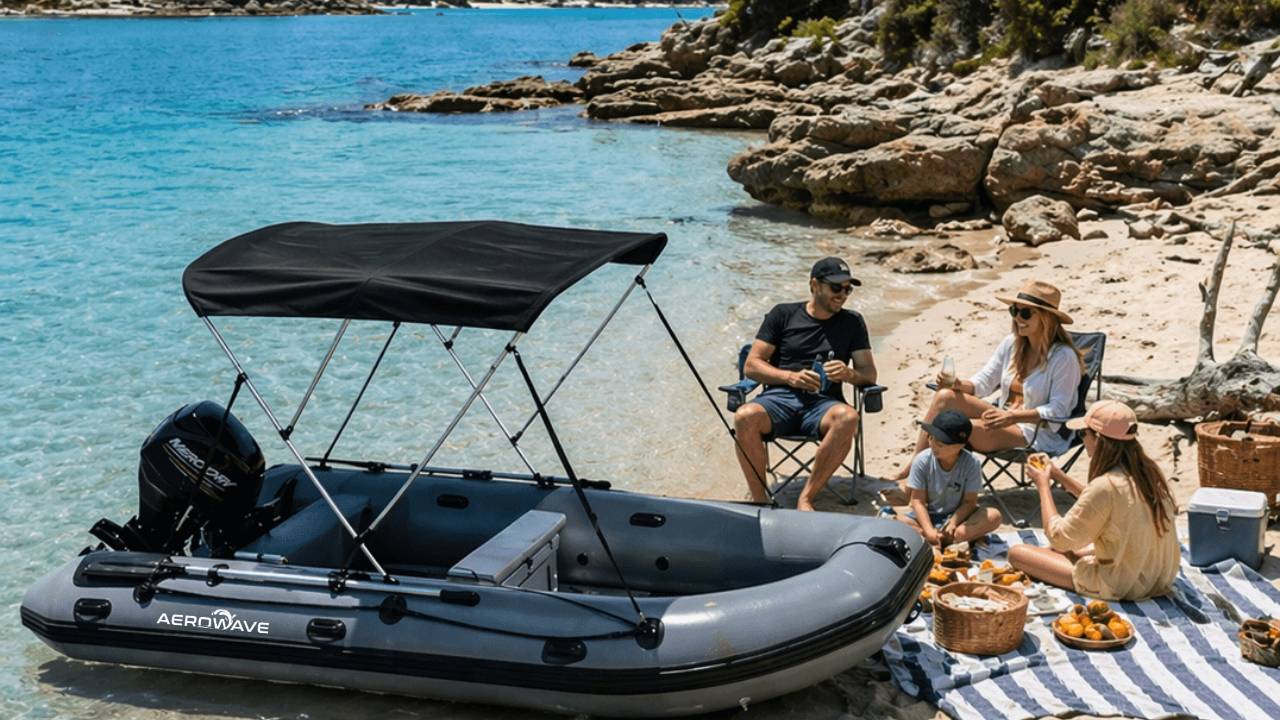
Aerowave Viper 400 Sovereign
Our best-selling boat: 4.0 m, 1.2 mm VALMEX hull, 7-year hull warranty.
US$3,167 USD
Delivered to your door, today's rate
- Free freight to United States · local taxes payable on arrival
- 7-year hull warranty
🇺🇸 Shipping to United States · landed price quoted in writing
Yes — we ship the Aerowave Viper 400 Sovereign to United States. Here's the landed price.
Our best-selling boat: 4.0 m, 1.2 mm VALMEX hull, 7-year hull warranty.
Aerowave Viper 400 Sovereign
- Boat package (export price)
- US$3,726
- 15% tariff relief credit
- − US$559
- Express air freight to United States
- Included
- Import duty, taxes & customs clearance
- Payable on arrival
- Estimated landed, USD
- US$3,167
Indicative, converted at today's rate, before local duty and tax on arrival. Ask below and we'll put a fixed figure in writing, valid 30 days.
- 7-year hull warranty
- 1500 GSM / 1.2 mm VALMEX® Heavy Plus hull
- CE certified to ISO 6185-3 and EU Directive 2013/53/EU
- Door-to-door, tracked the whole way
Your price, delivered to your door — freight included.
We email the full PDF quote (spec, freight, finance, WavePay) to your inbox in under 60 seconds. No spam — one quote, one follow-up.
See it for yourself
Real boats. Real owners. Real people behind them.
Plenty of what you read online these days is generated. Check us out properly — the factory, the reviews and the owners are all one click away. Why we use AI, and how to check we’re real
How our boats are built
Walk the production line: thermo-welded seams, 1.2 mm VALMEX Heavy Plus hulls, over-pressure relief valves on every chamber.
See the buildGoogle Maps reviews
Real Australian owners, five stars, published on our Google Business Profile with the map — read them there, not just on our own site.
Open Google Maps reviewsOwner stories
Boats in use — offshore, on rivers, on rescue duty. Photos and words from the people who actually own them.
Read owner storiesBest Inflatable Boat for Lakes vs Rivers: How to Choose in 2026
Lakes and rivers look, from a distance, like the same job — freshwater, small craft, a fishing rod or two, a cooler. In practice, they demand almost opposite things from a boat. The wrong choice will not sink you; it will just quietly frustrate you every weekend for the next ten years.
This guide is the piece we wish more first-time inflatable buyers read before they clicked "add to cart." We build the Aerowave range here in Australia — catamarans and monohulls, tenders and family boats — and we sell them into every inland water system from the top end of the Territory to the Southern Highlands, plus the entire lakes and rivers network of the US, UK and EU. What follows is what we tell our own customers on the phone.
Start with the water, not the boat
The most expensive mistake in small-boat buying is starting with a picture of a boat and working backwards. The right sequence is:
- Where — physically — do you launch and use it, 80 % of the time?
- How deep is that water at its shallowest realistic point?
- What's the fetch and typical chop?
- How far will you actually run in a day?
- What are you doing on board — fishing, exploring, ferrying kids, camping?
Answer those five in one sentence and the boat almost picks itself.
What lakes want
A big lake — Jindabyne, Eildon, Lake Argyle, Windermere, Coeur d'Alene, Lake Como, take your pick — behaves more like a small inland sea than a river. Fetch builds a proper chop by mid-morning, distances between ramps and fishing spots are non-trivial, and the wind on a warm afternoon can push a knot chop into a genuine metre.
Lakes reward, in order:
- Directional stability at cruising speed. You want the hull to track cleanly at 15–25 kn without hunting for the pressure line.
- Reserve buoyancy and dry ride. Chop coming at the bow shouldn't put a family in the front seat under a shower.
- Genuine range. Fuel and comfort to run 15–25 nautical miles in a day without turning the trip into an endurance event.
- A stable working platform. Whether it's fly-casting, netting a trout, or three teenagers hanging over the side, the boat should not feel like it's punishing you for standing up.
That set of requirements points squarely at a twin-hull catamaran with a proper aluminium floor, or a longer open-bow monohull with enough length to carry a bit of momentum through a chop. The Aerowave Viper 400 Open Bow is our default recommendation for big-lake work — it has the length to cut cleanly, the fabric spec to shrug off UV, and enough seating for the family without cluttering the cockpit for fishing.
If you fish more than you cruise, the WaveRunner 380 — a purpose-built catamaran with a broader stance and a wide clear deck — gives you the platform stability that changes what a "good day fishing" looks like.
What rivers want
Rivers punish exactly what lakes forgive. A boat that behaves like a champion at 22 kn across open water can be a nightmare on a winding estuary at 4 kn.
Rivers reward:
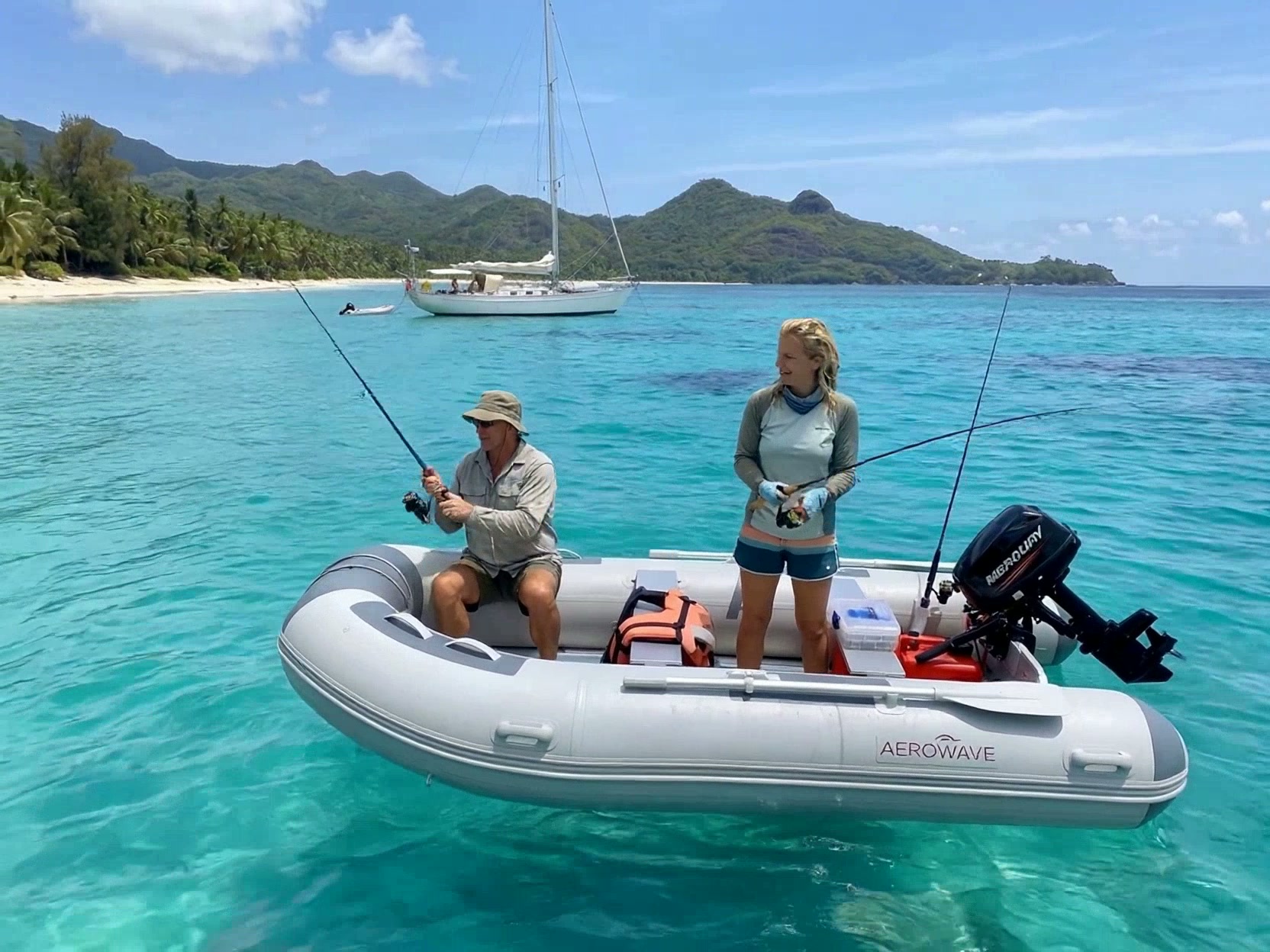
- Shallow draft. Every centimetre of draft you save is a stretch of river you can reach without pinning the prop against a sandbar. This is where twin-hull catamarans have a genuine, measurable advantage — the same displacement spread over two narrower hulls sits lower and shallower in the water than a single V-hull.
- Tight turning at low speed. Rivers are corners. Monohulls with a long keel line hunt through corners; catamarans and short beamy monohulls pivot.
- Snag tolerance. Overhanging branches, submerged logs, oyster leases, rocks. This is why the fabric spec matters even more on a river than a lake — a boat built on 0.9 mm bargain PVC will not last a season on the Hawkesbury.
- Portability. Rivers rarely have concrete boat ramps. You will drag, lift, and carry.
For genuinely shallow river and estuary work, the Aerowave AeroCat 330 and AeroCat 360 catamarans are hard to beat. The shallow draft opens up water most trailer-boats can only look at. If you want the same shallow-water access with more capacity for a mate, a dog and a day's fishing kit, step up to the WaveRunner 380.
Where a monohull genuinely shines on a river is the tender end of the range — the smaller, lighter, one-or-two-person day boats that carry easily to the water and slide off any bank. The Swift Tender 270 is the classic answer here.
The hull-shape decision, in plain English
There is a lot of ink spilled on catamaran-versus-monohull. The honest short version:
Catamarans give you — shallower draft, an enormously stable working platform, a wider clear deck for its length, and a softer ride in a beam sea. They are typically drier at low speed and have huge internal volume for their footprint. On rivers and shallow bays, this is the winning combination.
Open-bow monohulls give you — a slightly better ride into a head sea at cruising speed, cleaner directional tracking over long open runs, and a more traditional "boat" feel that some skippers just prefer. On big open lakes and coastal work, this is often the more relaxed ride.
Both, in an Aerowave, are built on the same 1.2 mm VALMEX® Heavy Plus fabric, with welded seams, three-plus chambers, and a CE certification to ISO 6185-3. The safety envelope does not change; the ride and the water access do.
Floors matter more than you think
The floor is the single most under-appreciated spec on an inflatable boat. It is the difference between a boat you enjoy and a boat you tolerate.
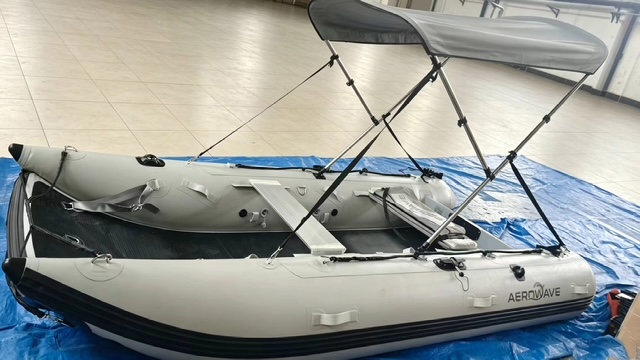
High-pressure air deck. Light, easy to inflate, cheap to replace. Perfectly fine for calm-water lake days and gentle river cruising. Fine for tenders and casual family use. Starts to feel bouncy at speed or in chop.
Aluminium floor. Stiffens the running surface into something much closer to a fibreglass hull. Better speed, drier ride, far more comfortable to stand and fish on. Adds a bit of pack weight and about ten extra minutes to setup. On the Aerowave Sovereign 400, aluminium floors are a straight A$500 upgrade and worth every dollar for lake work.
If you fish standing, run at speed, or expect chop — spec the aluminium.
Horsepower — enough, not maximum
The maximum HP rating on the transom plate is a ceiling, not a recommendation. Rivers and lakes reward different things, and neither rewards over-powering the hull.
For lake cruising — plan to sit at about 60–70 % of the rated maximum. That gives you comfortable cruise, sensible fuel burn, and reserve power for a following sea. On a Viper 400 rated to 40 hp, that's a 20–25 hp outboard for two-up cruising, or the full 40 hp if you regularly carry four adults.
For river work — go smaller, not larger. Torque and slow-speed control matter more than top-end horsepower. A 9.9 or 15 hp on a smaller catamaran gets you everywhere you need to go, uses a fraction of the fuel, and manoeuvres beautifully through corners.
We recommend the Chinese-built Hidea outboards to most of our owners because they represent honest, reliable value in the 5–40 hp range and we stock spares. Ask us for a specific match.
Fabric is safety and longevity, on both water types
This applies to lakes and rivers equally, and it is worth repeating. The single decision that determines how long your boat lasts and how safe it is in the water is the fabric.
Genuine German VALMEX® is measurably different from generic Chinese PVC. Our 1.2 mm VALMEX® Heavy Plus is 33 % thicker than the 0.9 mm VALMEX® used on comparable boats, and orders of magnitude more UV-, salt-, and abrasion-resistant than the 0.9 mm bargain PVC you'll see on entry-level imports. Service life is 10–12 years with routine care. On a river with snags and rocks, this fabric is what turns "I'd better not go near that bank" into "I'll thread that gap."
There is no version of this decision where cheaper fabric is a good idea.
Portability, storage, and the practical stuff
Two things people forget until they own the boat:
Setup and pack time. A high-pressure air-deck boat is on the water in about ten to twelve minutes with a rechargeable pump. An aluminium-floor boat adds another eight to ten. This matters if you launch three times a weekend.
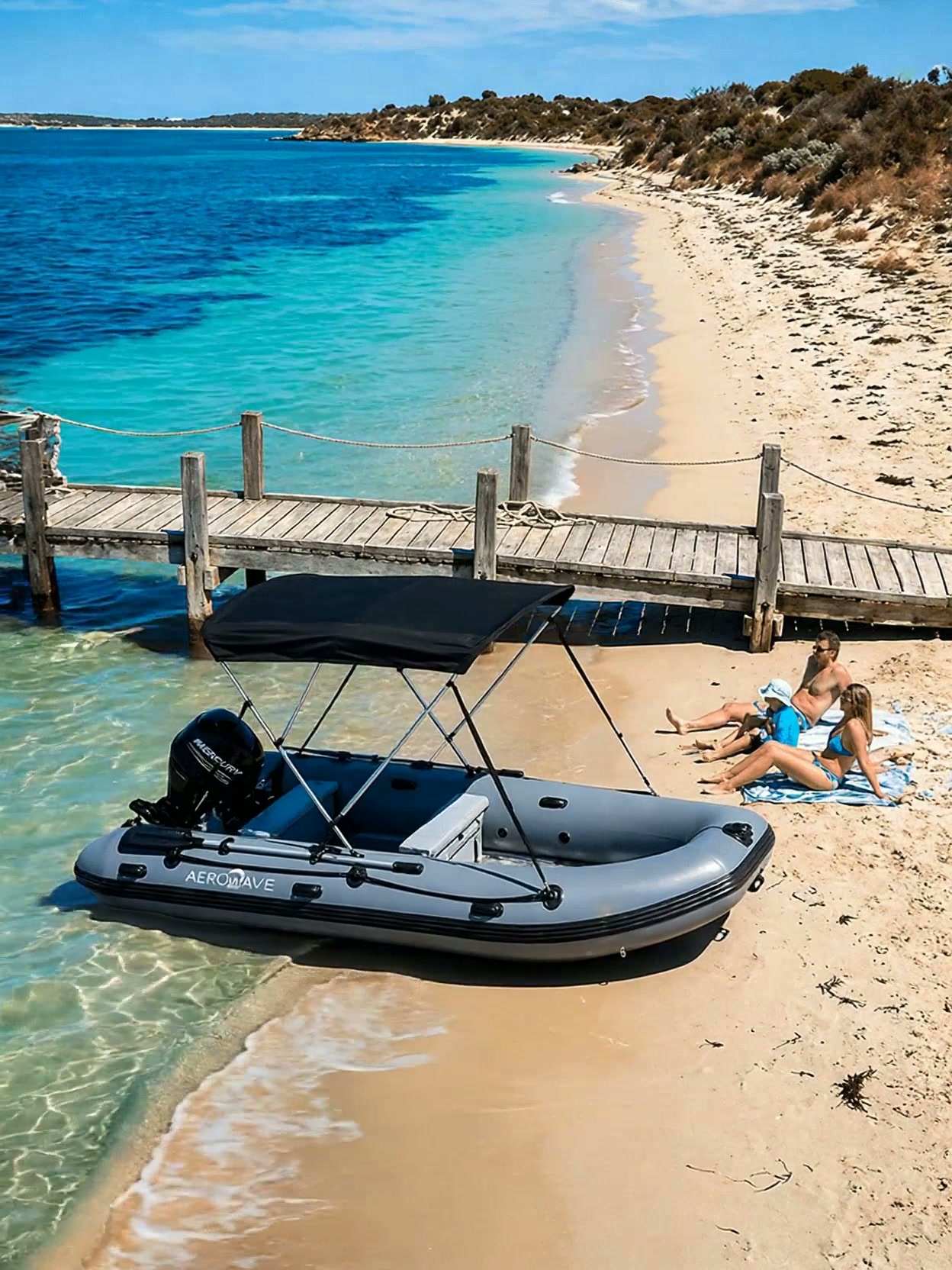
Pack size. Every Aerowave boat folds into two heavy-duty bags that fit in the boot of a normal SUV. This is the killer feature for river work — you can drive to a remote riverbank, launch, fish, pack up and drive home without ever touching a boat ramp.
For garage storage, the folded footprint is about the size of a large surfboard bag. Consider a proper wheel kit (like our LockPro Plus) if you're regularly walking the boat down a beach or riverbank.
The short answer, by scenario
- Big lakes, cruising, some fishing, two–four people: Aerowave Viper 400 Open Bow with aluminium floors, 25–40 hp.
- Big lakes, mostly fishing, want maximum deck stability: WaveRunner 380, 15–20 hp.
- Shallow rivers and estuaries, one or two people fishing: AeroCat 330 or AeroCat 360, 9.9–15 hp.
- River exploration, tender duty, ultra-portable: Swift Tender 270, 5–9.9 hp.
- Doing both regularly and want one boat: WaveRunner 380 or Viper 365 with aluminium floors.
One last honest note: nobody buying their first inflatable regrets spending an extra fifteen minutes on the phone with the builder before they commit. It is genuinely the fastest way to skip five years of learning the hard way.
Talk to us before you buy
We build these boats and we sell them direct. There is no dealer network between you and the person who can answer your question honestly. Send us the launch location, what you plan to do on board, and how many people, and we will tell you exactly which hull, floor and horsepower to spec.
The right boat, on the right water, is a decade of good weekends. The wrong one is a Facebook Marketplace listing in eighteen months. Get it right the first time.
Explore the Aerowave range
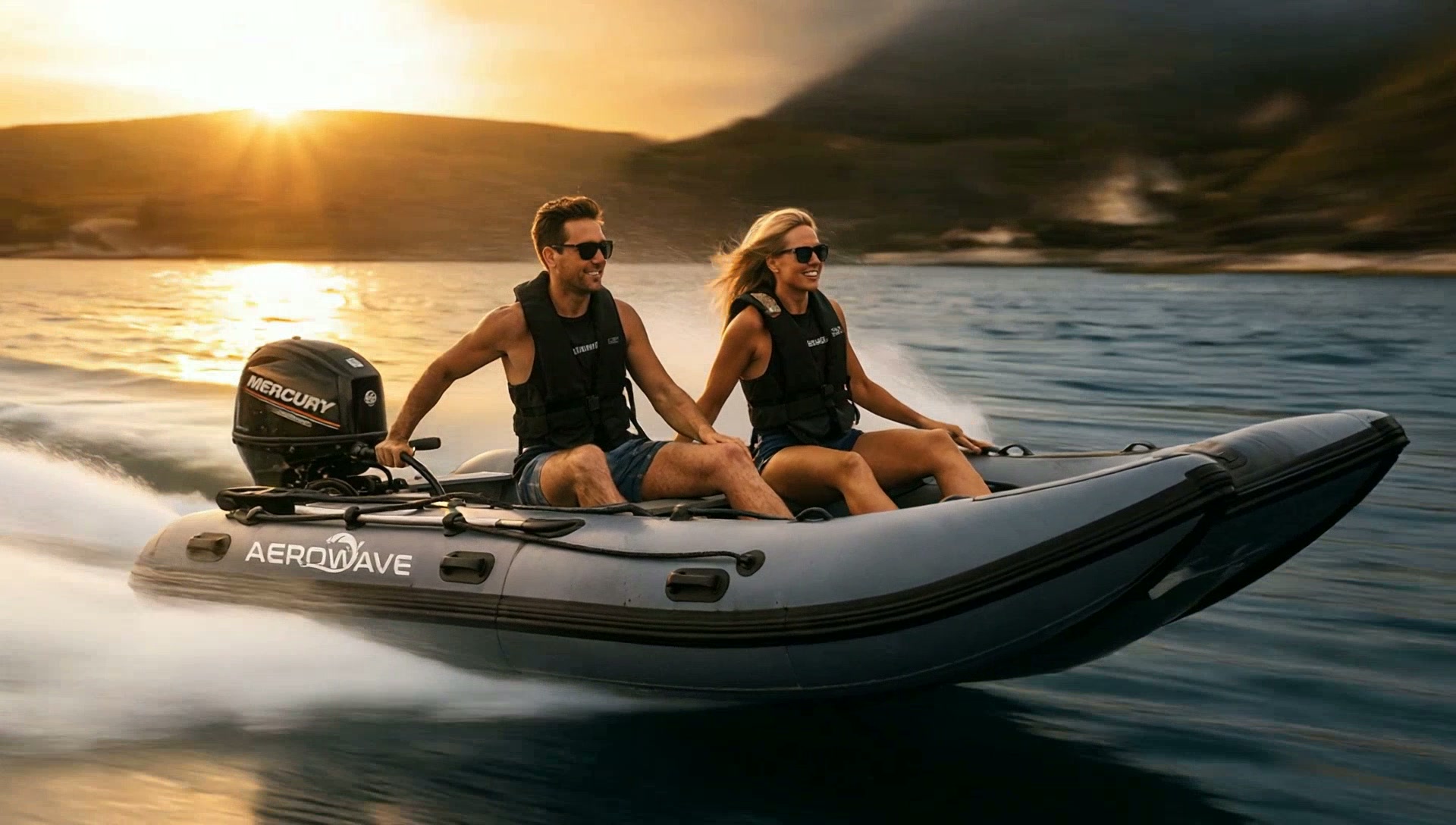
Weekend-Proof Score 17 questions · about 2 minutes
Will the boat you're about to buy survive an Australian summer?
Seventeen straight questions about where you'll use it, what you'll ask of it and the boat you're weighing up. You get a score out of 100, the exact weak points in your plan, and the one boat that genuinely fits.
Free · your result shows on screen · no email required
So which one is yours?
Pick how you'll actually use it and we'll take you straight to the right hull.
I want to fish it
Open bow, rod holders, deck space you can stand and cast from.
Viper Sport 400Family, diving and the beach
3.8 m Series 3 catamaran — low bow to climb back in wearing fins or a tank.
WaveRunner 380Tender / one-person launch
3.3 m hard-floor boat that packs into a bag and still takes a beach landing.
Viper 330Shop gear featured in this guide
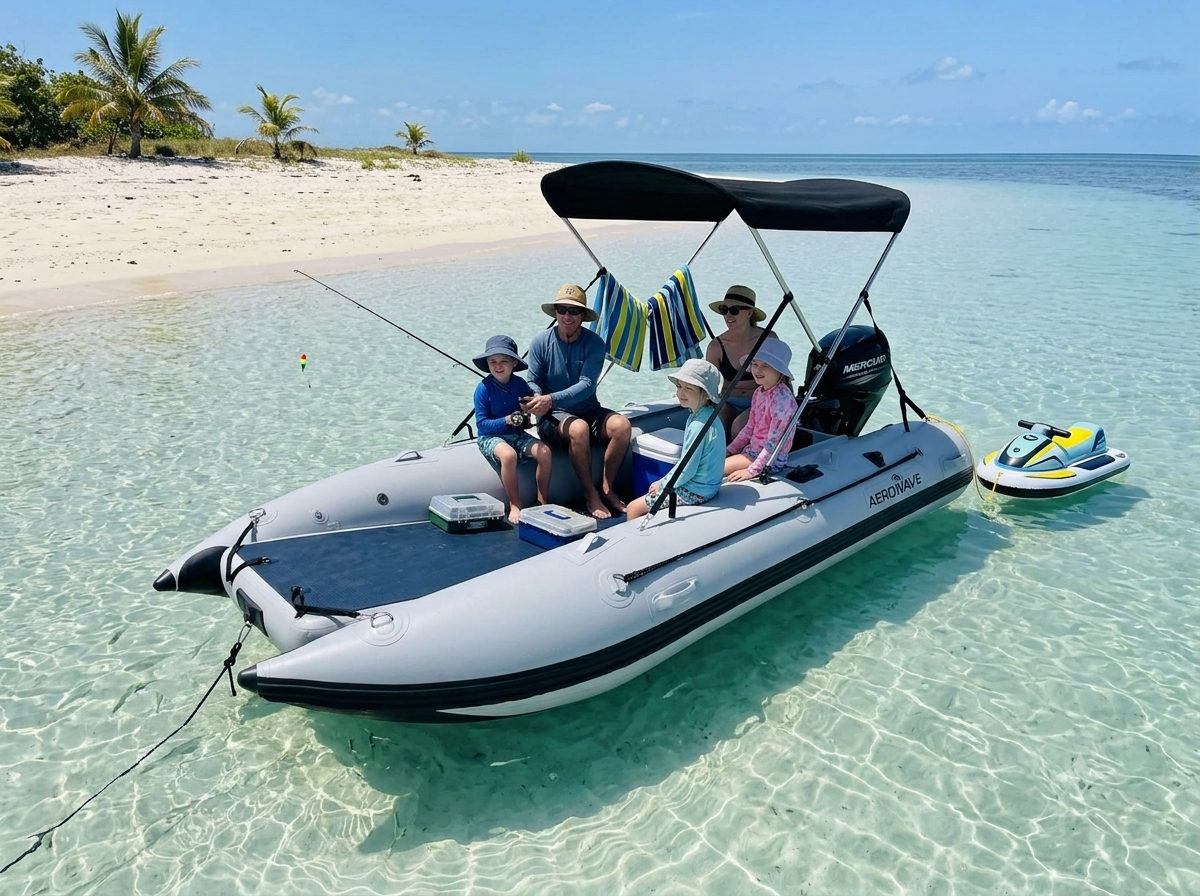
Aerowave WaveRunner 380 Series 3 Catamaran Package
The WaveRunner 380 Series 3 is a premium 3.8m inflatable catamaran package built for Australian and worldwide families, fishing, and coastal day boating — ideal for snorkeling and spearfishing — offering serious stability and premium German Valmex® construction.
Free freight to United States · local taxes payable on arrival
Aerowave Viper 400 Sovereign
Flagship 4m enclosed-bow inflatable catamaran. German VALMEX® 7321 Heavy Plus 1.2mm commercial-grade fabric, 10 PSI high-pressure drop-stitch air deck floor with VALMEX non-slip surface, LockPro wheels, full Bimini and FREE express delivery Australia-wide included. Winter special — save $1,000 until 31 August 2026.
Free freight to United States · local taxes payable on arrival
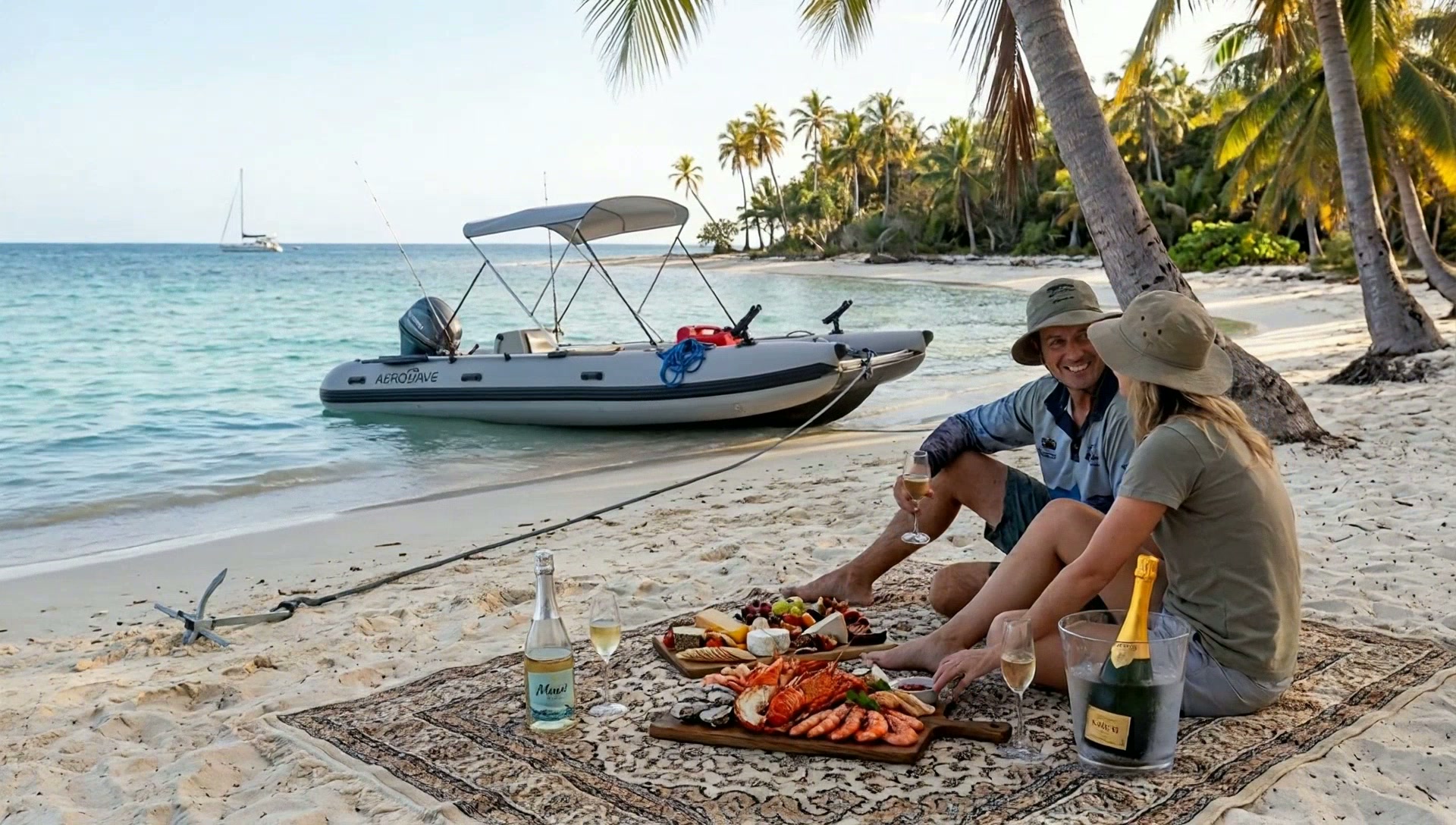
Aerowave Viper 365 Open Bow
Premium 3.65m Inflatable catamaran — built the same way as our flagship Viper 400 sports boat, just 35cm shorter. German VALMEX® 7321 Heavy Plus 1.2mm commercial-grade fabric, 10 PSI high-pressure drop-stitch air deck floor with VALMEX non-slip surface, LockPro wheels, full Bimini and FREE express delivery Australia-wide included.
Free freight to United States · local taxes payable on arrival
Not sure which suits you? Talk to a real boat owner.
Before you spend a cent
Buying from Australia, delivered to United States
You have never heard of us, we are on the other side of the world, and the internet is full of fakes. Fair enough. Here is everything you would need to check us out, in one place — no forms, no chat bot.
Australian designed business
Easy Inflatables, Avoca Beach NSW 2251. ABN 96 856 548 613. International orders ship from our Hong Kong hub.
222 owner reviews, 4.8 average
Read them in full, good and bad, on our reviews page.
CE certified, 7-year hull warranty
ISO 6185-3 and EU Directive 2013/53/EU. Warranty honoured worldwide.
Tracked, insured, door to door
FREE freight to United States · local tax/duty on arrival.
- Who am I actually buying from?
- Easy Inflatables, Avoca Beach NSW 2251, Australia. ABN 96 856 548 613. Sean is the owner and skipper, Gary Stewart handles sales on +61 2 4335 1603, Karen Matthews handles email. The boats are Australian designed; international orders ship from our Hong Kong dispatch hub so your landed price stays competitive. Phone us before you pay a cent — a real person answers.
- Is this really an Australian product?
- Yes — Australian designed and engineered on the NSW Central Coast. Manufacturing is done offshore to our spec, and international orders ship direct from our Hong Kong dispatch hub. If we routed every boat through Australia first, the freight alone would roughly double or triple your cost for the same hull.
- What do I pay, and what is not included?
- The delivery and import terms depend on your country. EU, UK, New Zealand and named Asia/Pacific lanes include duty and tax; US freight is free but US buyers pay import charges on arrival. Other destinations show their terms before payment.
- How do I pay safely?
- Card through Stripe (Visa, Mastercard, Amex, Apple Pay, Google Pay) or bank transfer. Card payments carry your bank's own dispute protection. We never ask for crypto, gift cards or payment to a personal account.
- What if it arrives damaged?
- Every boat ships fully tracked and insured door to door. Photograph the carton and the boat on arrival and email us — transit damage is claimed and replaced through us, not left with you and the courier.
- Is the warranty real outside Australia?
- Yes. The 7-year hull warranty on 1.2 mm VALMEX Heavy Plus and Orca Hypalon hulls applies wherever you are. Replacement parts are held in Australia and at our overseas hub and go out by express courier to your door.
- Is the boat actually certified?
- All Aerowave catamarans are CE certified to ISO 6185-3 and EU Directive 2013/53/EU. Certification paperwork is supplied with the boat — ask and we will send it before you order.
Frequently asked questions
- What's the single biggest difference between a lake boat and a river boat?
- Draft and manoeuvrability. Rivers punish anything that sits deep or turns wide; lakes reward stability and range. If you had to pick one number, pick draft — a shallow-draft catamaran opens up river water a monohull can't safely reach.
- Is a catamaran better than a monohull for shallow water?
- Yes, generally. A twin-hull catamaran of the same length draws significantly less water than an equivalent monohull because the volume is spread across two tubes rather than a single hull. That's why our Aerowave catamarans are a favourite on shallow river systems and estuaries.
- Do I need a bigger engine on a lake than a river?
- Usually yes. Lakes give you room to run, so range and cruise speed matter more. Rivers reward torque and control at low speed rather than top-end horsepower. Match the engine to your realistic use, not the maximum HP rating.
- Can one inflatable boat genuinely do both?
- Absolutely. That's the strength of the format — a well-specced Aerowave catamaran or open-bow monohull will happily punch across a lake in the morning and thread a river in the afternoon. This guide covers exactly how to spec it.
- What about snags and rocks in a river?
- This is where welded seams and premium fabric earn their price. Our 1.2 mm VALMEX® Heavy Plus is genuinely abrasion-resistant, and the multi-chamber layout means even a rare puncture won't end your day.
- Are inflatable boats stable enough for lake fishing?
- More stable than most fibreglass boats their size. The tubes act as huge outrigger floats, so casting, netting fish or standing to sight-cast is far less tippy than a mono-hull tinnie.
- What's the minimum floor upgrade you'd recommend?
- A high-pressure air deck is fine for calm lake and slow river. If you're planning to run at 20 kn+ or fish standing regularly, aluminium floors give you a stiffer, drier ride.
Ready to set sail?
Premium German-fabric inflatable catamarans, built to order and delivered to your door. Talk to our team or browse the fleet.
Like this guide? Get the next one in your inbox.
Owner-tested tips, gear deep-dives and Aussie boating know-how — no spam.