How to Maintain an Inflatable Boat: The Complete 2026 Guide
Ten minutes of routine after every trip, twenty minutes at end of season, and one honest storage habit. Do these and a quality inflatable will give you 10–12 years.
At a glance
Ten minutes of routine after every trip, twenty minutes at end of season, and one honest storage habit. Do these and a quality inflatable will give you 10–12 years.
- The after-every-trip routine — ten minutes
- The one habit that ruins boats
- Storage — where boats live between trips
- UV — the invisible enemy
What we'd put you in
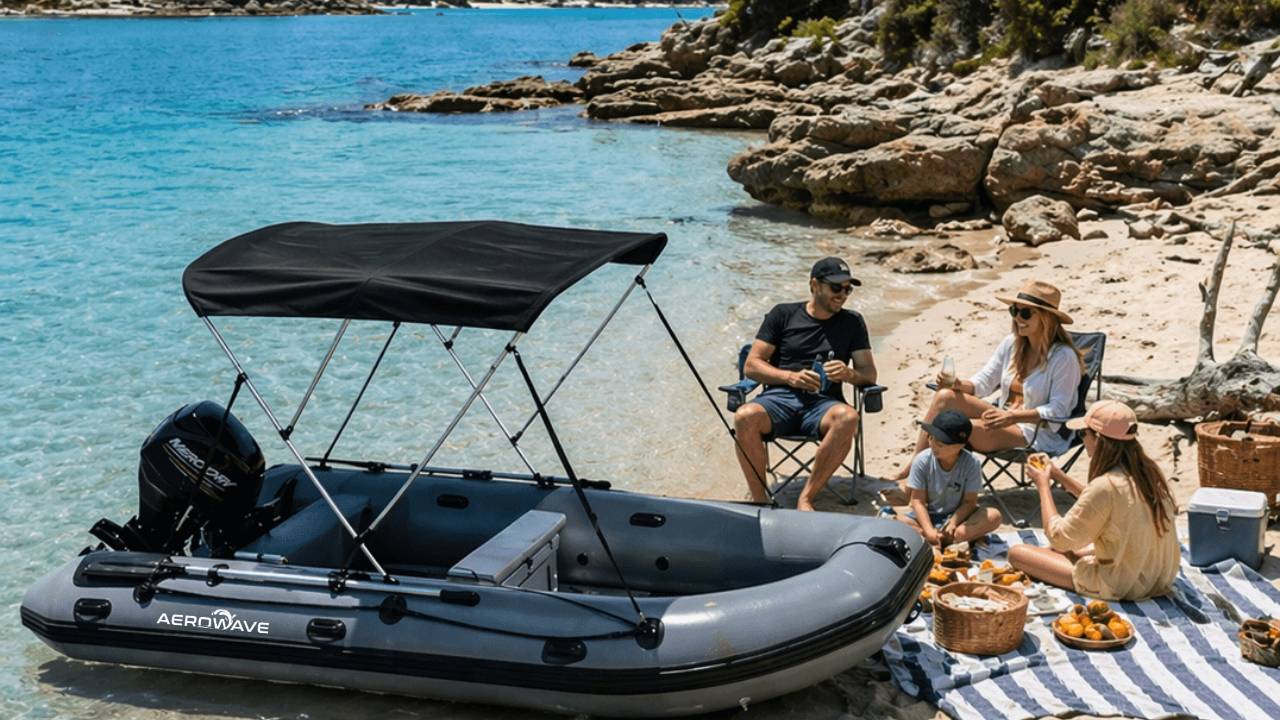
Aerowave Viper 400 Sovereign
Our best-selling boat: 4.0 m, 1.2 mm VALMEX hull, 7-year hull warranty.
US$3,167 USD
Delivered to your door, today's rate
- Free freight to United States · local taxes payable on arrival
- 7-year hull warranty
🇺🇸 Shipping to United States · landed price quoted in writing
Yes — we ship the Aerowave Viper 400 Sovereign to United States. Here's the landed price.
Our best-selling boat: 4.0 m, 1.2 mm VALMEX hull, 7-year hull warranty.
Aerowave Viper 400 Sovereign
- Boat package (export price)
- US$3,726
- 15% tariff relief credit
- − US$559
- Express air freight to United States
- Included
- Import duty, taxes & customs clearance
- Payable on arrival
- Estimated landed, USD
- US$3,167
Indicative, converted at today's rate, before local duty and tax on arrival. Ask below and we'll put a fixed figure in writing, valid 30 days.
- 7-year hull warranty
- 1500 GSM / 1.2 mm VALMEX® Heavy Plus hull
- CE certified to ISO 6185-3 and EU Directive 2013/53/EU
- Door-to-door, tracked the whole way
Your price, delivered to your door — freight included.
We email the full PDF quote (spec, freight, finance, WavePay) to your inbox in under 60 seconds. No spam — one quote, one follow-up.
See it for yourself
Real boats. Real owners. Real people behind them.
Plenty of what you read online these days is generated. Check us out properly — the factory, the reviews and the owners are all one click away. Why we use AI, and how to check we’re real
How our boats are built
Walk the production line: thermo-welded seams, 1.2 mm VALMEX Heavy Plus hulls, over-pressure relief valves on every chamber.
See the buildGoogle Maps reviews
Real Australian owners, five stars, published on our Google Business Profile with the map — read them there, not just on our own site.
Open Google Maps reviewsOwner stories
Boats in use — offshore, on rivers, on rescue duty. Photos and words from the people who actually own them.
Read owner storiesHow to Maintain an Inflatable Boat: The Complete 2026 Guide
Most people who own a quality inflatable boat get more than a decade out of it. A small number get three years and a Facebook Marketplace listing. The difference is almost never the boat — it's the routine.
The good news is that the routine is genuinely short. Ten minutes after every trip, twenty minutes at end of season, and one honest storage habit. That is the whole game. This is the same maintenance schedule we send to Aerowave owners with their welcome pack, condensed into a single article you can bookmark.
We build the Aerowave range in Australia and ship it worldwide. The fabric under your feet is the same 1.2 mm VALMEX® Heavy Plus that goes into commercial ribs and defence tenders. Treated properly, it will outlast the outboard. Here's how.
The after-every-trip routine — ten minutes
If you take one thing from this article, take this: rinse, dry, don't fold wet. Everything else is optimisation.
1. Rinse with fresh water while the boat is still wet. Every time it has touched salt water — no exceptions, no "I'll get it next weekend." Salt crystals are microscopic razor blades that grind between the fabric fibres every time the boat flexes. A ten-minute hose down before the boat dries washes them out before they can do work. Pay particular attention to the seams, the transom fittings, the D-rings, and inside the tubes near the valves.
2. Sponge off any grit, oil, sand or diesel. A soft sponge and warm fresh water is enough. If something has genuinely stained the fabric (fish blood, sunscreen, spilled two-stroke oil), a mild pH-neutral marine soap works. Never use household detergents, kitchen degreasers, methylated spirits, acetone or any petrochemical solvent — they attack the plasticiser in the PVC coating and shorten fabric life.
3. Let the boat air-dry completely. Twenty minutes upside-down on a lawn on a summer afternoon, longer in winter. Any residual moisture that gets folded into the boat is a mould and mildew factory.
4. Bleed pressure before you leave it in the sun. If you're not packing up immediately and the boat is going to sit in direct sun for more than an hour or so, open the over-pressure valves or bleed 10 % pressure from each tube. Air expands as it heats. On a 40 °C Australian day sitting on hot concrete, pressure inside a sealed tube can climb well past the design limit. The over-pressure valves exist to prevent exactly this — use them.
5. Check the transom bolts and valve caps. Sixty seconds, once. Loose transom bolts are the second most common preventable failure we see. Loose or missing valve caps let dust and moisture into the valve seat and eventually cost you pressure retention.
That's the routine. Ten minutes. Do it every trip and the boat pays you back tenfold.
The one habit that ruins boats
Folding a wet boat into a hot bag.
We could write this section as five hundred words on mould, hydrolysis, seam stress and delamination, or we could just tell you not to do it. Please, honestly, don't do it. If you must pack up before the boat is fully dry — leave the bag open, park somewhere the air can move over it, and unpack it as soon as you're home to finish the dry. Fifteen minutes of admin at the end of a trip saves you years off the boat.
Storage — where boats live between trips
Storage is where the biggest longevity gains and losses happen.
Best-case storage. Loosely inflated (roughly 50 % of running pressure), on a soft-covered rack or trolley, in a shaded space out of direct UV, with the over-pressure valves open. Somewhere that stays between about 5 °C and 30 °C. A garage, shed or covered carport is perfect. This lets the fabric relax at natural shape, avoids repeated hard folds through the same crease points, and eliminates any temperature-cycle stress on the seams.
Realistic storage. Deflated, cleanly folded (loosely, not tightly), in its transport bag, in a dry indoor space. Every Aerowave boat is designed to fold this way and lives happily like this for months at a time. The key words are dry and indoor. A boat stored under a tarp outside in an Australian summer is being cooked. A boat stored in a leaky garage over a wet winter is growing mould.
Bad storage — things not to do.
- Do not store fully inflated in direct sun, ever.
- Do not store folded and wet.
- Do not store with heavy objects sitting on top of the fabric.
- Do not store next to fuel, solvents, chlorine or acids.
- Do not store on bare concrete for months at a time — put a soft mat under it.
Rotate the fold occasionally. If the boat lives in its bag for six months, take it out and re-fold it a slightly different way once every couple of months. Same idea as rotating tyres — you're spreading the wear.
UV — the invisible enemy
More inflatable boats die of UV than punctures, salt, and accidents combined.
VALMEX® has excellent UV inhibitors in the coating, which is a large part of why our 1.2 mm Heavy Plus hulls run to 10–12 years. But no amount of coating chemistry beats the physics of aggressive Australian, southern Californian, Mediterranean or Middle Eastern sun. Every hour the boat sits in direct UV is an hour of measurable wear.
Two habits address 90 % of UV damage.
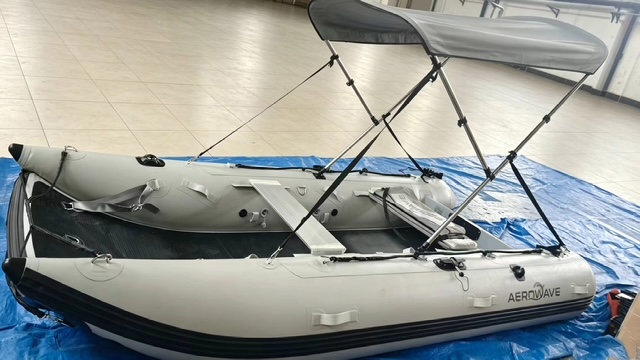
In use — keep a light-coloured cover, bimini or sun canopy over the boat when it's stationary at a mooring or anchored for an afternoon. Every Aerowave WaveRunner 380 ships with a grey or black bimini as standard for exactly this reason.
Between trips — store the boat covered and out of direct sun, always. If the only option is outdoor storage, a proper UV-rated marine cover pays for itself in the first year alone.
Valve care — five minutes a season
The valves are the second-most-important system on the boat after the fabric itself, and the least serviced. Do this once a year, at end of season.
Each tube has an inflation/deflation valve and, on Aerowave hulls, an over-pressure relief valve. Both have a captive plunger and a rubber seat. Both attract dust, sand and salt crystals into the seat area, which is what causes the slow overnight pressure loss owners often blame on a mystery leak.
Routine. Deflate the tube. Unscrew the valve base with the valve key that ships in your patch kit. Rinse the valve and the plunger seat with clean fresh water. Blot dry with a clean lint-free cloth. A tiny drop — genuinely one drop — of silicone-based valve lubricant on the O-ring. Screw the valve back in, finger-tight plus a nudge with the key. Do all valves. Re-inflate.
That five-minute annual routine keeps overnight pressure loss to a barely-measurable level for the life of the boat.
Seam inspection — one minute a season
If your boat has welded seams — every Aerowave does — this is a one-minute job. Run your fingers along every seam, inside and out, looking for any sign of lifting, discolouration or dimpling. On a properly welded VALMEX® seam, there will not be any. If there is anything unusual, photograph it and send it to us. We warranty every seam on every Aerowave hull.
If your boat has glued seams — and if you're not sure, ask — this inspection is more important. Glued seams age with UV and heat, and small lifts can propagate into full delamination if left. This is one of the many reasons welded construction is worth paying for.
The onboard patch kit
Every Aerowave boat ships with a patch kit. Know where it is, and know how to use it. Genuinely, you may go ten years without needing it — but the day you do, five minutes of practice at home pays off enormously.
What's in it. Two matching fabric off-cuts, a small tube of VALMEX-compatible adhesive, a valve key, a spare over-pressure valve cap, a strip of wet-and-dry sandpaper.
How to use it. Dry the area thoroughly. Rough the fabric surface and the underside of the patch with the sandpaper. Apply a thin, even coat of adhesive to both surfaces. Let both go tacky (about five minutes). Press the patch firmly on with a smooth roller or the back of a spoon, working from the centre outwards to push out air bubbles. Weight the patch down for 24 hours before re-inflating.
If you're at sea and need an emergency repair to get home, the same procedure works with the boat partially deflated — you just won't get the full permanent bond until you can complete the cure at home.
Annual service — twenty minutes, once a year
End of season, before it goes into storage:
- Full wash inside and out with fresh water and a soft brush.
- Deep dry, ideally 24 hours in a shaded, ventilated space.
- Full valve service as above.
- Full seam inspection as above.
- Check every D-ring, grab line, seat mount and floorboard clip. Tighten anything that's loosened.
- Check the transom bolts and re-torque if needed (the torque spec is in your owner's manual).
- Inspect the pump for wear on the hose and fittings.
- UV protectant. A single wipe-over with a marine-grade UV protectant (303 Aerospace Protectant is the industry benchmark) once a year. Do not use tyre-shine sprays — they contain solvents that attack PVC.
- Fold cleanly and pack away, dry, into the storage bag.
- Log the date somewhere. Next year, do it again on the same date.
Twenty minutes. Once a year. That's the whole thing.
What builders can offer that dealers cannot
We build these boats. When something goes wrong — and occasionally, over a decade of use, something does — we can send a replacement panel, ship a new valve, replace a floorboard, or courier a factory patch. That relationship with the actual builder is worth as much as any of the maintenance advice in this article.
Every Aerowave boat is backed by a five-year warranty (five to seven on selected Viper models), with parts held in Australia and in our Hong Kong hub for worldwide DHL Express dispatch. Nothing about ownership dead-ends at the boat leaving the ramp for the first time.
The short version
- Rinse every trip. Dry every trip. Never fold wet.
- Store loosely inflated in shade, or cleanly deflated in its bag, indoors, dry.
- Keep it out of the sun when it's not being used.
- Five minutes of valve care once a year.
- One minute of seam inspection once a year.
- Twenty-minute annual service, end of season.
- Know where the patch kit is.
Do this and the boat will genuinely give you a decade of good weekends. Skip it and no fabric on earth can save you.
Further reading
- Are Inflatable Boats Safe for Open Water?
- Aerowave Viper 400 Sovereign — flagship catamaran with full 1.2 mm VALMEX® Heavy Plus construction.
- Safety & Compliance — CE certification, warranty and Boat Code Certificate.
The five-minute routine that does 80% of the work
Do this every single trip and you will almost never need the harder jobs:
- Fresh-water rinse — hull, tubes, transom, floor, and especially the underside of the tubes where salt collects.
- Flush the outboard while you rinse the boat.
- Sponge out the tunnel and floor, then tip the water out through the drains.
- Wipe the valve recesses dry — salt crystals in a valve are the number-one cause of slow leaks.
- Dry before it folds. Fabric folded wet grows mould that stains permanently and stiffens the coating.
Seasonal schedule
| When | Job |
|---|---|
| Every trip | Rinse, flush, dry, valves wiped |
| Monthly | Pressure check cold, inspect seams and rubbing strake, check transom bolts |
| Quarterly | Deep clean with a pH-neutral marine wash, treat fabric with a UV protectant, service valves |
| Annually | Full seam inspection, replace patch-kit adhesive (it has a shelf life), outboard service, check grab lines and D-rings |
| Before storage | Wash, dry completely, deflate to ~50%, store loosely rolled in a cool dark place — never pressed flat under weight |
Salt and UV: the two things that actually age your boat in Australia
Nothing in the Australian climate is gentle. UV degrades coatings, and salt is abrasive and hygroscopic — it holds moisture against the fabric and inside fittings.
- UV: shade it. A Bimini, a cover, or a garage. Never store a boat inflated in direct summer sun with the over-pressure valves closed — heat expands air and you can force a seam.
- Salt: rinse every time, no exceptions. Two minutes with a hose is the cheapest maintenance you will ever do.
This is where fabric grade shows. Our premium hulls use 1500 GSM / 1.2 mm VALMEX® Heavy Plus — a 10–12 year service life with this routine. Our entry tier uses 1100 GSM / 0.9 mm VALMEX®, the same fabric most imported boats are built on, and it wants the same care to reach its own life expectancy. Two tiers, both ours, both honest about what they are.
Pressure, temperature and the mistake most owners make
Air pressure moves with temperature. A boat pumped to 10 PSI at 7 am on a cool morning can be well over spec by midday on a hot deck. That is what over-pressure valves are for, but the habit matters:
- Inflate to spec in the shade, not on hot sand.
- Bleed a little air if the boat has been sitting in the sun and the tubes feel drum-tight.
- Top up in the water, not on the trailer, when you can — the hull is supported evenly.
Small repairs, done properly
A pinhole leak is a 20-minute job, not a warranty claim:
- Find it with soapy water; mark it with a pencil.
- Deflate the chamber fully and clean both surfaces with the solvent supplied in your kit.
- Cut a round patch — round, never square; corners peel.
- Two thin coats of adhesive, wait for tack, press from the centre out, roll it flat.
- Leave 24 hours before inflating. Do not rush this step.
Seam separations, valve-base failures and fabric delamination are different — those are ours to look at. Send photos to the team and we will tell you straight whether it is a repair or a warranty item.
What will void your warranty
- Petrol, acetone, thinners, bleach or degreaser on the fabric.
- Pressure washing the seams.
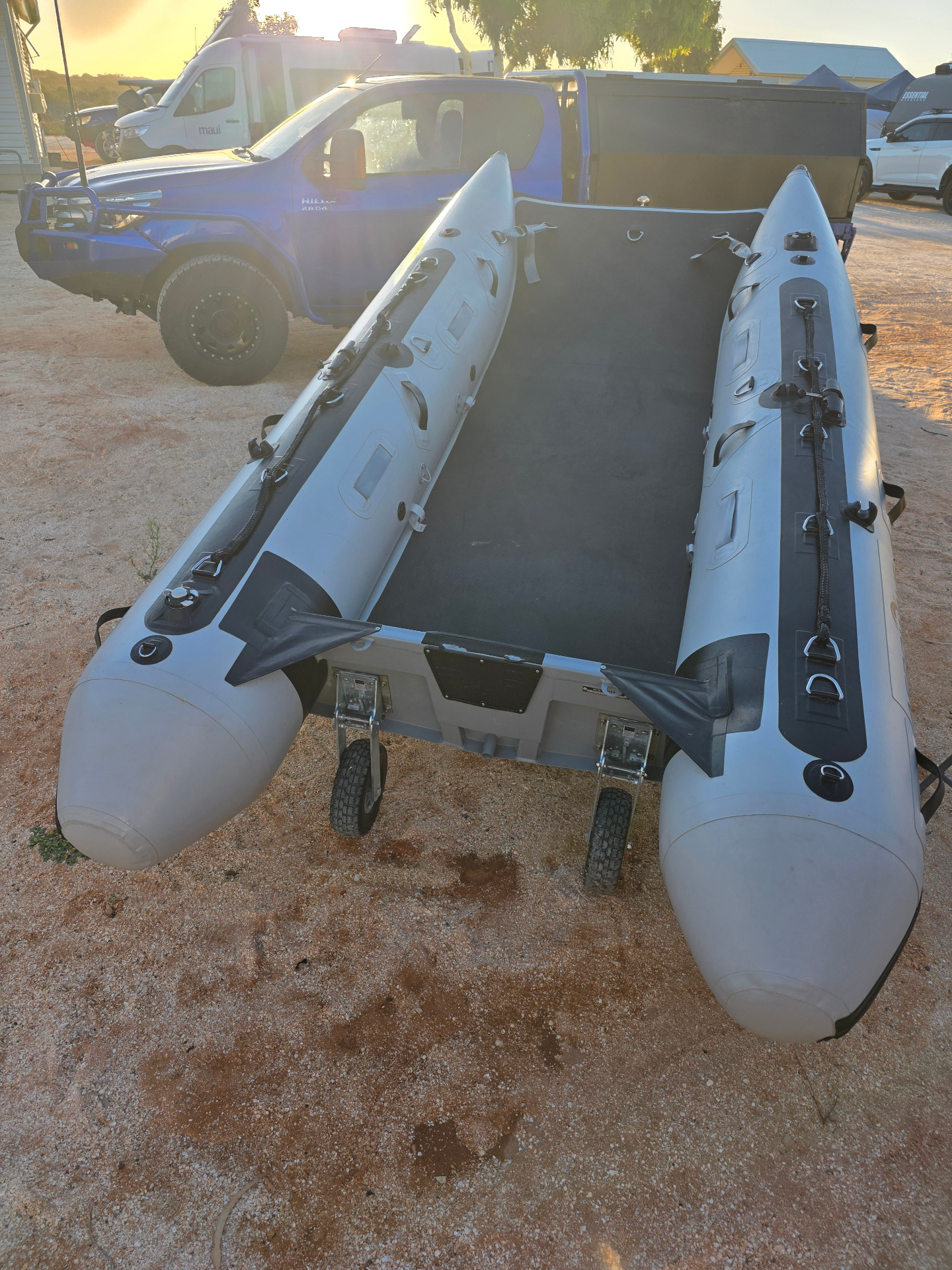
- Dragging the boat loaded across rock or oyster — use the wheel kit.
- Storing inflated in direct sun under pressure.
- Long-term storage wet or folded tight under weight.
Full terms are on the warranty page. Registration is automatic on boat purchases — you do not need to do anything.
Keep it simple
Rinse, dry, shade, correct pressure. Four habits. Do them and a properly built inflatable will outlast the car you tow it with. Questions about your specific boat? Call +61 2 4335 1603 or see the full range.
Explore the Aerowave range
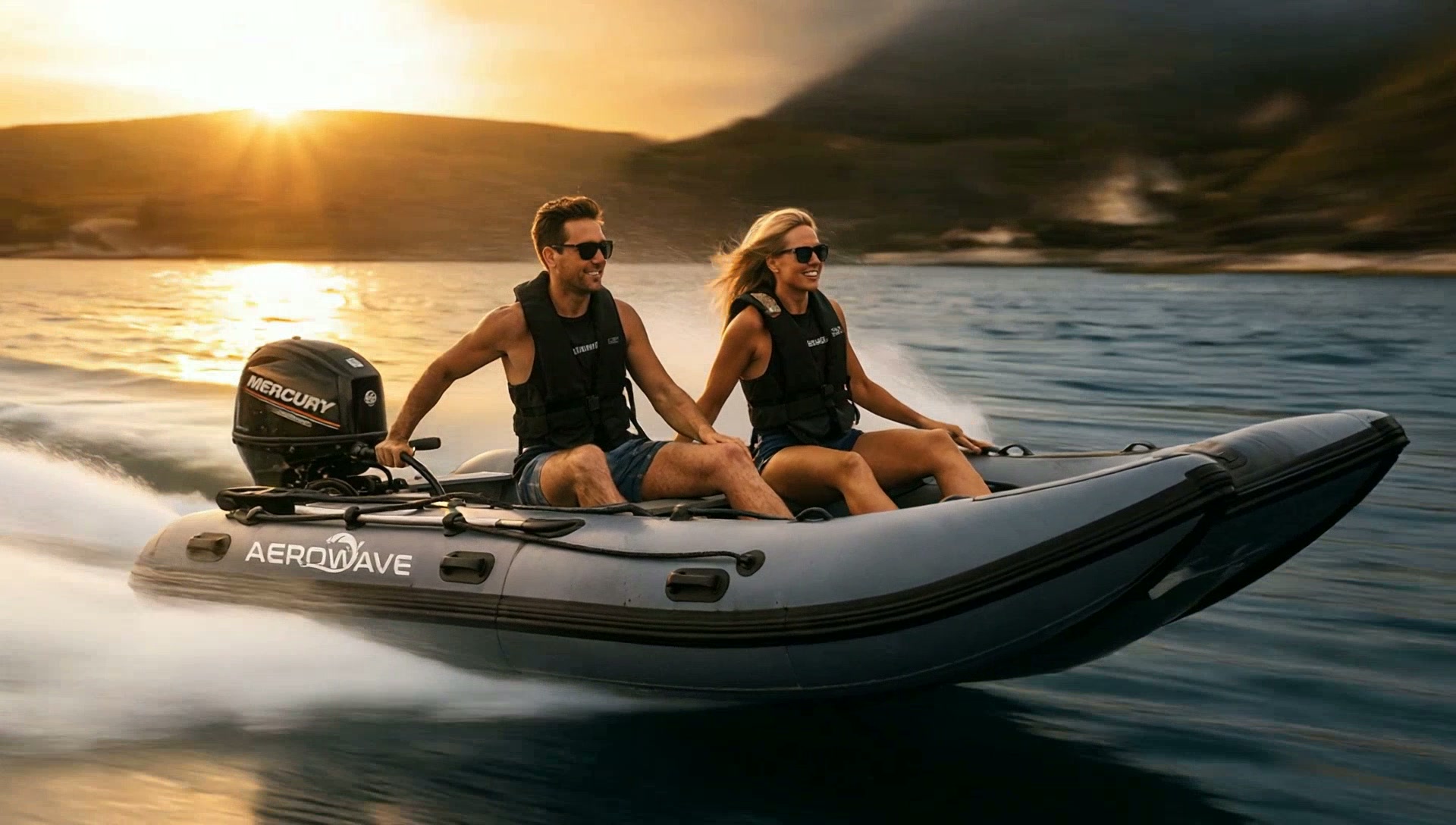
Weekend-Proof Score 17 questions · about 2 minutes
Will the boat you're about to buy survive an Australian summer?
Seventeen straight questions about where you'll use it, what you'll ask of it and the boat you're weighing up. You get a score out of 100, the exact weak points in your plan, and the one boat that genuinely fits.
Free · your result shows on screen · no email required
So which one is yours?
Pick how you'll actually use it and we'll take you straight to the right hull.
I want to fish it
Open bow, rod holders, deck space you can stand and cast from.
Viper Sport 400Family, diving and the beach
3.8 m Series 3 catamaran — low bow to climb back in wearing fins or a tank.
WaveRunner 380Tender / one-person launch
3.3 m hard-floor boat that packs into a bag and still takes a beach landing.
Viper 330Shop gear featured in this guide
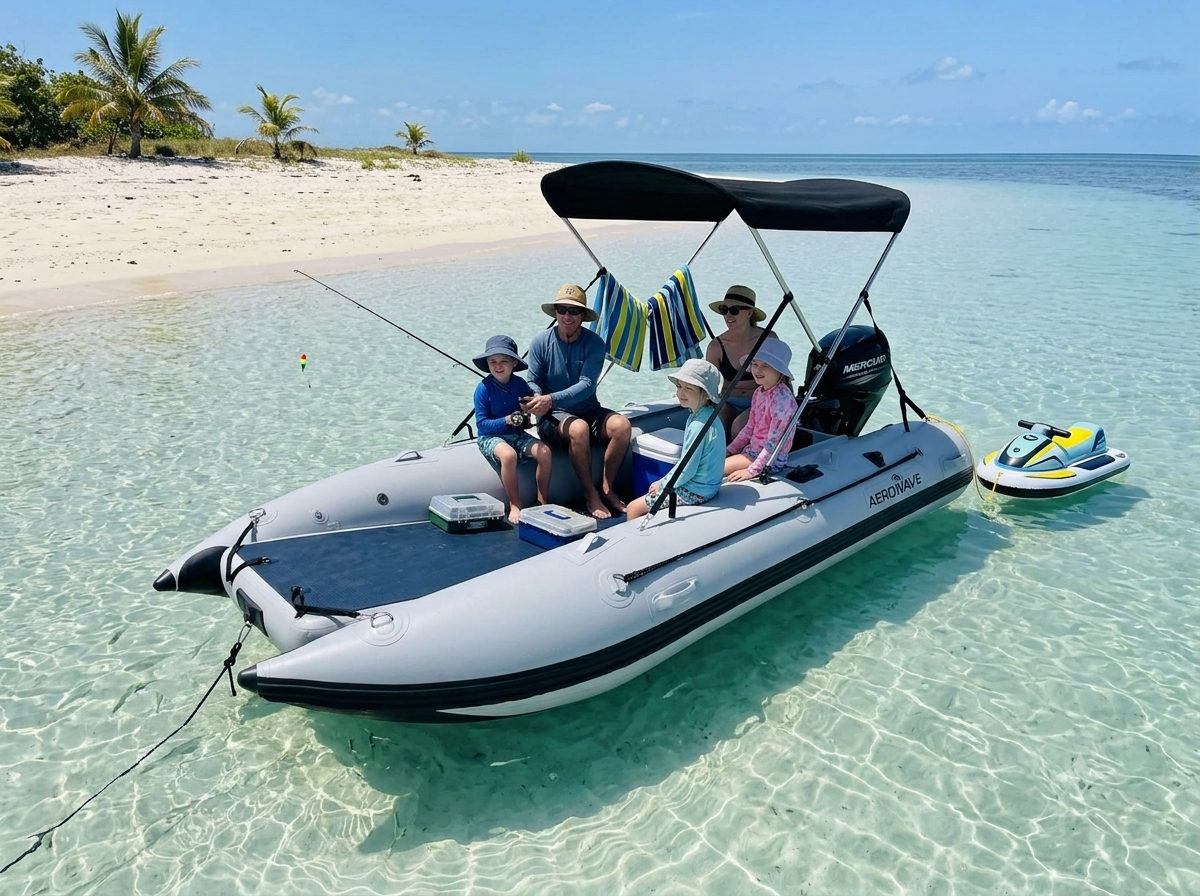
Aerowave WaveRunner 380 Series 3 Catamaran Package
The WaveRunner 380 Series 3 is a premium 3.8m inflatable catamaran package built for Australian and worldwide families, fishing, and coastal day boating — ideal for snorkeling and spearfishing — offering serious stability and premium German Valmex® construction.
Free freight to United States · local taxes payable on arrival
Aerowave Viper 400 Sovereign
Flagship 4m enclosed-bow inflatable catamaran. German VALMEX® 7321 Heavy Plus 1.2mm commercial-grade fabric, 10 PSI high-pressure drop-stitch air deck floor with VALMEX non-slip surface, LockPro wheels, full Bimini and FREE express delivery Australia-wide included. Winter special — save $1,000 until 31 August 2026.
Free freight to United States · local taxes payable on arrival
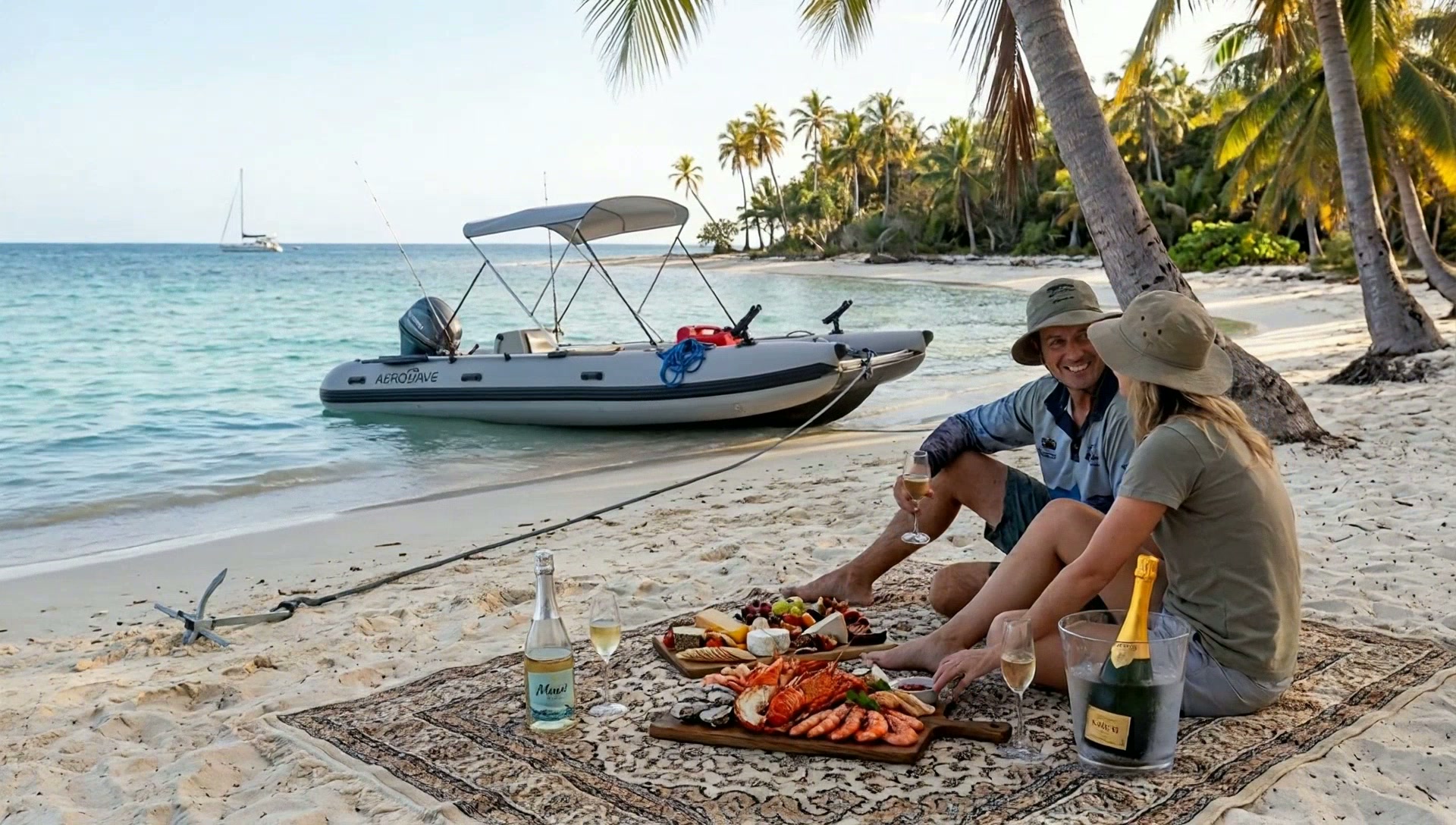
Aerowave Viper 365 Open Bow
Premium 3.65m Inflatable catamaran — built the same way as our flagship Viper 400 sports boat, just 35cm shorter. German VALMEX® 7321 Heavy Plus 1.2mm commercial-grade fabric, 10 PSI high-pressure drop-stitch air deck floor with VALMEX non-slip surface, LockPro wheels, full Bimini and FREE express delivery Australia-wide included.
Free freight to United States · local taxes payable on arrival
Not sure which suits you? Talk to a real boat owner.
Before you spend a cent
Buying from Australia, delivered to United States
You have never heard of us, we are on the other side of the world, and the internet is full of fakes. Fair enough. Here is everything you would need to check us out, in one place — no forms, no chat bot.
Australian designed business
Easy Inflatables, Avoca Beach NSW 2251. ABN 96 856 548 613. International orders ship from our Hong Kong hub.
222 owner reviews, 4.8 average
Read them in full, good and bad, on our reviews page.
CE certified, 7-year hull warranty
ISO 6185-3 and EU Directive 2013/53/EU. Warranty honoured worldwide.
Tracked, insured, door to door
FREE freight to United States · local tax/duty on arrival.
- Who am I actually buying from?
- Easy Inflatables, Avoca Beach NSW 2251, Australia. ABN 96 856 548 613. Sean is the owner and skipper, Gary Stewart handles sales on +61 2 4335 1603, Karen Matthews handles email. The boats are Australian designed; international orders ship from our Hong Kong dispatch hub so your landed price stays competitive. Phone us before you pay a cent — a real person answers.
- Is this really an Australian product?
- Yes — Australian designed and engineered on the NSW Central Coast. Manufacturing is done offshore to our spec, and international orders ship direct from our Hong Kong dispatch hub. If we routed every boat through Australia first, the freight alone would roughly double or triple your cost for the same hull.
- What do I pay, and what is not included?
- The delivery and import terms depend on your country. EU, UK, New Zealand and named Asia/Pacific lanes include duty and tax; US freight is free but US buyers pay import charges on arrival. Other destinations show their terms before payment.
- How do I pay safely?
- Card through Stripe (Visa, Mastercard, Amex, Apple Pay, Google Pay) or bank transfer. Card payments carry your bank's own dispute protection. We never ask for crypto, gift cards or payment to a personal account.
- What if it arrives damaged?
- Every boat ships fully tracked and insured door to door. Photograph the carton and the boat on arrival and email us — transit damage is claimed and replaced through us, not left with you and the courier.
- Is the warranty real outside Australia?
- Yes. The 7-year hull warranty on 1.2 mm VALMEX Heavy Plus and Orca Hypalon hulls applies wherever you are. Replacement parts are held in Australia and at our overseas hub and go out by express courier to your door.
- Is the boat actually certified?
- All Aerowave catamarans are CE certified to ISO 6185-3 and EU Directive 2013/53/EU. Certification paperwork is supplied with the boat — ask and we will send it before you order.
Frequently asked questions
- How often should I rinse the boat?
- Every time it touches salt water, without exception. Fresh water, ten minutes with a hose, before it dries. Salt crystals are the single biggest cause of premature fabric wear on inflatable boats.
- How long does an inflatable boat actually last?
- A hull built on genuine 1.2 mm VALMEX® Heavy Plus and cared for properly gives you 10–12 years of real-world service. A hull built on generic 0.9 mm Chinese PVC often gives you three to seven, no matter how well you look after it.
- Can I leave the boat inflated in the sun?
- Not for long, and never on a hot day with the over-pressure valves closed. Air expands as it heats. Fit and open the over-pressure valves, or partially deflate the boat if it will be sitting in direct sun for hours.
- What's the correct storage — inflated or deflated?
- Ideally, loosely inflated on a covered rack or trolley, out of UV. Second best is deflated in its bag, dry, in a cool space. Never store wet, never store fully inflated in a hot garage, and never fold sharp creases through the same spot repeatedly.
- Do welded seams need any care?
- Very little. Rinse them with fresh water, inspect once a season for any signs of lifting (there won't be any on a welded boat), and keep them out of prolonged UV. That's it — no sealants, no adhesives, no annual re-glue.
- What should be in my onboard patch kit?
- Two matching fabric patches, a small tube of VALMEX-compatible adhesive, a valve key, a spare over-pressure valve cap, and a strip of wet-and-dry sandpaper. Every Aerowave ships with the kit.
- When should I do the annual service?
- Once a year, ideally at end of season before it goes into storage. Twenty minutes with the checklist in this article covers everything.
Ready to set sail?
Premium German-fabric inflatable catamarans, built to order and delivered to your door. Talk to our team or browse the fleet.
Like this guide? Get the next one in your inbox.
Owner-tested tips, gear deep-dives and Aussie boating know-how — no spam.