
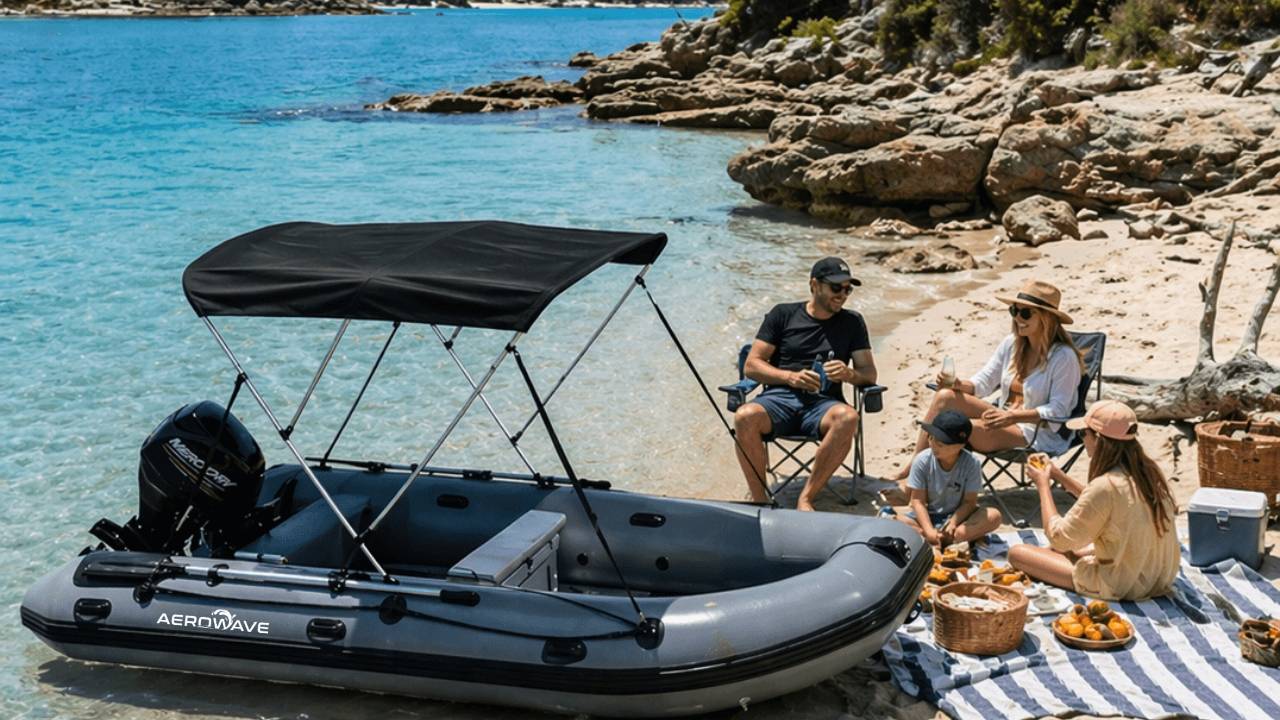
Inflatable Rescue Boat Australia: 2026 Buyer's Guide
What separates a genuine inflatable rescue boat from a recreational inflatable — fabric, seams, transom, deployment speed and compliance — plus how to spec one for surf, flood and patrol work in Australia.
Our recommendation
Aerowave Viper 400 Sovereign
1.2 mm fabric is about 33% thicker than common 0.9 mm fabric: more material between your boat and the water for everyday rubbing and knocks during beach launches. Careful handling still matters.
Length
4.0m / 13'1"
Beam
1.80m / 71"
Tube Diameter
51cm
Bare Boat Weight (without Bimini & wheel kit)
66kg / 145lbs
A rescue boat is judged on the worst day it is ever used, not the average one.
Inflatable rescue boats sit at the demanding end of the inflatable boat market. Surf clubs, SES units, councils, marine contractors and remote stations all need the same three things: the boat inflates and launches fast, it takes abuse without failing, and it carries crew plus a casualty without becoming unstable.
This guide covers how to spec one properly in Australia.
What makes a boat a rescue boat
1. Fabric that survives contact
Rescue boats meet rocks, concrete, ramp edges and debris. Recreational imports on 1100 decitex 0.7 / 0.9 mm PVC will not tolerate that schedule. Specify 1500 GSM / 1.2 mm VALMEX® Heavy Plus as the minimum, or Orca Hypalon where the boat is stored inflated in full sun year round.
2. Hot-air welded seams
Glued seams creep in heat and are the failure point most often reported on ageing service craft. Hot-air welded seams fuse the material rather than bonding it, which is what you want on a hull that gets loaded hot off a trailer in February.
3. Multiple independent chambers
Non-negotiable. A punctured chamber must leave the boat afloat, level and driveable back to shore.
4. A transom that keeps the prop buried
Ventilation in surf is not an inconvenience, it is a loss of steerage at the worst possible moment. A 380 mm transom keeps more prop in the water through swell.
Surf, flood and patrol are three different jobs
| Requirement | Surf rescue | Flood / swiftwater | Harbour patrol |
|---|---|---|---|
| Priority | Launch speed through break | Shallow draft, debris tolerance | Endurance, comfort |
| Hull | Light monohull or cat | Cat, open transom | Cat or RIB |
| Draft | Low | Very low | Moderate |
| Deck | Grip, minimal snag points | Flat, self-draining | Seated, console optional |
| Crew | 2–3 | 2–4 plus casualties | 2–4 |
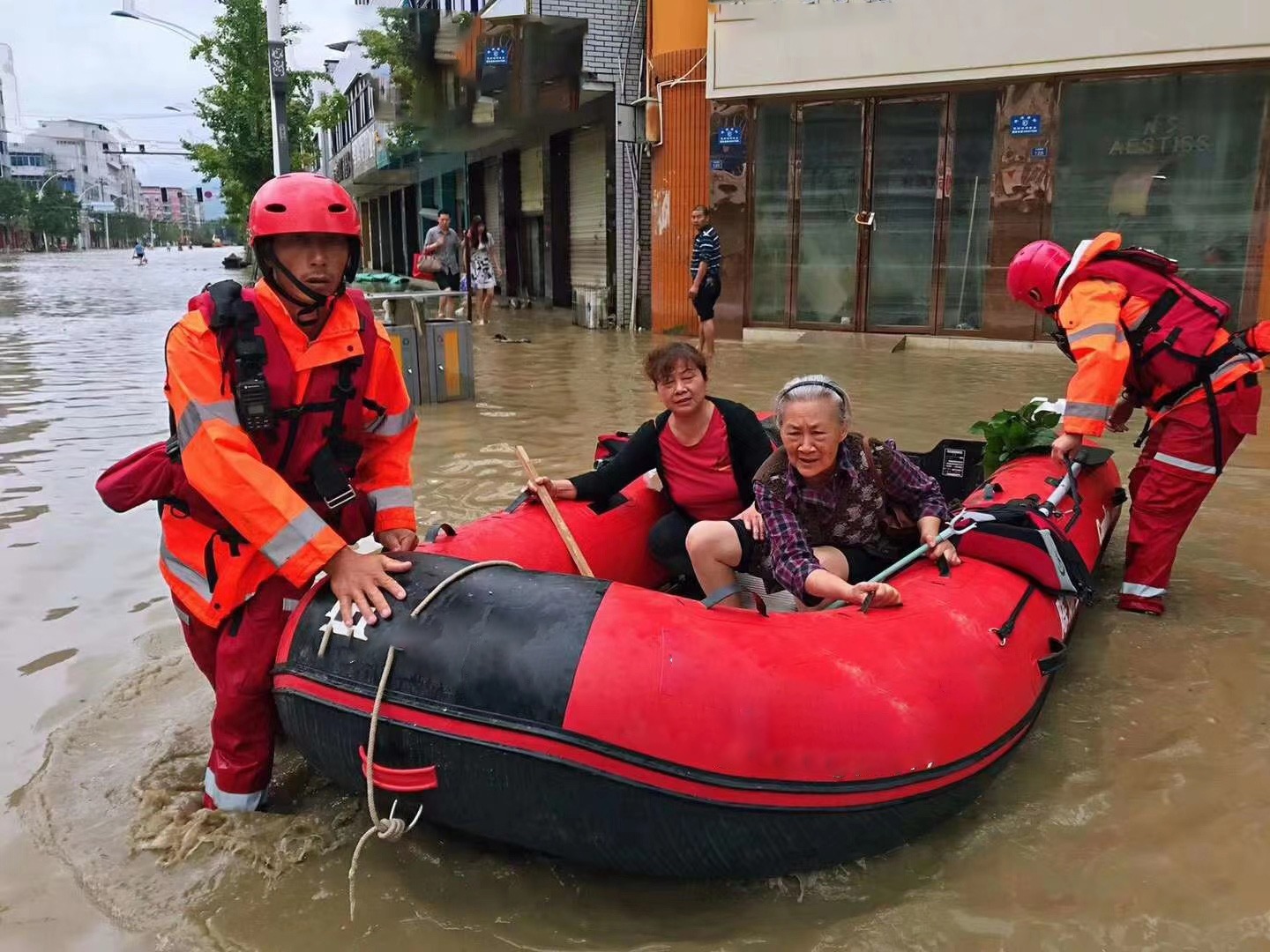
Flood work in particular rewards a catamaran layout: shallow draft over submerged fences and kerbs, an open self-draining transom, and buoyancy at the outer edges so the boat stays flat when crew and a casualty move to one side.
Specification checklist
- 1500 GSM / 1.2 mm VALMEX Heavy Plus hull (or Orca Hypalon upgrade)
- Hot-air welded seams throughout
- Minimum three independent air chambers plus a separate floor chamber
- Overpressure relief valves fitted
- Full-length grab lines and reinforced lifting/towing lugs
- Non-slip deck with drainage
- Reinforced rubbing strake and keel guard
- High-volume pump for rapid deployment, plus a manual backup
- Motor matched to the length, with a 380 mm transom
- CE certification to ISO 6185-3 and EU Directive 2013/53/EU
Australian registration is a separate step from CE certification — a Boat Code operator certificate followed by state registration. See registration and boat coding.
Deployment speed is a spec, not a feeling
Time it. From tailgate to underway, a two-person crew with a 22 psi electric pump should be moving in well under ten minutes on a 3.3–4.0 m boat. If your current setup takes twenty, the pump is usually the problem, not the boat.
A 22 psi electric pump and a set of launching wheels do more for real-world response time than another 5 hp.
Which Aerowave boats suit rescue and patrol work
| Model | Length | Best for | Price |
|---|---|---|---|
| Sport Series Offshore | 3.3–3.8 m | Surf and patrol, aluminium floor | from A$3,545 |
| WaveRunner 380 Series 3 | 3.8 m | Flood and swiftwater | A$4,945 |
| Viper 400 Sovereign | 4.0 m | Multi-crew, load capacity | A$6,245 |
| Sprint 350 RIB | 3.5 m | Sustained open water | A$6,990 |
Fleet and unit orders are quoted individually, including spares packs and replacement parts held in Australia and in our Hong Kong hub.
Getting a fleet quote
Tell us the job — surf, flood, patrol or commercial survey — crew numbers, storage arrangement and how the boats will be transported. We'll spec fabric, chambers, floor and motor around that rather than selling you a catalogue number.
Call +61 2 4335 1603 or read the commercial inflatable boats guide for the procurement detail.
Frequently asked questions
- What is an inflatable rescue boat?
- An inflatable rescue boat, or IRB, is a lightweight multi-chamber inflatable designed for rapid deployment in surf, flood and patrol work. Compared with a recreational inflatable it uses heavier fabric, welded seams, reinforced lifting and towing points, and a deck designed to drain and grip.
- What fabric should an inflatable rescue boat use?
- 1500 GSM / 1.2 mm VALMEX Heavy Plus as a minimum, or Orca Hypalon where the boat is stored inflated in permanent sun. Lighter 1100 decitex 0.7 to 0.9 mm PVC is not suited to repeated contact with rocks, concrete and debris.
- Are inflatable catamarans suitable for flood rescue?
- Yes, and they are often the preferred format. Shallow draft clears submerged fences and kerbs, the open transom self-drains, and buoyancy at the outer edges keeps the boat flat when crew and casualties move to one side.
- How fast can an inflatable rescue boat be deployed?
- With a 22 psi electric pump, a two-person crew should have a 3.3 to 4.0 m boat inflated and underway in well under ten minutes. Pump capacity is usually the limiting factor, not the hull.
- Do rescue inflatables need to be registered in Australia?
- Powered vessels follow state and territory registration rules. CE certification to ISO 6185-3 covers construction standards, but Australian registration is a separate step via a Boat Code operator certificate and then state registration.
- Can you supply inflatable rescue boats to clubs and councils in fleet quantities?
- Yes. Fleet orders are specified individually around the job, crew numbers and transport arrangements, and can include spares packs. Replacement parts are held in Australia and at our Hong Kong hub.
Finance this boat from $27/week
Estimate only — powered by Australian Motorcycle & Marine Finance (AMMF).
Paid upfront (AUD)
$617
10% of price
Term
5 years
60 monthly repayments
Comparison rate
9.95% p.a.
Subject to AMMF approval
Weekly
$27
Monthly
$118
Amount financed
$5,552
Indicative only. Actual repayments depend on your AMMF credit assessment, term, fees and the balloon you select. Talk to AMMF for a personalised quote on Aerowave Viper 400 Sovereign.
Like this guide? Get the next one in your inbox.
Owner-tested tips and Aussie boating know-how — no spam.
Ready when you are
Build your Viper 400 Sovereign in under 3 minutes.
1500 GSM / 1.2 mm VALMEX® hull. Five-year limited hull warranty plus two years of extended limited structural hull cover, subject to conditions. Free freight to United States · taxes included, nothing to pay on arrival.
delivered to your door
See it for yourself
Real boats. Real owners. Real people behind them.
Plenty of what you read online these days is generated. Check us out properly — the factory, the reviews and the owners are all one click away. Why we use AI, and how to check we’re real
How our boats are built
Walk the production line: thermo-welded seams, 1.2 mm VALMEX Heavy Plus hulls, over-pressure relief valves on every chamber.
See the buildGoogle Maps reviews
Real Australian owners, five stars, published on our Google Business Profile with the map — read them there, not just on our own site.
Open Google Maps reviewsOwner stories
Boats in use — offshore, on rivers, on rescue duty. Photos and words from the people who actually own them.
Read owner stories
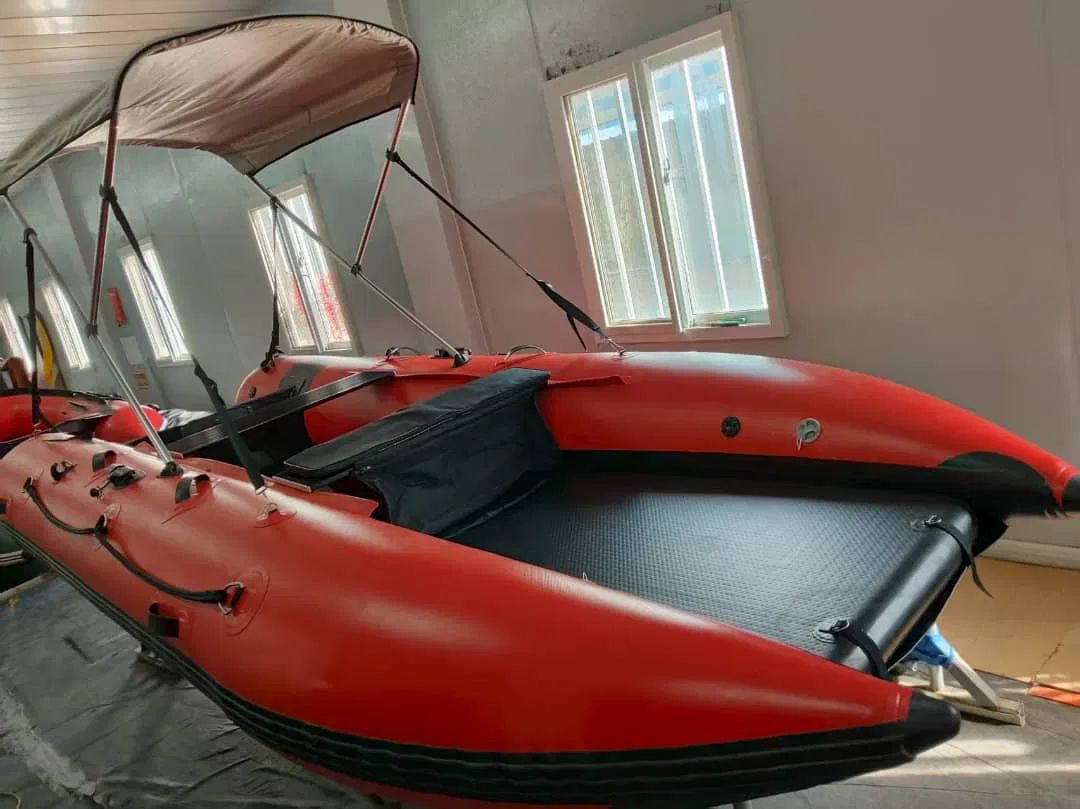
Aerowave Viper 400 Sovereign
US$4,701 USD · delivered to your door