
Tender Costs Compared: RIB vs Inflatable Catamaran vs Jet for the Yacht Owner
Tender costs compared: purchase price, storage, maintenance, insurance, depreciation and resale for rigid dinghies, RIBs, jet tenders and inflatable catamarans.
Our recommendation
Aerowave Swift Tender 270 SI
Length
270cm / 8'10"
Width
152cm / 4'11"
Tube diameter
40cm
Chambers
3+1
Choosing a tender is about more than the price on the day. The right boat should suit your yacht’s stowage, your usual passages and the way you welcome guests ashore, without creating a second maintenance routine you never wanted.
This guide compares four options: a rigid dinghy, a RIB, a jet tender and a soft-hull inflatable catamaran. The figures are indicative Australian-dollar planning ranges, not supplier or insurance quotes. Actual costs vary with size, engine, location, storage, use and condition.
Tender costs at a glance
| Tender type | Indicative purchase price, ready to use | Typical annual upkeep* | Dry storage and berth considerations | Resale outlook |
|---|---|---|---|---|
| Rigid dinghy (aluminium or fibreglass) | A$4,000–A$15,000; premium yacht models can exceed this | A$700–A$2,000 dry-stored; more if afloat | A rack or yard may work, but weight and deck footprint can be limiting | Often steady for popular, well-kept aluminium models |
| RIB | A$7,000–A$35,000+ | A$1,000–A$3,000 dry-stored; potentially A$1,500–A$3,500 afloat | Can suit davits, but needs space and UV protection | Brand and engine history help; ageing tubes can affect value |
| Jet tender | A$75,000–A$120,000+ | A$2,000–A$5,000 for routine service and consumables | Usually needs a suitable garage, cradle or lifting arrangement | High purchase value and narrower buyer pool make resale especially condition-dependent |
| Soft-hull inflatable catamaran | A$4,000–A$12,000 for a typical boat-and-outboard package | A$300–A$1,200 when dry-stored; more with heavy use or wet storage | Packs down for locker or on-deck storage; davits depend on yacht capacity and lift points | Fabric, seams, storage and engine records matter; percentage depreciation may be higher |
*Planning estimates, excluding fuel, financing and major repairs. A separate wet berth can add substantial cost; it is not included in the annual upkeep column.
Purchase price: compare complete tenders
A bare hull price can be misleading. For a fair comparison, include the engine, controls, fuel system, cover, lifting or launching equipment and essential safety gear. A jet tender has its power system built into the package, while an outboard tender requires an engine selected and purchased separately.
For a real local reference point, the Aerowave Swift Tender Series lists compact inflatable models from A$2,599 to A$3,199 for the boat, before an outboard. Those are soft-hull monohull tenders, not catamarans; they give a useful example of how much the hull alone can cost before the complete package is assembled.
A RIB typically costs more than a basic inflatable because it combines inflatable tubes with a rigid hull. It can deliver a more conventional, confident ride at speed, but the hull’s weight and shape affect how it is lifted and stored. Jet tenders sit in a different category: their premium is for integrated performance, presentation and a no-exposed-propeller design, not low-cost ownership.
Storage: the quiet cost that changes the maths
For a yacht owner, the most useful comparison is usually not “which tender fits a marina berth?” but “where will it live when it’s not in use?” A dedicated berth for a small tender is rarely the economical choice. Dry storage, a yacht garage, deck space or properly rated davits are usually more practical.
Club rack rates illustrate the difference: Fremantle Sailing Club lists tender and dinghy storage options, while the Royal Yacht Club of Victoria lists upright and flat tender storage. Fees and availability change, so check current rates directly.
A soft-hull inflatable catamaran can be deflated and packed away, making it a useful option when a fixed rigid hull would consume valuable deck or garage volume. If you plan to carry any tender on davits, confirm the davit’s safe working load, the tender’s lift points and the outboard’s weight with your yacht builder or installer. A compact packed boat does not make the motor disappear from the lifting calculation.
Maintenance and antifouling
Dry storage is where a soft-hull inflatable catamaran can keep ownership straightforward. Rinse it after use, dry it properly, protect it from prolonged UV exposure and inspect the fabric, seams, valves and fittings. It does not have a rigid hull that needs routine antifouling.
A rigid tender avoids tube care, but it still needs attention to its hull, fittings, corrosion or gelcoat, and outboard. Keep it afloat and you may add haul-out and bottom-care costs. A RIB has both a rigid underwater hull and inflatable tubes: if it lives in the water, antifouling may be appropriate for the hull using a system compatible with the manufacturer, while the tubes need their own cleaning and UV care.
A jet tender has no outboard to remove and no exposed propeller, but that does not make it maintenance-free. Its engine, jet pump, intake, cooling system, steering, reverse bucket and battery all need appropriate servicing. Specialist parts or labour can also make repairs more expensive than an owner expects.
Whichever tender you choose, the engine remains a recurring cost. Service intervals and prices depend on the make, engine hours and local dealer. For an outboard tender, ask what an annual service costs before choosing an engine size; for a jet, ask for the recommended service schedule and typical parts costs.
Insurance, depreciation and resale
Check your yacht policy before buying separate cover. Some yacht policies can extend to tenders and outboards, but limits and conditions vary. Confirm the insured value, theft cover, use, cruising area, transit and storage arrangements in writing. Pantaenius Australia and Youi both provide information on marine cover; ask the insurer how your specific tender would be treated.
Depreciation is just as individual. A rigid aluminium tender can appeal to practical buyers, while a sought-after RIB may retain interest if its tubes and engine are in good condition. For any inflatable, UV exposure, seam condition, repairs and storage history affect confidence. A jet’s higher purchase price means even a moderate percentage loss can represent a large sum.
Keep service receipts, photographs, original specifications and records of storage and repairs. That paperwork helps a future buyer understand what they are buying, and gives you a clearer view of ownership cost than a resale estimate alone.
A simple five-year ownership example
The illustration below shows how purchase price, routine costs and resale can combine. It uses one assumed package per type, not a forecast or quote, and excludes fuel, finance, major repairs, tender-lift installation and the cost of the yacht’s existing storage system.
| Example | Purchase | Five-year storage, upkeep and insurance | Assumed resale after five years | Approx. net five-year cost |
|---|---|---|---|---|
| Soft-hull catamaran package | A$8,000 | A$6,050 | A$3,500 | A$10,550 |
| Rigid dinghy package | A$12,000 | A$13,250 | A$7,800 | A$17,450 |
| RIB package | A$20,000 | A$17,000 | A$12,000 | A$25,000 |
| Jet tender | A$95,000 | A$32,500 | A$55,000 | A$72,500 |
The figures assume dry storage and ordinary use; keeping a tender afloat, significant damage, tube replacement or a major jet-system repair could change the result materially. The main takeaway is not that one tender will always be cheapest. It is that storage, maintenance and resale can outweigh the initial price difference over time.
Which tender suits your yacht?
A rigid dinghy can be a sensible choice when robustness and a long service life matter more than easy handling or compact stowage. A RIB suits owners who value speed, a familiar ride and a broad range of models, and who can protect the tubes and accommodate the rigid hull. A jet tender makes sense when its performance, integrated design and lack of an exposed propeller genuinely suit the yacht and its guests; it is a premium capability, not a budget alternative.
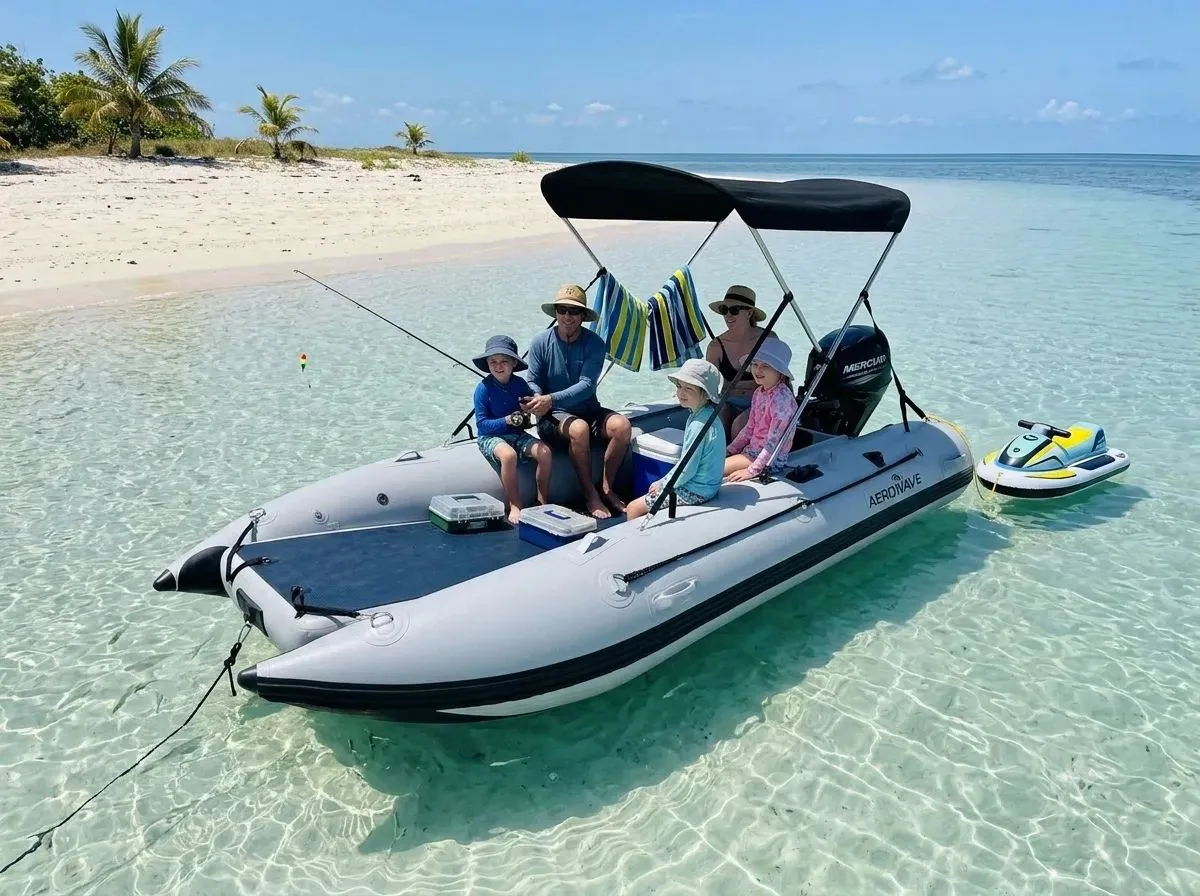
A soft-hull inflatable catamaran is worth considering when easy stowage, shallow-water beach access and a stable platform for guests are priorities. The flexible hull can be kinder when coming alongside, and a catamaran layout offers a different feel at rest from a narrow tender. It is not the answer for every passage or load, so match the model and engine to your yacht, conditions and intended use. Allow approximately 15 minutes for setup and launch preparation, depending on the boat and crew.
For an overview of options, visit our comparison page or explore the inflatable yacht tender guide. If you’re weighing up a written delivered price, request a free Australian quote, and compare the full specification and delivery details, not just the starting number.
Frequently asked questions
- What is the cheapest tender to own?
- For many yacht owners a soft-hull inflatable has the lowest total cost, because it packs away, needs no antifouling and avoids separate storage. Your own use decides it.
- How much does an Aerowave Swift Tender cost?
- The Swift Tender Series runs from A$2,599 to A$3,199 for the boat, before an outboard and accessories.
- Why is storage such a big part of tender costs?
- A rigid tender may need a rack, yard space or berth with its own fees. A deflated inflatable can stow aboard instead.
- Is a jet tender worth the cost?
- Jet tenders cost far more to buy and service and usually need a garage or cradle. They suit large yachts with the space and budget.
- Does my yacht insurance cover the tender?
- Some yacht policies extend to tenders and outboards. Confirm the insured value, theft cover, use and storage in writing with your insurer.
Finance this boat from $13/week
Estimate only — powered by Australian Motorcycle & Marine Finance (AMMF).
Paid upfront (AUD)
$290
10% of price
Term
5 years
60 monthly repayments
Comparison rate
9.95% p.a.
Subject to AMMF approval
Weekly
$13
Monthly
$55
Amount financed
$2,609
Indicative only. Actual repayments depend on your AMMF credit assessment, term, fees and the balloon you select. Talk to AMMF for a personalised quote on Aerowave Swift Tender 270 SI.
Like this guide? Get the next one in your inbox.
Owner-tested tips and Aussie boating know-how — no spam.
Ready when you are
Build your Swift Tender 270 SI in under 3 minutes.
1500 GSM / 1.2 mm VALMEX® hull. Five-year limited hull warranty. Free freight to United States · taxes included, nothing to pay on arrival.
delivered to your door
See it for yourself
Real boats. Real owners. Real people behind them.
Plenty of what you read online these days is generated. Check us out properly — the factory, the reviews and the owners are all one click away. Why we use AI, and how to check we’re real
How our boats are built
Walk the production line: thermo-welded seams, 1.2 mm VALMEX Heavy Plus hulls, over-pressure relief valves on every chamber.
See the buildGoogle Maps reviews
Real Australian owners, five stars, published on our Google Business Profile with the map — read them there, not just on our own site.
Open Google Maps reviewsOwner stories
Boats in use — offshore, on rivers, on rescue duty. Photos and words from the people who actually own them.
Read owner stories
Aerowave Swift Tender 270 SI
US$2,065 USD · delivered to your door