Inflatable Boat vs Pontoon Boat: Which Suits Australian Family Boating? (2026)
Stability, towing, storage, running costs and resale compared — an honest look at inflatable catamarans against pontoon boats for Australian families.
At a glance
Stability, towing, storage, running costs and resale compared — an honest look at inflatable catamarans against pontoon boats for Australian families.
- The short answer
- Stability: both good, for different reasons
- How a pontoon stays flat
- How an inflatable catamaran stays flat
What we'd put you in
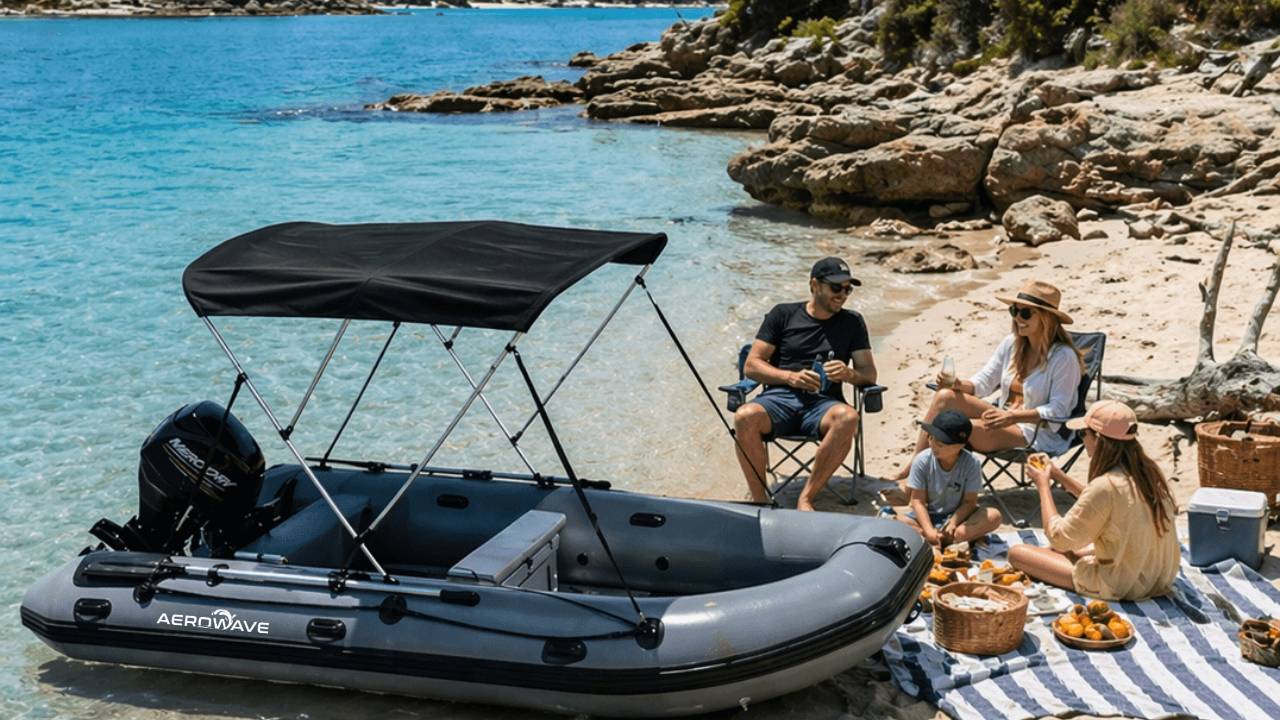
Aerowave Viper 400 Sovereign
Our best-selling boat: 4.0 m, 1.2 mm VALMEX hull, 7-year hull warranty.
US$3,167 USD
Delivered to your door, today's rate
- Free freight to United States · local taxes payable on arrival
- 7-year hull warranty
🇺🇸 Shipping to United States · landed price quoted in writing
Yes — we ship the Aerowave Viper 400 Sovereign to United States. Here's the landed price.
Our best-selling boat: 4.0 m, 1.2 mm VALMEX hull, 7-year hull warranty.
Written for Australian readers — but the boat ships to you. We are an Australian builder and this article is written from Australian waters. That changes nothing about what you can order: the same hull, the same 7-year warranty and the same certification go out to United States every week.
Aerowave Viper 400 Sovereign
- Boat package (export price)
- US$3,726
- 15% tariff relief credit
- − US$559
- Express air freight to United States
- Included
- Import duty, taxes & customs clearance
- Payable on arrival
- Estimated landed, USD
- US$3,167
Indicative, converted at today's rate, before local duty and tax on arrival. Ask below and we'll put a fixed figure in writing, valid 30 days.
- 7-year hull warranty
- 1500 GSM / 1.2 mm VALMEX® Heavy Plus hull
- CE certified to ISO 6185-3 and EU Directive 2013/53/EU
- Door-to-door, tracked the whole way
Your price, delivered to your door — freight included.
We email the full PDF quote (spec, freight, finance, WavePay) to your inbox in under 60 seconds. No spam — one quote, one follow-up.
See it for yourself
Real boats. Real owners. Real people behind them.
Plenty of what you read online these days is generated. Check us out properly — the factory, the reviews and the owners are all one click away. Why we use AI, and how to check we’re real
How our boats are built
Walk the production line: thermo-welded seams, 1.2 mm VALMEX Heavy Plus hulls, over-pressure relief valves on every chamber.
See the buildGoogle Maps reviews
Real Australian owners, five stars, published on our Google Business Profile with the map — read them there, not just on our own site.
Open Google Maps reviewsOwner stories
Boats in use — offshore, on rivers, on rescue duty. Photos and words from the people who actually own them.
Read owner storiesFamilies shopping for a stable, forgiving boat usually land on the same two options: a pontoon boat, or an inflatable catamaran. Both float on two buoyant hulls. Both feel rock solid when everyone stands on one side. After that, they are very different animals — and the difference shows up in your driveway, your fuel bill and your weekends.
The short answer
- Pontoon boat — best if you have a big tow vehicle, a permanent berth or a large shed, mostly flat inland water, and you want a floating lounge room.
- Inflatable catamaran — best if you want two-hull stability plus the ability to carry the boat in a station wagon, launch off a beach without a ramp, and handle coastal chop.
Stability: both good, for different reasons
How a pontoon stays flat
A pontoon boat rides on two rigid aluminium tubes set wide apart. Initial stability is excellent, which is why they feel so reassuring with kids moving around.
How an inflatable catamaran stays flat
An inflatable catamaran does the same job with two air-filled tubes at 8–10 PSI, with a tunnel between them. It has the same wide stance, but the tubes also absorb impact instead of transmitting it. In chop, a rigid pontoon slams; an inflatable tube flexes and softens the ride.
Where each one struggles
Pontoons dislike open water and wind chop — the flat deck between the hulls slaps hard. Inflatables dislike being under-inflated; keep pressure correct and they perform exactly as designed.
Towing, launching and storage
This is where most Australian families make their decision.
| Pontoon boat | Inflatable catamaran | |
|---|---|---|
| Trailer required | Always | Optional |
| Typical rig weight | 900–1,800 kg | 60–120 kg boat, no trailer needed |
| Storage | Shed, berth or driveway | Two bags in a garage corner |
| Beach launch | No | Yes, with wheels |
| Ramp queue | Yes | Often skipped entirely |
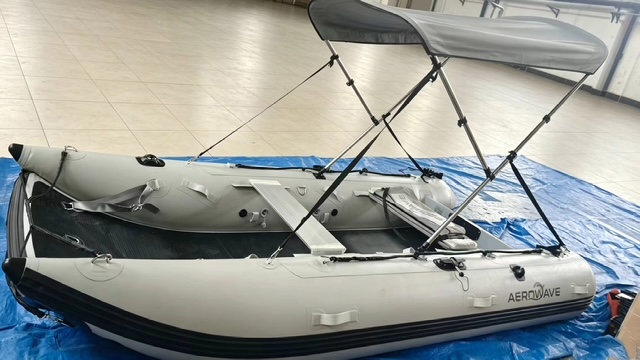
An inflatable packs into bags, fits in an SUV or a caravan boot, and launches straight off sand with a set of transom wheels. If you live in an apartment, tow with a mid-size car, or travel with a van, the practical gap is enormous.
Running costs over five years
Fuel
A pontoon needs 40–115HP to move usefully. An inflatable catamaran cruises happily on 9.9–20HP. Over a season that is hundreds of litres.
Rego, insurance and servicing
A trailer needs registration, bearings, lights and tyres. A larger outboard costs more to service. Inflatables often need no trailer at all, and a small four-stroke service is a fraction of the cost.
Depreciation
Both hold value reasonably in Australia. The inflatable advantage is that a quality hull built from 1500 GSM / 1.2 mm VALMEX® Heavy Plus with welded seams lasts 10–12 years, and buyers know it.
Fishing and family use
Fishing
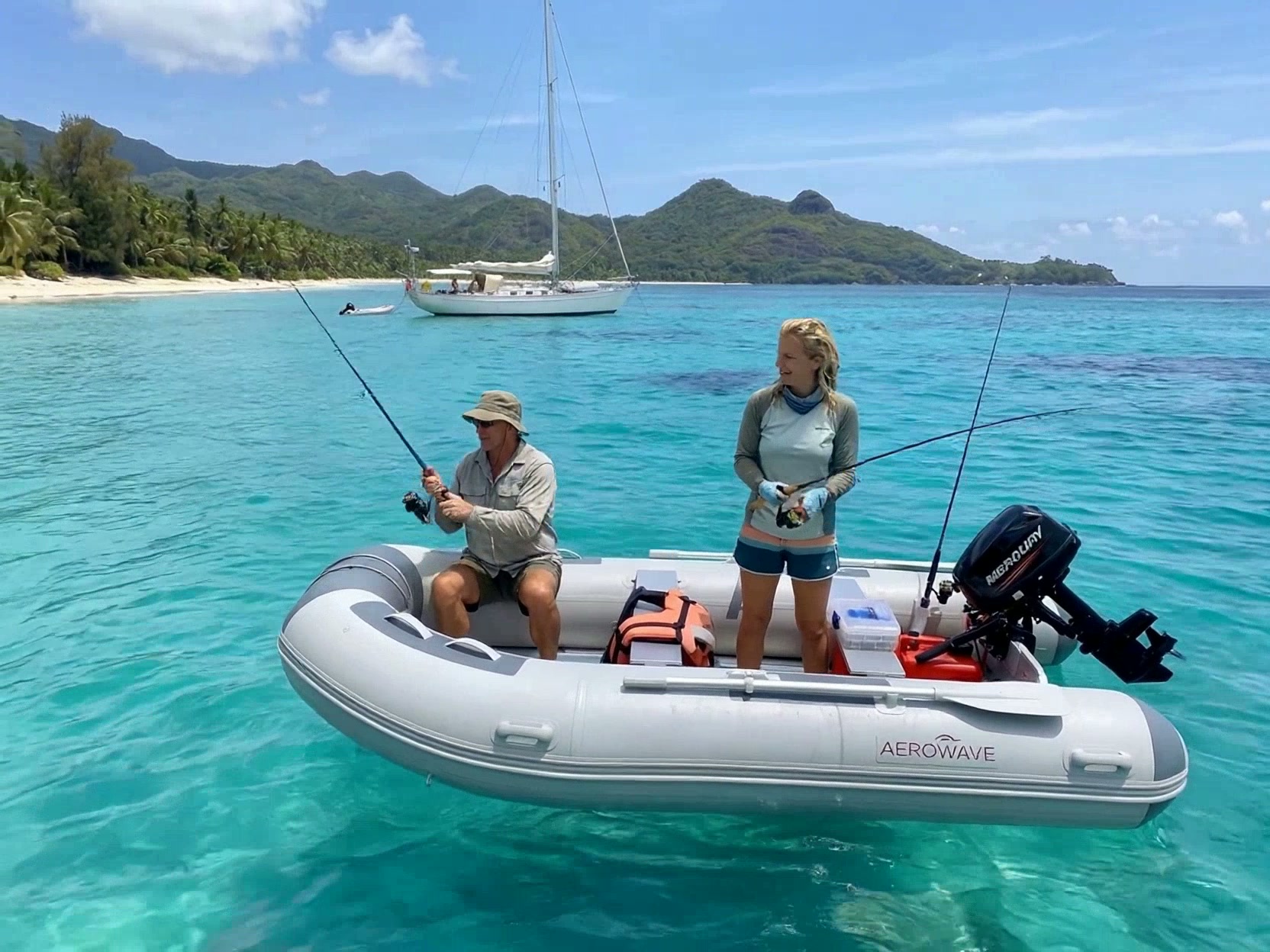
Inflatable catamarans have a huge usable floor for their length, a low freeboard for landing fish, and the tunnel keeps them stable at rest. Pontoons offer more seating and shade, but are harder to fish from in wind because they blow around badly at anchor.
Kids and swimming
Both are excellent. Soft tubes are kinder to shins and easier to climb back over from the water than a pontoon's rigid deck edge.
Coastal and offshore
Here the inflatable wins clearly. Pontoon boats are not designed for ocean chop or bar work. A well-built inflatable catamaran with a 380 mm transom, welded seams and correct pressure handles coastal conditions that a pontoon should never see.
So which should you buy?
Choose a pontoon if your boating is a calm lake, you already own the tow vehicle and the storage, and you want maximum seating and shade.
Choose an inflatable catamaran if you want:
- Two-hull stability without a trailer
- Beach launching and no ramp queues
- Coastal capability as well as flat water
- A boat that stores in a cupboard between trips
Where to start in the Aerowave range
- AeroCat 330 — lightest, easiest to handle solo.
- Viper 365 Open Bow — the family all-rounder.
- Viper 400 Sovereign — four adults, serious floor space, our flagship.
Every boat page shows the price openly, and includes a finance calculator. Prefer to talk it through? Call +61 2 4335 1603 or email sales@easyinflatables.com.au — or take the two-minute Weekend-Proof Score™ and we will tell you which size actually suits your water.
Related reading
Weekend-Proof Score 17 questions · about 2 minutes
Will the boat you're about to buy survive an Australian summer?
Seventeen straight questions about where you'll use it, what you'll ask of it and the boat you're weighing up. You get a score out of 100, the exact weak points in your plan, and the one boat that genuinely fits.
Free · your result shows on screen · no email required
So which one is yours?
Pick how you'll actually use it and we'll take you straight to the right hull.
I want to fish it
Open bow, rod holders, deck space you can stand and cast from.
Viper Sport 400Family, diving and the beach
3.8 m Series 3 catamaran — low bow to climb back in wearing fins or a tank.
WaveRunner 380Tender / one-person launch
3.3 m hard-floor boat that packs into a bag and still takes a beach landing.
Viper 330Shop gear featured in this guide
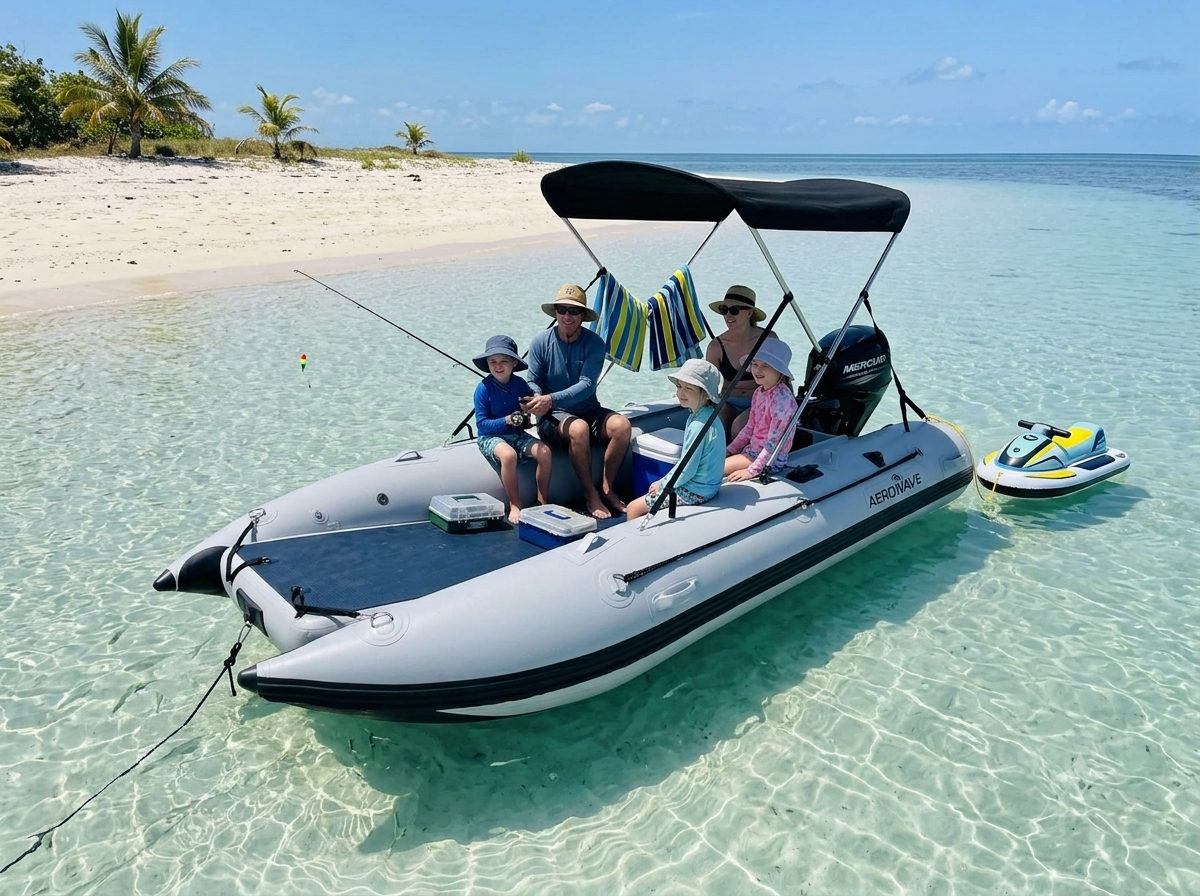
Aerowave WaveRunner 380 Series 3 Catamaran Package
The WaveRunner 380 Series 3 is a premium 3.8m inflatable catamaran package built for Australian and worldwide families, fishing, and coastal day boating — ideal for snorkeling and spearfishing — offering serious stability and premium German Valmex® construction.
Free freight to United States · local taxes payable on arrival
Aerowave Viper 400 Sovereign
Flagship 4m enclosed-bow inflatable catamaran. German VALMEX® 7321 Heavy Plus 1.2mm commercial-grade fabric, 10 PSI high-pressure drop-stitch air deck floor with VALMEX non-slip surface, LockPro wheels, full Bimini and FREE express delivery Australia-wide included. Winter special — save $1,000 until 31 August 2026.
Free freight to United States · local taxes payable on arrival
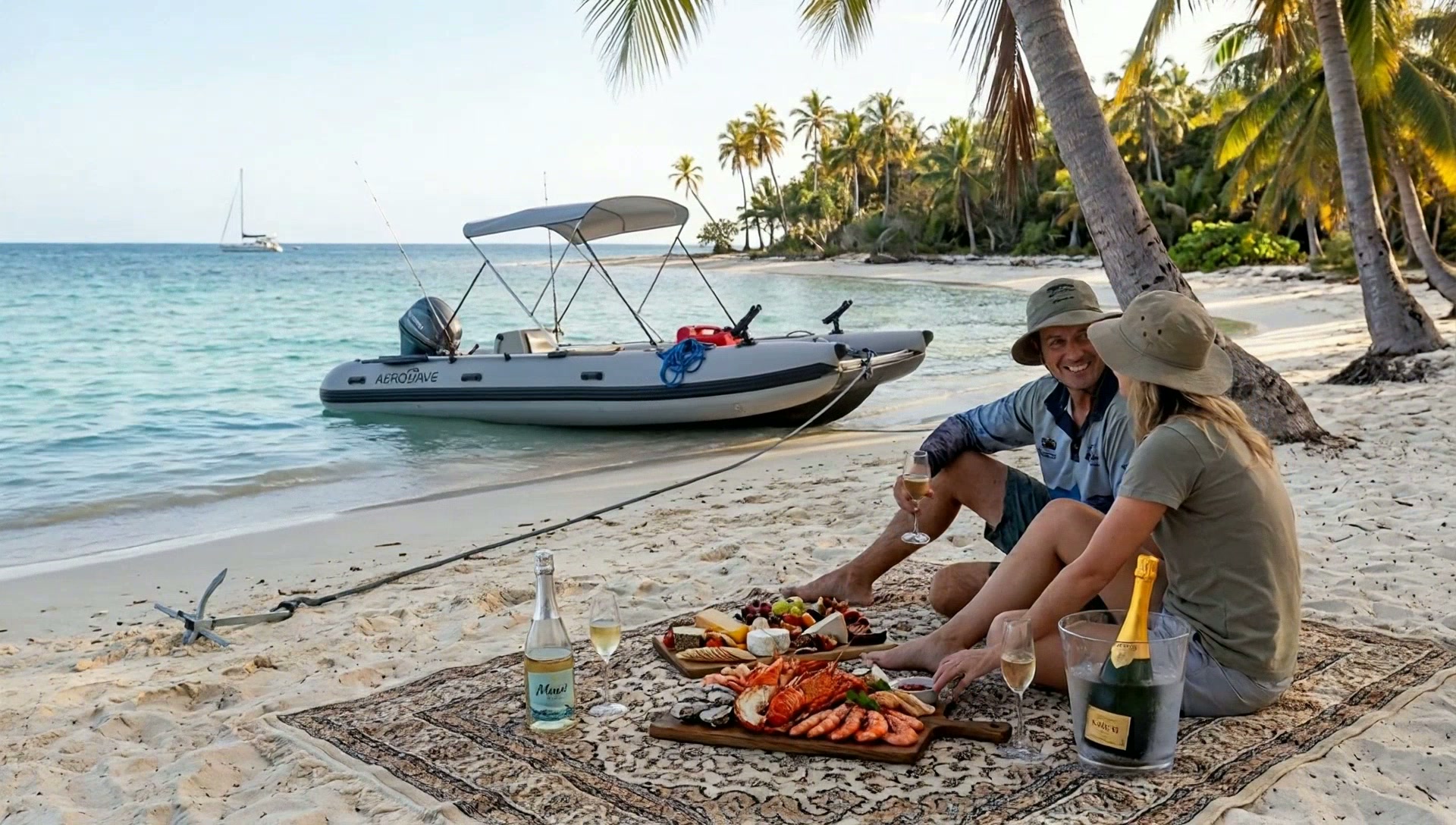
Aerowave Viper 365 Open Bow
Premium 3.65m Inflatable catamaran — built the same way as our flagship Viper 400 sports boat, just 35cm shorter. German VALMEX® 7321 Heavy Plus 1.2mm commercial-grade fabric, 10 PSI high-pressure drop-stitch air deck floor with VALMEX non-slip surface, LockPro wheels, full Bimini and FREE express delivery Australia-wide included.
Free freight to United States · local taxes payable on arrival
Not sure which suits you? Talk to a real boat owner.
Before you spend a cent
Buying from Australia, delivered to United States
You have never heard of us, we are on the other side of the world, and the internet is full of fakes. Fair enough. Here is everything you would need to check us out, in one place — no forms, no chat bot.
Australian designed business
Easy Inflatables, Avoca Beach NSW 2251. ABN 96 856 548 613. International orders ship from our Hong Kong hub.
222 owner reviews, 4.8 average
Read them in full, good and bad, on our reviews page.
CE certified, 7-year hull warranty
ISO 6185-3 and EU Directive 2013/53/EU. Warranty honoured worldwide.
Tracked, insured, door to door
FREE freight to United States · local tax/duty on arrival.
- Who am I actually buying from?
- Easy Inflatables, Avoca Beach NSW 2251, Australia. ABN 96 856 548 613. Sean is the owner and skipper, Gary Stewart handles sales on +61 2 4335 1603, Karen Matthews handles email. The boats are Australian designed; international orders ship from our Hong Kong dispatch hub so your landed price stays competitive. Phone us before you pay a cent — a real person answers.
- Is this really an Australian product?
- Yes — Australian designed and engineered on the NSW Central Coast. Manufacturing is done offshore to our spec, and international orders ship direct from our Hong Kong dispatch hub. If we routed every boat through Australia first, the freight alone would roughly double or triple your cost for the same hull.
- What do I pay, and what is not included?
- The delivery and import terms depend on your country. EU, UK, New Zealand and named Asia/Pacific lanes include duty and tax; US freight is free but US buyers pay import charges on arrival. Other destinations show their terms before payment.
- How do I pay safely?
- Card through Stripe (Visa, Mastercard, Amex, Apple Pay, Google Pay) or bank transfer. Card payments carry your bank's own dispute protection. We never ask for crypto, gift cards or payment to a personal account.
- What if it arrives damaged?
- Every boat ships fully tracked and insured door to door. Photograph the carton and the boat on arrival and email us — transit damage is claimed and replaced through us, not left with you and the courier.
- Is the warranty real outside Australia?
- Yes. The 7-year hull warranty on 1.2 mm VALMEX Heavy Plus and Orca Hypalon hulls applies wherever you are. Replacement parts are held in Australia and at our overseas hub and go out by express courier to your door.
- Is the boat actually certified?
- All Aerowave catamarans are CE certified to ISO 6185-3 and EU Directive 2013/53/EU. Certification paperwork is supplied with the boat — ask and we will send it before you order.
Frequently asked questions
- Is an inflatable catamaran as stable as a pontoon boat?
- Yes, for practical purposes. Both use two widely spaced hulls, so initial stability is very high. The inflatable also absorbs chop, so it feels steadier once there is wind on the water.
- Can a pontoon boat be used in the ocean?
- Pontoon boats are designed for sheltered inland and flat water. They slam badly in chop and are not suited to coastal or bar conditions.
- Do you need a trailer for an inflatable catamaran?
- No. The boat packs into bags, fits in an SUV or caravan, and launches off the beach with transom wheels. A trailer is optional, not required.
- Which is cheaper to run, a pontoon or an inflatable boat?
- The inflatable, comfortably. It cruises on 9.9–20HP instead of 40–115HP, and there is usually no trailer registration, bearings or tyres to maintain.
- Which is better for fishing?
- An inflatable catamaran offers more usable floor per metre, low freeboard for landing fish and better behaviour at anchor. Pontoons offer more seating and shade.
- How long does an inflatable boat last compared with a pontoon?
- A premium hull in 1500 GSM / 1.2 mm VALMEX® Heavy Plus with welded seams lasts 10–12 years with normal care and proper storage.
- Which is easier to store at home?
- The inflatable. It deflates into two bags that fit in a garage corner or an apartment cupboard, while a pontoon needs a driveway, shed or berth.
Ready to set sail?
Premium German-fabric inflatable catamarans, built to order and delivered to your door. Talk to our team or browse the fleet.
Like this guide? Get the next one in your inbox.
Owner-tested tips, gear deep-dives and Aussie boating know-how — no spam.