
Best Boat for Rough Water: How to Choose With Confidence (Australia 2026)
How to pick the best boat for rough water in Australia - hull shape, deadrise, fabric spec, load limits and safe power, compared across deep-V monohulls, inflatable catamarans and RIBs.
Our recommendation
Aerowave Sport Series Offshore Inflatable Boats
Model 230 Length
230cm / 7’6″
Model 230 Width
133cm / 4’7″
Model 230 No. Chambers
3+1
Model 230 Tube Dia
38cm
The best boat for rough water isn't the fastest one. It's the one that stays predictable when you're tired, loaded and heading home.
You leave a sheltered Australian bay in calm sunshine, then the wind swings before you turn for home. The chop steepens, passengers slide closer together, and the boat starts landing heavily between waves. At that point speed matters far less than control, stability and keeping water outside the hull.
Choosing the best boat for rough water comes down to hull shape, freeboard, reserve buoyancy, construction, crew size and the water you actually run. A family exploring coastal bays needs a different balance from an angler crossing exposed water, and a traveller packing a boat into an SUV needs both portability and sensible safety margin.
Why rough water changes everything
Rough water isn't one condition. It might be short wind chop inside a bay, a rolling swell along the coast, or a confused cross-sea where wind and swell arrive from different directions. Each places different demands on the hull, the driver and the crew.
A boat that feels lively in smooth water can become tiring when the surface changes. A flatter hull feels reassuring at rest but pounds in steep chop. A narrow boat travels efficiently but leaves less room for people, fuel and gear without eating into freeboard.
The useful word is sea-kindliness — how predictably a boat behaves when conditions get uncomfortable. A sea-kind boat enters waves cleanly, holds its course, sheds water, carries its load without burying the bow, and gives the driver time to react.
Australian safety data backs the conservative approach. Royal Life Saving Australia reports an average of 49 boating and watercraft drownings a year nationally, and Surf Life Saving Australia recorded 340 coastal boating drowning deaths between 2004 and 2019 — around 23 a year. A capable hull improves stability and reserve buoyancy, but it never replaces lifejackets, sensible speed, a weather check and a driver who knows when to turn back.
How hull shape handles chop and swell
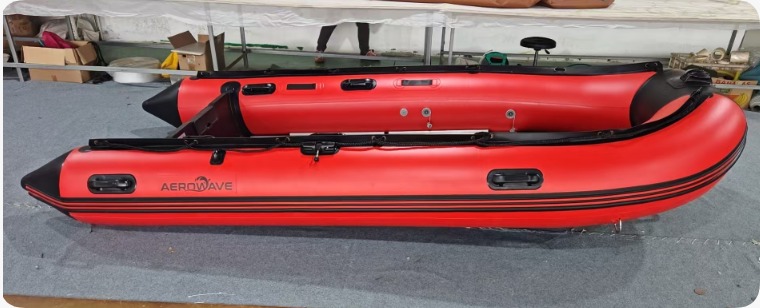
Deadrise is the angle of the hull bottom measured from the centreline out to the sides, and it decides how the boat meets a wave. A shallow-V presents more bottom surface: steadier at rest, harder landing in chop. A deeper-V presents a sharper entry and slices into the wave rather than slapping onto it.
Deeper-V designs in the range of roughly 20 to 30 degrees are generally better at cutting chop and reducing vertical slam, while shallow-V hulls give more static stability. A moderate deadrise around 19 to 24 degrees is the usual compromise for boats expected to handle bay chop and longer coastal swell.
Chop and swell are different problems
Short chop produces repeated impacts, so the driver manages throttle and trim to stop the bow dropping heavily into each trough. Longer swell lifts and lowers the boat more gradually, but cross-swell adds rolling, yawing and awkward diagonal movement.
A V-hull cuts a direct wave. A catamaran separates the water flow between two hulls and gives a broad, stable platform, though tunnel design, beam and loading all change how it behaves. There's a fuller breakdown in our catamaran versus monohull comparison.
The trade-off at rest
Deep-V designs ride softer underway but feel less settled while drifting or fishing. Most buyers ask which hull is "most stable" when the better question is stable for what. For family cruising between sheltered spots, a moderate-V or catamaran balances comfort and steadiness. For exposed runs where everyone stays seated, a deeper-V monohull or RIB usually wins — the case we make in when a deep-V monohull beats a catamaran.
Comparing boat types for rough water
| Boat type | Comfort underway | Stability at rest | Portability |
|---|---|---|---|
| Deep-V monohull | Strong | Moderate | Low to moderate |
| Inflatable catamaran | Good through mixed conditions | Very high | Moderate |
| RIB | Strong, depends on hull | High | Moderate |
| Air-deck inflatable | Fair, limited conditions | Moderate | High |
Deep-V monohulls
A deep-V monohull is the traditional choice for exposed coastal travel. The pointed entry reduces pounding and the keel helps the boat track through moving water. The cost is more draft, more sensitivity to weight placement and more roll at rest. Our Sport Series 380 SI and 420 SI are built around exactly that brief.
Inflatable catamarans
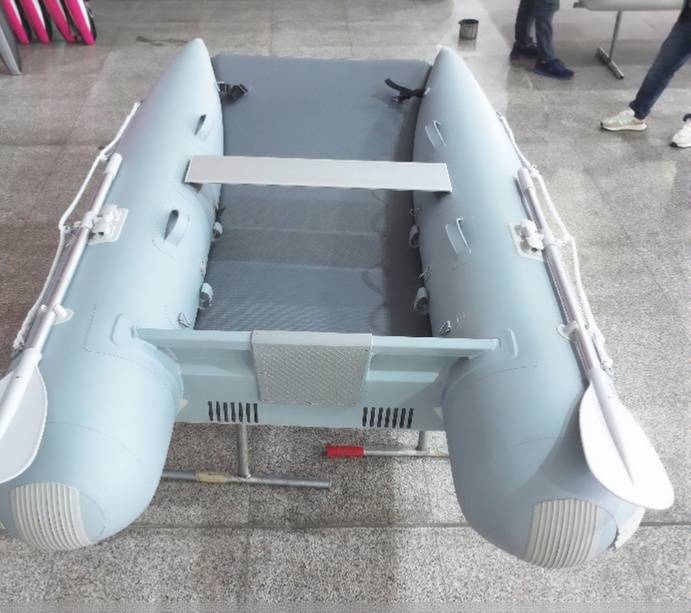
An inflatable catamaran separates buoyancy across two hulls, which gives high initial stability and useful reserve buoyancy when people move around. It's forgiving for family use and fishing in coastal water.
"Catamaran" on its own doesn't mean offshore capability. Check hull construction, floor type, working pressure, transom strength and the stated operating limits. Our tender, RIB and inflatable catamaran decision guide walks through it.
RIBs and air-deck inflatables
A RIB's rigid lower hull gives defined running geometry while the tubes add buoyancy and cushion contact at the sides. Air-deck inflatables are lighter and pack smaller, which suits portability-first buyers — but an air floor, small hull and modest freeboard aren't a substitute for a purpose-built offshore design.
Construction, materials and build quality
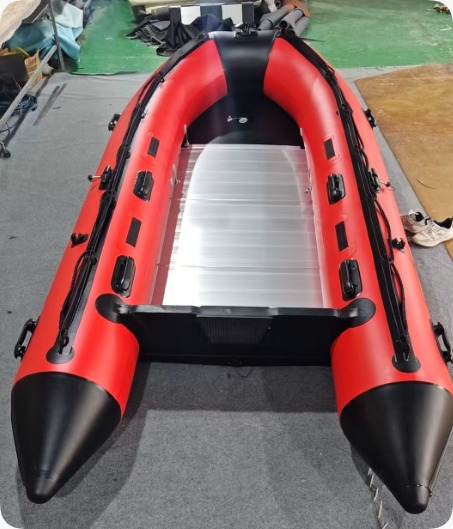
Hull geometry tells you how a boat meets a wave. Construction decides how long it keeps doing that under sun, salt, abrasion and pressure cycling. On an inflatable, look at fabric weight and thickness, reinforcement, seams, floor and transom — not the photos.
Fabric is always quoted properly as GSM and millimetres together. Our premium hulls use 1500 GSM / 1.2 mm VALMEX® Heavy Plus; our AeroCat range uses 1100 GSM / 0.9 mm VALMEX®. Plenty of imported boats stop at 1100 GSM / 0.9 mm and don't say so plainly. Orca Hypalon is available as an upgrade where owners want the RIB-industry standard. The 0.9 mm versus 1.2 mm breakdown explains what the extra thickness actually buys, and Hypalon versus 1.2 mm PVC covers the material trade-off.
Seams and floor systems
Hot-air-welded seams give consistent bonding in compatible PVC construction; glued seams rely on workmanship and adhesive life. Look for clean joins, substantial rub strips, reinforced lifting points, over-pressure relief valves and valves you can actually inspect.
A drop-stitch air floor keeps weight down and packs compactly. An aluminium floor gives a firmer platform for anglers who stand and move. Neither is automatically better — it depends on how you launch and how often you pack down.
Length, beam and usable capacity
Size the boat around the people and gear you actually carry: driver, passengers, fuel, battery, safety gear, esky, rods and wet clothing. A boat that only works lightly loaded looks fine in a showroom and loses freeboard the moment the family and gear come aboard. Our size guide compares 3.3 m, 3.65 m and 4.0 m for real crews.
A boat should feel underworked with your usual load. If every trip needs careful rearranging to keep the bow up, the boat is too small.
Power, load and staying inside safe limits
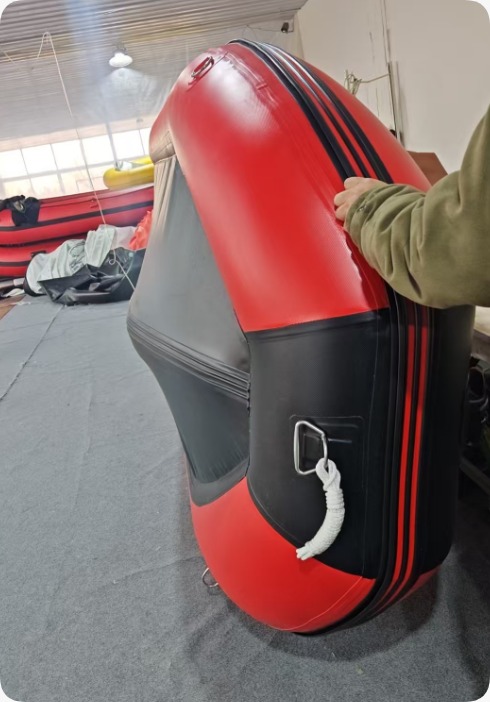
In rough water a correctly powered boat is easier to control. Too little power and the hull struggles to climb a wave or hold its line; too much invites speeds beyond the driver's experience. Start with the manufacturer's rating, then match the motor to the hull, crew and conditions — our motor sizing guide sets out the logic.
Extra weight reduces freeboard, like lowering the rim of a bucket closer to the water. In steep chop that leaves less room before spray or a wave comes aboard. Speed multiplies the impact when the hull drops into a trough, so throttle discipline matters as much as engine choice.
Know your capacity limits
Powered recreational vessels in New South Wales must display a safety label visible from each steering position stating the maximum safe load or number of people in calm water. For boats under six metres the NSW table gives:
- Up to 3 m: 2 people or 180 kg
- 3–3.5 m: 3 people or 270 kg
- 3.5–4.5 m: 4 people or 360 kg
- 4.5–5 m: 5 people or 450 kg
- 5–5.5 m: 6 people or 540 kg
- 5.5–6 m: 7 people or 630 kg
Those figures apply in calm water. South Australian and Tasmanian guidance both recommend treating capacity figures as good-conditions limits and cutting the load — roughly a third — in adverse weather or open sea.
Set up for control, not speed
Keep heavy items low and near the centre, secure loose gear, and don't stack passengers in the bow when you're running into chop. Carry the required safety equipment for your waterway, check the forecast, and tell someone your plan.
Choosing your Aerowave setup for Australian conditions
Start with the water, the crew and the gear, then choose the boat and engine together. Two people off a sheltered beach need a different rig from a family run loaded with fishing gear.
- Sport Series 380 SI / 420 SI — deep-V monohull, aluminium floor, built for exposed water and beach launching.
- Viper 330 / 365 / 400 — inflatable catamarans with a very stable fishing platform and easy pack-down.
- WaveRunner 380 — family layout with a 380 mm transom that keeps more prop in the water and kills ventilation.
Hidea outboard pairings run from 2.5 to 60 HP. Treat that as a selection range, not an invitation to fit the biggest motor — the right choice is the one that suits hull size, load and the model's rated maximum.
Every boat ships with a Bimini, a 22 PSI lithium pump, bags and rod mounts depending on package, and every Aerowave catamaran is CE certified to ISO 6185-3 and EU Directive 2013/53/EU. Compare layouts and sizes across the Aerowave range or browse inflatable boats for sale.
Your rough-water buying checklist
- Start with the water: bay chop, coastal swell, river work or exposed crossings.
- Check hull behaviour: deadrise, entry shape, beam, freeboard, and the balance between ride and stability at rest.
- Inspect construction: fabric in GSM and mm, seams, rub strips, valves, floor, transom reinforcement, drainage.
- Size for real use: add every passenger, fuel container, battery, esky and safety item before judging capacity.
- Read the capacity label: treat calm-water numbers as a limit, not a target.
- Choose controllable power: match the outboard to the hull and load, then drive to the conditions.
- Plan transport: trailer, vehicle, storage and launching routine.
- Verify support: warranty, parts availability, repairs and what's actually in the package.
Your final test is simple. Can you keep everyone seated, the load balanced, useful freeboard under you and the boat steering comfortably when the water stops being polite? If yes, you've chosen for control rather than marketing.
Not sure which hull suits your run? Call us on +61 2 4335 1603 and tell us where you launch, who's aboard and what you carry — we'll match the boat to the water, not the other way round.
Frequently asked questions
- What hull shape is best for rough water?
- For exposed water and running into chop, a deeper-V monohull (roughly 20-30 degrees of deadrise) gives the cleanest wave entry and least slamming. For stability while fishing or drifting, an inflatable catamaran is hard to beat. A moderate 19-24 degree deadrise is the usual all-round compromise for bay chop plus coastal swell.
- Are inflatable boats safe in rough water?
- A well-built inflatable is very safe within its stated limits. Large-volume tubes give enormous reserve buoyancy, and hulls in 1500 GSM / 1.2 mm VALMEX Heavy Plus with hot-air-welded seams and over-pressure relief valves handle repeated wave impact. What matters is matching the model, load and speed to the conditions - not the badge on the tube.
- Catamaran or monohull for offshore fishing in Australia?
- A catamaran gives you a broader, steadier platform at rest, which suits anglers who stand and move around. A deep-V monohull rides better through a long run into steep chop. If most of your day is spent fishing at anchor or on the drift, take the catamaran; if most of it is spent travelling to exposed ground, take the monohull.
- How much fabric thickness do I need for rough Australian conditions?
- Fabric should always be quoted as GSM and millimetres together. 1100 GSM / 0.9 mm VALMEX is a solid mainstream spec; 1500 GSM / 1.2 mm VALMEX Heavy Plus gives noticeably better abrasion and puncture resistance for beach launching, oyster country and rock work. Orca Hypalon is available as an upgrade for owners who want the RIB-industry standard.
- How much should I reduce my boat's load in rough weather?
- Capacity labels are calm-water figures. Australian state guidance commonly suggests cutting the rated number of people by around a third in adverse weather or open sea. Keep weight low and central, keep passengers out of the bow when running into chop, and preserve freeboard over payload.
- What size outboard suits a 3.65 m or 4.0 m inflatable?
- Most 3.65 m to 4.0 m Aerowave hulls run comfortably on 9.9 to 20 HP Hidea four-strokes, depending on load and layout. Fit the motor to the hull's rated maximum and your normal crew weight - more power than the hull is rated for only makes it harder to control in chop.
Finance this boat from $16/week
Estimate only — powered by Australian Motorcycle & Marine Finance (AMMF).
Deposit (AUD)
$355
10% of price
Term
5 years
60 monthly repayments
Comparison rate
9.95% p.a.
Subject to AMMF approval
Weekly
$16
Monthly
$68
Amount financed
$3,190
Indicative only. Actual repayments depend on your AMMF credit assessment, term, fees and the balloon you select. Talk to AMMF for a personalised quote on Aerowave Sport Series Offshore Inflatable Boats.
Like this guide? Get the next one in your inbox.
Owner-tested tips and Aussie boating know-how — no spam.
Ready when you are
Build your Sport Series Offshore Inflatable Boats in under 3 minutes.
1500 GSM / 1.2 mm VALMEX® hull. Five-year limited hull warranty. Free freight to United States · local taxes payable on arrival.
delivered to your door
See it for yourself
Real boats. Real owners. Real people behind them.
Plenty of what you read online these days is generated. Check us out properly — the factory, the reviews and the owners are all one click away. Why we use AI, and how to check we’re real
How our boats are built
Walk the production line: thermo-welded seams, 1.2 mm VALMEX Heavy Plus hulls, over-pressure relief valves on every chamber.
See the buildGoogle Maps reviews
Real Australian owners, five stars, published on our Google Business Profile with the map — read them there, not just on our own site.
Open Google Maps reviewsOwner stories
Boats in use — offshore, on rivers, on rescue duty. Photos and words from the people who actually own them.
Read owner stories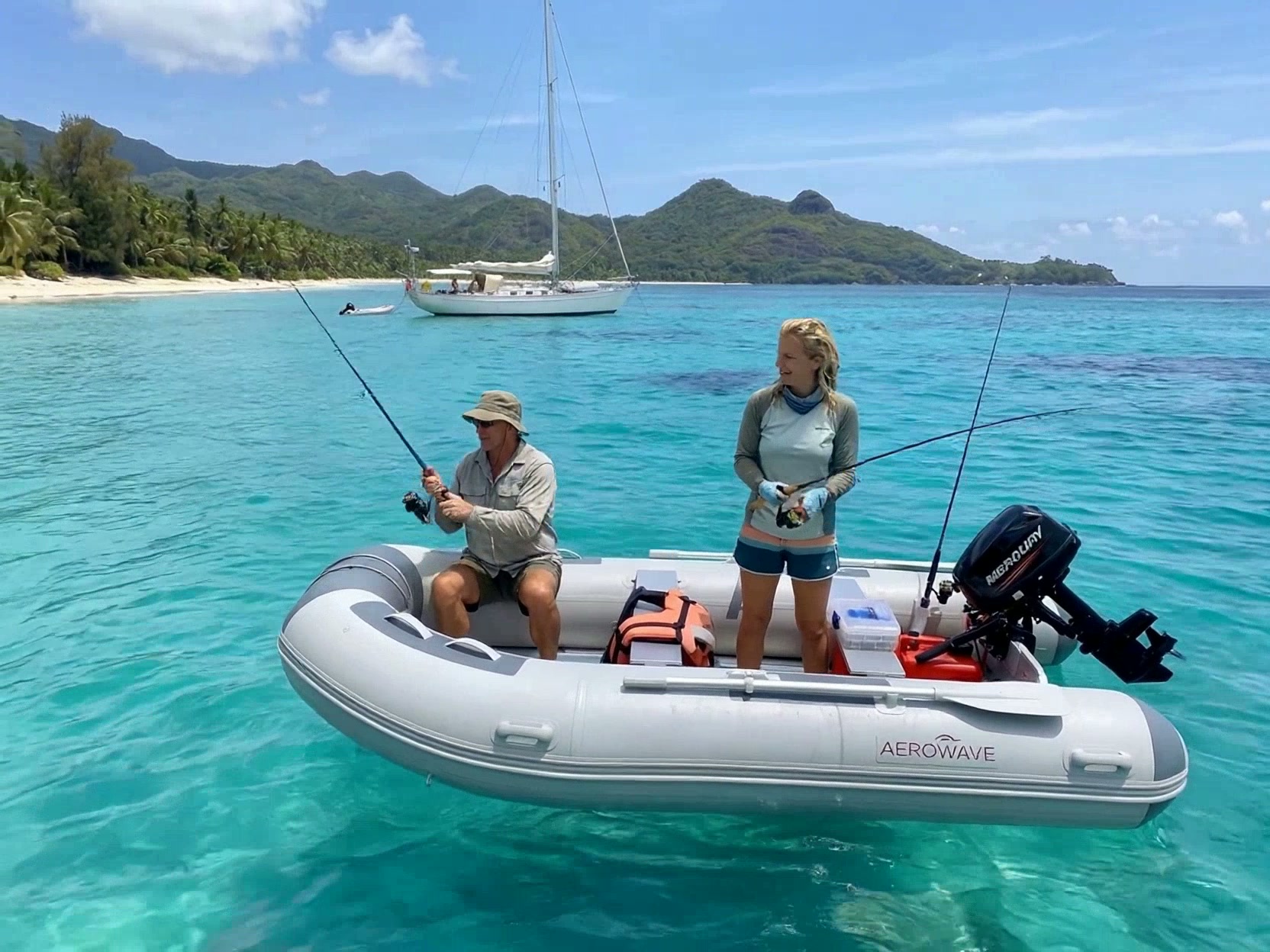
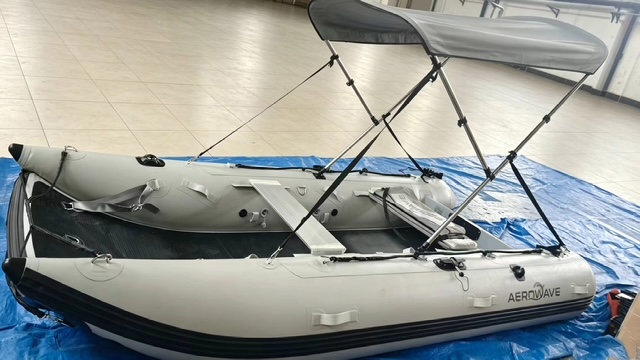
Aerowave Sport Series Offshore Inflatable Boats
US$1,989 USD · delivered to your door