Inflatable Boat Repair Australia: The Honest Owner's Guide to Seams, Punctures, Hypalon & PVC (2026)
Punctures, slow leaks, peeling seams — an honest, mechanic-free guide to fixing an inflatable boat in Australia. PVC vs Hypalon glues, when to DIY, when to send it to a specialist, and why the fabric under the glue matters more than the kit.
At a glance
Punctures, slow leaks, peeling seams — an honest, mechanic-free guide to fixing an inflatable boat in Australia. PVC vs Hypalon glues, when to DIY, when to send it to a specialist, and why the fabric under the glue matters more than the kit.
- The 4 things that actually go wrong
- Step 1 — Find the leak (properly)
- Step 2 — Work out what fabric you've got
- PVC (most common on cheap boats and Chinese roll-ups)
What we'd put you in
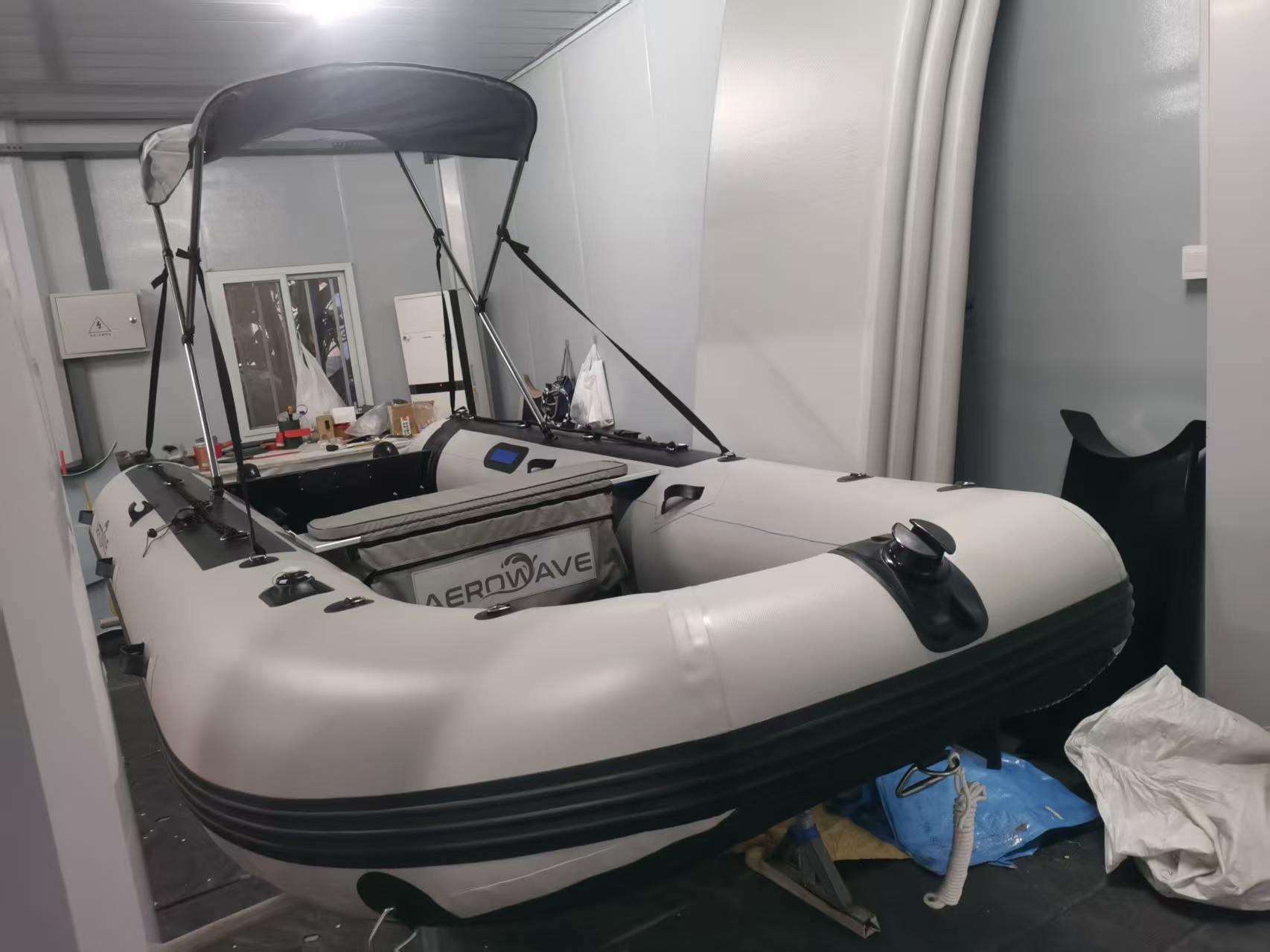
Aerowave Viper 400 Sovereign
1500 GSM / 1.2 mm VALMEX Heavy Plus — the fabric this article is really about.
US$3,167 USD
Delivered to your door, today's rate
- Free freight to United States · local taxes payable on arrival
- 7-year hull warranty
Ships to United States 🇺🇸 · tracked door to door
Fixing a hull today? Get the kit that actually holds.
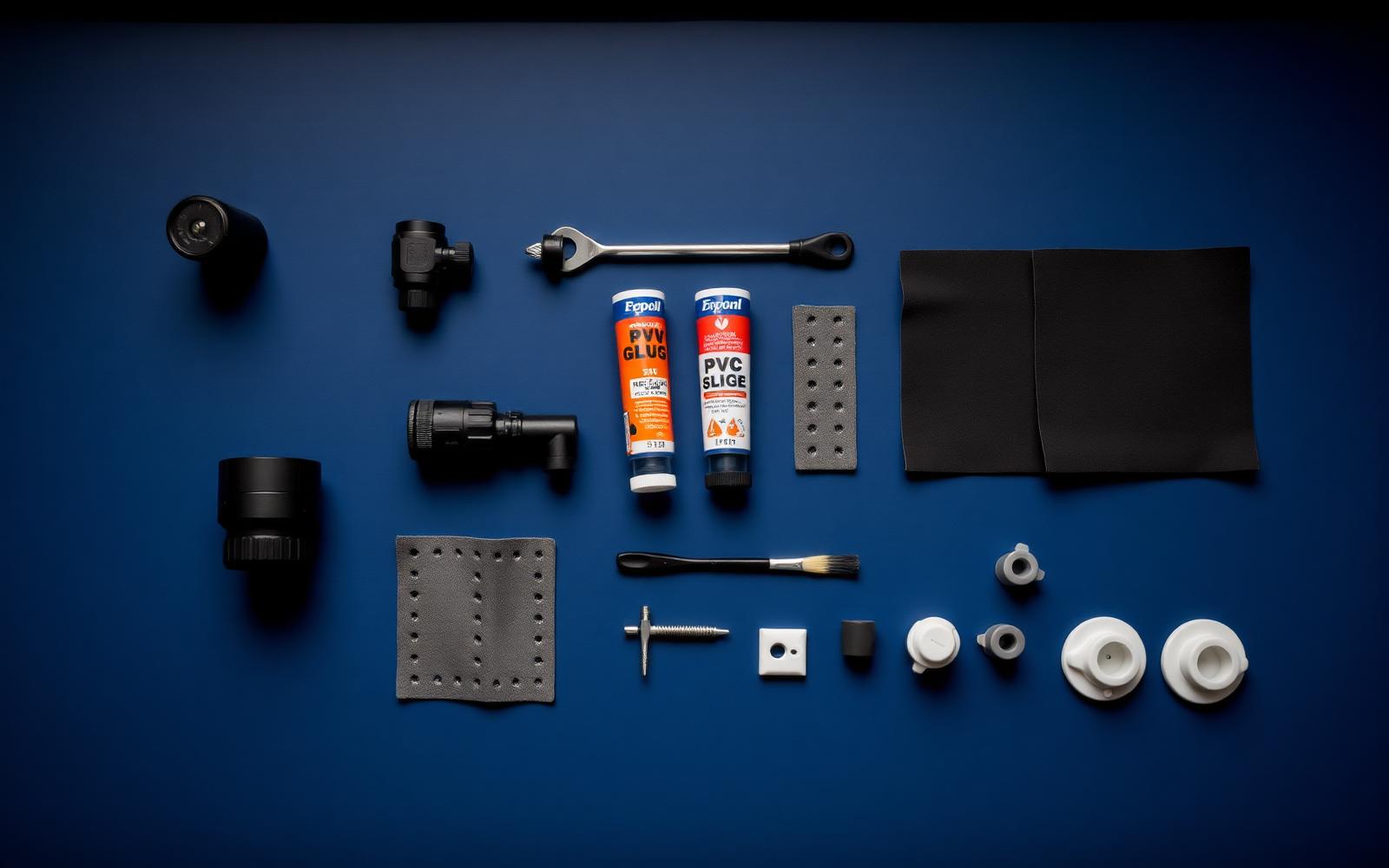
Two-part PVC adhesive, matched fabric patches and a seam roller — the same kit our factory uses on 1500 GSM VALMEX®.
- Two-part adhesive — single-part hardware-store glue lets go in the sun
- Patch fabric matched to hull weight, not generic vinyl
- Written step-by-step for a wet-season repair that lasts
We're putting this into production. Want first run at cost-plus pricing?
Add your email — no spam, one message when it ships. We use this list to tell our factory what to build next.
Or replace the boat entirely
Aerowave Viper 400 Sovereign
Delivered to United States — freight included in the figure below.
US$3,167landed, USD
- 7-year hull warranty
- CE certified to ISO 6185-3 and EU Directive 2013/53/EU
- Door-to-door, tracked the whole way
See it for yourself
Real boats. Real owners. Real people behind them.
Plenty of what you read online these days is generated. Check us out properly — the factory, the reviews and the owners are all one click away. Why we use AI, and how to check we’re real
How our boats are built
Walk the production line: thermo-welded seams, 1.2 mm VALMEX Heavy Plus hulls, over-pressure relief valves on every chamber.
See the buildGoogle Maps reviews
Real Australian owners, five stars, published on our Google Business Profile with the map — read them there, not just on our own site.
Open Google Maps reviewsOwner stories
Boats in use — offshore, on rivers, on rescue duty. Photos and words from the people who actually own them.
Read owner storiesEvery inflatable boat leaks eventually. The question is whether it's a 20-minute fix on the beach — or a A$400 trip to a repair specialist.
Most Aussie owners we talk to have the same story: bought a cheap PVC dinghy, spent two summers chasing slow leaks, and finally started Googling "how to repair an inflatable boat" at 6am on a Saturday with the boat half-inflated on the driveway.
This guide is the one we wish existed then. It's written by people who build inflatable boats for a living — not people who make money out of repairing them. So the honest advice up front: the best repair is the one you never have to do. But when you do have to do one, here's exactly how.
The 4 things that actually go wrong
Ignore the horror stories on Facebook. In real Australian conditions, ~95% of inflatable boat repairs fall into four categories:
- Puncture through the fabric — oyster lease, fish hook, dropped knife, sharp rock on the beach.
- Seam leak — the glued join between two panels lifts. Almost always a manufacturing / age / heat issue, not user damage.
- Valve leak — the one-way valve gets sand or salt in it and doesn't seal properly.
- Transom or D-ring lift — a glued-on fitting starts peeling off the tube.
The fix is different for each. So is the difficulty. Let's take them one at a time.
Step 1 — Find the leak (properly)
Half the "punctures" people bring us aren't punctures. They're a loose valve cap or a slightly rolled O-ring. Before you touch a repair kit:
- Inflate to full working pressure (for our Aerowave hulls that's 8–10 PSI; softer boats will be lower — check the label near the valve).
- Mix warm water and a good squirt of dish soap in a spray bottle.
- Spray the whole boat, panel by panel. Bubbles = leak. No bubbles = you're chasing a ghost.
- Don't forget the valves. Push the valve open with a matchstick; if it bubbles there, it's a valve service, not a repair.
If you can't find bubbles but the boat still goes soft overnight, it's almost always temperature — air contracts when it cools. That's not a leak.
Step 2 — Work out what fabric you've got
This is the step every cheap YouTube tutorial skips, and it's the one that decides whether your repair holds for a decade or a fortnight.
Australian inflatable boats are built from one of three fabrics:
PVC (most common on cheap boats and Chinese roll-ups)
- Feels plasticky. Shiny surface. Common weights: 0.6 mm, 0.9 mm.
- Repaired with PVC-specific glue (usually a two-part adhesive like Bostik 999 or Polymarine 2990).
- Life expectancy in the Aussie sun: 5–8 years before the fabric itself starts to give up.
Hypalon / CSM (traditional premium — Zodiac, Avon, older Highfield)
- Feels rubbery. Matte finish. Usually 1670 decitex or higher.
- Repaired with Hypalon two-part glue (Bostik 2402 + accelerator). Completely different chemistry to PVC glue.
- Life expectancy: 15–20 years, but far pricier.
VALMEX Heavy Plus (what we build with)
- German-made reinforced PVC-alloy. Ours is 1500 GSM / 1.2 mm on the Viper/Sovereign range, 1100 GSM / 0.9 mm on the AeroCat range.
- Uses PVC-family glues — but the fabric is so much thicker and more UV-stable that most owners never need a repair in the first place. That's the whole point.
- Expected lifespan: 10–12 years in Australian conditions.
Never put PVC glue on Hypalon or vice versa. The repair will look great for a week, then peel off in one clean sheet. If you don't know what fabric you've got, check with the manufacturer before you buy any glue.
Step 3 — Fix a puncture (the 20-minute version)
For anything under 50 mm long, in the flat part of a tube, and away from a seam:
What you need
- Repair patch of the same fabric as your boat (most boats ship with a small patch kit under the seat — dig it out).
- Correct two-part glue (PVC or Hypalon — see above).
- Acetone or MEK for cleaning.
- Clean rag, small brush, roller, marker, sharp scissors.
- Dry weather. Above 18 °C. Zero humidity if you can help it. Cold or damp = failed repair.
The steps
- Fully deflate the tube you're repairing. Repairs on inflated tubes never hold.
- Cut the patch round, not square — corners peel first. Aim for ~30 mm larger than the damage in every direction.
- Mark around the patch with a pencil so you know where to glue.
- Wipe the boat AND the patch with acetone. Twice. Let it flash off completely.
- Mix glue with the accelerator per the instructions — you get about 40 minutes of working time.
- Brush three thin coats onto both surfaces. Let each coat go tacky (about 5–10 minutes) before the next.
- Press the patch on from the middle out. Roll firmly — no air bubbles.
- Leave it for 24 hours before inflating. Ideally 48. Every failed home repair we've seen was inflated too soon.
That's it. If you did it right, that patch will outlast the rest of the boat.
Step 4 — Seam leaks (the honest bit)
If the leak is along a factory seam, stop.
Seam repairs are the job home DIY gets wrong most often, because:
- The panels are under permanent tension.
- The original bond is millimetres deep, done under heat and pressure at the factory.
- A surface glue-over almost never holds more than a season.
The right answer is one of:
- Warranty claim — if the boat is under 5 years old, this is a factory defect. Every reputable Aussie brand covers seam separation. Ours is 10 years on the fabric and 3 years on seams (see our warranty page).
- Professional re-seam — a proper repair specialist will strip the seam back, prep it under heat, and re-bond it. Expect A$300–A$600.
- Retire the boat. If seams are lifting on a 10-year-old cheap PVC hull, the fabric itself is at end of life. New glue won't save it.
Step 5 — Valve leaks (the easy win)
Bubbles at the valve almost always mean:
- Grain of sand under the O-ring, or
- Salt crystals gluing the one-way flap open.
Fix:
- Unscrew the valve body (most modern boats use a Halkey-Roberts or Bravo-style valve — comes out with a valve wrench you can buy for A$15).
- Rinse the whole valve under fresh water.
- Dry, then put a tiny smear of silicone grease (not petroleum jelly) on the O-ring.
- Screw back in firmly. Do the soap test again.
If it still leaks, replace the valve. Whole valve kits are A$30–A$50. That's a much cheaper fix than most people expect.
Step 6 — When to send it to a specialist
Australia has some genuinely good inflatable boat repair specialists. Send it in when:
- The damage is on or across a seam.
- The damage is longer than 100 mm.
- The transom, floor, or a D-ring has lifted.
- You've already tried a DIY patch and it failed.
- The boat is Hypalon and you don't have Hypalon glue on hand.
Expect A$150–A$500 depending on the job. That's still cheaper than a new boat — but it should also make you ask a bigger question: is the boat worth repairing at all?
The prevention story (this is the point)
Here's what nobody selling a repair kit will tell you: the single biggest predictor of how often you'll repair an inflatable boat is the fabric it's built from.
- 0.9 mm PVC in Aussie UV: expect a first serious repair around year 3–4.
- 1.1 mm quality PVC: year 5–7.
- 1.2 mm reinforced VALMEX (what we use): most owners never do one.
That's why we spec 1500 GSM / 1.2 mm VALMEX Heavy Plus on every Aerowave Viper, Sovereign and Sport Series hull, and 1100 GSM / 0.9 mm on the AeroCat range. Thicker fabric, better UV package, over-engineered seams. It costs more up front. It saves you every repair after that.
If you're on your second or third repair of a cheap boat, do the math. A new Aerowave Viper 400 Open Bow package is A$5,095 all-in — and you can split it across 4 fortnightly payments with WavePay, no credit check. Three big repair jobs on an old PVC hull will get you close to that anyway.
The tools we recommend keeping onboard
Even with a bulletproof boat, a small onboard kit is smart:
- 2 × patches in your boat's fabric (comes free with every Aerowave).
- Small tube of the correct two-part glue + accelerator.
- Small bottle of acetone.
- Cheap valve wrench.
- Roll of gaffer tape (temporary field fix only — get you home, not fix the boat).
If you bought your boat from us, that kit ships with every hull. If you didn't, order one from a marine chandler for about A$45.
Ready for a boat you're not fixing every summer?
Every Aerowave hull is built in the same VALMEX Heavy Plus fabric used by professional rescue services, backed by a 10-year fabric warranty, CE certified to ISO 6185-3, and delivered on free 30–40 day sea freight or 7–14 day air freight (A$810 customer share).
Have a look at the full range:
- Aerowave Viper Sport 400 Sports Package — the flagship 4.0 m open-bow
- AeroCat 360 Family Catamaran — the honest-price family cat
- Compare Viper vs AeroCat — which one suits your water
Prefer to talk it through? Call the workshop on +61 2 4335 1603 — we'd rather sell you the right boat once than watch you glue the wrong one every summer.
Weekend-Proof Score 17 questions · about 2 minutes
Will the boat you're about to buy survive an Australian summer?
Seventeen straight questions about where you'll use it, what you'll ask of it and the boat you're weighing up. You get a score out of 100, the exact weak points in your plan, and the one boat that genuinely fits.
Free · your result shows on screen · no email required
So which one is yours?
Pick how you'll actually use it and we'll take you straight to the right hull.
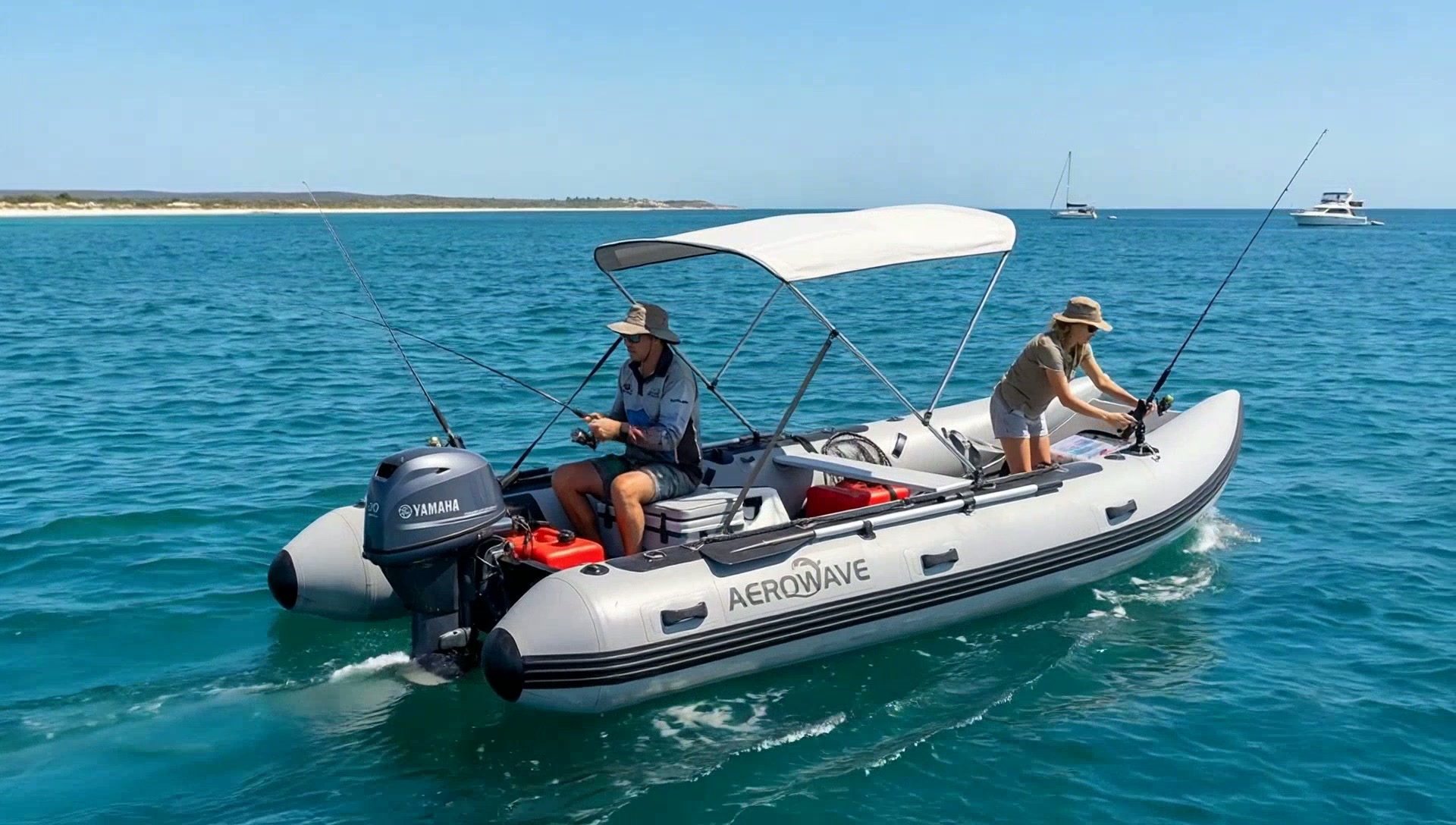
I want to fish it
Open bow, rod holders, deck space you can stand and cast from.
Viper Sport 400Family, diving and the beach
3.8 m Series 3 catamaran — low bow to climb back in wearing fins or a tank.
WaveRunner 380Tender / one-person launch
3.3 m hard-floor boat that packs into a bag and still takes a beach landing.
Viper 330Shop gear featured in this guide
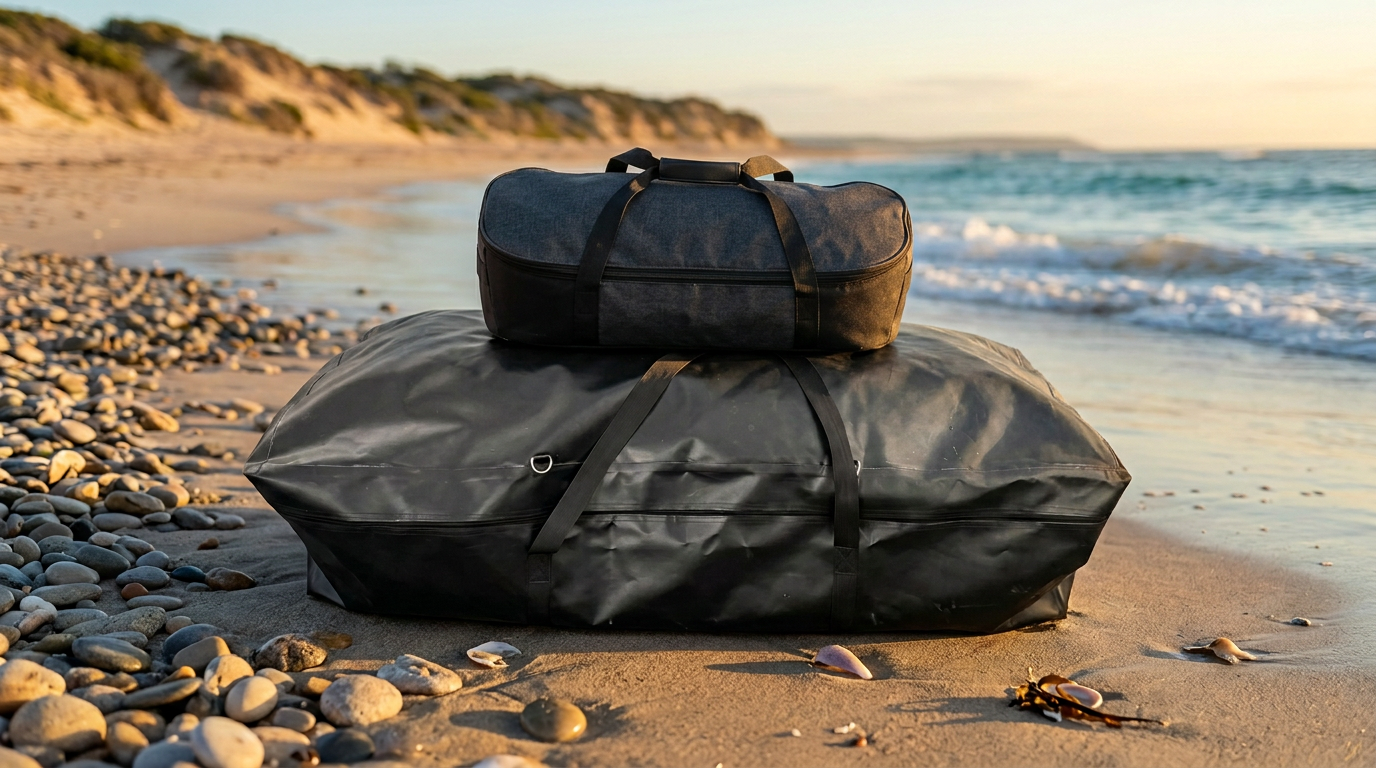
Aerowave Boat Bag & Wheel Bag Set — Australian-Made
The Aerowave Set — an Australian-made inflatable boat carry bag plus the matching launching wheel bag. Same 500 GSM European-spec ripstop PVC, same YKK zippers, boats up to 4.3 m, one price, postage included.
Free freight to United States · local taxes payable on arrival
Aerowave Viper 330
The compact premium Viper catamaran package built for buyers who want serious stability, easy transport, premium materials and real global support in a 3.3m boat. German VALMEX® 1.2mm fabric, 10 PSI high-pressure drop-stitch air deck floor with VALMEX non-slip surface, 5–7 year hull warranty and FREE express delivery Australia-wide.
Free freight to United States · local taxes payable on arrival
Aerowave Viper 400 Sovereign
Flagship 4m enclosed-bow inflatable catamaran. German VALMEX® 7321 Heavy Plus 1.2mm commercial-grade fabric, 10 PSI high-pressure drop-stitch air deck floor with VALMEX non-slip surface, LockPro wheels, full Bimini and FREE express delivery Australia-wide included. Winter special — save $1,000 until 31 August 2026.
Free freight to United States · local taxes payable on arrival
Not sure which suits you? Talk to a real boat owner.
Before you spend a cent
Buying from Australia, delivered to United States
You have never heard of us, we are on the other side of the world, and the internet is full of fakes. Fair enough. Here is everything you would need to check us out, in one place — no forms, no chat bot.
Australian designed business
Easy Inflatables, Avoca Beach NSW 2251. ABN 96 856 548 613. International orders ship from our Hong Kong hub.
222 owner reviews, 4.8 average
Read them in full, good and bad, on our reviews page.
CE certified, 7-year hull warranty
ISO 6185-3 and EU Directive 2013/53/EU. Warranty honoured worldwide.
Tracked, insured, door to door
FREE freight to United States · local tax/duty on arrival.
- Who am I actually buying from?
- Easy Inflatables, Avoca Beach NSW 2251, Australia. ABN 96 856 548 613. Sean is the owner and skipper, Gary Stewart handles sales on +61 2 4335 1603, Karen Matthews handles email. The boats are Australian designed; international orders ship from our Hong Kong dispatch hub so your landed price stays competitive. Phone us before you pay a cent — a real person answers.
- Is this really an Australian product?
- Yes — Australian designed and engineered on the NSW Central Coast. Manufacturing is done offshore to our spec, and international orders ship direct from our Hong Kong dispatch hub. If we routed every boat through Australia first, the freight alone would roughly double or triple your cost for the same hull.
- What do I pay, and what is not included?
- The delivery and import terms depend on your country. EU, UK, New Zealand and named Asia/Pacific lanes include duty and tax; US freight is free but US buyers pay import charges on arrival. Other destinations show their terms before payment.
- How do I pay safely?
- Card through Stripe (Visa, Mastercard, Amex, Apple Pay, Google Pay) or bank transfer. Card payments carry your bank's own dispute protection. We never ask for crypto, gift cards or payment to a personal account.
- What if it arrives damaged?
- Every boat ships fully tracked and insured door to door. Photograph the carton and the boat on arrival and email us — transit damage is claimed and replaced through us, not left with you and the courier.
- Is the warranty real outside Australia?
- Yes. The 7-year hull warranty on 1.2 mm VALMEX Heavy Plus and Orca Hypalon hulls applies wherever you are. Replacement parts are held in Australia and at our overseas hub and go out by express courier to your door.
- Is the boat actually certified?
- All Aerowave catamarans are CE certified to ISO 6185-3 and EU Directive 2013/53/EU. Certification paperwork is supplied with the boat — ask and we will send it before you order.
Frequently asked questions
- Can you repair an inflatable boat yourself?
- Yes — for punctures under about 50 mm in the flat part of a tube, a DIY repair with the correct two-part glue and a same-fabric patch will hold for the life of the boat. Seam leaks, transom lifts, and damage larger than 100 mm should go to a specialist.
- What glue do you use to repair an inflatable boat in Australia?
- It depends on the fabric. PVC and VALMEX boats use PVC two-part glue like Bostik 999 or Polymarine 2990. Hypalon boats use Hypalon-specific two-part glue like Bostik 2402 with accelerator. Never mix them — the wrong glue will peel off in weeks.
- How do I know if my inflatable boat is PVC or Hypalon?
- PVC feels shiny and plasticky; Hypalon feels matte and rubbery. If you are not sure, check with the manufacturer before buying glue. Most Australian inflatable boats sold in the last 10 years are PVC or reinforced PVC (VALMEX). Traditional Zodiac, Avon and older Highfield hulls are Hypalon.
- How much does professional inflatable boat repair cost in Australia?
- Expect A$150–A$500 for a specialist repair. Simple patches sit at the low end; seam re-bonds and transom re-glues are at the top. If you are facing your third A$300+ repair on an older PVC hull, a new premium boat is usually the better economic call.
- Do inflatable boat repair kits from Bunnings work?
- For the plastic-toy end of the market, sometimes. For a real boat, no — Bunnings kits are usually vinyl-repair adhesive, not marine two-part PVC or Hypalon glue. Buy the correct glue from a marine chandler or from the boat manufacturer directly.
- How long should I leave an inflatable boat patch to cure before using the boat?
- Minimum 24 hours, ideally 48 hours in dry weather above 18 °C. Every failed home repair we see was inflated or launched too soon. Patience is 90% of a good repair.
- Why does my inflatable boat go soft overnight if there is no leak?
- Air contracts as it cools. A 10 °C temperature drop overnight can knock 1–1.5 PSI off a fully inflated tube — that is normal, not a leak. Do the soapy water test in the morning at working pressure before assuming a puncture.
- When is an inflatable boat not worth repairing?
- When the fabric itself is at end of life: chalky surface, colour faded to grey/pink, multiple seams lifting, or the boat is over 10 years old and made from thin PVC. At that point, glue is only holding age at bay for another season.
Ready to set sail?
Premium German-fabric inflatable catamarans, built to order and delivered to your door. Talk to our team or browse the fleet.
Like this guide? Get the next one in your inbox.
Owner-tested tips, gear deep-dives and Aussie boating know-how — no spam.