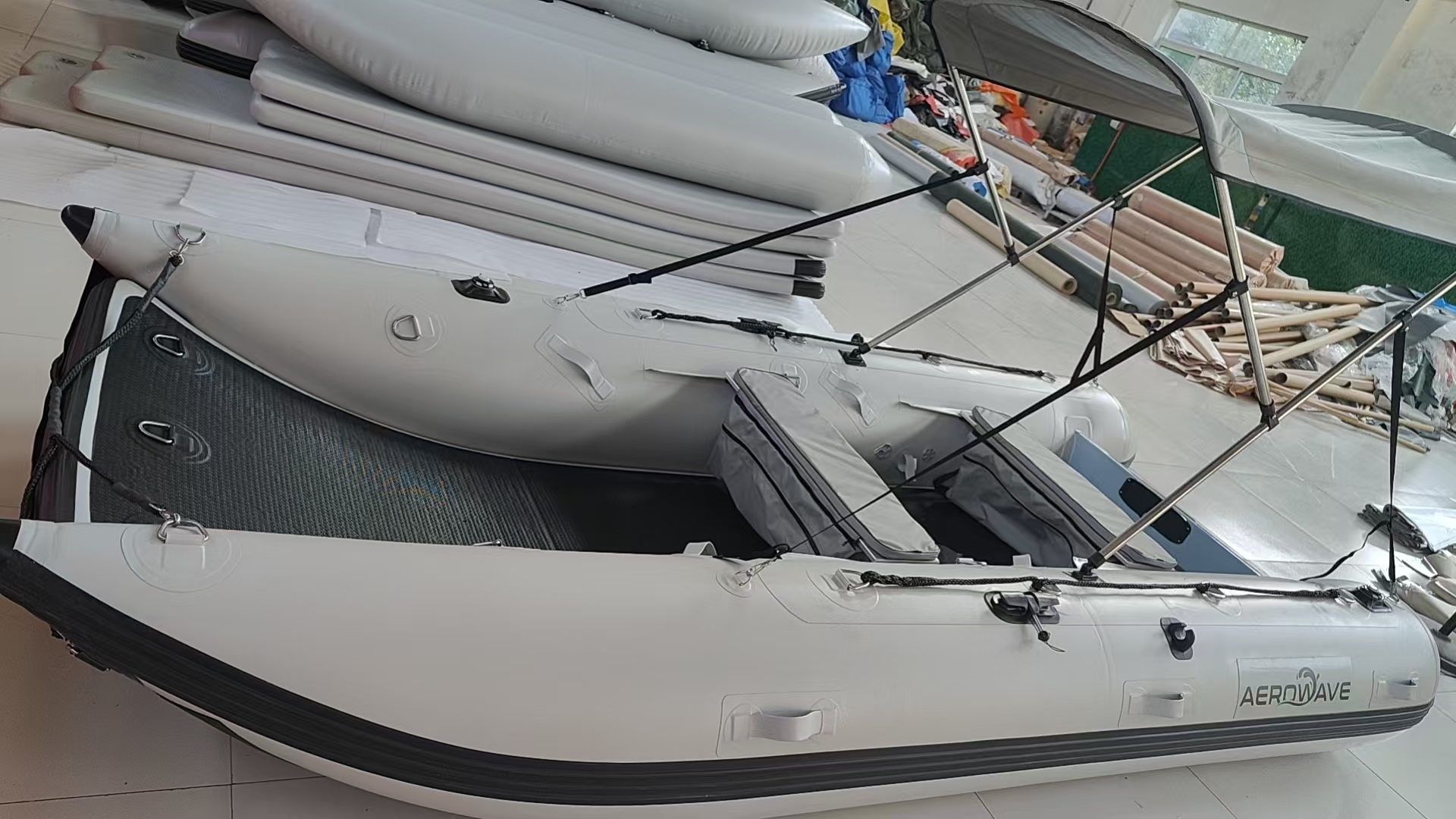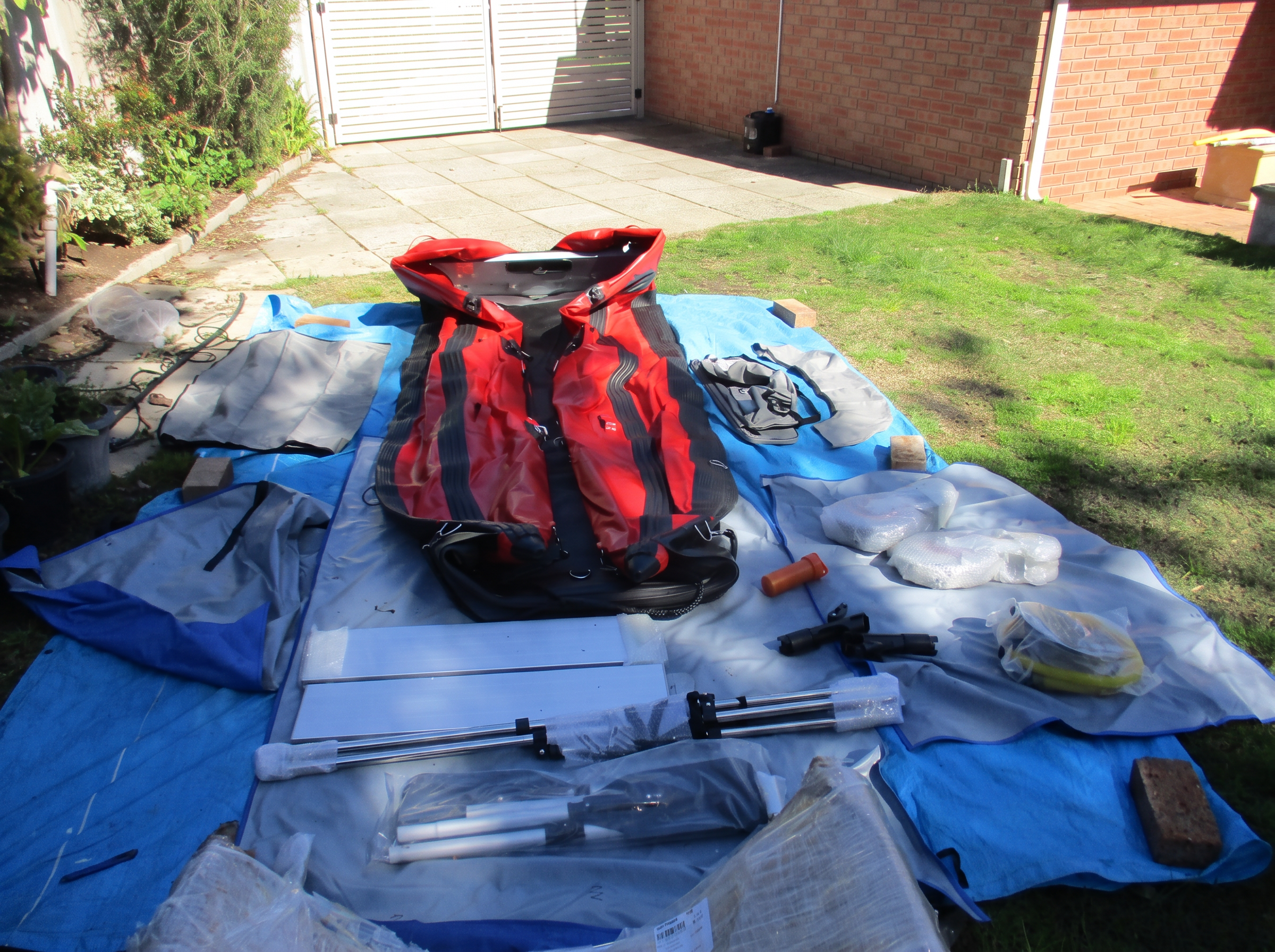
Are Cheap Inflatable Boats Worth It? The Real Cost of a 0.9 mm Hull
Think that bargain inflatable tender is saving you money? Unpack the true cost of ownership, UV degradation, seam failures, and fabric thickness in Australia.
At a glance
Think that bargain inflatable tender is saving you money? Unpack the true cost of ownership, UV degradation, seam failures, and fabric thickness in Australia.
- Are cheap inflatable boats worth it for coastal boating?
- The engineering anatomy of budget PVC vs commercial VALMEX
- Why 0.9 mm budget PVC fails in Australian conditions
- Glued seams vs welded construction: The hidden failure point
What we'd put you in
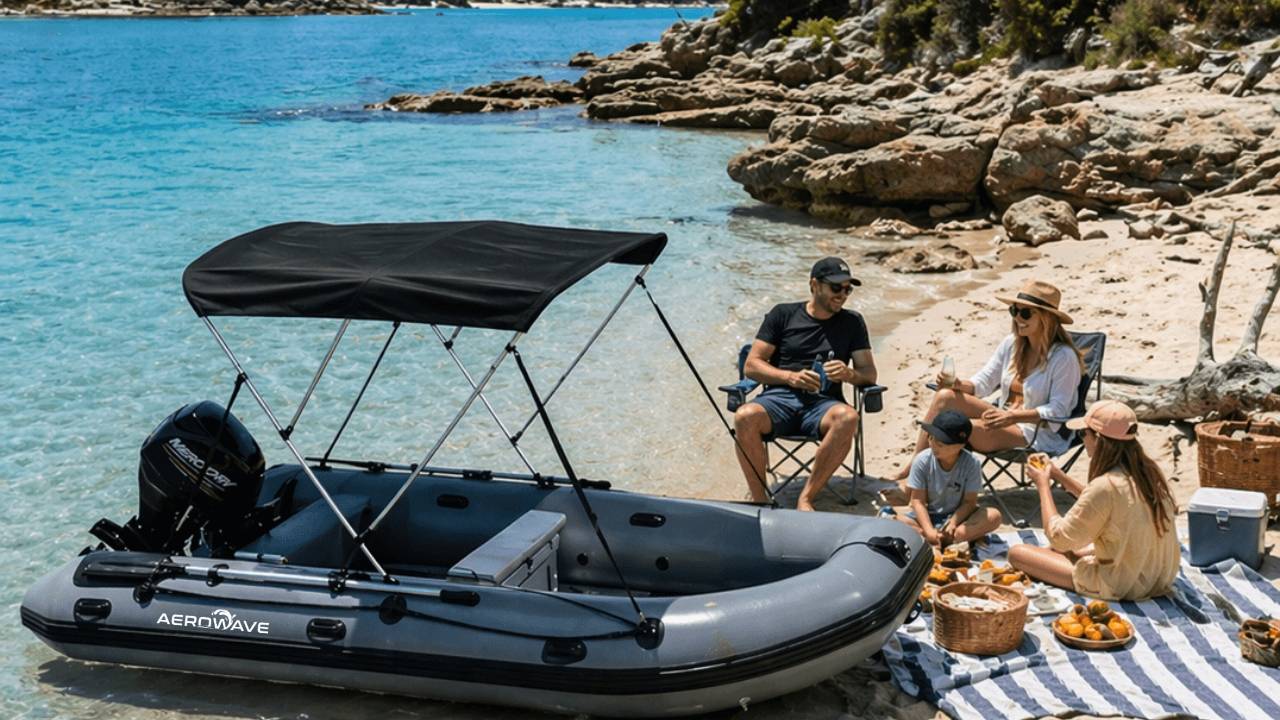
Aerowave Viper 400 Sovereign
Our best-selling boat: 4.0 m, 1.2 mm VALMEX hull, 5 + 2 year hull warranty.
US$4,164 USD
Delivered to your door, today's rate
- Free freight to United States · taxes included, nothing to pay on arrival
- 5 + 2 year hull warranty
🇺🇸 Shipping to United States · duty & taxes prepaid
Yes — we ship the Aerowave Viper 400 Sovereign to United States. Here's the landed price.
Our best-selling boat: 4.0 m, 1.2 mm VALMEX hull, 5 + 2 year hull warranty.
Aerowave Viper 400 Sovereign
- Boat package (export price)
- US$3,858
- 15% tariff relief credit
- − US$579
- Express air freight to United States
- Included
- Import duty, taxes & customs clearance
- US$885 — prepaid by us
- Estimated landed, USD
- US$4,164
Indicative, converted at today's rate. Ask below and we'll put a fixed figure in writing, valid 30 days.
- 5 + 2 year hull warranty
- 1500 GSM / 1.2 mm VALMEX® Heavy Plus hull
- CE certified to ISO 6185-3 and EU Directive 2013/53/EU
- Delivered duty paid — nothing to pay on arrival
Your price, delivered to your door — freight included.
We email the full PDF quote (spec, freight, finance, WavePay) to your inbox in under 60 seconds. No spam — one quote, one follow-up.
See it for yourself
Real boats. Real owners. Real people behind them.
Plenty of what you read online these days is generated. Check us out properly — the factory, the reviews and the owners are all one click away. Why we use AI, and how to check we’re real
How our boats are built
Walk the production line: thermo-welded seams, 1.2 mm VALMEX Heavy Plus hulls, over-pressure relief valves on every chamber.
See the buildGoogle Maps reviews
Real Australian owners, five stars, published on our Google Business Profile with the map — read them there, not just on our own site.
Open Google Maps reviewsOwner stories
Boats in use — offshore, on rivers, on rescue duty. Photos and words from the people who actually own them.
Read owner storiesA cheap inflatable boat usually delivers its best performance on the day you open the carton; every subsequent summer day under the Australian sun extracts a steep compound tax in degraded seams, micro-punctures, and unrecoverable depreciation.
Scroll through any online marketplace or budget camping outlet and the proposition appears tempting. Brand-new tenders, dinghies, and catamarans advertise seaworthy freedom for under fifteen hundred dollars. They boast shiny PVC, neat little foot pumps, and five-star reviews penned by owners who have spent precisely twenty minutes floating across a glassy freshwater dam. In the harsh reality of coastal Australia, however, watercraft are subjected to one of the most punitive marine proving grounds on earth. High ambient UV indices, abrasive shell grit, sharp oyster leases, and tidal current loads quickly expose the structural shortcuts inherent in low-cost manufacturing.
When evaluating cheap inflatable boats, the purchase price represents only an entry deposit. The true calculation is total cost of ownership across a three-to-ten-year horizon. Buying an inflatable craft built from paper-thin fabric with glued seams might seem thrifty at checkout, but that equation flips the moment the hull is left on davits through a January heatwave in Queensland or dragged across coarse sand on the New South Wales Central Coast.
To make an informed marine investment, you must understand where manufacturers strip out engineering integrity to hit budget price points, why base fabric construction dictates operational lifespan, and how a heavier commercial-grade platform radically alters your long-term ownership ledger.
Are cheap inflatable boats worth it for coastal boating?
Cheap inflatable boats are rarely worth the initial saving if you plan to use them in saltwater coastal environments, anchor them outdoors, or navigate around boat ramps and rocky foreshores. Within eighteen to twenty-four months of Australian sun exposure, entry-level polymers undergo plasticiser migration, rendering the fabric sticky, brittle, and prone to catastrophic seam separation under working air pressure.
There is, of course, a narrow use case for budget inflatables. If your vessel lives permanently in an air-conditioned garage, gets inflated twice a year for a calm paddle around an inland lake, and never encounters barnacles or harsh chemical washdowns, an economy hull will float. But treating a sub-thousand-dollar import as an everyday yacht tender, serious dive platform, or estuary fishing rig is an expensive mistake.
Initial Low Retail Cost -> Rapid UV Breakdown (18-24 Mo) -> Frequent Glue & Seam Repairs -> Zero Resale Value / Landfill Premium German Fabric -> 10-12 Year Stable Lifespan -> Routine Fresh Water Washdown -> High Retained Capital Value
Marine craft operating along the Australian seaboard face brutal ultraviolet radiation. The Bureau of Meteorology regularly records solar UV index values exceeding 12 during peak summer months. Low-grade polyvinyl chloride (PVC) formulations rely on budget plasticisers to remain supple. Under aggressive radiant heat and relentless UV bombardment, those plasticisers leach out. The fabric loses tensile strength, the outer coating discolours, and internal thread matrices lose cohesion. What seemed like a bargain tender transforms into an unpatchable, gummy hull that cannot maintain standard operating pressure.
The engineering anatomy of budget PVC vs commercial VALMEX
To understand why cheap inflatable boats fail, you must examine the textile engineering beneath the surface colourway. Not all PVC is created equal; in truth, calling both a budget import and a commercial offshore catamaran "PVC" is like comparing pressed cardboard to structural marine ply.
======================================================================== BUDGET INFLATABLE FABRIC (Generic Asian Import)
[ Top Layer ] Thin, un-stabilised PVC film (susceptible to yellowing) [ Core Weft ] Low-density polyester yarn (loose weave, low tear threshold) [ Base Layer ] Standard PVC backing (prone to plasticiser leaching) Total Density: ~750 to 900 GSM | Thickness: 0.7 mm – 0.9 mm
COMMERCIAL HEAVY PLUS (German Mehler VALMEX®)
[ Top Layer ] Dense, UV-treated polymer shield + chemical barrier [ Core Weft ] High-tenacity 1100–1500 Decitex Trevira polyester scrim [ Base Layer ] Dual-side knife-coated elastomeric polymer matrix Total Density: 1500 GSM | Thickness: 1.2 mm (Viper Series)
Entry-level hulls utilise calendered PVC laminates ranging from 750 to 900 GSM (grams per square metre), typically measuring roughly 0.7 mm to 0.9 mm in thickness. In these budget fabrics, base polyester cloth is simply sandwiched between two rolled sheets of PVC film using heat and light pressure. The bond between the base cloth and outer layers is purely mechanical. Over time, flexing, folding, and hydraulic pressure break down this lamination, causing microscopic delamination bubbles, porosity leaks, and structural softening.
In contrast, high-tier inflatables like the Aerowave Viper series utilise German-engineered Mehler VALMEX® Heavy Plus fabric rated at 1500 GSM with a 1.2 mm thickness, or the AeroCat series running 1100 decitex at 0.9 mm VALMEX. These fabrics are manufactured via a continuous knife-coating technique. Liquid polymer is impregnated deep into the tightly woven synthetic base cloth (Trevira high-tenacity polyester), melting the layers into a monolithic, puncture-resistant membrane. The fabric does not delaminate because there are no separate laminates to separate.
Why 0.9 mm budget PVC fails in Australian conditions
When you see a cheap boat advertised with a "0.9 mm heavy-duty hull", caution is warranted. The term "0.9 mm" refers solely to physical thickness, not textile density, polymer formulation, or structural weave integrity. A 0.9 mm budget PVC often combines a sparse, low-thread-count base cloth with heavy, low-grade plasticisers to artificially bulk out caliper thickness.
When a hull constructed from this material strikes an oyster-encrusted navigation marker or rubs against an abrasive wooden jetty piling, the low-density internal yarn fails to halt tear propagation. A light scrape tears through the outer film and runs along the structural thread lines. In contrast, high-density 1500 GSM 1.2 mm VALMEX incorporates an exceptionally dense yarn matrix that resists shear forces, snagging, and abrasion, offering a functional operating lifespan of 10 to 12 years under proper care.
Glued seams vs welded construction: The hidden failure point
Seam failure represents the number one structural killer of cheap inflatable boats across Australia. In economy production facilities, tubes are assembled using single-part or standard contact adhesives applied by hand. This manufacturing choice reduces factory overheads, but it leaves an Achilles heel baked into the design.
Contact glues are thermo-reactive. When an inflatable tender is left tethered on a yacht's swim platform or stowed on the foredeck in 35-degree heat, dark tube surfaces can easily reach skin temperatures exceeding 65 degrees Celsius. Under this thermal load combined with internal tube pressure, economy adhesives soften, turn gummy, and creep. The seam gradually slips until an entire baffle, tube end-cap, or transom joint separates with a sudden rush of air.
+----------------------------------------------------------------------+ | THERMAL DELAMINATION CYCLE (GLUED SEAMS) | | | | 1. High Sun Exposure -> Surface temp exceeds 60°C | | 2. Pressure Rise -> Tube pressure climbs from 3.0 PSI to 4.5+ PSI| | 3. Adhesive Creep -> Glue softens; joint shears under tension | | 4. Catastrophic Pop -> Rapid air loss at transom or tube seam | +----------------------------------------------------------------------+
Quality engineering circumvents adhesive vulnerability through thermo-welding (hot air or high-frequency radio welding) and advanced multi-stage bonding procedures. Welded seams melt overlapping polymer edges together at the molecular level, creating a structural joint stronger than the parent fabric itself. Where structural bonding agents are mandated, aerospace-grade, two-part polyurethane adhesives containing specific isocyanate cross-linking agents must be cured under strictly monitored temperature and humidity tolerances.
Every vessel built for offshore competence—such as the Aerowave Viper, AeroCat, and WaveRunner lines—is manufactured strictly to CE certified ISO 6185-3 standards. This international compliance protocol mandates stringent mechanical shear testing, high-temperature environmental baking tests, and hydrostatic overpressure safety margins that budget imports skip to shave costs.
The true cost of owning cheap inflatable boats
To grasp the genuine economics of cheap inflatable boats, one must look past the initial sales receipt and calculate the cost over a multi-year ownership cycle. Consider an Australian owner purchasing a sub-$1,500 budget tender compared to investing in an engineered craft like the Aerowave AeroCat 335 (A$3,895) or the commercial-grade Aerowave Viper 330 (A$5,145).
| Ownership Factor | Budget 0.9 mm Import Hull | AeroCat 335 / Viper 330 Hull |
|---|---|---|
| Initial Purchase Price | A$1,200 – A$1,600 | A$3,895 – A$5,145 |
| Included Freight | Rarely included (A$150–A$350 extra) | Delivery included for Australian customers |
| Expected Tube Lifespan | 2 to 4 years (stored outdoors) | 10 to 12 years (with proper care) |
| Fabric Construction | 750–900 GSM Calendered PVC | 1100 Decitex / 1500 GSM German VALMEX® |
| Fabric Thickness | 0.7 mm – 0.9 mm | 0.9 mm (AeroCat) / 1.2 mm (Viper Heavy Plus) |
| Typical Repair Expenses (Years 1–4) | A$450 – A$900 (valves, glue, pinholes) | A$0 (standard user maintenance) |
| Transom Integrity | Painted exterior ply (delaminates ~Year 3) | 380 mm marine composite / sealed structural transom |
| Deck System | Thin slatted wood or low-PSI deck | Rigid 8–10 PSI high-pressure drop-stitch air deck |
| Warranty Cover | 12 months limited (parts return) | Up to 5-year or 5 + 2-year manufacturer warranty |
| Resale Value (at Year 4) | Negligible / Landfill (A$0 – A$150) | High residual value (60% to 75% original cost) |
| True Cost Per Month | ~A$45 – A$65 per month | ~A$32 – A$42 per month |
When amortised across a decade, the "expensive" boat is objectively the cheaper asset to run. The budget tender demands constant workshop intervention, runs through cans of specialty two-part glue, causes missed weekends on the water due to sudden deflations, and ultimately ends its life in local council hard-waste collections within four years.
Transom construction: Where budget boats crack under pressure
The transom bears the entire vibrational, thrust, and torsional workload generated by your outboard motor. On cheap inflatable boats, this critical component is almost universally constructed from generic exterior-grade plywood, wrapped in a single superficial coat of resin or black paint, and secured to the tubes using narrow, glued PVC flange strips.
Water always finds an ingress point. It penetrates around mounting screws, transom drain fittings, or transducer brackets. Once water breaches the timber core of a budget boat:
- The internal plies rot and separate invisibly inside the painted coating.
- The timber swells, crushing the transom mounting pads when outboard clamps are tightened.
- Tube bonding flanges experience extreme rotational fatigue as the soft timber flexes under throttle.
In contrast, high-performance soft inflatable boats (SIBs) employ heavy-duty, marine-sealed transoms designed to withstand punishing hydrodynamic torque. The transom dimensions—such as the standard 380 mm transom height optimised for short-shaft outboards like the Hidea 4-stroke range—are anchored using heavy-duty, moulded EPDM or reinforced structural collars. These components dissipate motor vibration throughout the entire tube assembly rather than concentrating stress points into a glued seam.
Hydrodynamic Thrust ==> Moulded Transom Collars ==> Distributed Tube Tension (Rigid) Hydrodynamic Thrust ==> Glued Plywood Flange ==> Focal Point Torsion ==> Transom Shear (Failure)
If you pair a modern engine—such as a Hidea 9.9HP, 15HP, or 20HP 4-stroke—with a flimsy transom, the engine leg will flex noticeably inward under hard acceleration. This flex alters your propeller trim angle, causes the hull to wallow, drastically cuts fuel economy, and risks tearing the transom entirely free from the inflatable tubes in heavy chop.
Ride quality and stability: Inflatable catamarans vs cheap round-tail tenders
Beyond fabric durability and glue breakdown, cheap inflatable boats extract an immense penalty in on-water safety and passenger comfort. The classic budget inflatable is an archaic, round-tail monohull with a flat bottom or a minimal inflatable V-keel.
Anyone who has piloted an entry-level monohull tender across a choppy harbour recognises the symptoms:
- Severe Spray Ingress: Flat or poorly rockered tubes push water forward and outward, funneling windblown saltwater directly over the bow into passengers' faces.
- Bow Rise and Cavitation: Because weight is concentrated aft near the small engine, the bow points skyward under throttle, struggling to plane until someone awkwardly crawls forward.
- Instability on Boarding: Stepping onto the side tube of a budget round-tail tender shifts the centre of buoyancy, tipping the boat at steep angles that make step-ins from high docks precarious.
ROUND-TAIL MONOHULL (Standard Budget Tender)
( )=====================( ) \ / __________ WATER _________/ High hydro-drag, wet spray, rolls easily under foot.
INFLATABLE CATAMARAN (Aerowave Viper / AeroCat / WaveRunner) __ __ ( ) ( ) | | === TUNNEL AIR CUSHION == | | () () Twin hull tracking, air-cushioned tunnel, ultra-stable gunwales.
Twin-hull inflatable catamarans—exemplified by hulls like the Aerowave WaveRunner 380, the versatile AeroCat 380 (A$4,570), or the heavy-duty Viper 400 Open Bow (A$5,495)—completely transform stability and performance on the water. Catamaran hulls feature twin parallel sponsons linked by a raised floor structure. This creates an engineered central tunnel that traps air, cushioning the hull over surface chop while dramatically reducing wetted surface drag.
An inflatable catamaran planes almost flat, eliminating steep bow rise. When drifting over shallow sandbanks or hauling a heavy crab pot aboard, you can stand safely on either outer tube without tipping the deck. The raised floor stays well clear of surface slop, keeping your deck, gear, and supplies dry even when powering through stiff bay chop.
The drop-stitch floor factor
Flooring represents another vast performance differentiator. Budget craft rely on either basic slatted timber floors that bend beneath your feet or loose aluminium panels that rattle, pinch fingers during setup, and corrode in saltwater. High-specification inflatable catamarans leverage integrated high-pressure drop-stitch decks inflated between 8 and 10 PSI.
Drop-stitch fabric connects thousands of internal polyester filaments between upper and lower structural skins, allowing inflation pressures four to five times higher than standard tube chambers. The result is a rock-solid, non-slip floor that matches the rigidity of marine ply without the back-breaking transport weight or galvanic corrosion concerns.
Protecting your investment: The truth about maintenance and tube chaps
No matter what vessel you operate, proper preventative maintenance pays massive dividends in the Australian sun. If you run a high-grade 1.2 mm VALMEX hull, proper protection stretches your working life beyond a decade; if you already own a 0.9 mm hull, protection is the only barrier keeping it from rapid failure.
To maximise tube life, follow these rules:
- Deploy Purpose-Built Tube Covers: UV radiation degrades polymers through photochemical oxidation. Fitting custom accessories like Aerowave Tube Chaps (A$1,000 for a handmade, custom-fitted pair) shields the top sponson surfaces from direct solar degradation, fuel spills, and fish scales.
- Maintain Correct PSI: Air expands significantly under heat. A tube inflated to 3.0 PSI at 7:00 AM on a cool morning can soar past 4.5 PSI by midday. Over-pressurisation stresses internal baffles. Always carry a reliable pressure gauge and release small amounts of air during heatwaves if your boat lacks automatic over-pressure relief valves.
- Wash Down with Fresh Water: Salt crystals act like miniature prisms that focus UV energy, while microscopic sand grains grind against fabric seams during transport. Rinse the hull with fresh water after every saltwater outing and store it completely dry in an Aerowave Heavy-Duty Boat Bag (A$299).
- Never Use Petrochemical Cleaners: Harsh solvents, degreasers, and automotive polishes strip the factory plasticiser barriers out of PVC hulls. Clean tubes exclusively with specialized marine inflatable washes or mild, biodegradable soaps.
How to spot a poor-quality inflatable boat before you buy
Before spending hard-earned money, walk through this quality inspection checklist. It will help you quickly distinguish a seaworthy vessel from an under-engineered import.
- Check the Compliance Plate: Ensure the hull features an authentic CE Plate referencing ISO 6185-3 standards, specifying passenger limits, max outboard weight, and working chamber pressures.
- Inspect Transom Seam Overlaps: Look closely at the joins where the transom meets the inflatable tubes. If you see visible glue seepage, air bubbles along seam edges, or simple unreinforced butt joins, walk away.
- Confirm Exact Fabric GSM: Demand the fabric specification sheet. Do not settle for vague terms like "marine-grade composite". Ask for exact decitex and GSM ratings (e.g., 1100 Decitex or 1500 GSM VALMEX).
- Check Valve Positioning and Types: Premium craft use recessed, quarter-turn push-push marine valves (such as Halkey-Roberts pattern valves) located for easy top access and protected by dust seals.
- Evaluate the Transom Core: Check whether the transom is thin exterior-grade ply or a heavy-duty, marine-sealed 380 mm structure built to handle modern 4-stroke outboard torque.
- Review the Warranty Terms: Inspect warranty exclusions. Budget suppliers often provide a basic 12-month parts-only warranty that excludes "commercial use, sun exposure, or seam separation". High-end designs back their products with genuine 5-year or 5 + 2-year hull coverage.
Custom manufacturing vs off-the-shelf budget imports
When buying cheap inflatable boats, you are purchasing an off-the-shelf commodity mass-produced months earlier, flat-packed in high-humidity shipping containers, and left sitting in uninsulated warehouses. By the time that budget hull arrives at your door, its glue joints may have already undergone repeated thermal heating cycles without ever touching the water.
High-end watercraft take a fundamentally different manufacturing path. At Easy Inflatables, every Aerowave craft is individually custom-built. Standard builds require up to three and a half weeks in production (and up to four weeks for Hypalon builds), followed by 10 to 13 days transit. Australian buyers benefit from delivery included directly in the purchase terms, while international customers can view specific freight options via easyinflatables.com.au/international.
Rather than settling for generic colours and arbitrary fittings, custom manufacturing secures you a tailored setup. You can pair an open-bow sport runabout with an Aerowave Viper Sovereign Bow Bag (A$250) or match an Aerowave Viper 330 with a factory-matched Hidea 9.9HP 4-stroke short shaft package (A$8,245). You secure your custom build slot with a simple 50% deposit, with the balance due only once the vessel successfully clears final Quality Control inspection.
If you prefer to carry accessories organised in heavy-duty luggage, you can outfit your boat with an Australian-Made Heavy-Duty Wheel Bag (A$109) or an Aerowave Boat Bag & Wheel Bag Set (A$389), knowing every seam, stitch, and component is purpose-built to survive Australian conditions.
The bottom line
Cheap inflatable boats present an alluring initial price tag, but the true cost of ownership tells a very different story once sun, salt, and surf come into play. Low-density 0.9 mm fabrics, thermo-reactive glued seams, and unsealed transoms turn what should be an open-ended maritime adventure into constant patch jobs, frustrating leaks, and premature disposal.
Investing in a boat engineered with genuine 1100 decitex to 1500 GSM VALMEX, high-pressure drop-stitch decks, and proven catamaran stability delivers confidence on the water, ten to twelve years of dependable service life, and outstanding resale value. Build your setup right the first time, take to the water with complete peace of mind, and let quality engineering handle the elements.
To discuss custom hull builds, outboard pairing, or bespoke accessories, call our Australian specialist team on +61 2 4335 1603 or email sales@easyinflatables.com.au.
Related
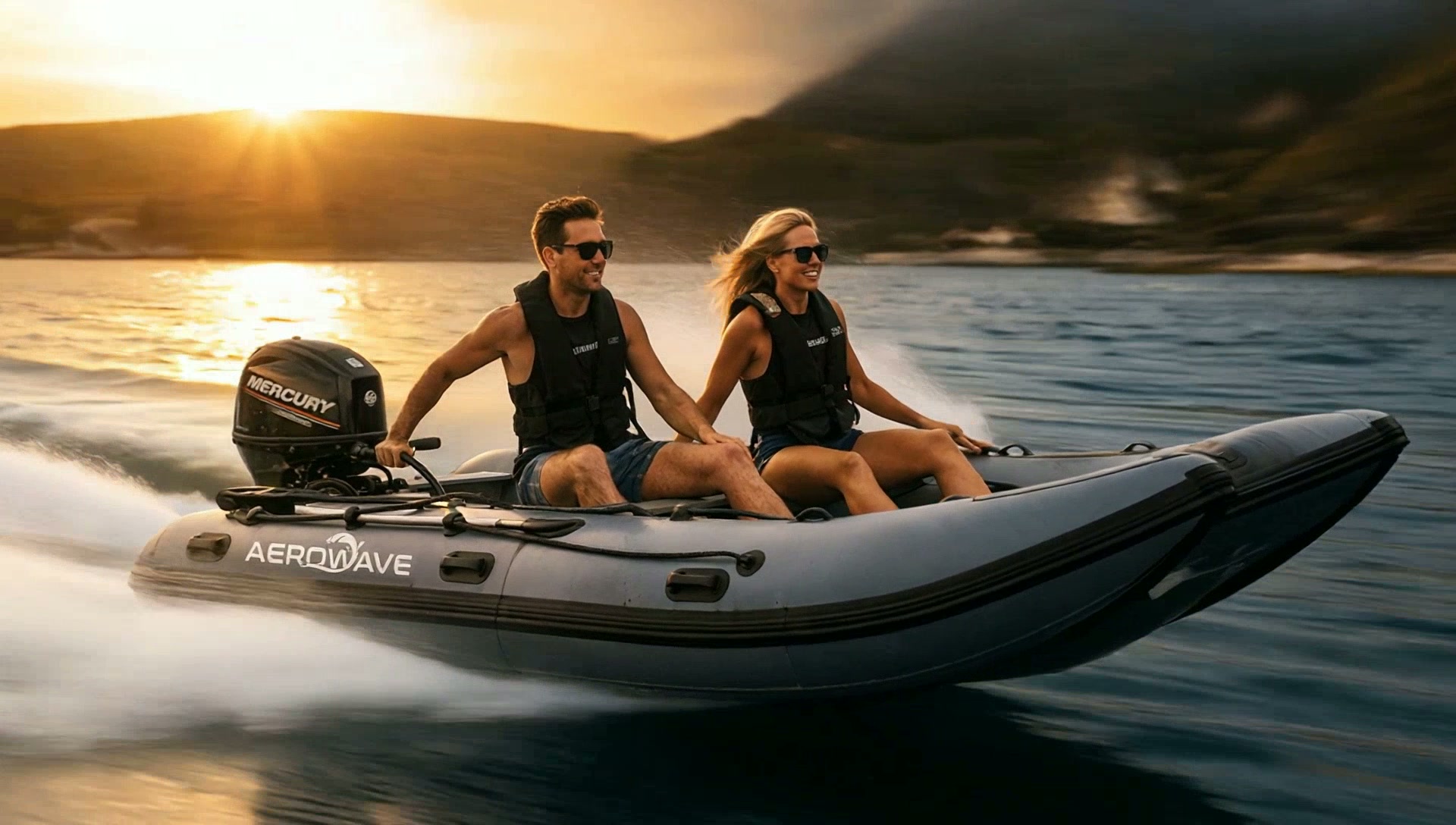
Weekend-Proof Score 17 questions · about 2 minutes
Will the boat you're about to buy survive an Australian summer?
Seventeen straight questions about where you'll use it, what you'll ask of it and the boat you're weighing up. You get a score out of 100, the exact weak points in your plan, and the one boat that genuinely fits.
Free · your result shows on screen · no email required
So which one is yours?
Pick how you'll actually use it and we'll take you straight to the right hull.
I want to fish it
Open bow, rod holders, deck space you can stand and cast from.
Viper Sport 400Family, diving and the beach
3.8 m Series 3 catamaran — low bow to climb back in wearing fins or a tank.
WaveRunner 380Tender / one-person launch
3.3 m hard-floor boat that packs into a bag and still takes a beach landing.
Viper 330Shop gear featured in this guide
Aerowave WaveRunner 380 Series 3 Catamaran Package
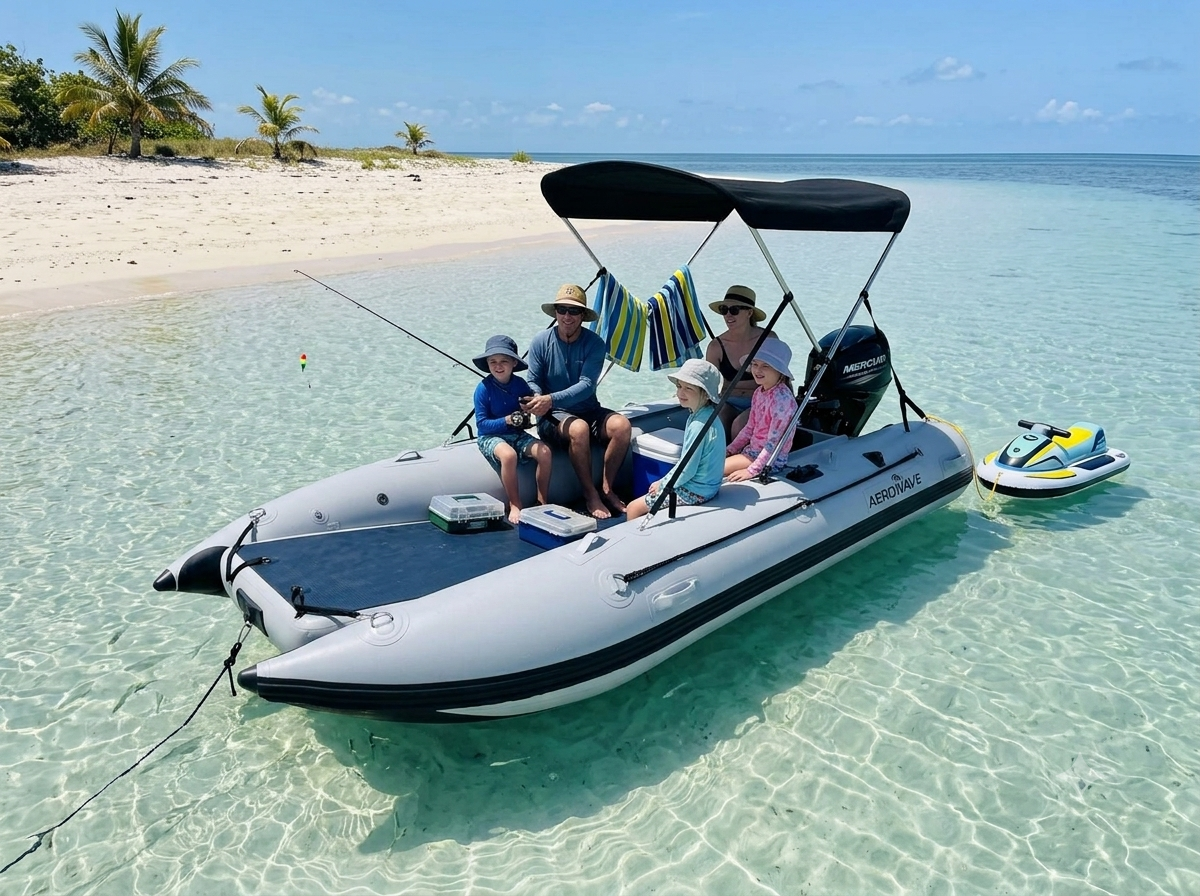
The WaveRunner 380 Series 3 is a premium 3.8m inflatable catamaran package built for Australian and worldwide families, fishing, and coastal day boating — ideal for snorkeling and spearfishing — offering serious stability and premium German Valmex® construction.
Free freight to United States · taxes included, nothing to pay on arrival
Aerowave Viper 400 Sovereign
Flagship 4m enclosed-bow inflatable catamaran. German VALMEX® 7321 Heavy Plus 1.2mm commercial-grade fabric, 10 PSI high-pressure drop-stitch air deck floor with VALMEX non-slip surface, LockPro wheels, full Bimini and FREE express delivery Australia-wide included.
Free freight to United States · taxes included, nothing to pay on arrival
Aerowave Viper 365 Open Bow
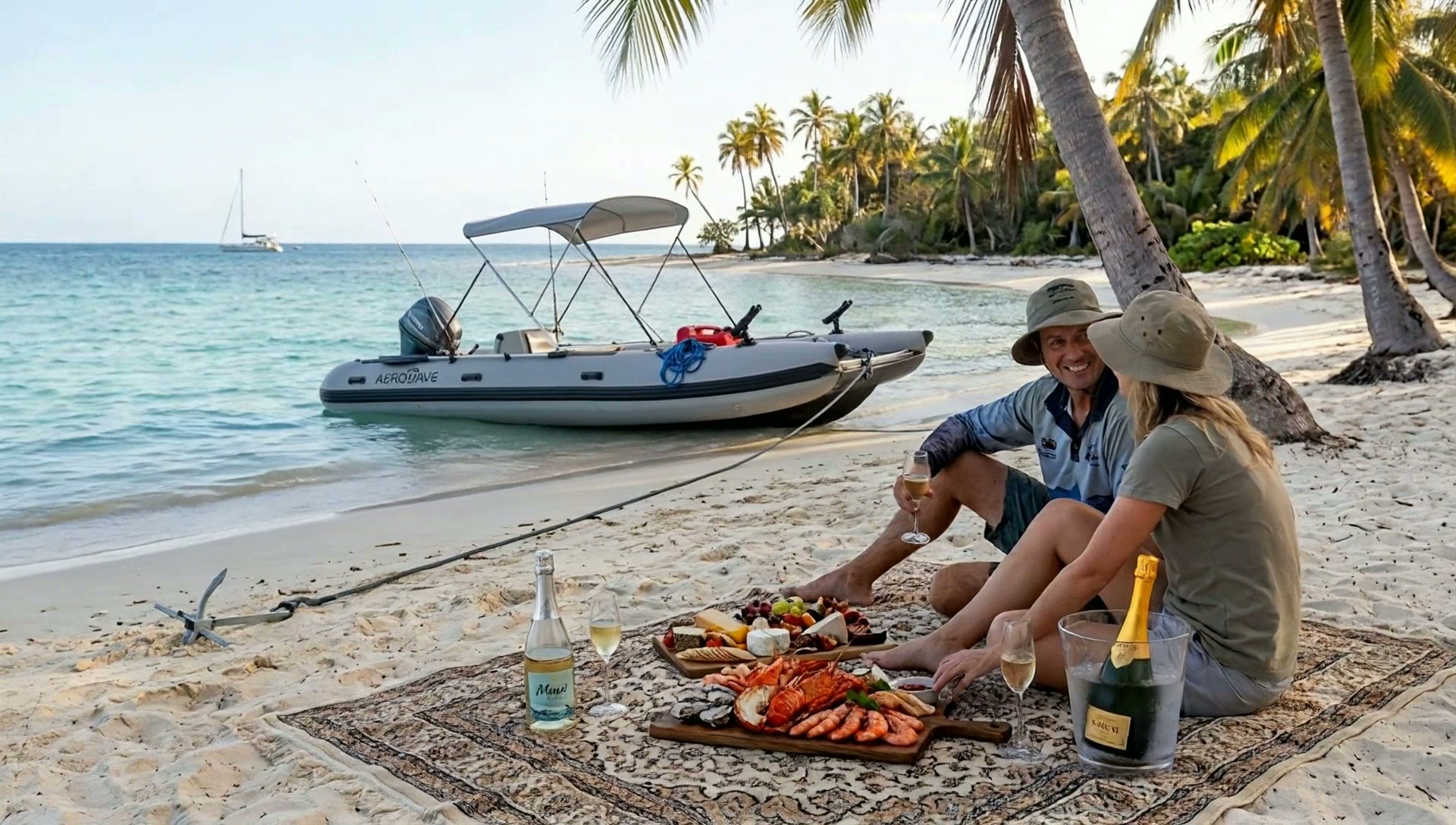
Premium 3.65m Inflatable catamaran — built the same way as our flagship Viper 400 sports boat, just 35cm shorter. German VALMEX® 7321 Heavy Plus 1.2mm commercial-grade fabric, 10 PSI high-pressure drop-stitch air deck floor with VALMEX non-slip surface, LockPro wheels, full Bimini and FREE express delivery Australia-wide included.
Free freight to United States · taxes included, nothing to pay on arrival
Not sure which suits you? Talk to a real boat owner.
Before you spend a cent
Buying from Australia, delivered to United States
You have never heard of us, we are on the other side of the world, and the internet is full of fakes. Fair enough. Here is everything you would need to check us out, in one place — no forms, no chat bot.
Australian designed business
Easy Inflatables, Avoca Beach NSW 2251. ABN 96 856 548 613. International orders ship from our Hong Kong hub.
Rated 5.0 on Google
Every review is on our Google Business Profile, with the reviewer's name and the date.
CE certified, 5 + 2 year hull warranty
ISO 6185-3 and EU Directive 2013/53/EU. Warranty honoured worldwide.
Tracked, insured, door to door
Freight, duty & taxes included · nothing to pay on arrival.
- Who am I actually buying from?
- Easy Inflatables, Avoca Beach NSW 2251, Australia. ABN 96 856 548 613. Sean is the owner and skipper, Gary Stewart handles sales on +61 2 4335 1603, Karen Matthews handles email. The boats are Australian designed; international orders ship from our Hong Kong dispatch hub so your landed price stays competitive. Phone us before you pay a cent — a real person answers.
- Is this really an Australian product?
- Yes — Australian designed and engineered on the NSW Central Coast. Manufacturing is done offshore to our spec, and international orders ship direct from our Hong Kong dispatch hub. If we routed every boat through Australia first, the freight alone would roughly double or triple your cost for the same hull.
- What do I pay, and what is not included?
- The delivery and import terms depend on your country. US and UK boat orders include free express freight and prepaid import charges — nothing to pay on arrival. New Zealand and named Asia/Pacific lanes include duty and tax. EU buyers pay import charges on arrival. Other destinations show their terms before payment.
- How do I pay safely?
- Card through Stripe (Visa, Mastercard, Amex, Apple Pay, Google Pay) or bank transfer. Card payments carry your bank's own dispute protection. We never ask for crypto, gift cards or payment to a personal account.
- What if it arrives damaged?
- Every boat ships fully tracked and insured door to door. Photograph the carton and the boat on arrival and email us — transit damage is claimed and replaced through us, not left with you and the courier.
- Is the warranty real outside Australia?
- Yes. The 5 + 2 year hull warranty on 1.2 mm VALMEX Heavy Plus and Orca Hypalon hulls applies wherever you are. Replacement parts are held in Australia and at our overseas hub and go out by express courier to your door.
- Is the boat actually certified?
- All Aerowave catamarans are CE certified to ISO 6185-3 and EU Directive 2013/53/EU. Certification paperwork is supplied with the boat — ask and we will send it before you order.
Frequently asked questions
- How long do cheap inflatable boats last in Australia?
- Most cheap inflatable boats built from budget 0.7 mm to 0.9 mm PVC last between 2 and 4 years when used in Australia. High ambient UV radiation and heat degrade the adhesives and leach out budget plasticisers, typically causing seam separation or air loss long before commercial-grade hulls show wear.
- What is the difference between 0.9 mm PVC and 1.2 mm VALMEX?
- The difference lies in fabric density and construction method. Generic 0.9 mm PVC is typically a low-density calendered laminate (around 750–900 GSM) that scratches easily and delaminates. In contrast, 1.2 mm VALMEX Heavy Plus is a German knife-coated technical fabric rated at 1500 GSM with extreme tear strength and a 10 to 12-year lifespan.
- Can you repair seam failures on cheap inflatable boats?
- Minor surface punctures can be patched, but widespread seam failure on cheap glued boats is exceptionally difficult to repair permanently. Once thermal cycling breaks down the original contact adhesive, re-glued seams often peel away in adjacent areas under standard operating pressure.
- Are inflatable catamarans better than standard inflatable dinghies?
- Yes, inflatable catamarans offer significantly better stability, faster planing, and a drier ride than standard round-tail monohulls. Their twin-hull design traps an air cushion beneath the tunnel floor, cutting through chop efficiently while letting passengers stand securely on the sponsons without tipping.
- Why does my inflatable boat lose pressure on hot days?
- While air naturally expands in the sun and contracts in cool water, sudden pressure loss on hot days usually signals micro-leaks around valve stems or softening glue along main seams. High-quality hulls feature mechanical welded seams and safety over-pressure relief valves to prevent catastrophic pressure spikes.
- What warranty should I expect when buying an inflatable boat?
- Budget imports generally offer a basic 12-month parts-only warranty loaded with UV and seam failure exclusions. In contrast, premium craft feature dedicated guarantees—such as the 5-year warranty on Aerowave AeroCat, WaveRunner, and Sport Series hulls, or the 5 + 2-year warranty on the commercial-grade Viper range.
Ready to set sail?
Premium German-fabric inflatable catamarans, built to order and delivered to your door. Talk to our team or browse the fleet.
Like this guide? Get the next one in your inbox.
Owner-tested tips, gear deep-dives and Aussie boating know-how — no spam.