Inflatable Boat Weight Capacity: A Complete Guide to Payload, People & Motors
Don't just trust the capacity plate. Learn the crucial difference between a boat's maximum payload and its comfortable, safe load for Australian conditions.
At a glance
Don't just trust the capacity plate. Learn the crucial difference between a boat's maximum payload and its comfortable, safe load for Australian conditions.
- What Exactly Is Inflatable Boat Weight Capacity?
- How to Read Your Boat's Capacity Plate (And What It Really Means)
- The Critical Difference: Max Payload vs. Comfortable Load
- Maximum Payload
What we'd put you in
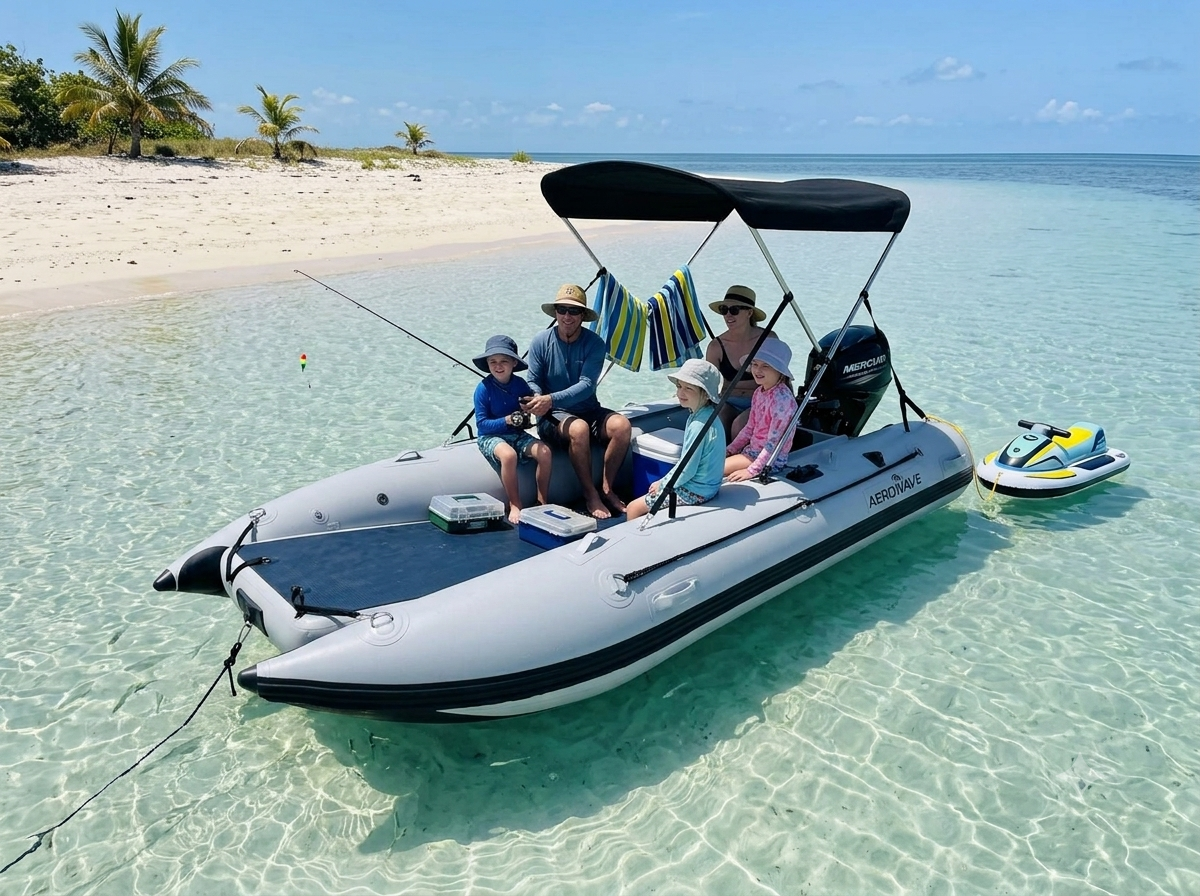
Aerowave WaveRunner 380 Series 3 Catamaran Package
The 380 mm transom keeps the prop buried, whatever you hang off it.
US$2,774 USD
Delivered to your door, today's rate
- Free freight to United States · local taxes payable on arrival
- 7-year hull warranty
🇺🇸 Shipping to United States · landed price quoted in writing
Yes — we ship the Aerowave WaveRunner 380 Series 3 Catamaran Package to United States. Here's the landed price.
The 380 mm transom keeps the prop buried, whatever you hang off it.
Aerowave WaveRunner 380 Series 3 Catamaran Package
- Boat package (export price)
- US$3,264
- 15% tariff relief credit
- − US$490
- Express air freight to United States
- Included
- Import duty, taxes & customs clearance
- Payable on arrival
- Estimated landed, USD
- US$2,774
Indicative, converted at today's rate, before local duty and tax on arrival. Ask below and we'll put a fixed figure in writing, valid 30 days.
- 7-year hull warranty
- 1500 GSM / 1.2 mm VALMEX® Heavy Plus hull
- CE certified to ISO 6185-3 and EU Directive 2013/53/EU
- Door-to-door, tracked the whole way
Your price, delivered to your door — freight included.
We email the full PDF quote (spec, freight, finance, WavePay) to your inbox in under 60 seconds. No spam — one quote, one follow-up.
See it for yourself
Real boats. Real owners. Real people behind them.
Plenty of what you read online these days is generated. Check us out properly — the factory, the reviews and the owners are all one click away. Why we use AI, and how to check we’re real
How our boats are built
Walk the production line: thermo-welded seams, 1.2 mm VALMEX Heavy Plus hulls, over-pressure relief valves on every chamber.
See the buildGoogle Maps reviews
Real Australian owners, five stars, published on our Google Business Profile with the map — read them there, not just on our own site.
Open Google Maps reviewsOwner stories
Boats in use — offshore, on rivers, on rescue duty. Photos and words from the people who actually own them.
Read owner storiesA boat's maximum payload is a number; its safe, comfortable capacity is an art.
Every inflatable boat sold in Australia comes with a capacity plate stating its maximum load. It’s a comforting, solid-looking number stamped right there on the transom. But here's the crucial detail that many new boaties miss: that number represents a legal and theoretical maximum, tested in glass-calm, laboratory-like conditions. It is not a target for your weekend trip to the reef or a run across a windy bay. The real-world inflatable boat weight capacity—the load your vessel can carry safely, comfortably, and with predictable performance—is a far more nuanced figure.
Understanding the difference between this 'plate capacity' and a sensible 'operational capacity' is arguably the single most important piece of knowledge for any SIB (soft inflatable boat) owner. It’s the key to a dry ride, optimal fuel efficiency, responsive handling, and, most importantly, the safety of everyone on board. Overloading, even when technically within the legal limit, is a primary cause of poor performance and dangerous situations on the water. It turns a nimble, high-performance craft into a sluggish, water-logged barge.
This guide will walk you through everything you need to know about your inflatable boat's weight capacity. We'll decipher the capacity plate, explain how to calculate a realistic load for Australian conditions, detail the critical impact of weight distribution, and explore the serious risks of getting it wrong. Our goal is to equip you with the expert knowledge to load your boat with confidence, whether you're skippering an Aerowave Viper catamaran or a compact Swift Tender.
What Exactly Is Inflatable Boat Weight Capacity?
In simple terms, an inflatable boat's weight capacity is the total weight—including people, the outboard motor, fuel, and all your gear—that the vessel is certified to carry safely while remaining afloat and stable in calm water. This is not a number the manufacturer guesses; it's determined through rigorous testing protocols outlined by international standards, such as ISO 6185-3, to which all Easy Inflatables boats are certified.
During certification, the boat is methodically loaded with weight until it exhibits specific undesirable characteristics, like water ingress over the transom or a critical loss of stability. The certified capacity is then set well below this failure point, providing a built-in safety margin.
The capacity plate will typically break this down into two key figures:
- Maximum Persons: A number representing how many individuals the boat is designed to hold. This is based on an assumed average weight per person (usually around 75-85 kg), and it's more of a spatial and stability guideline than a hard weight rule.
- Maximum Weight Capacity (or Payload): This is the most important number. It's the total weight of everything you can add to the empty boat. This figure includes the weight of the people, but also the outboard, fuel tank, battery, esky, fishing equipment, anchor, safety gear, and the dog. If it's not part of the boat itself, it counts towards this total.
Think of the 'persons' number as a suggestion and the 'total weight' as the law. You can easily exceed the total weight capacity with fewer people than the plate suggests if they are heavy or carrying a lot of gear.
How to Read Your Boat's Capacity Plate (And What It Really Means)
Every new boat must have a capacity plate, also known as a builder's plate, permanently affixed to the vessel, usually on the inside of the transom. It's the boat's official ID card, and learning to read it is a fundamental skill.
Here’s a breakdown of the information you'll find and its practical meaning:
- Max Persons: As discussed, this is a guideline. Four adults on a boat rated for four people might be fine for a calm harbour cruise, but add diving gear or a big esky, and you could be pushing your weight limit.
- Max Weight Capacity / Max Load: This is your primary limit in kilograms. It's the total mass the boat's buoyancy can support with an adequate safety margin for stability and freeboard (the height from the waterline to the top of the tubes).
- Max Engine Power (HP/kW): This is the maximum horsepower (or kilowatts) the transom is structurally engineered to handle. Exceeding this, even by a little, puts immense stress on the transom and can make the boat dangerously unstable, especially at speed. It can and will void your warranty.
- Max Engine Weight: This is a critically important but often overlooked figure. A modern, heavy 15HP four-stroke can weigh more than an old 25HP two-stroke. A motor that is too heavy, even if it's within the HP limit, will make the boat stern-heavy, causing it to handle poorly and struggle to get on the plane. Always check both HP and weight limits. The Hidea 4-stroke outboards we pair with our boats are selected for their excellent power-to-weight ratio.
The big asterisk on every capacity plate is this: all ratings are valid for calm waters. Once you introduce wind, chop, and ocean swell, that maximum capacity's safety margin begins to shrink. This is why understanding the next concept is so vital.
The Critical Difference: Max Payload vs. Comfortable Load
This is the secret that experienced boaties know. The number on the plate is the maximum, not the optimum. There’s a world of difference between a boat that is technically floating and one that is performing well.
Maximum Payload
Loading your boat to its absolute maximum rated capacity is a test of its buoyancy, not its performance. At 100% of its payload, an inflatable will:
- Sit very low in the water, with minimal freeboard.
- Be extremely susceptible to taking on water from small waves or even the wake of another boat.
- Feel sluggish, unresponsive, and difficult to manoeuvre.
- Struggle to get on the plane, forcing the engine to work incredibly hard and burn excessive fuel.
- Have almost no reserve buoyancy to lift the bow over oncoming waves, creating a wet and potentially dangerous ride.
It's like loading a ute until the suspension is completely compressed. You can legally drive it down the road, but you wouldn’t want to take it on a winding mountain pass at speed. It’s simply not safe or pleasant.
Comfortable (Operational) Load
For the best experience on the water, you should aim for a comfortable operational load. This is typically around 60-75% of your boat's maximum rated payload.
At this more sensible loading, your inflatable will:
- Ride high in the water with plenty of freeboard, ensuring a dry deck.
- Leap onto the plane with ease.
- Handle crisply and responsively.
- Achieve better fuel economy from the outboard.
- Have ample reserve buoyancy to handle unexpected chop or swell, providing a crucial safety margin.
This is the sweet spot where your premium inflatable catamaran, with its advanced hull design and high-pressure air deck, can truly shine.
Calculating Your Real-World Inflatable Boat Weight Capacity
So, how do you figure out your practical, day-to-day carrying capacity? It’s a simple process of subtraction. Let's create a checklist and then run a real-world scenario with our popular Aerowave WaveRunner 380, which has a generous maximum payload of 780 kg.
Your Pre-Launch Weight Checklist
- Find Max Payload: Start with the maximum weight capacity from your boat's plate (e.g., 780 kg).
- Subtract Motor Weight: Find the dry weight of your outboard. A Hidea 15HP 4-stroke, a common pairing for the WaveRunner 380, weighs approximately 51 kg.
- Subtract Fuel Weight: Petrol weighs about 0.75 kg per litre. A standard 24-litre portable fuel tank, when full, adds about 18 kg.
- Subtract Battery Weight: If you have an electric start motor or run electronics, a typical marine battery adds another 15-25 kg.
- Subtract Essential Gear: Your anchor with its chain and rope, plus your mandatory safety kit (flares, V-sheet, life jackets, etc.), can easily add 20-30 kg.
The number you're left with is your true 'usable capacity' for people and their personal gear (eskies, fishing rods, dive bags, etc.).
Comparison Table: Maxed Out vs. Sensible Load
Let's see how this plays out on an Aerowave WaveRunner 380 (Max Payload: 780 kg).
| Item | Scenario 1: Pushing the Limits | Scenario 2: Comfortable Day Trip |
|---|---|---|
| Base Boat | Aerowave WaveRunner 380 | Aerowave WaveRunner 380 |
| Max Payload | 780 kg | 780 kg |
| People | 4 adults @ 90kg each = 360 kg | 2 adults @ 90kg each = 180 kg |
| Hidea 15HP Outboard | 51 kg | 51 kg |
| Fuel (24L tank) | 18 kg | 18 kg |
| Safety Gear & Anchor | 25 kg | 25 kg |
| Esky, Fishing/Dive Gear | 120 kg | 60 kg |
| TOTAL LOAD | 574 kg | 334 kg |
| Remaining Capacity | 206 kg | 446 kg |
| % of Max Load Used | ~74% | ~43% |
| Verdict | Technically compliant and within the 75% rule of thumb. This represents a realistic maximum for a well-handling boat. | An ideal, light load. The boat will be exceptionally fast, nimble, and dry, with a massive safety margin. The ultimate goal for managing inflatable boat weight capacity effectively. |
As you can see, the weight adds up incredibly fast. Scenario 1 is a perfectly manageable load for a high-quality catamaran like the WaveRunner 380, but it demonstrates how a '4 person' trip is much more than just the weight of the people.
The Impact of Weight Distribution on Performance and Safety
Where you put the weight is just as important as how much weight you're carrying. An improperly balanced boat is inefficient and can be genuinely dangerous. Inflatable boats, with their light weight and flat bottoms, are particularly sensitive to load distribution.
Too Much Weight Aft (Stern-Heavy)
This is the most common loading mistake. With the skipper, the heavy outboard, and the fuel tank all at the back, the stern digs in and the bow points to the sky.
- Effects: The boat will struggle to get on the plane, a phenomenon known as 'squatting'. It will push a massive wave and burn huge amounts of fuel. In a following sea (waves coming from behind), you risk a wave washing over the low transom and swamping the engine.
Too Much Weight Forward (Bow-Heavy)
This occurs when you put all your heavy gear like anchors and full eskies right up in the bow.
- Effects: The bow will dig into the water, causing the boat to wander and be difficult to steer, known as 'bow steering'. This is extremely dangerous when running into a head sea, as the bow can bury itself in the face of a wave instead of lifting over it, potentially leading to a catastrophic 'pitchpole' (flipping end-over-end).
Uneven Side-to-Side Loading
This happens if you have one particularly heavy passenger or all the gear stowed on one side.
- Effects: The boat will list to one side, affecting stability both at rest and underway. It will turn more sharply one way than the other and feel 'tippy', especially in a crosswind or beam sea.
Best Practices for Loading Your Inflatable
- Centralise Mass: Place your heaviest items (fuel tank, battery, esky) as low and as close to the centre of the boat as possible.
- Balance Passengers: Distribute the weight of your passengers evenly around the boat. If you are skippering alone from the stern, moving the fuel tank and some gear forward can make a huge difference.
- Use a Bow Bag: A dedicated, waterproof bow bag, like our Australian-made Aerowave Viper Sovereign Bow Bag ($250), is the perfect solution for balancing the boat. It allows you to store medium-weight items securely in the bow, countering the weight of the skipper and motor at the stern to achieve a level trim.
- Experiment: On a calm day, with a typical load, experiment by moving gear and people around. You will feel the difference in handling immediately. Find the 'sweet spot' for your setup.
What Happens if You Overload an Inflatable Boat? The Risks Explained
Ignoring your boat's capacity limits isn't just about poor performance; it's a serious safety risk that puts you, your passengers, and other water users in jeopardy. Here's what happens when you push things too far:
-
Drastically Reduced Freeboard: The boat sinks lower, and the distance from the waterline to the top of the tube is reduced. A small wave that you would normally ride over can now slop into the boat, beginning a dangerous cycle of taking on more water, getting heavier, and sinking lower still.
-
Loss of Stability: The boat becomes top-heavy and tender. It will feel 'wallowy' and unstable, reacting sluggishly to steering inputs and being easily upset by waves from the side (a beam sea).
-
Inability to Plane: You'll be stuck in displacement mode, chugging along at 5-6 knots with the bow in the air, no matter how much throttle you apply. This makes you vulnerable in changing conditions, as you don't have the speed to outrun a storm or navigate a strong current effectively.
-
Extreme Structural Stress: Overloading places immense strain on the entire boat. The transom, which holds the powerful outboard, is put under forces it wasn't designed for. The seams, floor, and fabric are all stressed. While the premium German VALMEX® fabric we use (1100 GSM on the AeroCat, and a massive 1500 GSM Heavy Plus on the Viper) is exceptionally durable with a 10-12 year expected lifespan, chronic overloading is a surefire way to shorten it.
-
Swamping and Capsizing: This is the ultimate, life-threatening risk. In rough water, an overloaded boat has no reserve buoyancy. It cannot lift its bow to meet an oncoming wave. The wave will break over the bow, filling the boat with hundreds of kilograms of water in an instant, leading to swamping or an immediate capsize.
-
Legal and Insurance Consequences: Operating an overloaded vessel is illegal and will attract a fine. More importantly, in the event of an accident, your insurance policy will almost certainly be void, leaving you personally liable for any damage or injury.
Catamaran vs. Monohull: Does Hull Shape Affect Weight Capacity?
Yes, hull design plays a significant role in how a boat carries its weight.
Inflatable Catamarans (e.g., Aerowave Viper, AeroCat, WaveRunner) Our specialty lies in inflatable catamarans for a reason. The twin-hull design offers inherent advantages in load-carrying:
- Superior Stability: With two widely spaced hulls, a catamaran has a much larger 'footprint' on the water, making it exceptionally stable both at rest and underway. This stability is a huge asset when loading heavy or uneven gear like dive tanks.
- Higher Payload for Length: Catamarans can typically carry a heavier load more effectively than a monohull of the same length. Our Aerowave WaveRunner 380 ($4,945), at just 3.8 metres, boasts a huge 780 kg payload and space for 6 people.
- Efficient Planing: The tunnel between the hulls traps a cushion of air at speed, creating aerodynamic lift. This helps the boat get onto the plane more easily, even with a substantial load.
Inflatable Monohulls (e.g., Aerowave Swift Tender) A classic V-hull inflatable monohull is still an incredibly capable and buoyant platform. The large diameter tubes provide immense flotation.
- Impressive Capacity: Don't underestimate them. A compact tender like the Aerowave Swift Tender 290 SI ($3,199) can carry 500 kg and 4 people—a massive capacity for a boat under 3 metres long.
- Handling Dynamics: They can be more sensitive to side-to-side weight distribution than a catamaran. Achieving a balanced load is key to their performance.
Ultimately, both designs are fantastic load-carriers. A catamaran offers a distinct edge in stability and rough-water performance with a load, while a premium monohull offers simplicity and outstanding capacity for its size.
The Bottom Line
Your inflatable boat's weight capacity is the foundation of its safety and performance. To get the most out of your vessel and ensure every trip is a safe one, remember these key principles:
- Treat the capacity plate as a legal maximum for perfect conditions, not a daily target.
- Aim to operate at 60-75% of your max payload for a safe, dry, and high-performance ride.
- Remember that weight distribution is just as critical as the total weight itself. Balance is key.
- Always do the maths before you launch. Add up the weight of your motor, fuel, gear, and passengers.
Investing in a premium quality boat from a trusted Australian supplier gives you the peace of mind that it’s built from the best materials and engineered to perform safely up to its stated limits. If you're looking for a boat that matches your specific load-carrying needs, our team is here to help. Give us a call at +61 2 4335 1603 or email sales@easyinflatables.com.au to discuss the perfect Aerowave model for your adventures.
Related
Weekend-Proof Score 17 questions · about 2 minutes
Will the boat you're about to buy survive an Australian summer?
Seventeen straight questions about where you'll use it, what you'll ask of it and the boat you're weighing up. You get a score out of 100, the exact weak points in your plan, and the one boat that genuinely fits.
Free · your result shows on screen · no email required
So which one is yours?
Pick how you'll actually use it and we'll take you straight to the right hull.
I want to fish it
Open bow, rod holders, deck space you can stand and cast from.
Viper Sport 400Family, diving and the beach
3.8 m Series 3 catamaran — low bow to climb back in wearing fins or a tank.
WaveRunner 380Tender / one-person launch
3.3 m hard-floor boat that packs into a bag and still takes a beach landing.
Viper 330Shop gear featured in this guide
Aerowave WaveRunner 380 Series 3 Catamaran Package
The WaveRunner 380 Series 3 is a premium 3.8m inflatable catamaran package built for Australian and worldwide families, fishing, and coastal day boating — ideal for snorkeling and spearfishing — offering serious stability and premium German Valmex® construction.
Free freight to United States · local taxes payable on arrival
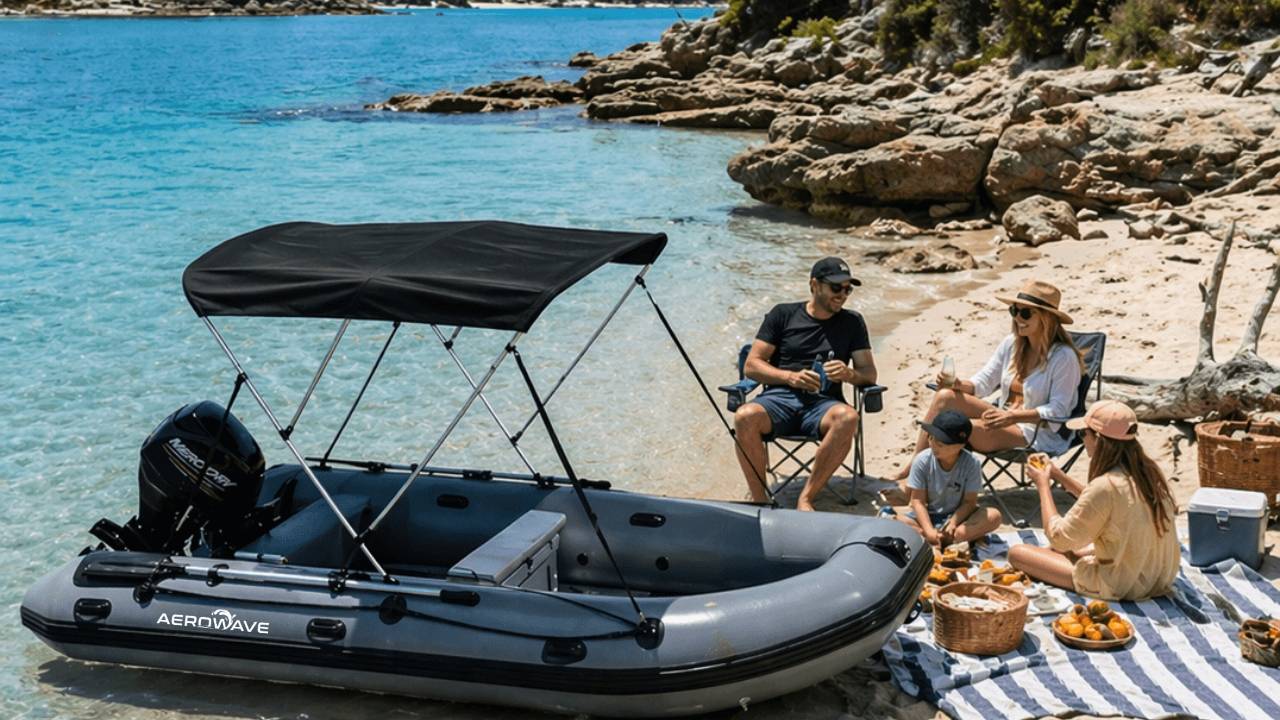
Aerowave Viper 400 Sovereign
Flagship 4m enclosed-bow inflatable catamaran. German VALMEX® 7321 Heavy Plus 1.2mm commercial-grade fabric, 10 PSI high-pressure drop-stitch air deck floor with VALMEX non-slip surface, LockPro wheels, full Bimini and FREE express delivery Australia-wide included. Winter special — save $1,000 until 31 August 2026.
Free freight to United States · local taxes payable on arrival
Aerowave Viper 365 Open Bow
Premium 3.65m Inflatable catamaran — built the same way as our flagship Viper 400 sports boat, just 35cm shorter. German VALMEX® 7321 Heavy Plus 1.2mm commercial-grade fabric, 10 PSI high-pressure drop-stitch air deck floor with VALMEX non-slip surface, LockPro wheels, full Bimini and FREE express delivery Australia-wide included.
Free freight to United States · local taxes payable on arrival
Not sure which suits you? Talk to a real boat owner.
Before you spend a cent
Buying from Australia, delivered to United States
You have never heard of us, we are on the other side of the world, and the internet is full of fakes. Fair enough. Here is everything you would need to check us out, in one place — no forms, no chat bot.
Australian designed business
Easy Inflatables, Avoca Beach NSW 2251. ABN 96 856 548 613. International orders ship from our Hong Kong hub.
222 owner reviews, 4.8 average
Read them in full, good and bad, on our reviews page.
CE certified, 7-year hull warranty
ISO 6185-3 and EU Directive 2013/53/EU. Warranty honoured worldwide.
Tracked, insured, door to door
FREE freight to United States · local tax/duty on arrival.
- Who am I actually buying from?
- Easy Inflatables, Avoca Beach NSW 2251, Australia. ABN 96 856 548 613. Sean is the owner and skipper, Gary Stewart handles sales on +61 2 4335 1603, Karen Matthews handles email. The boats are Australian designed; international orders ship from our Hong Kong dispatch hub so your landed price stays competitive. Phone us before you pay a cent — a real person answers.
- Is this really an Australian product?
- Yes — Australian designed and engineered on the NSW Central Coast. Manufacturing is done offshore to our spec, and international orders ship direct from our Hong Kong dispatch hub. If we routed every boat through Australia first, the freight alone would roughly double or triple your cost for the same hull.
- What do I pay, and what is not included?
- The delivery and import terms depend on your country. EU, UK, New Zealand and named Asia/Pacific lanes include duty and tax; US freight is free but US buyers pay import charges on arrival. Other destinations show their terms before payment.
- How do I pay safely?
- Card through Stripe (Visa, Mastercard, Amex, Apple Pay, Google Pay) or bank transfer. Card payments carry your bank's own dispute protection. We never ask for crypto, gift cards or payment to a personal account.
- What if it arrives damaged?
- Every boat ships fully tracked and insured door to door. Photograph the carton and the boat on arrival and email us — transit damage is claimed and replaced through us, not left with you and the courier.
- Is the warranty real outside Australia?
- Yes. The 7-year hull warranty on 1.2 mm VALMEX Heavy Plus and Orca Hypalon hulls applies wherever you are. Replacement parts are held in Australia and at our overseas hub and go out by express courier to your door.
- Is the boat actually certified?
- All Aerowave catamarans are CE certified to ISO 6185-3 and EU Directive 2013/53/EU. Certification paperwork is supplied with the boat — ask and we will send it before you order.
Frequently asked questions
- How many people can I safely fit in a 3-metre inflatable boat?
- This depends entirely on the specific boat's rating. For example, our Aerowave Swift Tender 290 SI (2.9m) is rated for 4 people with a total payload of 500kg. However, for better comfort and a safer ride in anything but glass-calm water, 2 or 3 adults would be a more practical limit. Always check the capacity plate.
- Does adding a high-pressure air deck floor reduce my boat's weight capacity?
- No, the weight of the air deck is already part of the boat's 'empty' weight. The maximum payload stated on the capacity plate is the total additional weight (people, motor, gear) you can add to the complete boat. You don't need to subtract the floor's weight from the payload.
- Can I put a bigger motor on my inflatable if I don't carry many people?
- Absolutely not. You must never exceed the maximum horsepower (HP) or the maximum engine weight rating on the capacity plate. These limits are determined by the transom's structural strength and the boat's overall stability dynamics, not just the total weight. An overpowered boat is dangerously unstable and risks catastrophic transom failure.
- Is the inflatable boat weight capacity different for saltwater and freshwater?
- The certified capacity rating is the same for both. While you do get a very slight buoyancy advantage in denser saltwater, this effect is negligible for practical purposes. The much more significant factor is the sea state, as open saltwater environments are typically rougher than inland freshwater.
- What's more important: the 'persons' capacity or the 'total weight' capacity?
- The total weight capacity (in kg) is the most critical number to adhere to. The 'persons' number is only a rough guideline based on a theoretical average person's weight. Three heavy adults with extensive fishing or diving gear can easily exceed the total weight limit, even if the boat is rated for four or five people. Always calculate your total load.
- Does a boat's fabric material affect its weight capacity?
- Indirectly, yes. A boat constructed from stronger, more robust fabric, like the 1500 GSM VALMEX® Heavy Plus PVC used on our Aerowave Viper series, allows engineers to design larger tubes and a stronger overall structure. This robust construction can then be certified for a higher weight capacity compared to boats made with flimsier materials.
- Will overloading my inflatable boat void the warranty?
- Yes, almost certainly. Operating a boat outside its specified limits, including overloading, is considered improper use. This will typically void the manufacturer's warranty, such as the comprehensive 5-year (or 5+2 year on Viper) warranty we offer on Aerowave boats. It can also void your insurance coverage.
Ready to set sail?
Premium German-fabric inflatable catamarans, built to order and delivered to your door. Talk to our team or browse the fleet.
Like this guide? Get the next one in your inbox.
Owner-tested tips, gear deep-dives and Aussie boating know-how — no spam.