

The Definitive Guide to Buying and Operating an Inflatable Boat in Melbourne and Port Phillip Bay
Tackle the notorious Port Phillip chop and navigate Western Port with ease. Here is how modern inflatable catamarans outperform traditional tinnies across Victorian waters.
At a glance
Tackle the notorious Port Phillip chop and navigate Western Port with ease. Here is how modern inflatable catamarans outperform traditional tinnies across Victorian waters.
- Choosing an inflatable boat in Melbourne: Port Phillip vs Western Port
- The Port Phillip chop: Why short-period waves punish traditional hulls
- Western Port tidal flows and mangrove shallows
- How does an inflatable boat Melbourne boaters choose handle cold southern water and UV?
What we'd put you in
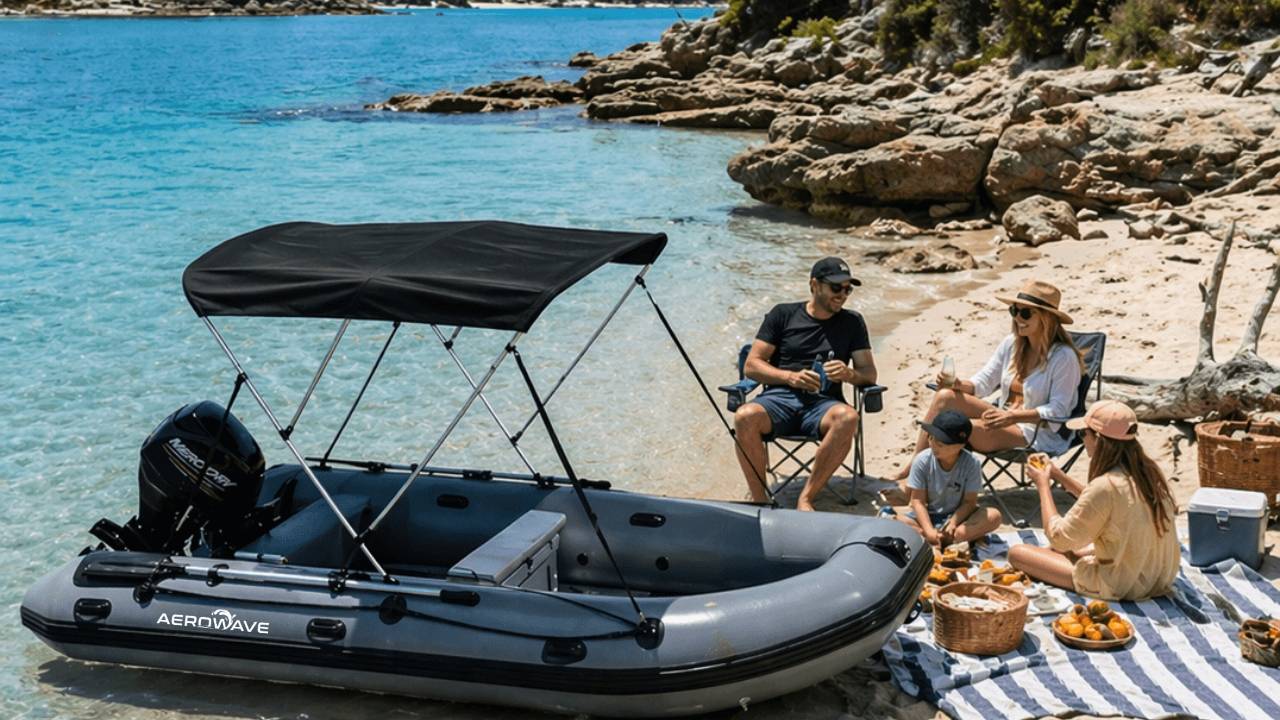
Aerowave Viper 400 Sovereign
Our best-selling boat: 4.0 m, 1.2 mm VALMEX hull, 7-year hull warranty.
US$3,279 USD
Delivered to your door, today's rate
- Free freight to United States · local taxes payable on arrival
- 7-year hull warranty
🇺🇸 Shipping to United States · landed price quoted in writing
Yes — we ship the Aerowave Viper 400 Sovereign to United States. Here's the landed price.
Our best-selling boat: 4.0 m, 1.2 mm VALMEX hull, 7-year hull warranty.
Aerowave Viper 400 Sovereign
- Boat package (export price)
- US$3,858
- 15% tariff relief credit
- − US$579
- Express air freight to United States
- Included
- Import duty, taxes & customs clearance
- Payable on arrival
- Estimated landed, USD
- US$3,279
Indicative, converted at today's rate, before local duty and tax on arrival. Ask below and we'll put a fixed figure in writing, valid 30 days.
- 7-year hull warranty
- 1500 GSM / 1.2 mm VALMEX® Heavy Plus hull
- CE certified to ISO 6185-3 and EU Directive 2013/53/EU
- Door-to-door, tracked the whole way
Your price, delivered to your door — freight included.
We email the full PDF quote (spec, freight, finance, WavePay) to your inbox in under 60 seconds. No spam — one quote, one follow-up.
See it for yourself
Real boats. Real owners. Real people behind them.
Plenty of what you read online these days is generated. Check us out properly — the factory, the reviews and the owners are all one click away. Why we use AI, and how to check we’re real
How our boats are built
Walk the production line: thermo-welded seams, 1.2 mm VALMEX Heavy Plus hulls, over-pressure relief valves on every chamber.
See the buildGoogle Maps reviews
Real Australian owners, five stars, published on our Google Business Profile with the map — read them there, not just on our own site.
Open Google Maps reviewsOwner stories
Boats in use — offshore, on rivers, on rescue duty. Photos and words from the people who actually own them.
Read owner storiesPort Phillip Bay has broken the spirit of many trailer boats, but twin-tube tunnel catamarans turn Melbourne's notorious afternoon chop into an effortless, dry ride.
If you have spent any time around Victoria's coastline, you already know that purchasing an inflatable boat Melbourne skippers can rely on demands a completely different mindset than shopping for a leisure tender in Sydney Harbour or the Gold Coast. Port Phillip Bay is an expansive, shallow, landlocked sea spanning roughly 1,930 square kilometres, with an average depth of just 14 metres. When a brisk 15 to 25-knot southerly front barrels in from Bass Strait, that shallow water stacks up into an aggressive, short-period square chop. Traditional rigid monohulls and budget flat-bottomed tenders slam violently, drenching their occupants and jarring backs from Mornington to Sandringham.
Yet Melbourne represents one of the most vibrant trailer-free boating communities in Australia. From chasing winter snapper off Black Rock and squid around the Sorrento weed beds to running the winding mangrove channels of Western Port around Hastings and Corinella, the demand for versatile, lightweight, pack-down watercraft is unprecedented. Inner-city urbanisation across Southbank, Docklands, Richmond, and South Yarra means fewer boaties have a suburban driveway or a four-wheel drive capable of towing two tonnes of fiberglass.
Owning an inflatable craft in Melbourne unlocks spontaneous water access without the trauma of ramp rage at Patterson River or Altona. However, surviving Victorian waters requires understanding how hull hydrodynamics, fabric engineering, and cold-water physics intersect. This guide dissects everything you must know before taking an inflatable vessel out onto Port Phillip, Western Port, and beyond.
Choosing an inflatable boat in Melbourne: Port Phillip vs Western Port
Selecting the right craft starts with understanding where you intend to drop anchor. Victoria's two central bays may sit side-by-side, but hydrographically they are entirely different beasts.
The Port Phillip chop: Why short-period waves punish traditional hulls
Port Phillip Bay’s unique geography creates a treacherous wave spectrum. Because the bay is relatively shallow and features massive expanses of open fetch, winds generate waves with very short wave periods—typically three to four seconds. In a conventional V-hull tinnie or traditional rounded-nose RIB (rigid inflatable boat), your bow drops directly into the trough of the next wave before the hull has crested the first. The result is continuous pounding, heavy spray, and high fuel burn.
In contrast, modern twin-tube inflatable catamarans—such as the AeroWave AeroCat and Aerowave Viper platforms—eliminate the belly of the boat altogether. By suspending a high-pressure drop-stitch deck between two independent sponsons, the hull creates an aerodynamic tunnel. As the craft picks up speed, air compresses under the deck, generating aerodynamic lift that cushions the boat over wave crests. The twin hulls slice through the water like twin knives rather than acting like a hydrodynamic snowplough. You stay entirely dry, your spine remains intact, and your motor works far less to maintain plane.
Western Port tidal flows and mangrove shallows
Western Port demands an entirely distinct tactical approach. Dominated by French Island and Phillip Island, Western Port is an intricate network of deep tidal channels carved between expansive mudflats, sandbanks, and mangrove sanctuaries. Tidal currents here can exceed 4 to 5 knots through narrow gutters such as the San Remo passage and Stony Point.
For Western Port anglers hunting King George whiting or gummy sharks, an inflatable catamaran provides two game-changing advantages:
- Ultra-shallow draft: With sponsons drawing barely 15 to 20 cm of water when off-plane, you can glide safely across sandbars where conventional aluminium plate boats would ground their keels.
- Zero-suction grounding: If you happen to touch bottom on an outgoing tide near Corinella, an inflatable hull does not succumb to the hydraulic suction that traps heavy fiberglass or aluminium hulls into coastal silt. You can easily step over the gunwale, push off, or wait for the flood tide without catastrophic hull damage.
How does an inflatable boat Melbourne boaters choose handle cold southern water and UV?
Melbourne's climate is notoriously temperamental, cycling through blistering 38°C dry northern winds in January to damp, 11°C winter mornings when Southern Ocean fronts scrape across the bay. Marine inflatables operate under intense thermal stress in these waters.
German Mehler VALMEX vs entry-grade PVC in Victorian conditions
Many entry-level inflatables sold across Australia are constructed from basic thin-ply PVC glued together with volatile single-part adhesives. Under Melbourne's searing summer UV, those budget polymers rapidly degrade. Plasticisers migrate out of cheap PVC within three seasons, leaving the fabric brittle, chalky, and prone to seam delamination along stress points.
To withstand Victoria’s climatic variance, premium vessels are engineered with German Mehler VALMEX® fabric. For instance, the AeroWave AeroCat line utilizes 1100 GSM / 0.9 mm VALMEX, while the flagship Aerowave Viper series upgrades to an astonishing 1500 GSM / 1.2 mm VALMEX Heavy Plus. This material features a dense internal polyester base weave treated with high-grade PVC coatings that resist abrasion from Mornington Peninsula reef limestone, dropped snapper rigs, and coarse shell grit.
VALMEX fabric exhibits a verified lifespan of 10 to 12 years even in high-UV marine environments. Crucially, its internal structural stability ensures thermal expansions and contractions do not weaken bonded or welded seams over time.
Pressure management: Mornington sun to sudden Antarctic fronts
Water temperature in Port Phillip drops to 12–14°C in winter and peaks around 21°C in mid-summer. However, deck and tube temperatures on a sunny afternoon at Safety Beach can hit 45°C. Air expands when heated and contracts when cooled (Boyle’s Law in direct effect):
- Tube pressures: Inflatable tubes should ideally run between 3.0 and 3.5 PSI (0.20 to 0.24 bar).
- High-pressure air-deck floors: Drop-stitch air decks require 8.0 to 10.0 PSI (0.55 to 0.69 bar) to provide rigid, flex-free footing that mimics solid fiberglass.
When you pump your air tubes up on a searing asphalt boat ramp and immediately drop the hull into 14°C Victorian water, the chamber pressure naturally decreases by 0.5 to 1.0 PSI within ten minutes. Experienced Melbourne boaters always top off pressures after five minutes on the water using a high-pressure manual stirrup pump or digital two-stage pump. Conversely, if you haul the boat onto black sand on an afternoon reaching 36°C, release a quick burst of air from each chamber or ensure your valves are set correctly to avoid unnecessary seam strain.
Which inflatable catamaran hull design works best across Victorian waters?
Not all inflatable platforms are engineered equal. Victorian conditions quickly expose the difference between a high-tensile sports catamaran and a garden-variety tender.
Tunnel-hull catamaran vs traditional V-hull inflatables
Traditional V-hull inflatables rely on a single central keel tube inflated beneath a soft or sectional floor. While acceptable as sheltered-water yacht tenders in Martha Cove or St Kilda Marina, they possess fundamental weaknesses when tackling open-bay waters:
- Bow steer and broaching: Running downwind in a steep Port Phillip following sea, a V-hull bow digs deeply into the back of the wave ahead. The craft tends to 'bow steer', pulling aggressively off-centre and forcing the skipper to fight the tiller.
- Lateral instability: At rest, a single narrow V-profile rocks sharply whenever an angler shifts weight from port to starboard.
An inflatable catamaran changes the game completely. The twin parallel sponsons act as twin dynamic outriggers, delivering unmatched primary stability. When two 90 kg anglers stand on the same tube to net a 70 cm Port Phillip snapper, the boat barely heels over three degrees. Running downwind, the air-cushioned tunnel prevents nose-diving; air entering the front bow opening lifts the nose automatically, tracking straight and true without broaching.
Low-draft beach launches: From Safety Beach to Black Rock
One of the greatest luxuries of owning an inflatable boat Melbourne explorers love is bypassing congested council boat ramps. On opening weekend of snapper season in late October, the ramp queues at Patterson River can back up for three hours, accompanied by frayed tempers and damaged trailers.
With a lightweight catamaran hull equipped with heavy-duty fold-down transom wheels, your launch options explode:
- Safely drop your boat off your roof racks or out of your boot onto the sand at Safety Beach, Rosebud, Altona, or Half Moon Bay.
- Roll the fully rigged craft straight down the sand into the shore break with one hand.
- Fire up your outboard in knee-deep water and clear the shallows effortlessly.
No council launching fees, no trailer servicing, no salt-encrusted wheel bearings, and zero time spent idling in line at Carrum.
+-------------------------------------------------------------------------+ | AIR-ENTRAPMENT HULL DYNAMICS | | | | Incoming Air & Chop Lift & Shock Absorption | | =======================> ===========================> | | | | [ Port Tube ] === Compressed Air Tunnel === [ Stbd Tube ] | | (1500 GSM VALMEX) (8-10 PSI Drop-Stitch) (1500 GSM VALMEX)| | \ / | | _______ Water Surface / Short-Period Chop ___/ | | | | Result: High-speed air compression lifts the air deck clear of | | crests. Smooth ride, low hydrodynamic drag, and zero broaching. | +-------------------------------------------------------------------------+
Storing and transporting an inflatable boat in Melbourne apartments and townhouses
Inner-city Melbourne living is booming, but high-density living is notoriously hostile to trailer ownership. A five-metre plate-aluminium boat requires at least seven metres of total garage length, off-street driveway clearance, and council parking permits that are increasingly difficult to obtain in suburbs like Fitzroy, Prahran, or Port Melbourne. Commercial boat storage yards around Williamstown or Chelsea Heights regularly charge upwards of A$250 to A$400 per month just to park on open gravel.
The pack-down reality: Car boots, lifts, and balcony storage
A modern inflatable catamaran fundamentally dismantles these storage barriers. When deflated and rolled into a high-tensile carrier—such as the Australian-made Aerowave Heavy-Duty Boat Bag (A$299)—a 3.8-metre or 4.0-metre boat packs down into a package roughly 125 cm × 65 cm × 45 cm.
This footprint fits effortlessly into:
- The rear luggage space of a standard family station wagon, SUV, or dual-cab ute tub.
- A standard passenger elevator inside Docklands or St Kilda high-rise apartments.
- A lockup basement storage cage or secure garage corner.
You do not need a dedicated parking bay, you pay zero annual trailer registration to VicRoads, and your boat remains safely sheltered from sun bleaching and urban vandals.
Transom wheels and launching without boat ramp queues
To make modular boat ownership seamless in Victoria, transom wheels are an indispensable upgrade. Bolted securely to the reinforced marine transom (built to a standard 380 mm short-shaft outboard height), heavy-duty pneumatic or puncture-proof wheels swing downward and lock in place for overland transit.
You assemble the boat at your car park or beachfront grass clearing, inflate the chambers using an electric 12V pump, mount your light 4-stroke outboard, clip in your fuel tank, and wheel the complete vessel down to the water edge like a wheelbarrow. Once floating, you simply swing the wheels up into their locked vertical position and motor away.
Top models compared for Victorian bay boating
Choosing the correct vessel depends on your crew size, intended cruising range, and engine size. Below is a detailed breakdown of the premier inflatable hulls engineered for southern coastal waters.
| Boat Model | Hull Weight | Material Specification | Max Engine Rating | Ideal Victorian Waterways & Use Case | Live Pricing (AUD) | | :--- | :--- | :--- | :--- | :--- | :--- | :--- | :--- | :--- | :--- | | AeroWave AeroCat 335 | ~38 kg | 1100 GSM / 0.9 mm VALMEX | 10 HP | Solo bay fishing, Western Port creeks, Port Phillip whiting | A$3,895 (Ready-to-Fish) | | AeroWave AeroCat 380 | ~46 kg | 1100 GSM / 0.9 mm VALMEX | 15 HP | 2-person bay touring, spear-fishing Queenscliff, squid jigging | A$4,570 | | AeroWave AeroCat 400 | ~52 kg | 1100 GSM / 0.9 mm VALMEX | 20 HP | General family cruising, coastal island exploration, mixed diving | A$5,235 | | Aerowave Viper 330 | ~42 kg | 1500 GSM / 1.2 mm VALMEX Heavy Plus | 15 HP | Rough-water compact tender, rugged rock-hopping around Sorrento | A$5,145 | | Aerowave Viper 365 Open Bow | ~48 kg | 1500 GSM / 1.2 mm VALMEX Heavy Plus | 20 HP | Serious inshore angler platform; rapid open bow beach boarding | A$5,495 | | Aerowave Viper 400 Open Bow | ~56 kg | 1500 GSM / 1.2 mm VALMEX Heavy Plus | 25 HP | All-weather Port Phillip chop conqueror; ultimate inflatable boat Melbourne anglers use | A$5,595 (Sports Package) | | Aerowave Viper 400 Sovereign | ~58 kg | 1500 GSM / 1.2 mm VALMEX Heavy Plus | 25 HP | Luxury coastal expedition craft with integrated bow-cover system | A$5,845 | | Aerowave WaveRunner 380 | ~45 kg | 1100 GSM / 0.9 mm VALMEX | 15 HP | Versatile all-rounder package; entry-level sports catamaran | A$4,945 (Series 3 Package) |
Every Aerowave Viper hull is backed by an industry-leading 5 + 2-year warranty, while the AeroCat, WaveRunner, and Sport Series hulls carry a comprehensive 5-year warranty. All boats comply rigorously with CE standards under ISO 6185-3, verifying that transom construction, chamber division, and buoyancy margins meet strict international maritime safety protocols.
Essential gear checklist for navigating Port Phillip and Western Port
Victorian maritime safety compliance is strictly monitored by Maritime Safety Victoria (MSV) and Victoria Police Water Police squads stationed at Williamstown. When outfitting your inflatable craft for Port Phillip or Western Port, legal requirements mandate specific safety equipment depending on your distance from shore.
- Level 100+ Lifejackets (PFDs): Port Phillip and Western Port are classified as coastal waters. Every passenger on an inflatable vessel under 4.8 metres must wear an approved Level 100, Level 150, or Level 275 lifejacket at all times when underway.
- Waterproof Marine VHF Radio: Mobile phone coverage drops out in pockets along Mornington's southern cliffs and the eastern side of French Island. A floating 5W handheld marine VHF (keeping watch on Channel 16 and Channel 67) is essential for receiving bureau weather updates.
- Dual High-Pressure Inflation Pumps: Always carry your high-volume 12V electric inflator for rapid shore assembly, plus an onboard high-pressure manual hand pump clipped beneath a seat thwart for unexpected pressure maintenance on cold water.
- Heavy-Duty Boat & Wheel Bags: Protect your vehicle upholstery and keep your hull immaculate during apartment transport. Using the Aerowave Boat Bag & Wheel Bag Set (A$389) prevents sand, salt grit, and dampness from leaking into your boot.
- Fabric Protection & Tube Chaps: If you routinely fish for flathead, snapper, and calamari, protect your sponsons against sharp spines, jig prongs, and baking summer UV by fitting a custom pair of handmade Aerowave Tube Chaps (A$1,000).
- Substantial Anchoring Setup: Given Western Port's screaming 4-knot currents and Port Phillip's sand-over-clay seabed, pack a 2.5 kg to 4.0 kg galvanized Bruce/claw or high-holding Rocna-style anchor, paired with at least 5 metres of 6 mm short-link chain and 40 metres of 8 mm nylon anchor warp.
- Bailing Bucket & Hand Bailer: Even with self-draining open transoms or scupper plugs, MSV requires a manual bailing bucket equipped with a lanyard on all powered small craft.
- Waterproof Bow Storage: Keep your emergency flares, first aid kits, warm layers, and dry clothes secure using the custom-moulded Aerowave Viper Sovereign Bow Bag (A$250).
Engine pairings: Selecting the right four-stroke outboard for Melbourne waters
An inflatable catamaran derives its magic from lightweight efficiency. Because the twin hulls generate aerodynamic lift and have significantly less wetted surface area than a deep-V monohull, they require substantially less horsepower to hit blistering speeds.
For most Melbourne skippers, modern 4-stroke outboards represent the gold standard:
- Clean, quiet trolling: When drifting the Portsea shallows for squid or slow-trolling micro-jigs for salmon along the Mornington breakwater, four-stroke engines idle silently without the nauseating two-stroke exhaust fumes blowing back into your face.
- Fuel range: A 4.0-metre inflatable catamaran powered by a 15 HP or 20 HP 4-stroke outboard can run all day across Port Phillip on a single 12-litre or 24-litre external fuel tank.
Top factory-matched packages include:
- Aerowave WaveRunner 380 + Hidea 15HP 4-Stroke Package (A$8,189): An outstanding entry-level bay platform offering swift hole-shot performance, easily transporting two adults and fishing gear at over 20 knots.
- Aerowave Viper 330 + Hidea 9.9HP 4-Stroke Short Shaft Package (A$8,245): A featherweight, high-portability setup engineered for singlehanded car-boot launches or yacht tender duties.
- Aerowave Viper 400 Open Bow + Hidea 20HP 4-Stroke Short Shaft Package (A$9,385): The ultimate Victorian offshore day-boat configuration. With 20 horsepower surging through twin 1500 GSM VALMEX sponsons, this craft chews through the nasty midday Patterson River chop while retaining the agility to carry four divers or anglers safely.
- Aerowave Viper 400 Sovereign + Hidea 20HP 4-Stroke Package (A$10,665): The pinnacle luxury build, offering bow shelter protection, premium deck styling, and heavy-duty offshore engineering.
The bottom line on owning an inflatable boat in Melbourne
Victorian boating does not require half a million dollars invested in a dry-stack berth, nor does it require parking a massive trailer out on a suburban street. By matching a high-end catamaran hull to the specific hydrological realities of Port Phillip and Western Port, you secure an agile, ultra-seaworthy, and completely portable vessel ready for any weather window.
Whether you are stalking calamari across the Queenscliff seagrass beds or running offshore along Mornington’s iconic cliffs, an engineered catamaran inflatable boat in Melbourne gives you total freedom. All boats ordered through Easy Inflatables are custom-built to strict specifications—taking roughly three weeks to manufacture (up to four weeks for Hypalon builds), followed by 7 to 10 days delivery. Best of all, delivery is completely included for Australian buyers, with a standard 50% build deposit securing your factory production slot while the remaining balance falls due only after your boat clears final quality-control testing.
Have questions about setting up an inflatable for Victorian waters? Phone our technical team on +61 2 4335 1603 or drop an email to sales@easyinflatables.com.au to discuss hull designs, outboard options, or custom accessories.
Related
Weekend-Proof Score 17 questions · about 2 minutes
Will the boat you're about to buy survive an Australian summer?
Seventeen straight questions about where you'll use it, what you'll ask of it and the boat you're weighing up. You get a score out of 100, the exact weak points in your plan, and the one boat that genuinely fits.
Free · your result shows on screen · no email required
So which one is yours?
Pick how you'll actually use it and we'll take you straight to the right hull.
I want to fish it
Open bow, rod holders, deck space you can stand and cast from.
Viper Sport 400Family, diving and the beach
3.8 m Series 3 catamaran — low bow to climb back in wearing fins or a tank.
WaveRunner 380Tender / one-person launch
3.3 m hard-floor boat that packs into a bag and still takes a beach landing.
Viper 330Shop gear featured in this guide
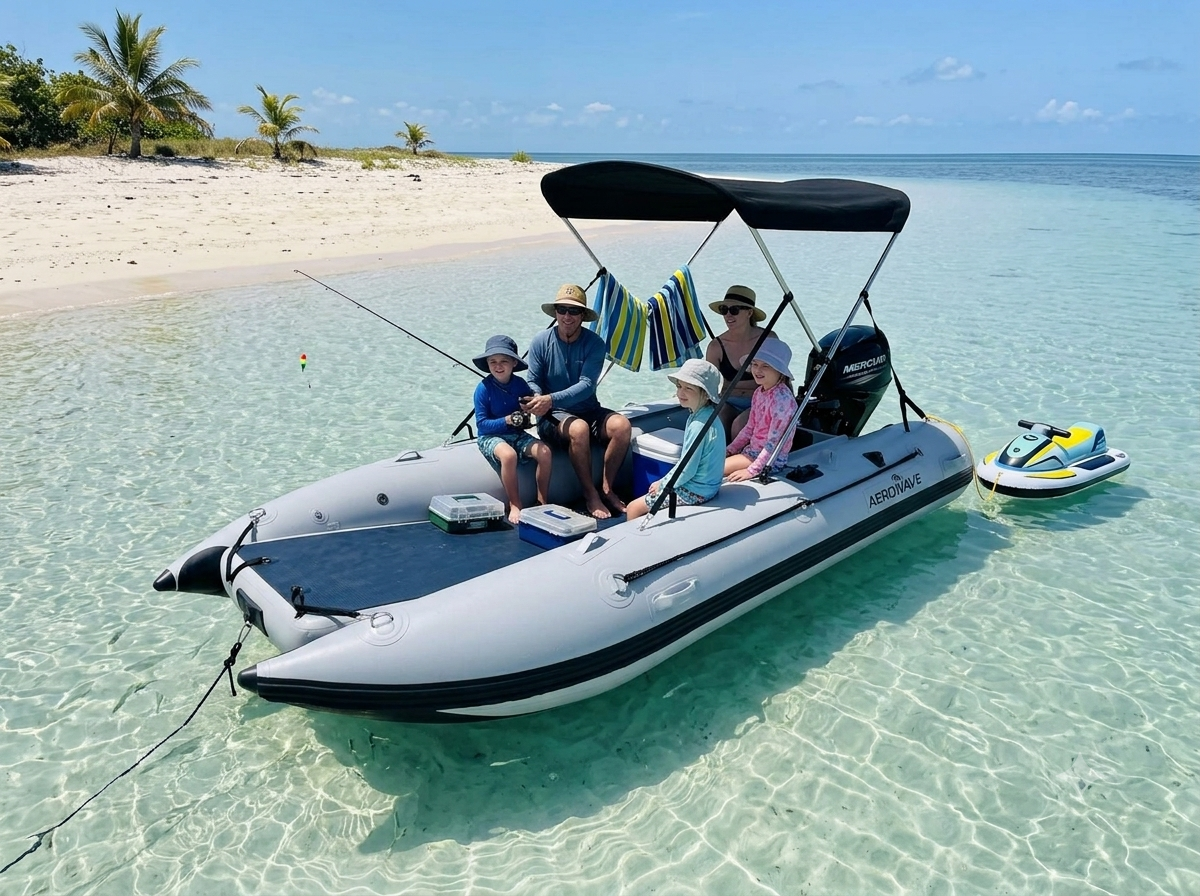
Aerowave WaveRunner 380 Series 3 Catamaran Package
The WaveRunner 380 Series 3 is a premium 3.8m inflatable catamaran package built for Australian and worldwide families, fishing, and coastal day boating — ideal for snorkeling and spearfishing — offering serious stability and premium German Valmex® construction.
Free freight to United States · local taxes payable on arrival
Aerowave Viper 400 Sovereign
Flagship 4m enclosed-bow inflatable catamaran. German VALMEX® 7321 Heavy Plus 1.2mm commercial-grade fabric, 10 PSI high-pressure drop-stitch air deck floor with VALMEX non-slip surface, LockPro wheels, full Bimini and FREE express delivery Australia-wide included. Winter special — save $1,000 until 31 August 2026.
Free freight to United States · local taxes payable on arrival
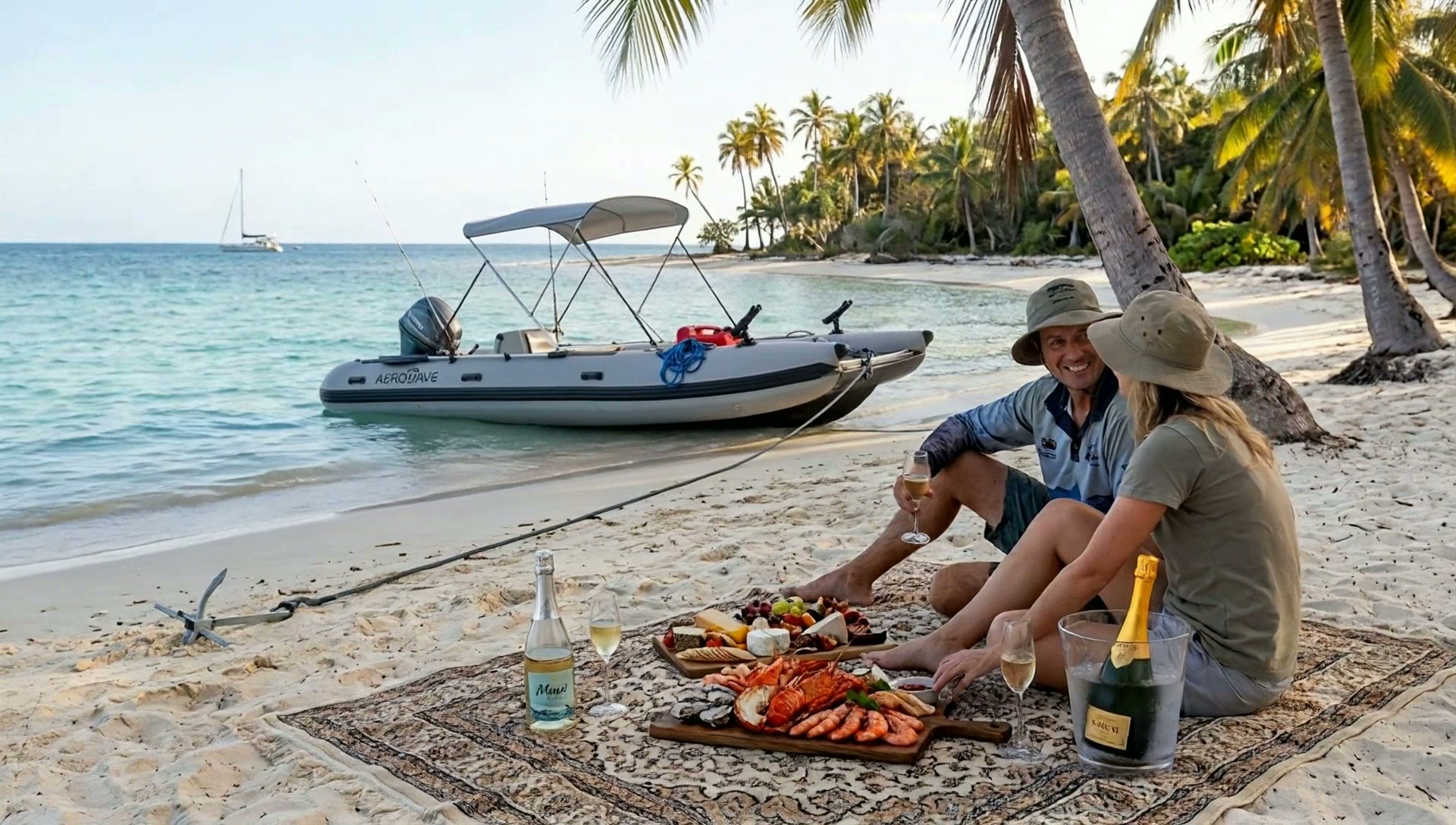
Aerowave Viper 365 Open Bow
Premium 3.65m Inflatable catamaran — built the same way as our flagship Viper 400 sports boat, just 35cm shorter. German VALMEX® 7321 Heavy Plus 1.2mm commercial-grade fabric, 10 PSI high-pressure drop-stitch air deck floor with VALMEX non-slip surface, LockPro wheels, full Bimini and FREE express delivery Australia-wide included.
Free freight to United States · local taxes payable on arrival
Not sure which suits you? Talk to a real boat owner.
Before you spend a cent
Buying from Australia, delivered to United States
You have never heard of us, we are on the other side of the world, and the internet is full of fakes. Fair enough. Here is everything you would need to check us out, in one place — no forms, no chat bot.
Australian designed business
Easy Inflatables, Avoca Beach NSW 2251. ABN 96 856 548 613. International orders ship from our Hong Kong hub.
Rated 5.0 on Google
Every review is on our Google Business Profile, with the reviewer's name and the date.
CE certified, 7-year hull warranty
ISO 6185-3 and EU Directive 2013/53/EU. Warranty honoured worldwide.
Tracked, insured, door to door
FREE freight to United States · local tax/duty on arrival.
- Who am I actually buying from?
- Easy Inflatables, Avoca Beach NSW 2251, Australia. ABN 96 856 548 613. Sean is the owner and skipper, Gary Stewart handles sales on +61 2 4335 1603, Karen Matthews handles email. The boats are Australian designed; international orders ship from our Hong Kong dispatch hub so your landed price stays competitive. Phone us before you pay a cent — a real person answers.
- Is this really an Australian product?
- Yes — Australian designed and engineered on the NSW Central Coast. Manufacturing is done offshore to our spec, and international orders ship direct from our Hong Kong dispatch hub. If we routed every boat through Australia first, the freight alone would roughly double or triple your cost for the same hull.
- What do I pay, and what is not included?
- The delivery and import terms depend on your country. EU, UK, New Zealand and named Asia/Pacific lanes include duty and tax; US freight is free but US buyers pay import charges on arrival. Other destinations show their terms before payment.
- How do I pay safely?
- Card through Stripe (Visa, Mastercard, Amex, Apple Pay, Google Pay) or bank transfer. Card payments carry your bank's own dispute protection. We never ask for crypto, gift cards or payment to a personal account.
- What if it arrives damaged?
- Every boat ships fully tracked and insured door to door. Photograph the carton and the boat on arrival and email us — transit damage is claimed and replaced through us, not left with you and the courier.
- Is the warranty real outside Australia?
- Yes. The 7-year hull warranty on 1.2 mm VALMEX Heavy Plus and Orca Hypalon hulls applies wherever you are. Replacement parts are held in Australia and at our overseas hub and go out by express courier to your door.
- Is the boat actually certified?
- All Aerowave catamarans are CE certified to ISO 6185-3 and EU Directive 2013/53/EU. Certification paperwork is supplied with the boat — ask and we will send it before you order.
Frequently asked questions
- Do I need a boat licence to operate an inflatable boat in Melbourne?
- Yes. In Victoria, Maritime Safety Victoria requires any person operating a powered recreational vessel—regardless of engine size or hull type—to hold a valid Marine Licence. If you operate your inflatable craft over 10 knots, you must also hold a Personal Watercraft (PWC) endorsement only if the vessel is legally classified as a PWC, which standard tiller-steered inflatable boats are not.
- Can an inflatable boat handle the rough chop in Port Phillip Bay?
- Yes, provided you choose an inflatable catamaran hull rather than a flat-bottom tender. Twin-tube catamarans create an air-cushioned tunnel that absorbs Port Phillip's short-period chop, allowing the boat to slice through waves cleanly without the severe slamming and soaking common to small monohull aluminium tinnies.
- Where can I legally launch an inflatable boat around Melbourne without using a boat ramp?
- You can hand-launch an inflatable boat equipped with transom wheels from most public beaches across Victoria where motorized vessels are not explicitly prohibited by local municipal bylaws or Parks Victoria. Popular off-ramp launch spots include Safety Beach, Altona Beach, and Half Moon Bay, provided you observe coastal speed limits (5 knots within 200m of the shoreline).
- How does Victorian cold water affect inflatable boat tube pressure?
- Dropping your boat into 12–14°C Victorian bay water causes the air inside your chambers to contract rapidly, reducing pressure by up to 1.0 PSI. Always inflate your tubes and high-pressure air deck slightly firm on the ramp, let the hull sit in the water for five to ten minutes to equalize, and then top up to operating pressure (3.0–3.5 PSI for tubes, 8–10 PSI for drop-stitch floors).
- How do I store an inflatable boat in a Melbourne apartment?
- Deflate the chambers, roll the boat into its heavy-duty carry bag, and pack the floor flat. A deflated 3.8m to 4.0m boat measures roughly 125 cm × 65 cm × 45 cm, fitting easily inside a standard passenger elevator, apartment balcony cupboard, or basement storage cage.
- What is the difference between 1100 GSM and 1500 GSM VALMEX fabric?
- GSM stands for grams per square metre, indicating fabric density and thickness. While 1100 GSM (0.9 mm) VALMEX provides exceptional durability and light weight for the AeroCat series, the 1500 GSM (1.2 mm) VALMEX Heavy Plus used on the Aerowave Viper provides extreme puncture resistance against sharp snapper fins, oyster leases, and rocky boat launches.
- Are boat delivery fees included when shipping to Melbourne?
- Yes. Delivery is included for all Australian customers who order through Easy Inflatables. Custom builds take around three weeks to craft (four weeks for Hypalon), followed by 7 to 10 days delivery directly to your door in Victoria.
Ready to set sail?
Premium German-fabric inflatable catamarans, built to order and delivered to your door. Talk to our team or browse the fleet.
Like this guide? Get the next one in your inbox.
Owner-tested tips, gear deep-dives and Aussie boating know-how — no spam.

