Inflatable Boat Losing Air Overnight? How to Tell a Real Leak From Normal Pressure Drop
Soft tubes by morning usually is not a puncture. The four-step overnight test that separates temperature drop and dirty valves from a genuine seam or fabric failure.
At a glance
Soft tubes by morning usually is not a puncture. The four-step overnight test that separates temperature drop and dirty valves from a genuine seam or fabric failure.
- Why pressure drops even when nothing is wrong
- The temperature swing nobody accounts for
- Fabric relax on a new boat
- Valve seat contamination
What we'd put you in
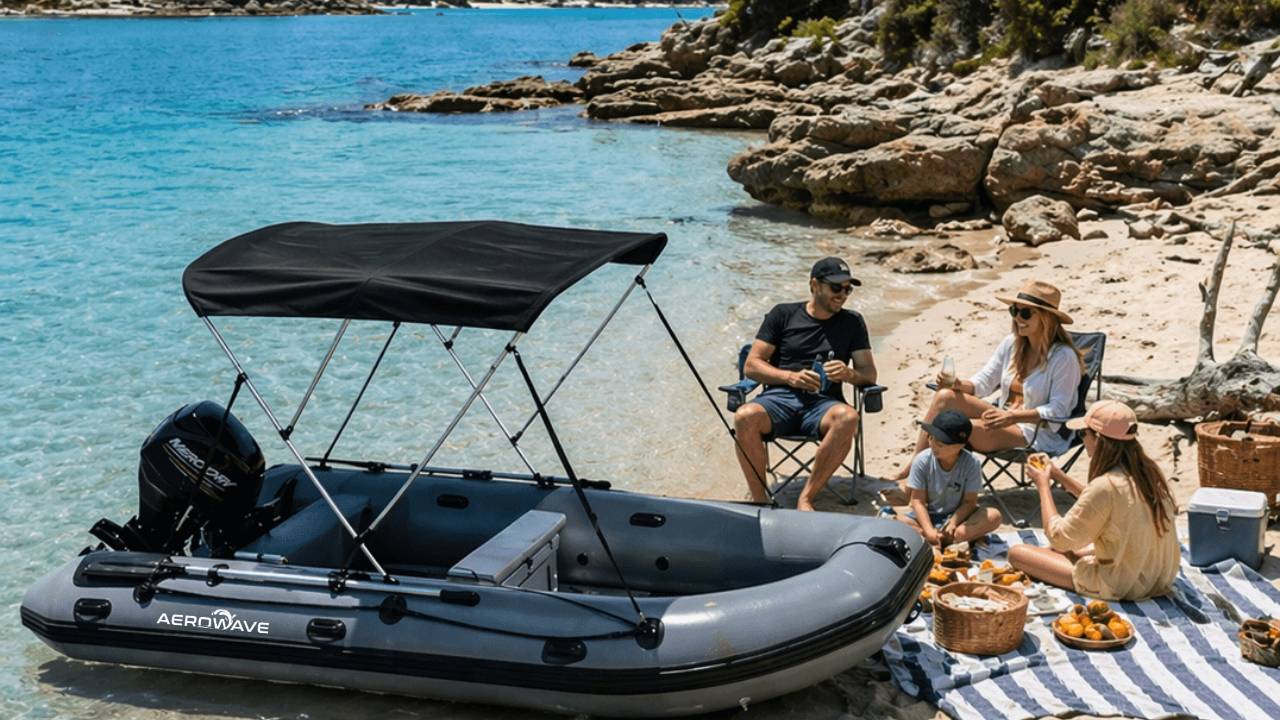
Aerowave Viper 400 Sovereign
1500 GSM / 1.2 mm VALMEX Heavy Plus — the fabric this article is really about.
US$3,279 USD
Delivered to your door, today's rate
- Free freight to United States · local taxes payable on arrival
- 7-year hull warranty
Ships to United States 🇺🇸 · tracked door to door
Fixing a hull today? Get the kit that actually holds.
Two-part PVC adhesive, matched fabric patches and a seam roller — the same kit our factory uses on 1500 GSM VALMEX®.
- Two-part adhesive — single-part hardware-store glue lets go in the sun
- Patch fabric matched to hull weight, not generic vinyl
- Written step-by-step for a wet-season repair that lasts
We're putting this into production. Want first run at cost-plus pricing?
Add your email — no spam, one message when it ships. We use this list to tell our factory what to build next.
Or replace the boat entirely
Aerowave Viper 400 Sovereign
Delivered to United States — freight included in the figure below.
US$3,279landed, USD
- 7-year hull warranty
- CE certified to ISO 6185-3 and EU Directive 2013/53/EU
- Door-to-door, tracked the whole way
See it for yourself
Real boats. Real owners. Real people behind them.
Plenty of what you read online these days is generated. Check us out properly — the factory, the reviews and the owners are all one click away. Why we use AI, and how to check we’re real
How our boats are built
Walk the production line: thermo-welded seams, 1.2 mm VALMEX Heavy Plus hulls, over-pressure relief valves on every chamber.
See the buildGoogle Maps reviews
Real Australian owners, five stars, published on our Google Business Profile with the map — read them there, not just on our own site.
Open Google Maps reviewsOwner stories
Boats in use — offshore, on rivers, on rescue duty. Photos and words from the people who actually own them.
Read owner storiesAlmost every "my inflatable is leaking" call we take turns out to be one of four things — and only one of them is a hole.
Your boat was rock hard when you rolled it off the ramp. Next morning the tubes have gone soft, the floor feels spongy and the whole thing looks tired. Before you start hunting for a puncture, understand this: an inflatable boat that loses pressure overnight is usually behaving exactly as physics says it should.
The job is separating normal pressure drop from a genuine fault — because the fix, and the cost, are completely different.
Why pressure drops even when nothing is wrong
Air inside a tube obeys the gas laws. Drop the temperature and the pressure falls with it, with no air escaping at all.
The temperature swing nobody accounts for
A tube pumped to 3.5 PSI on a 34°C afternoon and left on a 16°C lawn overnight will read noticeably softer by sunrise — typically 0.4 to 0.7 PSI down. Nothing has leaked. Put the boat back in the sun and the pressure climbs straight back up.
The same effect works in reverse and it is far more dangerous: a boat pumped hard in the cool of the morning and left on hot sand or a black trailer can gain pressure through the day. That is how seams get overloaded.
Fabric relax on a new boat
A brand new hull stretches a little on its first few inflations as the fabric and welded seams take up load. Expect to top up on day one, day two and day three. By the fourth or fifth inflation it settles and stops.
Valve seat contamination
A single grain of sand or a strand of dried seaweed sitting on the valve seat will bleed air slowly all night. This is the single most common "leak" we see, and it takes thirty seconds to fix.
The four-step overnight test
Do this before you buy repair glue or ring anyone.
Step 1: Inflate cold, measure cold
Pump every chamber to its rated pressure in shade, write down the gauge reading and the air temperature. Ours run 3.4 PSI in the tubes and 8–10 PSI in the air deck. Guessing by thumb pressure is useless here.
Step 2: Leave it in stable conditions
Garage, carport or shade — anywhere the temperature will not swing 15 degrees. Do not leave it in the sun for this test.
Step 3: Read it again after 12 hours
- Loss under 10% with a similar temperature reading: normal. There is nothing wrong with your boat.
- Loss of 10–25%: valve or fitting, almost always.
- Chamber flat or nearly flat: a genuine breach in fabric or seam.
Step 4: Isolate the chamber
Every chamber is independent for exactly this reason. If one goes down and the others hold, you have narrowed the search to a third of the boat before you have even wet a sponge.
Finding the actual leak
Soapy water, in the right order
Mix dish soap into a spray bottle and work in this sequence, because that is the order of likelihood:
- Valve body and seat — unscrew the valve cap, spray around the collar and the insert.
- Seams — run along the welded tube seams, especially where the tube meets the transom and where the floor tapers into the bow.
- Fittings — D-rings, handles, rubbing strake ends, drain plug.
- Open fabric — last, because clean fabric almost never fails on its own.
Bubbles that grow are your leak. Bubbles that appear once and stop are trapped air in the weave.
What each result actually means
Valve leaking: most valves unscrew with a cheap plastic key that should live in your kit. Clean the seat, check the O-ring, refit firm. This is a five-minute roadside job.
Seam leaking: this is the one that matters. A weeping seam is not a puncture — it is the bond between two panels letting go, and it will keep spreading. Glued-seam boats do this as the adhesive ages. Our hulls are high-frequency welded rather than glued, which is why seam separation is not a normal failure mode on them.
Fabric pinhole: oyster shell, fishing knife, dog claw. A genuine puncture in the open fabric is a legitimate patch repair and holds indefinitely.
Where cheap boats lose the argument
Air loss is the symptom. Fabric quality and construction decide whether it stays a five-minute valve clean or turns into a boat you stop trusting.
| Budget inflatables | Aerowave hulls | |
|---|---|---|
| Hull fabric | 1100 GSM / 0.9 mm PVC typical | 1500 GSM / 1.2 mm VALMEX® Heavy Plus |
| Seams | Often glued | High-frequency welded |
| Over-pressure protection | Rarely fitted | Relief valves fitted as standard |
| Expected fabric service life | 3–6 years | 10–12 years |
| Hull warranty | 1–3 years | 7 years on Viper hulls |
Thinner fabric moves more under pressure cycling. More movement means more work at the seams and fittings, and that is what eventually shows up as an overnight softening that will not go away.
Storage habits that quietly cause air loss
- Never store fully inflated in the sun. Drop tube pressure by about 30% if the boat lives outside.
- Rinse the valves, not just the boat. Salt crystals on a valve seat are abrasive and they hold the seat open.
- Do not roll it wet and put it away for a month. Trapped moisture attacks fittings and adhesive-bonded accessories long before it attacks the hull.
- Keep the valve key in the boat bag. The tool you need at the ramp is the one sitting in a drawer at home.
When to stop testing and get help
Call it in if you see any of the following:
- A chamber that empties in under two hours
- A seam bubbling anywhere along its length
- A tube that has gone hard and drum-tight in the sun and will not vent
- Any air loss on a boat still inside its hull warranty period
Take a photo, note the chamber and the pressure history, and send it through. Owners with an Aerowave hull get walked through it directly — most of it is solved with a valve key and a rinse.
Check the build before you buy the boat. Fabric weight, seam method and relief valves decide whether you spend your Sundays fishing or diagnosing.
Weekend-Proof Score 17 questions · about 2 minutes
Will the boat you're about to buy survive an Australian summer?
Seventeen straight questions about where you'll use it, what you'll ask of it and the boat you're weighing up. You get a score out of 100, the exact weak points in your plan, and the one boat that genuinely fits.
Free · your result shows on screen · no email required
So which one is yours?
Pick how you'll actually use it and we'll take you straight to the right hull.
I want to fish it
Open bow, rod holders, deck space you can stand and cast from.
Viper Sport 400Family, diving and the beach
3.8 m Series 3 catamaran — low bow to climb back in wearing fins or a tank.
WaveRunner 380Tender / one-person launch
3.3 m hard-floor boat that packs into a bag and still takes a beach landing.
Viper 330Shop gear featured in this guide
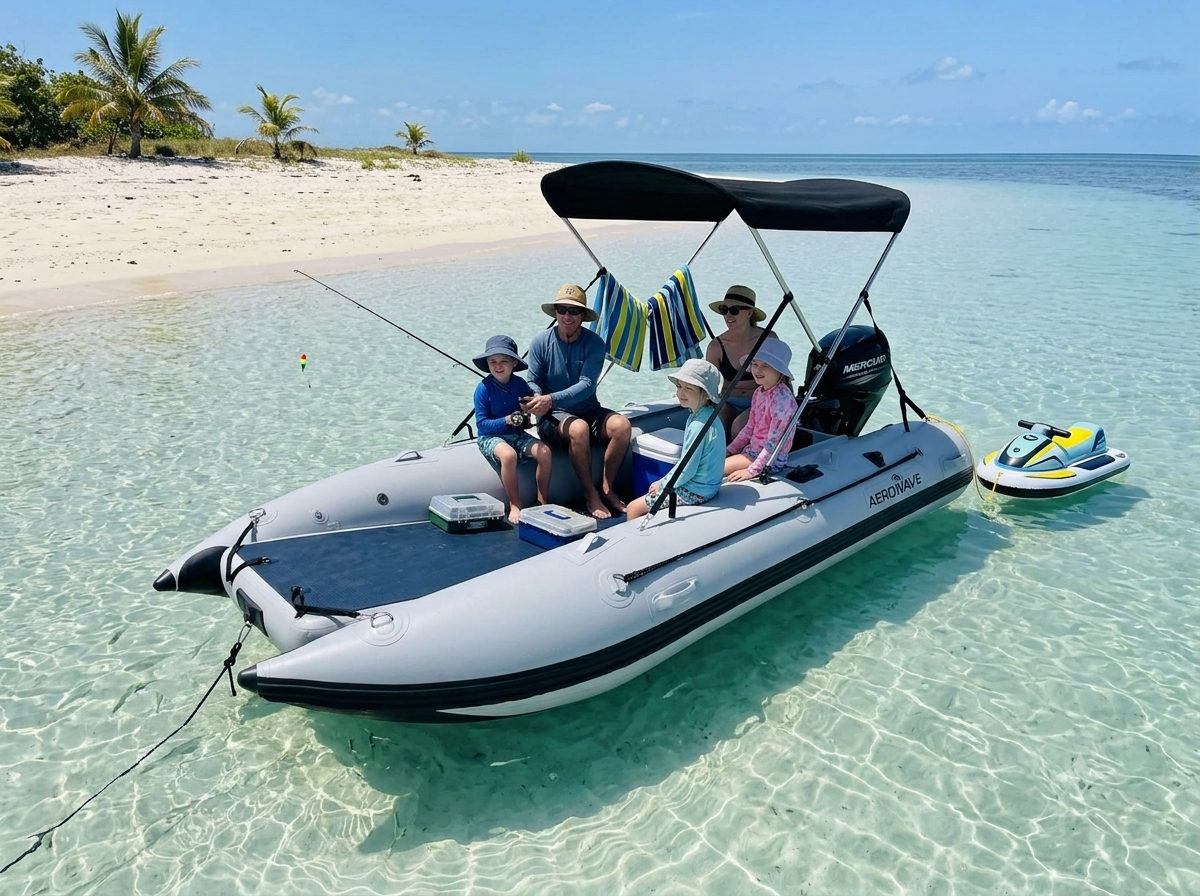
Aerowave WaveRunner 380 Series 3 Catamaran Package
The WaveRunner 380 Series 3 is a premium 3.8m inflatable catamaran package built for Australian and worldwide families, fishing, and coastal day boating — ideal for snorkeling and spearfishing — offering serious stability and premium German Valmex® construction.
Free freight to United States · local taxes payable on arrival
Aerowave Viper 400 Sovereign
Flagship 4m enclosed-bow inflatable catamaran. German VALMEX® 7321 Heavy Plus 1.2mm commercial-grade fabric, 10 PSI high-pressure drop-stitch air deck floor with VALMEX non-slip surface, LockPro wheels, full Bimini and FREE express delivery Australia-wide included. Winter special — save $1,000 until 31 August 2026.
Free freight to United States · local taxes payable on arrival
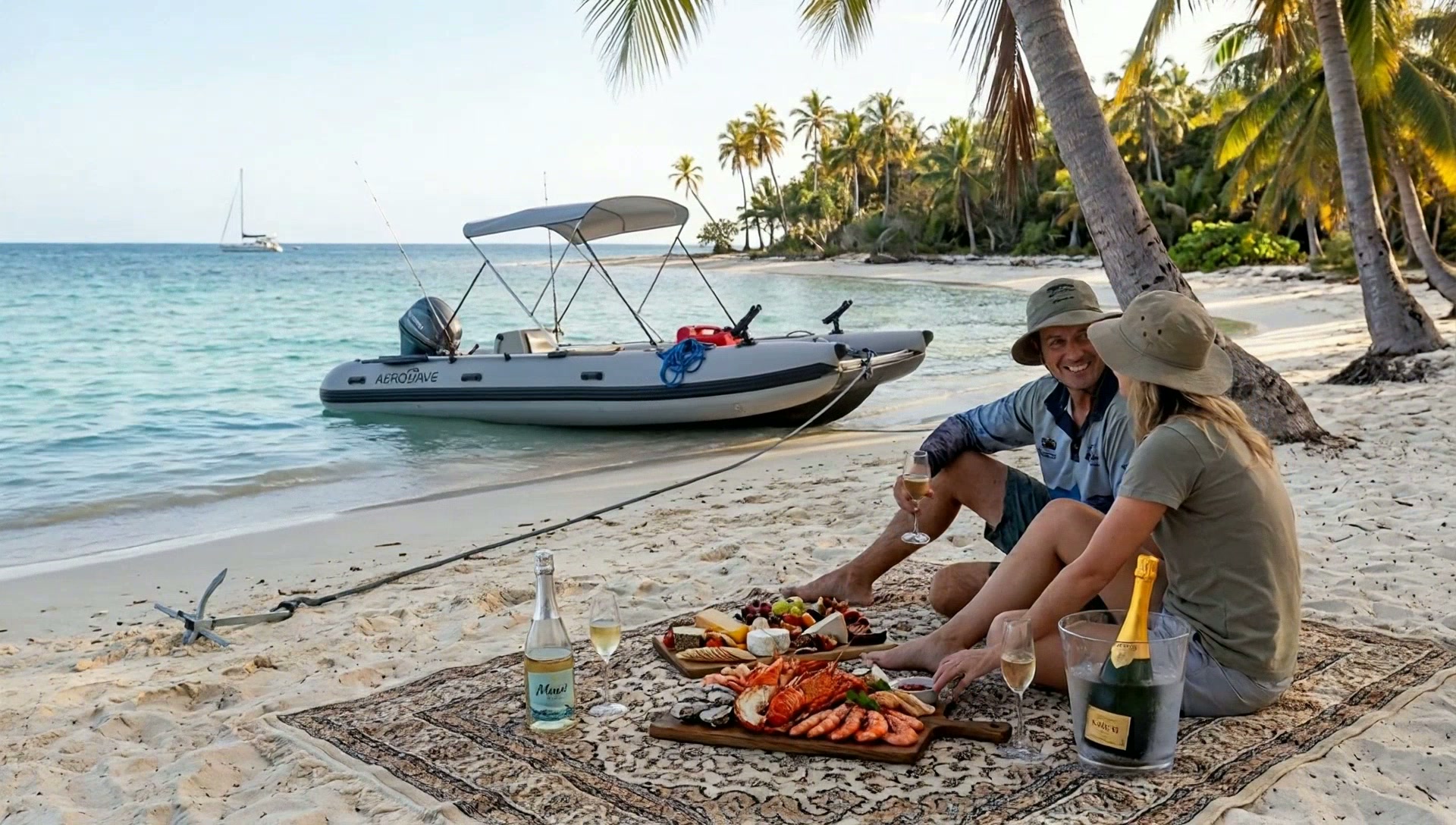
Aerowave Viper 365 Open Bow
Premium 3.65m Inflatable catamaran — built the same way as our flagship Viper 400 sports boat, just 35cm shorter. German VALMEX® 7321 Heavy Plus 1.2mm commercial-grade fabric, 10 PSI high-pressure drop-stitch air deck floor with VALMEX non-slip surface, LockPro wheels, full Bimini and FREE express delivery Australia-wide included.
Free freight to United States · local taxes payable on arrival
Not sure which suits you? Talk to a real boat owner.
Before you spend a cent
Buying from Australia, delivered to United States
You have never heard of us, we are on the other side of the world, and the internet is full of fakes. Fair enough. Here is everything you would need to check us out, in one place — no forms, no chat bot.
Australian designed business
Easy Inflatables, Avoca Beach NSW 2251. ABN 96 856 548 613. International orders ship from our Hong Kong hub.
222 owner reviews, 4.8 average
Read them in full, good and bad, on our reviews page.
CE certified, 7-year hull warranty
ISO 6185-3 and EU Directive 2013/53/EU. Warranty honoured worldwide.
Tracked, insured, door to door
FREE freight to United States · local tax/duty on arrival.
- Who am I actually buying from?
- Easy Inflatables, Avoca Beach NSW 2251, Australia. ABN 96 856 548 613. Sean is the owner and skipper, Gary Stewart handles sales on +61 2 4335 1603, Karen Matthews handles email. The boats are Australian designed; international orders ship from our Hong Kong dispatch hub so your landed price stays competitive. Phone us before you pay a cent — a real person answers.
- Is this really an Australian product?
- Yes — Australian designed and engineered on the NSW Central Coast. Manufacturing is done offshore to our spec, and international orders ship direct from our Hong Kong dispatch hub. If we routed every boat through Australia first, the freight alone would roughly double or triple your cost for the same hull.
- What do I pay, and what is not included?
- The delivery and import terms depend on your country. EU, UK, New Zealand and named Asia/Pacific lanes include duty and tax; US freight is free but US buyers pay import charges on arrival. Other destinations show their terms before payment.
- How do I pay safely?
- Card through Stripe (Visa, Mastercard, Amex, Apple Pay, Google Pay) or bank transfer. Card payments carry your bank's own dispute protection. We never ask for crypto, gift cards or payment to a personal account.
- What if it arrives damaged?
- Every boat ships fully tracked and insured door to door. Photograph the carton and the boat on arrival and email us — transit damage is claimed and replaced through us, not left with you and the courier.
- Is the warranty real outside Australia?
- Yes. The 7-year hull warranty on 1.2 mm VALMEX Heavy Plus and Orca Hypalon hulls applies wherever you are. Replacement parts are held in Australia and at our overseas hub and go out by express courier to your door.
- Is the boat actually certified?
- All Aerowave catamarans are CE certified to ISO 6185-3 and EU Directive 2013/53/EU. Certification paperwork is supplied with the boat — ask and we will send it before you order.
Frequently asked questions
- Is it normal for an inflatable boat to lose air overnight?
- Yes, within limits. A drop of under about 10% over 12 hours is normal pressure change from falling air temperature, not a leak. Anything beyond that points to a valve, fitting or seam issue.
- How do I find a leak in an inflatable boat?
- Spray soapy water in order of likelihood: valve body and seat first, then welded seams, then fittings such as D-rings and handles, and only then the open fabric. Growing bubbles mark the leak.
- Why does my inflatable boat go soft in the morning but firm up during the day?
- That is temperature, not a leak. Air pressure falls as the boat cools overnight and rises again in the sun. If pressure returns without topping up, nothing has escaped.
- Can a leaking valve be fixed at the boat ramp?
- Usually. Most valves unscrew with a plastic valve key. Clean the seat, check the O-ring for sand or salt, refit firmly and re-test. Keep the key in your boat bag.
- Is a leaking seam repairable?
- A weeping seam is an adhesive bond letting go and it tends to spread, so it needs proper assessment rather than a patch. Welded seams do not fail this way, which is why our hulls are high-frequency welded rather than glued.
Ready to set sail?
Premium German-fabric inflatable catamarans, built to order and delivered to your door. Talk to our team or browse the fleet.
Like this guide? Get the next one in your inbox.
Owner-tested tips, gear deep-dives and Aussie boating know-how — no spam.