Inflatable Boat Pumps Australia: 2026 Buyer's Guide to PSI, Valves & 12V Power
Manual, 12V, 240V or lithium? Match your pump to real tube and air-deck pressures, the valves on your boat and the way you launch in Australia.
At a glance
Manual, 12V, 240V or lithium? Match your pump to real tube and air-deck pressures, the valves on your boat and the way you launch in Australia.
- Why the Right Pump Changes Your Day on the Water
- Match the pump to the outing
- Understanding PSI, Valves, and Pressure Targets
- Read the pressure ceiling first
What we'd put you in
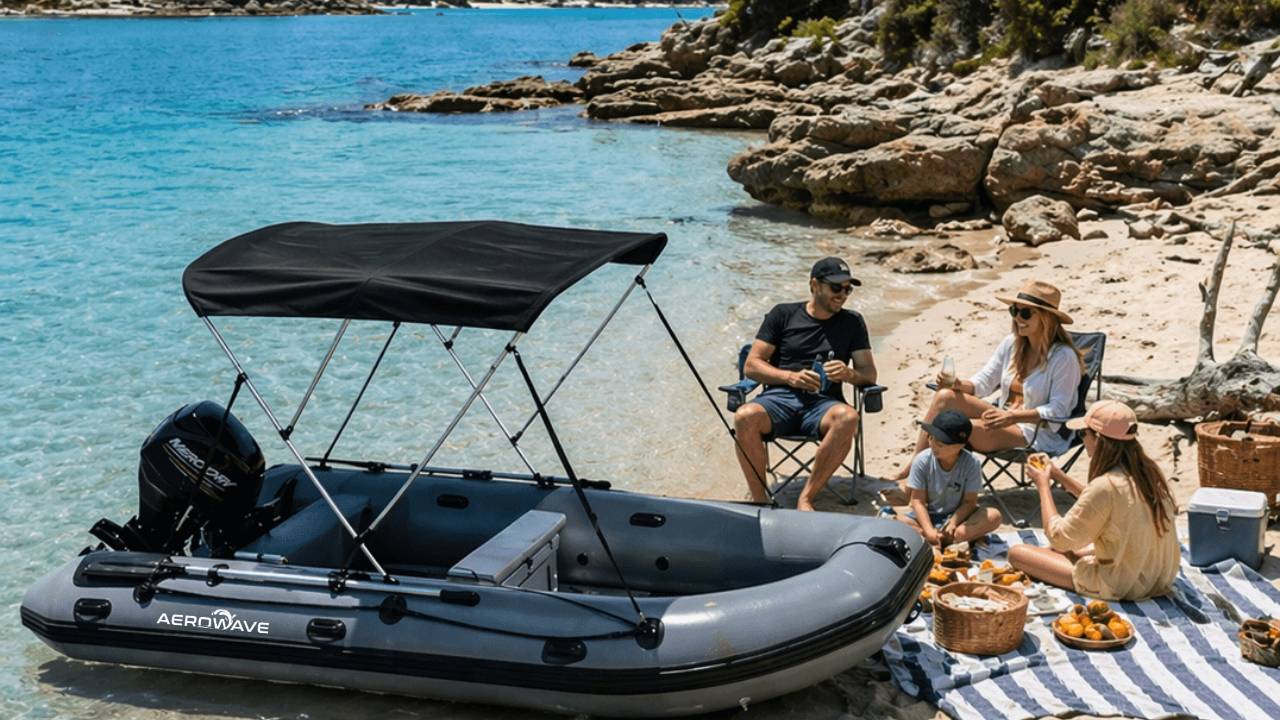
Aerowave Viper 400 Sovereign
Our best-selling boat: 4.0 m, 1.2 mm VALMEX hull, 7-year hull warranty.
US$3,167 USD
Delivered to your door, today's rate
- Free freight to United States · local taxes payable on arrival
- 7-year hull warranty
Ships to United States 🇺🇸 · tracked door to door
Keeping power dry on an inflatable is the whole problem.
Sealed IP67 battery box, bus bar, USB and 12 V outlets — sized for a trolling motor on a soft-floor boat.
- Sealed lid and gland entries — spray and green water stay out
- Strap points that suit a tube D-ring, not a bolted deck
- 12 V, USB-C and Anderson takeoffs in one box
We're putting this into production. Want first run at cost-plus pricing?
Add your email — no spam, one message when it ships. We use this list to tell our factory what to build next.
Or replace the boat entirely
Aerowave Viper 400 Sovereign
Delivered to United States — freight included in the figure below.
US$3,167landed, USD
- 7-year hull warranty
- CE certified to ISO 6185-3 and EU Directive 2013/53/EU
- Door-to-door, tracked the whole way
See it for yourself
Real boats. Real owners. Real people behind them.
Plenty of what you read online these days is generated. Check us out properly — the factory, the reviews and the owners are all one click away. Why we use AI, and how to check we’re real
How our boats are built
Walk the production line: thermo-welded seams, 1.2 mm VALMEX Heavy Plus hulls, over-pressure relief valves on every chamber.
See the buildGoogle Maps reviews
Real Australian owners, five stars, published on our Google Business Profile with the map — read them there, not just on our own site.
Open Google Maps reviewsOwner stories
Boats in use — offshore, on rivers, on rescue duty. Photos and words from the people who actually own them.
Read owner stories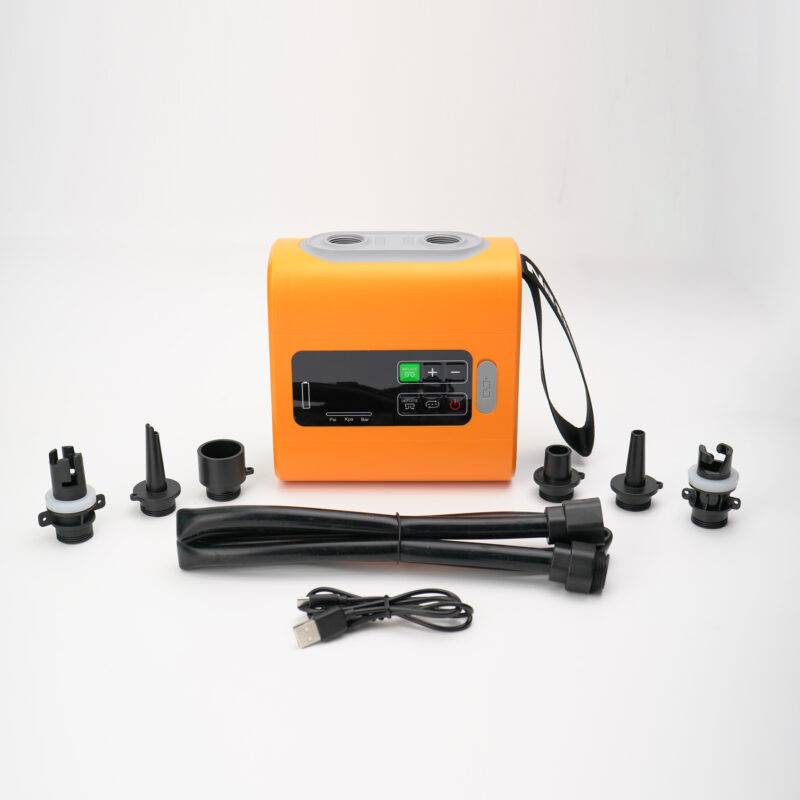
You're at the boat ramp, the family's ready, and the inflatable is still on the ground. The pump in your boot suddenly matters more than the boat itself. A weak manual pump can turn a simple launch into a sweaty delay, while the wrong electric pump may drain your vehicle battery without ever reaching the pressure your air deck needs.
The right choice among inflatable boat pumps in Australia depends on where you launch, how often you inflate, the valves fitted to your boat, and whether you need to reach a high-pressure floor. This guide compares 12V, 240V, lithium and manual options, then explains how bundled boat packages, pressure controls and Australian support affect the buying decision.
Why the Right Pump Changes Your Day on the Water
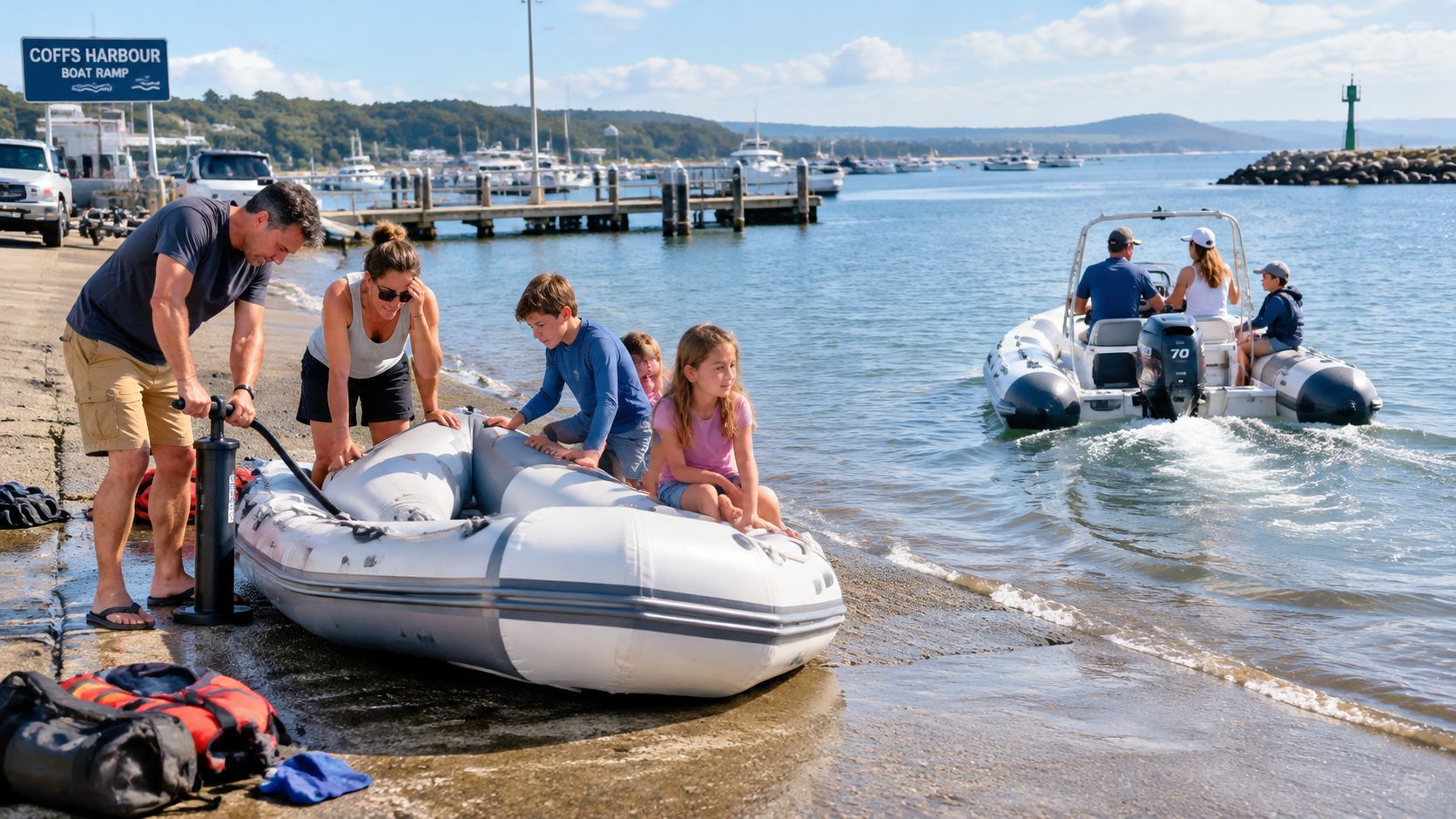
At a busy Coffs Harbour ramp on a long weekend, two families can use the same style of RIB and have completely different mornings. One is still working a hand pump long after the boat has been unrolled. The other has connected a pressure-controlled electric pump, fitted the floor and started loading gear while the first family is still swapping arms.
The difference usually isn't the hull. It's the pump sitting in the boot.
New South Wales has a large recreational base for inflatable craft. The 2023 NSW Recreational Boater Survey estimated more than one million users of powered boats and more than one million users of unpowered watercraft in the state. It also found that households owning four or more watercraft increased from 16% in 2019 to 25% in 2023, while 97% of respondents owned one or more lifejackets. That points to an established, safety-conscious boating market where a spare pump, a reliable gauge and quick inflation accessories make practical sense.
Match the pump to the outing
Beach launching from a 4WD calls for a high-pressure pump that can work in short bursts, deflate the boat efficiently for the drive home and connect easily to the vehicle. A long 12V lead matters if the battery is at the front and the boat is sitting near the towball.
RV and caravan travel favours a rechargeable lithium pump. You can keep it in a cupboard, recharge it away from mains power and avoid running leads across a campsite. It's the cleanest setup for families who inflate, use, dry and pack away the boat during the same trip.
Yacht tender work has a different priority. Raw speed matters less than quiet, repeatable pressure and dependable operation from a house battery. A tender may be inflated and deflated repeatedly, so a pump that stops at the selected pressure is more useful than one that only advertises a large headline number.
Read the inflation and deflation guidance for inflatable boats before choosing by speed alone. Your conditions, storage and tolerance for manual effort should decide the pump class.
Understanding PSI, Valves, and Pressure Targets
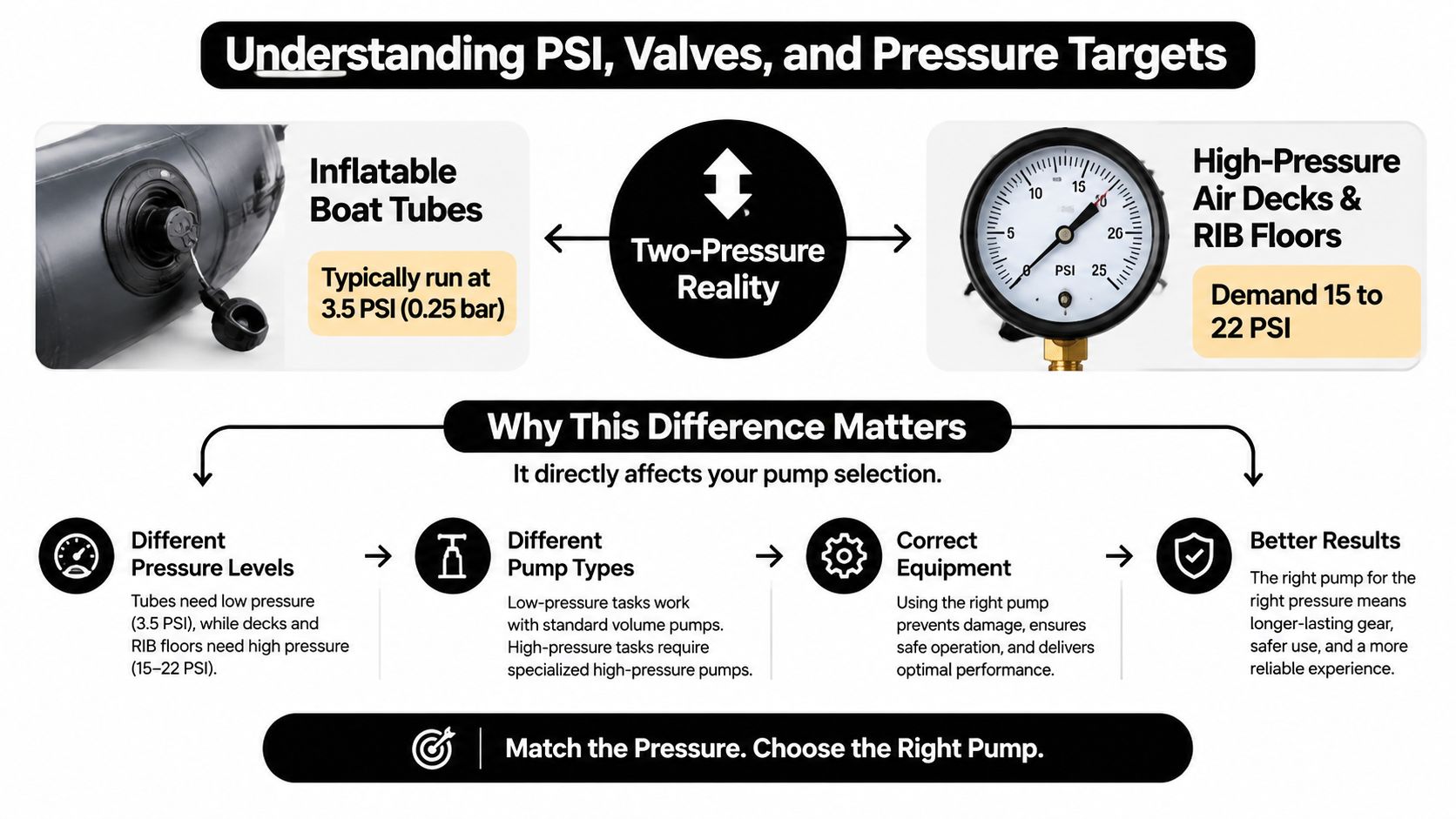
The first mistake buyers make is treating every inflatable chamber as if it uses the same pressure. It doesn't.
Australian commissioning guidance commonly places main tubes at about 3.5 PSI, or 24 kPa, while high-pressure air decks are inflated to 8 to 10 PSI, or 55 to 69 kPa, according to Australian inflatable-boat commissioning guidance. Some pump and boat systems are designed to reach a higher ceiling, including 22 PSI, which gives one pump enough range for demanding high-pressure floors as well as lower-pressure tubes.
The tube creates the hull shape and supports the boat's flotation. The air deck needs more pressure because it acts as a stiff structural platform. If the deck is soft, tracking and load support suffer. If a low-pressure tube is exposed to excessive pressure, seams, valves and fabric can carry unnecessary stress.
Read the pressure ceiling first
A pump that stops at 4 PSI may fill a soft tube but won't suit a high-pressure RIB floor. Conversely, a pump capable of 22 PSI must be used with the correct preset, gauge or automatic stop when filling a tube.
An Australian IRB manual states that hull chambers should reach 4.5 PSI, warns that the supplied pump can deliver up to 10 PSI, and explains that over-inflation can cause fabric stretch, failure or permanent distortion as temperature changes. The IRB manual reinforces the practical rule: use a gauge and follow the boat manufacturer's pressure specification.
Valves determine whether the pump works
Australian-market inflatables commonly use:
- Boston valves, found on many budget tubes and recreational inflatables.
- Halkey-Roberts push-pin valves, common on tenders, SUPs and higher-pressure equipment.
- Bayonet-style Bravo fittings, used on many European-built boats and marine accessories.
Adaptor kits bridge these systems, but cheap plastic adaptors can leak or snap during sustained high-pressure cycles. Check that the pump includes the fitting your boat uses, rather than assuming the nozzle will fit.
Valve design isn't unique to boats. A useful comparison is this explanation of solar lantern air valve design, which shows how valve shape affects airflow, sealing and ease of use in inflatable products.
Airflow matters as much as PSI
PSI tells you how much pressure the pump can build. CFM or litres per minute tells you how quickly it moves air. A pump can have a high pressure ceiling but still take a long time to fill a large hull if its airflow is modest.
Australian pump specifications span maximum outputs from about 12 PSI to 22 PSI, as shown in this Australian pump specification example. Use the highest-pressure part of your boat as the minimum pressure target, then choose airflow according to how often you launch and how much waiting you'll accept at the ramp.
For safe pressure control, review the guidance on over-pressurisation valves before connecting a high-output pump.
Comparing Pump Types for Australian Conditions
Australian buyers have four practical choices: 12V electric, 240V mains, lithium-ion rechargeable, and manual hand or foot pumps. The right option depends on where you launch, how often you inflate, and whether the boat is near a vehicle or power outlet.
| Pump Type | Max PSI | Typical CFM/L/min | Inflate 3.5m RIB | Price Band AUD | Best For |
|---|---|---|---|---|---|
| 12V electric | 10 to 15 PSI | Around 450 L/min | Fast for tubes, dependent on floor pressure | A$60 to A$120 | Run-and-launch users with a healthy vehicle battery |
| 240V mains | Higher-pressure output | Varies by model | Fast where mains power is available | A$180 to A$350 | Powered campsites, workshops and inverter-equipped rigs |
| Lithium compressor | Up to 22 PSI | Around 70 L/min | Portable, with slower bulk airflow | A$80 to A$180 | RV travel, beach launches and off-grid use |
| Manual or foot pump | Low-pressure use | Human-powered | Labour-intensive | A$40 to A$80 | Backup inflation and simple soft-floor craft |
The price bands and examples reflect Australian retail listings for inflatable boat pumps and accessories. Use them as buying guidance, not as a guarantee for every model.
12V electric pumps
A 12V pump is the straightforward choice for a boat ramp, fishing rig or launch beside the four-wheel drive. Models such as the Bravo BP12 and comparable units generally target roughly 10 to 15 PSI, combining high airflow with substantial current demand. They fill tubes quickly when the vehicle battery is healthy and the boat stays close to the car.
The trade-off is dependence on the vehicle. You need a suitable socket, enough lead length and battery capacity for repeated inflation cycles. Cheap unbranded pumps can also bring inconsistent adaptors, weak thermal protection and unclear pressure controls. For regular ramp use, pay for reliable fittings and protection rather than choosing on price alone.
240V pumps
Mains pumps deliver strong output at home, in a garage or on a powered campsite. They suit yacht-tender preparation before departure and workshop use, where a dependable outlet is available. They are a poor match for an isolated beach launch, while an inverter adds cables, setup time and extra electrical demand.
Lithium compressors
A lithium unit suits RV travel, beach launches and yacht tendering when carrying the boat to the water matters more than maximum bulk airflow. Easy Inflatables' 22 PSI electric air pump is intended for boats, yacht tenders, inflatable catamarans, SUPs and high-pressure air decks.
It will not necessarily match a high-output 12V pump for raw speed. Its advantage is practical: you can inflate away from the vehicle, without relying on a ramp-side socket. That makes it the more useful option for an RV traveller or beach camper.
Manual and foot pumps
Keep one as a backup. A manual pump still works with a flat battery, an unpowered campsite or a failed vehicle socket. It is suitable for topping up a soft tube and simple soft-floor craft, but it is a poor primary tool for a high-pressure air deck or repeated fishing trips.
Buying rule: Choose a pump that reaches the boat's real pressure target, provides suitable airflow and matches the power source you actually carry. A high PSI figure alone does not make a pump suitable for Australian use.
Power Source Realities for Beaches, Campsites and Boat Ramps
A beach launch exposes weak power planning quickly. A 12V cigarette-style pump works well when the four-wheel drive is parked beside the ramp, then becomes awkward when the boat sits down the sand, beside an unpowered campsite or on the far side of a yacht.
Australian pump shelves cover low-cost 12V inflators, cordless units and lithium compressors. Product claims about inflating a full hull or a 3 m dinghy describe specific conditions, not a guaranteed result for every boat. Hull volume, valve restriction, starting pressure and temperature all change the time required. Choose from the use case first, then check the pump's connector, battery capacity and pressure control.
Vehicle power works, until it doesn't
A 12V pump connected to a running vehicle is the straightforward boat-ramp arrangement. It is less convenient for inflating more than one craft, topping up after a pressure check or working with an older vehicle whose starter battery is already under strain.
A separate battery box keeps accessory demand away from the starter system. Read this boat battery box guide before building a portable setup around a 12V pump, fish finder or other small boating accessories. For fishing rigs, that separation matters more than saving a few cables.
Off-grid charging needs planning
Rechargeable pumps fit RV travel and beach launches because you can charge them away from the water. Pairing one with a solar blanket, a USB-C power delivery charger or a dual-battery system can work, provided the charging plan matches the day's use. Ask how many inflation and deflation cycles you expect, whether the pump may need to refill a floor after a temperature change and where the next recharge will occur.
A 240V pump can run from an inverter, but the inverter must match the pump's electrical demand. It adds heat, fan noise and another device that needs protection from sand and water.
Dawn launches make noise part of the decision. A compact lithium pump creates less cable clutter than a mains setup, while a manual pump remains the quietest backup around sleeping campers or yacht owners. For an RV traveller, beach camper or yacht tender, Easy Inflatables' bundled 22 PSI lithium pump removes the need to build the power arrangement around the vehicle, while a manual pump still gives you a fallback if batteries or sockets fail.
How Easy Inflatables Builds Pump and Boat Packages
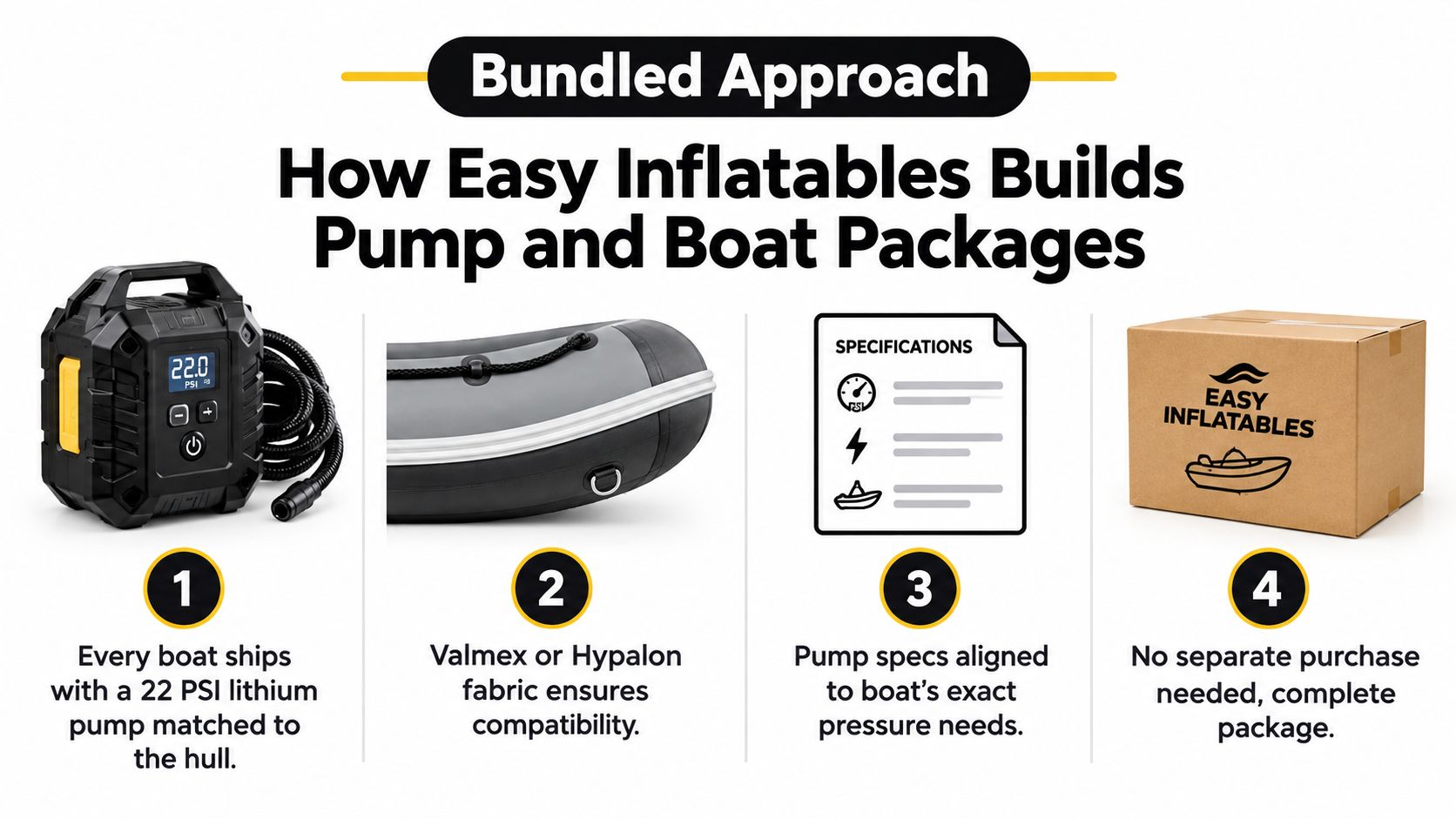
A pump should be matched to the hull before the boat leaves the warehouse. That's the logic behind the bundled approach used by Easy Inflatables, where boat packages include a 22 PSI lithium pump matched to the boat rather than leaving the buyer to find one later.
The pressure range covers the two jobs most owners face. Main Valmex or Hypalon chambers run at a lower tube pressure, while an air deck or aluminium-hybrid floor panel needs a much higher setting to become rigid. One pump with controlled presets can handle both tasks, provided the operator follows the boat's pressure instructions.
What a complete package should solve
A usable package should remove the small problems that stop a launch:
- Sun protection: Fitted Bimini tops suit exposed runs, including family trips around Moreton Bay.
- Matched propulsion: Hidea outboards are selected to suit the boat's rated horsepower rather than added as an afterthought.
- Manual backup: Alloy oars give you a way to manoeuvre if the motor or fuel system isn't available.
- Repair readiness: A repair kit, pressure gauge and correct valves belong in the boating kit from day one.
The broader Australian market supports this kind of complete approach. The Boating Industry Association's national industry material places Australia's marine industry at about $10.2 billion in 2025. Inflatable craft also have professional and defence relevance, including Royal Australian Navy rigid-hulled inflatable boats used for high-speed boarding, personnel transport and over-the-horizon interception missions.
Stock, custom colours and tender layouts
Easy Inflatables holds production-line models from 2.5 m to 4.2 m in stock, while custom colours and tender configurations carry a stated 4 to 6 week lead time. That distinction matters if you need a boat for a planned holiday rather than a general future purchase.
The right package depends on the role. A yacht tender needs compact storage and dependable repeat inflation. A family rig may benefit more from a Bimini and stable deck space. An inflatable catamaran buyer should pay close attention to floor pressure, valve compatibility and the pump's ability to reach the specified setting.
Maintenance, Care and Troubleshooting Inflatable Boat Pumps
A powerful pump only helps if you control it. Over-inflation is one of the quickest ways to damage seams, valves and fabric, particularly when a boat sits in direct Australian sun and the internal air warms.
Set the pressure before you start. Use the lower tube specification for the main chambers and the higher setting for the air deck, following the manufacturer's manual rather than copying another boat's numbers. Automatic stop isn't a luxury on a high-pressure pump. It reduces the chance of walking away while the pump continues to build pressure.
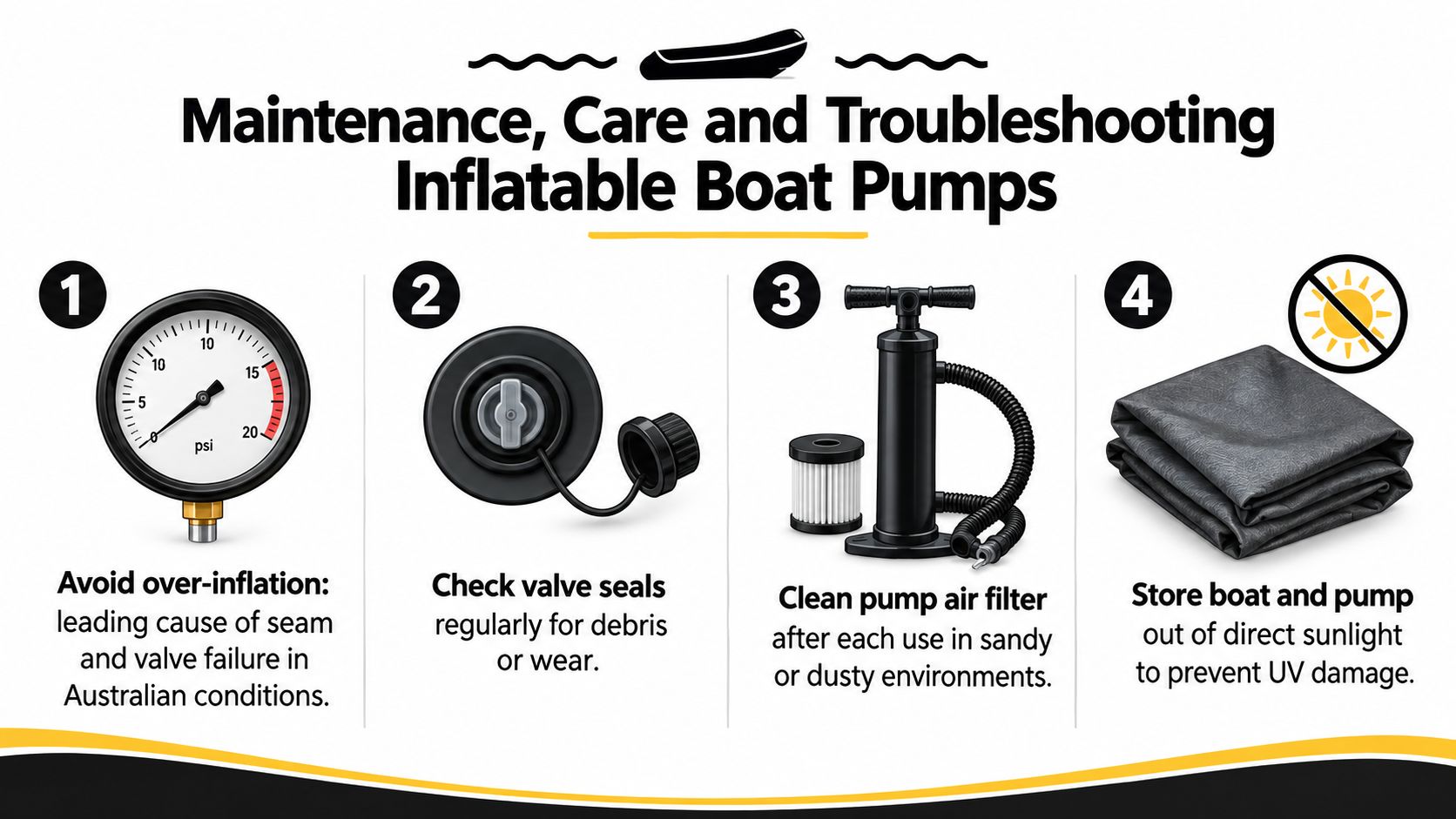
Keep sand and salt out
Beach launches introduce grit into Boston and Halkey-Roberts valves. Inspect the valve face before connecting the hose, check the O-ring for damage and keep spare caps in a sealed pouch. After saltwater use, rinse the pump intake and connectors with fresh water, then dry everything before storage.
Store lithium pumps away from extreme heat and direct sunlight. Heat affects battery cells, seals and plastic fittings, so the pump shouldn't live permanently in a hot vehicle.
Diagnose the simple faults first
A pump that cycles on and off without reaching pressure often has a loose hose connection or worn O-ring. Slow inflation commonly points to a blocked intake filter, while an error light on a lithium unit may indicate low battery rather than motor failure.
Use this complete inflatable boat maintenance guide as a routine reference, then add a yearly inspection of threaded connectors and a light re-grease where the manufacturer permits it.
Service habit: Rinse after saltwater exposure, clear the filter after sandy launches and check the gauge before trusting the pump's automatic stop.
Buying Tips and What to Expect from an Australian Retailer
Start with the boat, not the pump. Find the highest-pressure chamber, usually the air deck or RIB floor, then choose a pump whose stated ceiling comfortably reaches that requirement. After that, confirm the valve adaptors, hose fittings and gauge are included.
Run through this checklist before paying:
- Pressure match: Confirm the pump can reach the highest specified pressure without relying on an unverified maximum.
- Adaptor fit: Check that the box includes the Boston, Halkey-Roberts or Bravo fitting your boat uses.
- Lead length: Measure from the battery or vehicle socket to the furthest tube, not just the transom.
- Storage size: Check the carry bag and pump dimensions against the RV cupboard, SUV boot or yacht locker.
- Backup gear: Budget for spare valve caps, a repair kit, a 22 PSI gauge and a second hose if your trips are remote.
Australian retailers can also differ sharply in what happens after checkout. Easy Inflatables lists free metro shipping, 3 to 5 year hull warranties, 12-month pump warranties, Queensland-based phone and email support, and same-week dispatch for stocked packages. Custom Hypalon builds carry stated 4 to 6 week lead times, so ask for availability before arranging a holiday or launch date.
Keep the proof of purchase, serial details and photographs of the pump and boat. A local support team can usually resolve a fitting, warranty or replacement-parts issue more directly than an overseas return process.
Don't buy the cheapest pump and hope it copes. For a soft-floor inflatable used occasionally, a manual backup or basic 12V pump may be enough. For repeated family launches, RV travel, yacht tendering or a high-pressure inflatable catamaran floor, a controlled lithium pump with the correct adaptors is the more sensible setup.
Easy Inflatables offers inflatable boat packages that include a matched 22 PSI lithium pump, pressure accessories and boat equipment selected for recreational, tender and fishing use. Visit Easy Inflatables to compare stocked and custom packages, check pump compatibility and speak with the Australian support team before you buy.
Where to next
If your current pump is the reason launches feel like hard work, the fix is usually a pressure-controlled electric pump plus the correct valve adaptor for your boat.
- Every Aerowave Viper catamaran full package ships with a high-pressure electric pump and the matching adaptors.
- Lighter, recreational option: the Aerowave AeroCat 380 packs down small and inflates in minutes.
- Browse the full range of inflatable boats and packages or the accessories catalogue.
Not sure which pressure your floor needs? Send us the model and we will confirm it in writing before you buy.
Weekend-Proof Score 17 questions · about 2 minutes
Will the boat you're about to buy survive an Australian summer?
Seventeen straight questions about where you'll use it, what you'll ask of it and the boat you're weighing up. You get a score out of 100, the exact weak points in your plan, and the one boat that genuinely fits.
Free · your result shows on screen · no email required
So which one is yours?
Pick how you'll actually use it and we'll take you straight to the right hull.
I want to fish it
Open bow, rod holders, deck space you can stand and cast from.
Viper Sport 400Family, diving and the beach
3.8 m Series 3 catamaran — low bow to climb back in wearing fins or a tank.
WaveRunner 380Tender / one-person launch
3.3 m hard-floor boat that packs into a bag and still takes a beach landing.
Viper 330Shop gear featured in this guide
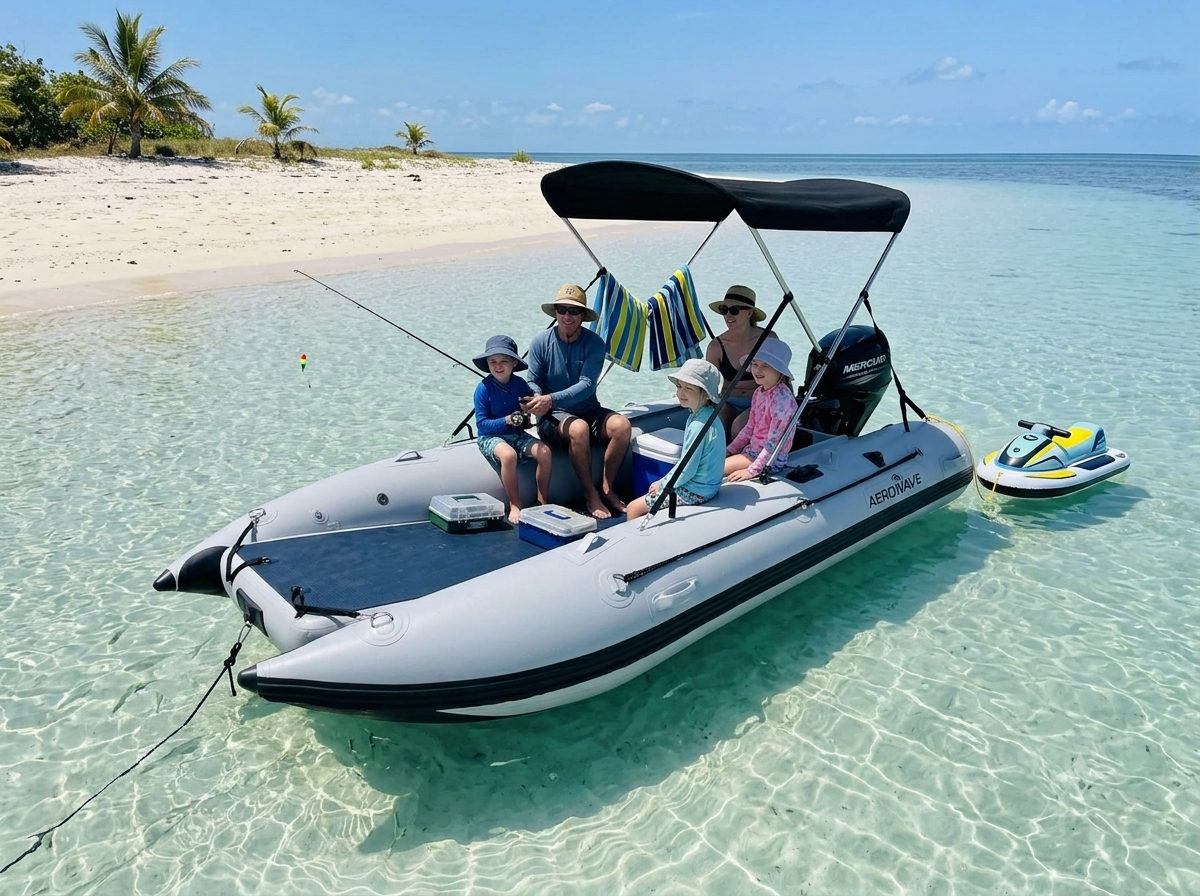
Aerowave WaveRunner 380 Series 3 Catamaran Package
The WaveRunner 380 Series 3 is a premium 3.8m inflatable catamaran package built for Australian and worldwide families, fishing, and coastal day boating — ideal for snorkeling and spearfishing — offering serious stability and premium German Valmex® construction.
Free freight to United States · local taxes payable on arrival
Aerowave Viper 400 Sovereign
Flagship 4m enclosed-bow inflatable catamaran. German VALMEX® 7321 Heavy Plus 1.2mm commercial-grade fabric, 10 PSI high-pressure drop-stitch air deck floor with VALMEX non-slip surface, LockPro wheels, full Bimini and FREE express delivery Australia-wide included. Winter special — save $1,000 until 31 August 2026.
Free freight to United States · local taxes payable on arrival

Aerowave Viper 365 Open Bow
Premium 3.65m Inflatable catamaran — built the same way as our flagship Viper 400 sports boat, just 35cm shorter. German VALMEX® 7321 Heavy Plus 1.2mm commercial-grade fabric, 10 PSI high-pressure drop-stitch air deck floor with VALMEX non-slip surface, LockPro wheels, full Bimini and FREE express delivery Australia-wide included.
Free freight to United States · local taxes payable on arrival
Not sure which suits you? Talk to a real boat owner.
Before you spend a cent
Buying from Australia, delivered to United States
You have never heard of us, we are on the other side of the world, and the internet is full of fakes. Fair enough. Here is everything you would need to check us out, in one place — no forms, no chat bot.
Australian designed business
Easy Inflatables, Avoca Beach NSW 2251. ABN 96 856 548 613. International orders ship from our Hong Kong hub.
222 owner reviews, 4.8 average
Read them in full, good and bad, on our reviews page.
CE certified, 7-year hull warranty
ISO 6185-3 and EU Directive 2013/53/EU. Warranty honoured worldwide.
Tracked, insured, door to door
FREE freight to United States · local tax/duty on arrival.
- Who am I actually buying from?
- Easy Inflatables, Avoca Beach NSW 2251, Australia. ABN 96 856 548 613. Sean is the owner and skipper, Gary Stewart handles sales on +61 2 4335 1603, Karen Matthews handles email. The boats are Australian designed; international orders ship from our Hong Kong dispatch hub so your landed price stays competitive. Phone us before you pay a cent — a real person answers.
- Is this really an Australian product?
- Yes — Australian designed and engineered on the NSW Central Coast. Manufacturing is done offshore to our spec, and international orders ship direct from our Hong Kong dispatch hub. If we routed every boat through Australia first, the freight alone would roughly double or triple your cost for the same hull.
- What do I pay, and what is not included?
- The delivery and import terms depend on your country. EU, UK, New Zealand and named Asia/Pacific lanes include duty and tax; US freight is free but US buyers pay import charges on arrival. Other destinations show their terms before payment.
- How do I pay safely?
- Card through Stripe (Visa, Mastercard, Amex, Apple Pay, Google Pay) or bank transfer. Card payments carry your bank's own dispute protection. We never ask for crypto, gift cards or payment to a personal account.
- What if it arrives damaged?
- Every boat ships fully tracked and insured door to door. Photograph the carton and the boat on arrival and email us — transit damage is claimed and replaced through us, not left with you and the courier.
- Is the warranty real outside Australia?
- Yes. The 7-year hull warranty on 1.2 mm VALMEX Heavy Plus and Orca Hypalon hulls applies wherever you are. Replacement parts are held in Australia and at our overseas hub and go out by express courier to your door.
- Is the boat actually certified?
- All Aerowave catamarans are CE certified to ISO 6185-3 and EU Directive 2013/53/EU. Certification paperwork is supplied with the boat — ask and we will send it before you order.
Frequently asked questions
- What PSI should an inflatable boat be inflated to?
- Most main tubes run between 3 and 4 PSI (roughly 0.2 to 0.28 bar) and high-pressure air decks run 8 to 10 PSI. Always inflate to the pressure printed on the tube or in your owner manual, and re-check after the boat has been sitting in Australian sun, because heat raises pressure.
- Do I need an electric pump, or will a manual pump do?
- A good double-action manual pump will get a small tender up to pressure and is worth carrying as a backup. For anything from about 3.3 m upwards, or any boat with a high-pressure air deck, an electric pump with a pressure cut-off saves 10 to 20 minutes and a lot of sweat at the ramp.
- Will a 12V pump flatten my car battery?
- A typical 12V high-pressure pump draws current for only a few minutes per chamber. Run the engine while inflating, or use a lithium power pack, and battery drain is a non-issue. Trouble only starts if you inflate repeatedly with the ignition off on an older battery.
- What valve do Australian inflatable boats use?
- Most modern inflatables, including the Aerowave range, use Halkey-Roberts style push-push valves. Check that any pump you buy includes the H-R adaptor, plus the wider air-deck adaptor if your boat has a high-pressure floor.
- How long should it take to inflate an inflatable catamaran?
- With a pressure-controlled electric pump, a 3.8 m catamaran is typically up to full pressure in around 6 to 10 minutes, including the air deck. By hand, expect 20 to 30 minutes and a solid workout.
- Can I over-inflate an inflatable boat?
- Yes, and it is the most common cause of avoidable seam stress. Use a pump with an automatic pressure cut-off or a gauge, inflate in the shade where possible, and release a little air if the boat has been sitting in full sun on a hot day.
- Is a pump included when I buy a boat from Easy Inflatables?
- Yes. Every full package includes a high-pressure electric pump and the correct adaptors for that hull, so the boat is ready to launch the day it arrives.
Ready to set sail?
Premium German-fabric inflatable catamarans, built to order and delivered to your door. Talk to our team or browse the fleet.
Like this guide? Get the next one in your inbox.
Owner-tested tips, gear deep-dives and Aussie boating know-how — no spam.