Inflatable Catamaran vs Dinghy: The Definitive Australian Buyer's Guide
Deciding between an inflatable catamaran vs dinghy? Compare stability, planing speed, deck space, and pack-down dimensions to find your ideal tender.
At a glance
Deciding between an inflatable catamaran vs dinghy? Compare stability, planing speed, deck space, and pack-down dimensions to find your ideal tender.
- Inflatable Catamaran vs Dinghy: Core Hydrodynamic Differences
- How Monohulls Displace Water
- The Tunnel-Hull Air Cushion
- Stability at Rest: Inflatable Catamaran vs Dinghy on Australian Waters
What we'd put you in
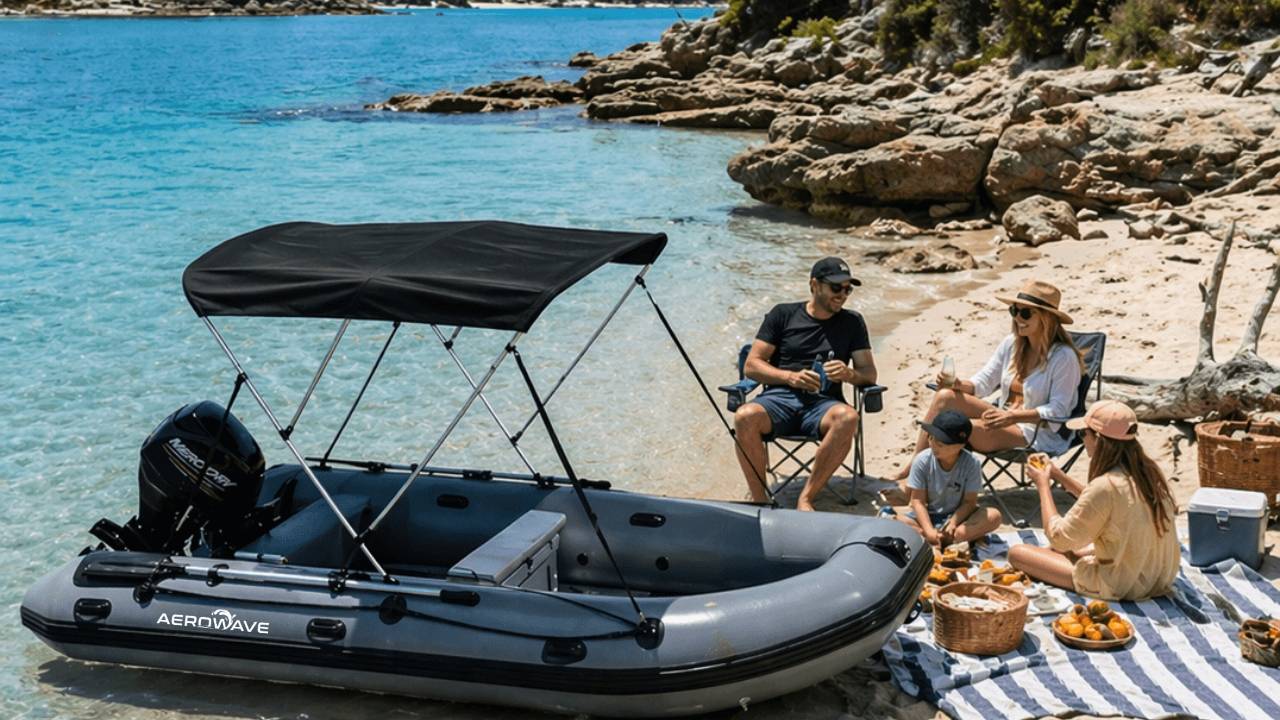
Aerowave Viper 400 Sovereign
If you're reading about catamarans, this is the one we build most of.
US$3,279 USD
Delivered to your door, today's rate
- Free freight to United States · local taxes payable on arrival
- 7-year hull warranty
🇺🇸 Shipping to United States · landed price quoted in writing
Yes — we ship the Aerowave Viper 400 Sovereign to United States. Here's the landed price.
If you're reading about catamarans, this is the one we build most of.
Written for Australian readers — but the boat ships to you. We are an Australian builder and this article is written from Australian waters. That changes nothing about what you can order: the same hull, the same 7-year warranty and the same certification go out to United States every week.
Aerowave Viper 400 Sovereign
- Boat package (export price)
- US$3,858
- 15% tariff relief credit
- − US$579
- Express air freight to United States
- Included
- Import duty, taxes & customs clearance
- Payable on arrival
- Estimated landed, USD
- US$3,279
Indicative, converted at today's rate, before local duty and tax on arrival. Ask below and we'll put a fixed figure in writing, valid 30 days.
- 7-year hull warranty
- 1500 GSM / 1.2 mm VALMEX® Heavy Plus hull
- CE certified to ISO 6185-3 and EU Directive 2013/53/EU
- Door-to-door, tracked the whole way
Your price, delivered to your door — freight included.
We email the full PDF quote (spec, freight, finance, WavePay) to your inbox in under 60 seconds. No spam — one quote, one follow-up.
See it for yourself
Real boats. Real owners. Real people behind them.
Plenty of what you read online these days is generated. Check us out properly — the factory, the reviews and the owners are all one click away. Why we use AI, and how to check we’re real
How our boats are built
Walk the production line: thermo-welded seams, 1.2 mm VALMEX Heavy Plus hulls, over-pressure relief valves on every chamber.
See the buildGoogle Maps reviews
Real Australian owners, five stars, published on our Google Business Profile with the map — read them there, not just on our own site.
Open Google Maps reviewsOwner stories
Boats in use — offshore, on rivers, on rescue duty. Photos and words from the people who actually own them.
Read owner stories
Choosing between an inflatable catamaran and a conventional inflatable dinghy comes down to a fundamental trade-off: unmatched high-speed stability and deck space versus traditional compact nesting stowage.
For decades, the standard choice for an Australian tender, estuary runabout, or portable fishing craft was the ubiquitous round-tail or V-hull inflatable dinghy. You inflated the PVC tubes, dropped in an aluminium or slatted floor, clamped on a portable outboard, and tolerated a wet, displacement-heavy ride that bounced through coastal chop. However, the rapid engineering evolution of soft inflatable catamaran tenders has disrupted that default thinking across coastal anchorages from Pittwater to the Whitsundays.
Today, modern tunnel-hull inflatables deliver hydrodynamic lift, lateral stability, and interior deck volume that traditional monohull inflatables simply cannot replicate. Yet, conventional tenders retain distinct packaging and handling characteristics that still appeal to certain blue-water cruisers with tight foredeck footprints.
If you are weighing up an inflatable catamaran vs dinghy for your next primary tender or car-topping expedition, you need objective engineering data rather than dealership marketing. Below, we break down hull physics, real-world load behaviour, rough-water performance, pack-down volume, and long-term ownership costs to determine which platform belongs on your transom.
Inflatable Catamaran vs Dinghy: Core Hydrodynamic Differences
An inflatable catamaran uses dual parallel sponsons to create an aerated tunnel hull that rides on a cushion of air, whereas a conventional inflatable dinghy relies on a single monohull profile that plows water until forced onto the plane.
To understand why these two craft behave so differently on choppy Australian bays, you have to examine how each hull manages wetted surface area and displacement. A conventional soft inflatable boat (often referred to in maritime circles as a SIB dinghy) features a rounded, tapered bow and either a flat floor or an inflatable high-pressure V-keel beneath an air deck or panelled aluminium floorboards.
How Monohulls Displace Water
When you throttle up a traditional inflatable dinghy, the bow points skyward as the wide single hull battles against its own bow wave. The entire wetted footprint of the craft drags through the chop until the motor produces enough kinetic thrust to overcome hull speed, forcing the boat over the "hump" and onto a plane. In short-period chop—typical of Moreton Bay or Port Phillip—the flat or shallow-V underside slaps directly against incoming swells, transferring shock loads directly into your knees and lower back.
The Tunnel-Hull Air Cushion
An inflatable catamaran operates on twin high-buoyancy sponsons (tubes) running parallel along the port and starboard sides, elevated above a central high-pressure drop-stitch floor (inflated to a rigid 8–10 PSI). As forward speed increases, incoming air and displaced spray funnel into the central tunnel cavity. This hydrodynamic dynamic creates three performance advantages:
- Aerodynamic and Hydrodynamic Lift: The trapped air in the tunnel generates positive lift, lifting the majority of the hull surface out of the water and drastically reducing wetted surface drag.
- Shock Absorption: Instead of a single blunt floor striking waves, the twin pontoons pierce the chop like parallel knife blades, allowing energy to dissipate through the central air channel.
- Low-Speed Tracking: The dual sponsons act like twin skegs, preventing the skittish sideways drifting and windcocking common to shallow-V inflatable dinghies during tight harbour docking maneuvers.
Stability at Rest: Inflatable Catamaran vs Dinghy on Australian Waters
An inflatable catamaran delivers vastly superior lateral stability at rest compared to a monohull dinghy because its primary buoyant volumes are positioned at the extreme outer edges of the beam.
Anyone who has boarded a traditional 2.5-metre inflatable dinghy from the swim platform of a cruiser knows the familiar "roll-and-dip" sensation. Step firmly onto the port tube of a monohull tender, and the entire hull rotates around its central axis, lifting the starboard tube out of the water and dumping the floor into a precarious angle. For spearfishers re-entering the boat with heavy gear, scuba divers hauling twin tanks, or older boaters seeking sure footing, this rotational instability remains a persistent safety hazard.
Traditional Monohull Inflatable: Single pivot axis creates rotational roll [ Tube ] ====== Floor ====== [ Tube ] \ / ----- Centerline ----/
Catamaran Tunnel Hull: Wide twin sponson stance resists tipping forces [ Sponson ] ================= [ Sponson ] || (Suspended Air Deck) || Water Water
In stark contrast, an inflatable catamaran behaves like a floating platform. With buoyant pontoons pushed to the maximum operational width, stepping your entire body weight onto one sponson simply compresses that pontoon slightly into its water displacement zone while the opposite pontoon stays firmly planted.
Whether you are retrieving a crab pot over the gunwale in an estuary or standing up to flick soft plastics at mangrove jacks, an inflatable catamaran provides a sure-footed deck. On premium catamarans like the Aerowave Viper 330 (A$5,145) or the larger Viper 400 Open Bow (A$5,595), the stability is comparable to a rigid twin-hull aluminium work punt, yet retains the impact-absorbing softness of an inflatable tube.
Performance and Planing: Inflatable Catamaran vs Dinghy Speed and Efficiency
An inflatable catamaran planes quicker and achieves higher top speeds with smaller outboards than a conventional inflatable dinghy of identical length.
Because a catamaran hull dramatically cuts wetted surface area once the tunnel pressurises, it requires substantially less horsepower to escape displacement drag. A traditional 3.2-metre monohull dinghy carrying two 90 kg adults often struggles to plane with an 8 HP or 9.9 HP outboard, demanding aggressive forward weight shifting just to drop the bow.
Lower Horsepower Thresholds
By contrast, an inflatable catamaran like the AeroWave AeroCat 335 (A$3,895) or AeroCat 380 (A$4,570) hops onto the plane cleanly at minimal throttle with an entry-level outboard. Even paired with a lightweight portable motor—such as the Hidea 9.9HP 4-stroke on an Aerowave Viper 330 package (A$8,245)—a catamaran gets up on top of the water without bow-rise drama, maintaining level sightlines throughout the acceleration curve.
Reduced Cavitation and Transom Tuning
Due to the clean, undisturbed water flow funnelled down the tunnel between the twin sponsons, the outboard propeller receives non-aerated, dense water when the transom height is dialled in. Quality inflatable catamarans feature a dedicated 380 mm transom engineered specifically for short-shaft outboards, ensuring cavitation plates align precisely with the sponson line to eliminate ventilation in aggressive turns.
Usable Cockpit Space and Bow Boarding: Open Bow vs Closed Nose
Inflatable catamarans provide significantly more usable interior floor area than round-tail dinghies because their parallel sponson architecture eliminates the cramped, tapered front point.
Look at the floor plan of a standard 3-metre round-tail inflatable tender: the interior floor space narrows aggressively toward the bow point, rendering the front third of the craft practically useless for stowing bulky gear, dive crates, or ice boxes. Passengers seated forward are forced to tuck their legs sideways across the floorboards.
Open Bow Architecture for Seamless Boarding
Many performance inflatable catamarans adopt an open-bow configuration, as seen across the Aerowave Viper range—such as the Viper 365 Open Bow (A$5,495) and the flagship Viper 430 Open Bow Sports Package (A$6,095).
This open design features a low, squared-off front drop-stitch deck section suspended between the pontoons rather than a towering wall of PVC tube. The practical advantages for everyday Australian boaters are immediate:
- Beach Landings: Passengers can simply step forward directly onto the sand without climbing over a 450 mm round tube.
- Swimmer and Diver Recovery: Crawling back aboard after a snorkel or freediving session is effortless; you slide over the flat front deck without requiring a heavy transom boarding ladder.
- Unobstructed Sightlines: The flat forward aspect gives you complete visibility of underwater reef bombies and sandbars when creeping through shallow river bars.
For boaters who want the water-shedding attributes of an enclosed front end, models like the Aerowave Viper 400 Sovereign (A$5,845) bridge the gap by integrating a raised, wave-piercing bow shield that keeps spray outside the cockpit during offshore runs.
Pack-Down Size, Portability, and Yacht Tender Stowage
A traditional inflatable dinghy packs down into a slightly smaller, more rounded stowage bundle, whereas an inflatable catamaran folds into a flatter, marginally longer package.
If you own a cruising yacht with restricted foredeck clearance between the mast and the forestay, pack-down geometry matters just as much as on-water stability. A classic monohull inflatable tender—such as the Aerowave Swift Tender 230 SI (A$2,599) or Swift Tender 290 SI (A$3,199)—can be rolled into a tightly wrapped cylinder that slides neatly into a deck locker or lazarette.
An inflatable catamaran, built around rigid transom structures and dual parallel sponson baffles, folds like a flat envelope. When deflated, the high-pressure drop-stitch floor (8–10 PSI) removes completely or rolls flat within the sponsons.
Weight Distribution and Handling
While the folded bundle of a catamaran may be 10–15% longer than an equivalent-length monohull tender, it is often simpler to balance across standard 4WD roof racks or utility trays. Transporting your deflated boat is made much easier with heavy-duty Australian-made transport bags:
- Aerowave Heavy-Duty Boat Bag (A$299): Engineered from commercial-grade fabric with reinforced box-stitched webbing handles, built to withstand the coarse non-skid decks of cruiser cockpits.
- Aerowave Australian-Made Heavy-Duty Wheel Bag (A$109): Keeps launch wheels and hardware separated from sensitive tube fabric.
- Aerowave Boat Bag & Wheel Bag Set (A$389): A complete storage pairing tailored to fit rolled catamaran tubes and floor decks without seam stress.
PACK-DOWN COMPARISON Traditional Dinghy: Rolls into a compact, thick cylinder (~110 cm x 60 cm x 40 cm) Catamaran SIB: Folds into a flat, wide rectangle (~125 cm x 65 cm x 25 cm)
Inflatable Catamaran vs Dinghy: Technical Specification Matrix
To weigh up performance, materials, and price across both categories, review this side-by-side engineering breakdown based on real specs and certified Australian marine standards:
| Specification / Feature | Inflatable Catamaran (e.g. Aerowave Viper / AeroCat) | Traditional Inflatable Dinghy (e.g. Aerowave Swift Tender) |
|---|---|---|
| Hull Architecture | Twin pontoon tunnel hull with high-pressure air cushion | Monohull profile with flat floor or inflatable V-keel |
| Lateral Stability at Rest | Exceptional; resists rolling when boarding outer tubes | Moderate; prone to rotational listing under offset loads |
| Planing Threshold | Low; planes flat with minimal horsepower (8–15 HP) | Medium to High; requires higher throttle to overcome bow rise |
| Chop Handling | Tunnel absorbs impact; pierces wave crests smoothly | Slaps against short chop; rougher ride for crew |
| Floor Technology | Independent 8–10 PSI high-pressure drop-stitch floor | Integrated drop-stitch air mat or panelled floorboards |
| Cockpit Geometry | Full-width squared floor; optional open bow | Tapered, narrowing forward footprint |
| Fabric Construction | 1100 GSM VALMEX or 1500 GSM / 1.2 mm VALMEX Heavy Plus | 1100 GSM VALMEX or standard commercial-grade fabrics |
| Expected Fabric Life | 10–12 years under Australian UV conditions | 10–12 years (premium fabric) / 3–5 years (budget PVC) |
| Transom Height | Standardised 380 mm short shaft | Standardised 380 mm short shaft |
| Safety Certification | CE Certified to ISO 6185-3 standard | CE Certified to ISO 6185 standard |
| Entry Price Point | From A$3,895 (AeroCat 335 Ready-to-Fish) | From A$2,599 (Swift Tender 230 SI) |
Durability and Engineering: VALMEX Fabric vs Budget PVC
Regardless of whether you choose an inflatable catamaran or dinghy, hull longevity under the harsh Australian sun depends entirely on the fabric grade, UV inhibitors, and seam engineering.
Many cheap inflatable tenders imported into Australia use entry-level Asian PVC fabrics rated at 800 to 900 GSM with plasticised coatings that break down under intense UV exposure within three seasons. In tropical Queensland or Western Australia, reflective heat degrades low-grade adhesives, leading to catastrophic transom delamination and pinhole leaks.
The German VALMEX Advantage
Premium soft inflatable craft utilise German-engineered Mehler VALMEX fabrics:
- AeroCat Series: Built with 1100 GSM / 0.9 mm VALMEX, delivering exceptional puncture resistance, rip-stop tensile strength, and cold-crack resilience while keeping total pack weight low.
- Viper Series: Upgraded to industrial-grade 1500 GSM / 1.2 mm VALMEX Heavy Plus. This is one of the heaviest commercial-grade polymer fabrics deployed in marine tenders, engineered specifically to resist sharp oyster racks, mangrove snags, and abrasive boat-ramp concrete.
Both materials deliver an expected working lifespan of 10–12 years under Australian conditions when cared for properly. Furthermore, long-term durability is backed by clear build assurances: the Viper range includes a 5 + 2-year warranty, while the AeroCat, WaveRunner, and Sport Series are covered by a comprehensive 5-year warranty (accessories feature a 1-year warranty).
To safeguard your investment against continuous sun exposure on cruiser davits, high-grade fabric chaps are well worth considering. Custom accessories like the Aerowave Tube Chaps (A$1,000 for a handmade, custom-fitted pair) prevent UV degradation and abrasion without requiring messy spray-on coatings.
Which Hull Form Suits Your Boating Needs? A Use-Case Decision Matrix
There is no universal winner between an inflatable catamaran vs dinghy; your choice hinges entirely on how you launch, where you store the boat, and what activities dominate your weekends.
Scenario 1: The Bluewater Cruising Yacht Tender
- Primary Need: Lightweight davit hoisting, compact foredeck footprint, dry guest transfers.
- Best Choice: Small Inflatable Catamaran (3.3 m to 3.8 m) or Compact Monohull Tender.
- The Analysis: If your yacht has limited beam or light-duty snap davits, a sub-3-metre monohull like the Aerowave Swift Tender 270 SI (A$2,899) minimizes hanging weight. However, if your yacht regularly carries guests to shore through choppy harbour anchorages, a catamaran like the WaveRunner 380 Series 3 Catamaran Package (A$4,945) keeps passengers completely dry thanks to its elevated tunnel, eliminating the spray that drenches traditional dinghy riders.
Scenario 2: The Estuary and Inshore Sport Fisherman
- Primary Need: Casting platform stability, shallow-draft access, durable construction.
- Best Choice: Inflatable Catamaran with Open Bow.
- The Analysis: Catamarans dominate this domain. The flat, non-flexing 8–10 PSI drop-stitch air deck allows two anglers to stand, sight-cast, and land large fish without destabilising the boat. Selecting the AeroWave AeroCat 335 Ready-to-Fish Pack (A$3,895) gives you an agile fishing skiff capable of creeping across shallow 150 mm flats where rigid tinnies would run aground.
Scenario 3: Spearfishing, Scuba Diving, and Snorkelling
- Primary Need: Easy water re-entry, massive load carrying, gear security.
- Best Choice: Heavy-Duty Open-Bow Catamaran.
- The Analysis: Re-boarding a monohull dinghy from deep water with a weight belt and dive tank is an exhausting physical ordeal that often results in capsizing small tenders. With an open-bow craft like the Aerowave Viper 400 Open Bow (A$5,595) or Viper 450 Open Bow (A$6,345), divers can simply kick forward, grab the front deck grab handles, and slide straight onto the deck between the sponsons.
Scenario 4: The Caravan and 4WD Outback Explorer
- Primary Need: Rapid beach deployment, roof-rack transport, simple pack-up.
- Best Choice: AeroCat 335 or WaveRunner 380.
- The Analysis: When touring remote coastlines like the Ningaloo Reef or Fraser Island, you need a boat that folds into your vehicle or sits comfortably atop a camper trailer. The AeroWave AeroCat 380 (A$4,570) provides full offshore safety and coastal capability while packing flat into storage bags, eliminating the need to tow a dedicated boat trailer across rutted corrugated tracks.
Buyer's Pre-Purchase Checklist: Assessing Your Requirements
Before placing an order or paying a build deposit on a new craft, run through this practical checklist to make sure you have matched your boat to your gear and operational demands:
- Measure Your Transom and Outboard Match: If you already own an outboard, verify its shaft length. Both the Viper and AeroCat series are optimised for a standard 380 mm short-shaft motor. Pairing a long-shaft outboard with a short-shaft tunnel transom will cause excessive drag and water spraying into the cockpit.
- Check Real Payload vs Waterline Lift: Account for full gear weight. While traditional dinghies submerge their floors deeper under heavy loads, catamarans retain lift due to their wide buoyant pontoons. If you routinely carry 4 adults plus gear, look at the Aerowave Viper 400 Sovereign + Hidea 20HP 4-Stroke Package (A$10,665) to ensure you maintain high freeboard.
- Storage Footprint Calculations: Measure your vehicle cargo space or foredeck chocks. An inflatable catamaran deflates into a wider, flatter parcel than a rolled monohull.
- Inspect Transom Reinforcement: Verify that the transom is mechanically bonded and sealed to prevent water ingress into the core. Premium models use marine composite materials that will never rot like unsealed marine plywood.
- Factor In Custom Build Schedules: High-end boats from Easy Inflatables are built to order. Standard VALMEX builds require roughly three weeks to manufacture (up to four weeks for Hypalon models), followed by 7–10 days delivery. A 50% build deposit secures your production slot, with the remaining balance due only after the boat passes its final quality-control inspection.
- Confirm Delivery Terms: Delivery is included for Australian customers across our entire boat lineup. (Overseas buyers can consult easyinflatables.com.au/international for specific freight and regional import terms).
The Bottom Line
When comparing an inflatable catamaran vs dinghy, the catamaran emerges as the clear winner for boaters who prioritise lateral stability, level high-speed planing, passenger comfort in rough chop, and open-bow utility. While a traditional inflatable dinghy remains a viable budget-conscious choice for tight yacht lazarettes or brief calm-water marina hops, its hydrodynamic limitations are hard to ignore once you face open Australian coastal conditions.
Whether you opt for the ultra-rugged 1500 GSM VALMEX construction of the Aerowave Viper series or the agile versatility of the AeroCat line, investing in a tunnel-hull design transforms your time on the water from a bumpy compromise into a stable, dry, and capable adventure.
For expert advice on sizing, motor pairing, or custom builds, reach out to our team on +61 2 4335 1603 or email sales@easyinflatables.com.au to configure your setup.
Related
Weekend-Proof Score 17 questions · about 2 minutes
Will the boat you're about to buy survive an Australian summer?
Seventeen straight questions about where you'll use it, what you'll ask of it and the boat you're weighing up. You get a score out of 100, the exact weak points in your plan, and the one boat that genuinely fits.
Free · your result shows on screen · no email required
So which one is yours?
Pick how you'll actually use it and we'll take you straight to the right hull.
I want to fish it
Open bow, rod holders, deck space you can stand and cast from.
Viper Sport 400Family, diving and the beach
3.8 m Series 3 catamaran — low bow to climb back in wearing fins or a tank.
WaveRunner 380Tender / one-person launch
3.3 m hard-floor boat that packs into a bag and still takes a beach landing.
Viper 330Shop gear featured in this guide
Aerowave WaveRunner 380 Series 3 Catamaran Package
The WaveRunner 380 Series 3 is a premium 3.8m inflatable catamaran package built for Australian and worldwide families, fishing, and coastal day boating — ideal for snorkeling and spearfishing — offering serious stability and premium German Valmex® construction.
Free freight to United States · local taxes payable on arrival
Aerowave Viper 400 Sovereign
Flagship 4m enclosed-bow inflatable catamaran. German VALMEX® 7321 Heavy Plus 1.2mm commercial-grade fabric, 10 PSI high-pressure drop-stitch air deck floor with VALMEX non-slip surface, LockPro wheels, full Bimini and FREE express delivery Australia-wide included. Winter special — save $1,000 until 31 August 2026.
Free freight to United States · local taxes payable on arrival
Aerowave Viper 365 Open Bow
Premium 3.65m Inflatable catamaran — built the same way as our flagship Viper 400 sports boat, just 35cm shorter. German VALMEX® 7321 Heavy Plus 1.2mm commercial-grade fabric, 10 PSI high-pressure drop-stitch air deck floor with VALMEX non-slip surface, LockPro wheels, full Bimini and FREE express delivery Australia-wide included.
Free freight to United States · local taxes payable on arrival
Not sure which suits you? Talk to a real boat owner.
Before you spend a cent
Buying from Australia, delivered to United States
You have never heard of us, we are on the other side of the world, and the internet is full of fakes. Fair enough. Here is everything you would need to check us out, in one place — no forms, no chat bot.
Australian designed business
Easy Inflatables, Avoca Beach NSW 2251. ABN 96 856 548 613. International orders ship from our Hong Kong hub.
Rated 5.0 on Google
Every review is on our Google Business Profile, with the reviewer's name and the date.
CE certified, 7-year hull warranty
ISO 6185-3 and EU Directive 2013/53/EU. Warranty honoured worldwide.
Tracked, insured, door to door
FREE freight to United States · local tax/duty on arrival.
- Who am I actually buying from?
- Easy Inflatables, Avoca Beach NSW 2251, Australia. ABN 96 856 548 613. Sean is the owner and skipper, Gary Stewart handles sales on +61 2 4335 1603, Karen Matthews handles email. The boats are Australian designed; international orders ship from our Hong Kong dispatch hub so your landed price stays competitive. Phone us before you pay a cent — a real person answers.
- Is this really an Australian product?
- Yes — Australian designed and engineered on the NSW Central Coast. Manufacturing is done offshore to our spec, and international orders ship direct from our Hong Kong dispatch hub. If we routed every boat through Australia first, the freight alone would roughly double or triple your cost for the same hull.
- What do I pay, and what is not included?
- The delivery and import terms depend on your country. EU, UK, New Zealand and named Asia/Pacific lanes include duty and tax; US freight is free but US buyers pay import charges on arrival. Other destinations show their terms before payment.
- How do I pay safely?
- Card through Stripe (Visa, Mastercard, Amex, Apple Pay, Google Pay) or bank transfer. Card payments carry your bank's own dispute protection. We never ask for crypto, gift cards or payment to a personal account.
- What if it arrives damaged?
- Every boat ships fully tracked and insured door to door. Photograph the carton and the boat on arrival and email us — transit damage is claimed and replaced through us, not left with you and the courier.
- Is the warranty real outside Australia?
- Yes. The 7-year hull warranty on 1.2 mm VALMEX Heavy Plus and Orca Hypalon hulls applies wherever you are. Replacement parts are held in Australia and at our overseas hub and go out by express courier to your door.
- Is the boat actually certified?
- All Aerowave catamarans are CE certified to ISO 6185-3 and EU Directive 2013/53/EU. Certification paperwork is supplied with the boat — ask and we will send it before you order.
Frequently asked questions
- Is an inflatable catamaran more stable than a traditional inflatable dinghy?
- Yes, an inflatable catamaran is significantly more stable at rest and underway because its buoyancy is positioned at the extreme outer beam. Stepping onto one side does not cause the boat to list heavily, making boarding, diving, and fishing far safer than in a monohull dinghy.
- Can you use a smaller outboard on an inflatable catamaran than a dinghy?
- Yes, the tunnel hull creates hydrodynamic lift and traps an aerated cushion of air, drastically reducing wetted surface drag. As a result, an inflatable catamaran planes faster and achieves higher speeds with lower horsepower than an equivalent-sized monohull dinghy.
- Does an inflatable catamaran handle chop better than a monohull inflatable tender?
- In short-period coastal chop, an inflatable catamaran delivers a markedly smoother and drier ride. The twin pontoon sponsons cut cleanly through waves while the central tunnel disperses wave energy, whereas flat or shallow-V dinghy bottoms slap directly against chop.
- How does pack-down size compare between an inflatable catamaran and a standard dinghy?
- A traditional monohull dinghy rolls into a tighter, rounder cylinder, making it slightly easier to tuck into small round lazarette lockers. An inflatable catamaran folds into a flatter, slightly longer rectangular package, which stores exceptionally well on 4WD roof racks, ute trays, or yacht foredecks.
- Are open-bow inflatable catamarans safe in rough open water?
- Yes, open-bow catamarans are engineered to be self-draining and ride high on their twin sponsons. Any water that enters the front immediately drains out through the open bow and stern scuppers without flooding the cockpit floor, and models like the Viper series are CE certified to the rigorous ISO 6185-3 standard.
- How long will a VALMEX inflatable catamaran last in the Australian sun?
- Premium German VALMEX fabric (1100 GSM on AeroCat or 1500 GSM Heavy Plus on Viper) has an expected working lifespan of 10 to 12 years in Australian conditions. This far exceeds budget PVC imports, which often degrade and suffer seam failure within 3 to 5 years under intense UV exposure.
- What is the typical build and delivery timeline for an Aerowave boat?
- Each boat is custom-built, taking approximately three weeks in production (up to four weeks for Hypalon models) followed by 7 to 10 days for delivery. Australian customers secure their production slot with a 50% build deposit, paying the remaining balance only once the boat clears final quality-control testing, with delivery included nationwide.
Ready to set sail?
Premium German-fabric inflatable catamarans, built to order and delivered to your door. Talk to our team or browse the fleet.
Like this guide? Get the next one in your inbox.
Owner-tested tips, gear deep-dives and Aussie boating know-how — no spam.