Small Fishing Boat Australia: Why Modern Inflatables Beat Traditional Tinnies for Solo Anglers
Ditch trailer maintenance, ramp queues, and hull slap. Discover why modern inflatable catamarans outfish aluminium tinnies for solo Australian anglers.
At a glance
Ditch trailer maintenance, ramp queues, and hull slap. Discover why modern inflatable catamarans outfish aluminium tinnies for solo Australian anglers.
- What Makes the Best Small Fishing Boat in Australia for Solo Anglers?
- Why Choose an Inflatable Over a Tinny as a Small Fishing Boat in Australia?
- 1. Zero Trailer Registration and No Council Ramp Queues
- 2. Unmatched Casting Deck Stability: Twin Cat Sponsons vs Narrow Aluminium Vee
What we'd put you in
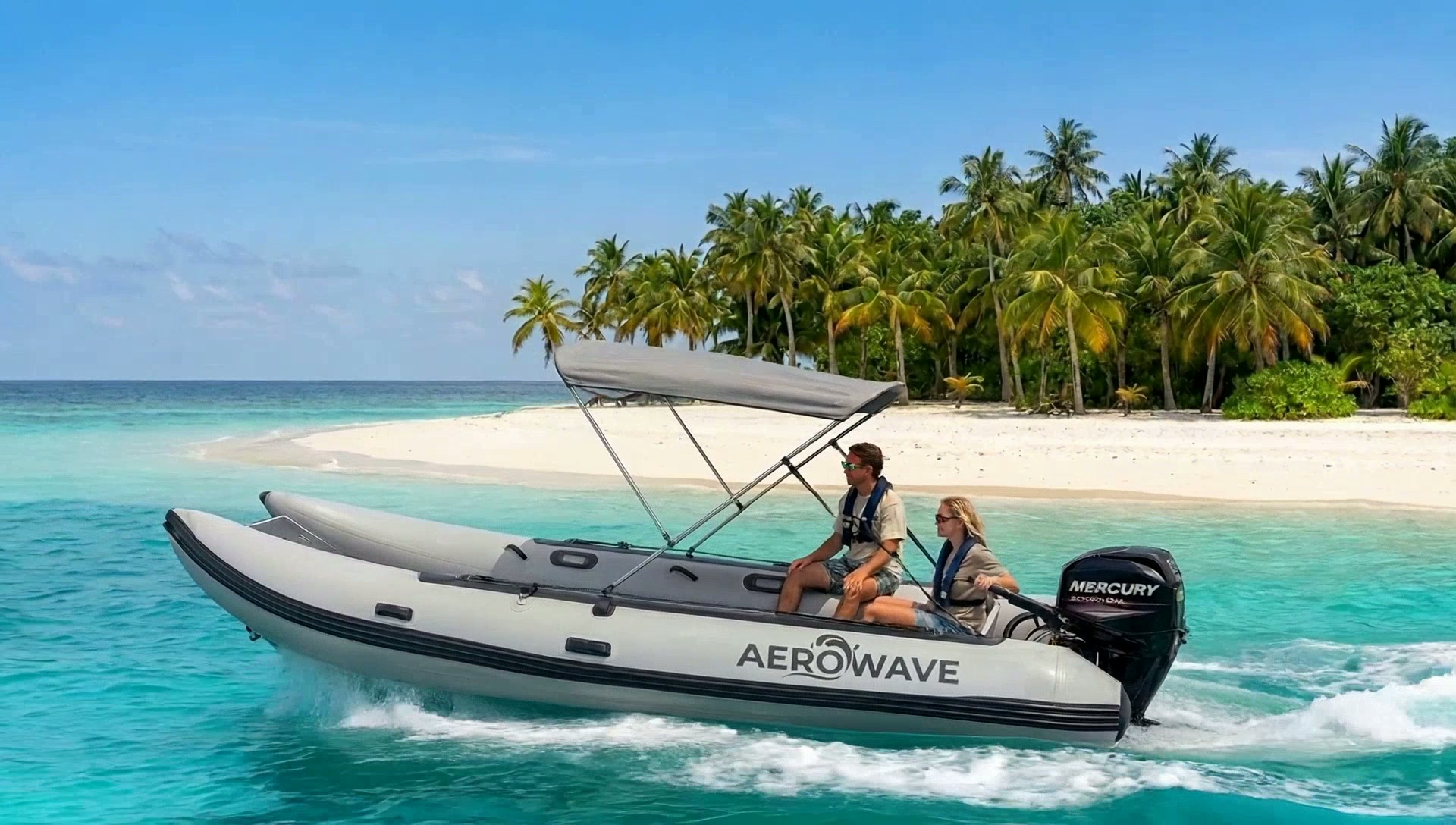
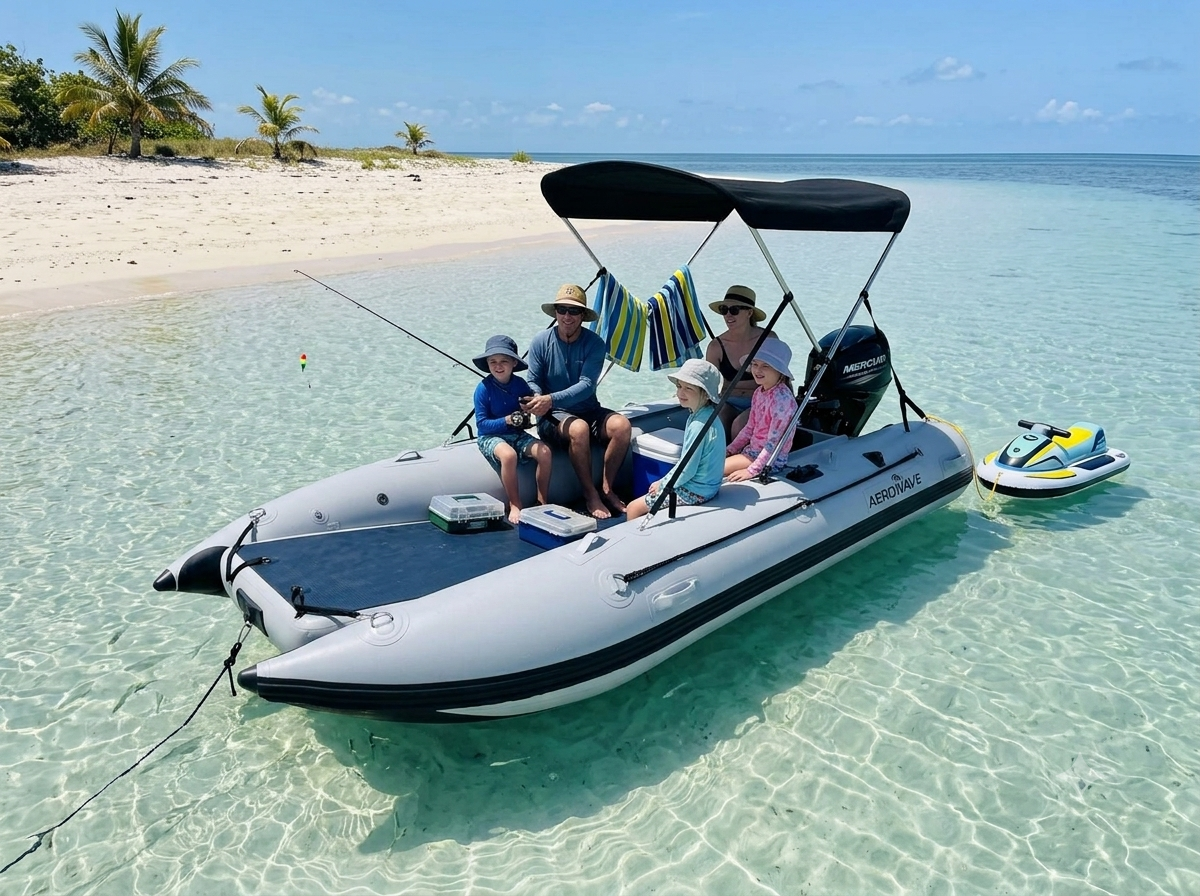
Aerowave Viper 400 Open Bow — Sports Package
Open bow, heavy-duty rod holders, and deck space you can actually fish from.
US$3,986 USD
Delivered to your door, today's rate
- Free freight to United States · taxes included, nothing to pay on arrival
- 5 + 2 year hull warranty
🇺🇸 Shipping to United States · duty & taxes prepaid
Yes — we ship the Aerowave Viper 400 Open Bow — Sports Package to United States. Here's the landed price.
Open bow, heavy-duty rod holders, and deck space you can actually fish from.
Written for Australian readers — but the boat ships to you. We are an Australian builder and this article is written from Australian waters. That changes nothing about what you can order: the same hull, the same 5 + 2 year warranty and the same certification go out to United States every week.
Aerowave Viper 400 Open Bow — Sports Package
- Boat package (export price)
- US$3,693
- 15% tariff relief credit
- − US$554
- Express air freight to United States
- Included
- Import duty, taxes & customs clearance
- US$847 — prepaid by us
- Estimated landed, USD
- US$3,986
Indicative, converted at today's rate. Ask below and we'll put a fixed figure in writing, valid 30 days.
- 5 + 2 year hull warranty
- 1500 GSM / 1.2 mm VALMEX® Heavy Plus hull
- CE certified to ISO 6185-3 and EU Directive 2013/53/EU
- Delivered duty paid — nothing to pay on arrival
Your price, delivered to your door — freight included.
We email the full PDF quote (spec, freight, finance, WavePay) to your inbox in under 60 seconds. No spam — one quote, one follow-up.
See it for yourself
Real boats. Real owners. Real people behind them.
Plenty of what you read online these days is generated. Check us out properly — the factory, the reviews and the owners are all one click away. Why we use AI, and how to check we’re real
How our boats are built
Walk the production line: thermo-welded seams, 1.2 mm VALMEX Heavy Plus hulls, over-pressure relief valves on every chamber.
See the buildGoogle Maps reviews
Real Australian owners, five stars, published on our Google Business Profile with the map — read them there, not just on our own site.
Open Google Maps reviewsOwner stories
Boats in use — offshore, on rivers, on rescue duty. Photos and words from the people who actually own them.
Read owner storiesFor generations of Australian anglers, the aluminium tinny was the unquestioned rite of passage—until the realities of trailer maintenance, ramp gridlock, and suburban storage made ownership more work than recreation.
When searching for the ultimate small fishing boat Australia offers today, solo anglers inevitably find themselves caught between two worlds. On one side sits the ubiquitous 3.5-metre pressed aluminium dinghy: noisy, unyielding, and perpetually tied to a rusty steel trailer parked on the front lawn. On the other stands the modern high-pressure inflatable catamaran: an agile, puncture-resistant craft engineered with twin hulls, drop-stitch high-pressure decks, and German-milled PVC fabrics that deflate into the boot of a mid-sized SUV.
For an angler heading out alone to cast soft plastics at daylight, convenience dictates how often you actually get on the water. A vessel that requires a dedicated vehicle tow bar, council parking permits, annual trailer bearing repacks, and a twenty-minute reversing routine down a slimy council ramp creates friction. The modern inflatable eliminates that friction entirely.
By reimagining the hull form through twin hydrodynamic sponsons rather than a hard aluminium vee, contemporary craft like the AeroWave AeroCat and Aerowave Viper deliver stability, shallow-draft access, and transportability that rigid-hull alternatives simply cannot match. If you fish alone, the verdict is shifting rapidly.
What Makes the Best Small Fishing Boat in Australia for Solo Anglers?
The best small fishing boat in Australia for a solo angler is one that delivers primary stability at rest, can be launched single-handedly away from crowded ramps, and requires no ongoing trailer registration or suburban storage compromises. It must also handle genuine coastal chop without soaking the skipper or vibrating through your knees.
When evaluating a craft for solo estuary, river, or inshore work, four design variables dictate your on-water success:
- Primary lateral stability: The ability to walk gunwale-to-gunwale and lean over the edge to land a flathead without tipping the gunwale underwater.
- Draft and displacement: How shallow you can drift across sandbars and tidal mangroves where estuary predators feed.
- Solo transit logistics: Whether you can lift, wheel, or car-top the boat when a concrete ramp is nowhere in sight.
- Stealth and acoustic footprint: Eliminating the hollow metallic ringing sound of dropping sinkers, tackle trays, or anchor chains against a raw aluminium hull.
Traditional aluminium dinghies fail on three out of four of these metrics. Modern inflatable catamarans, by contrast, excel across all four.
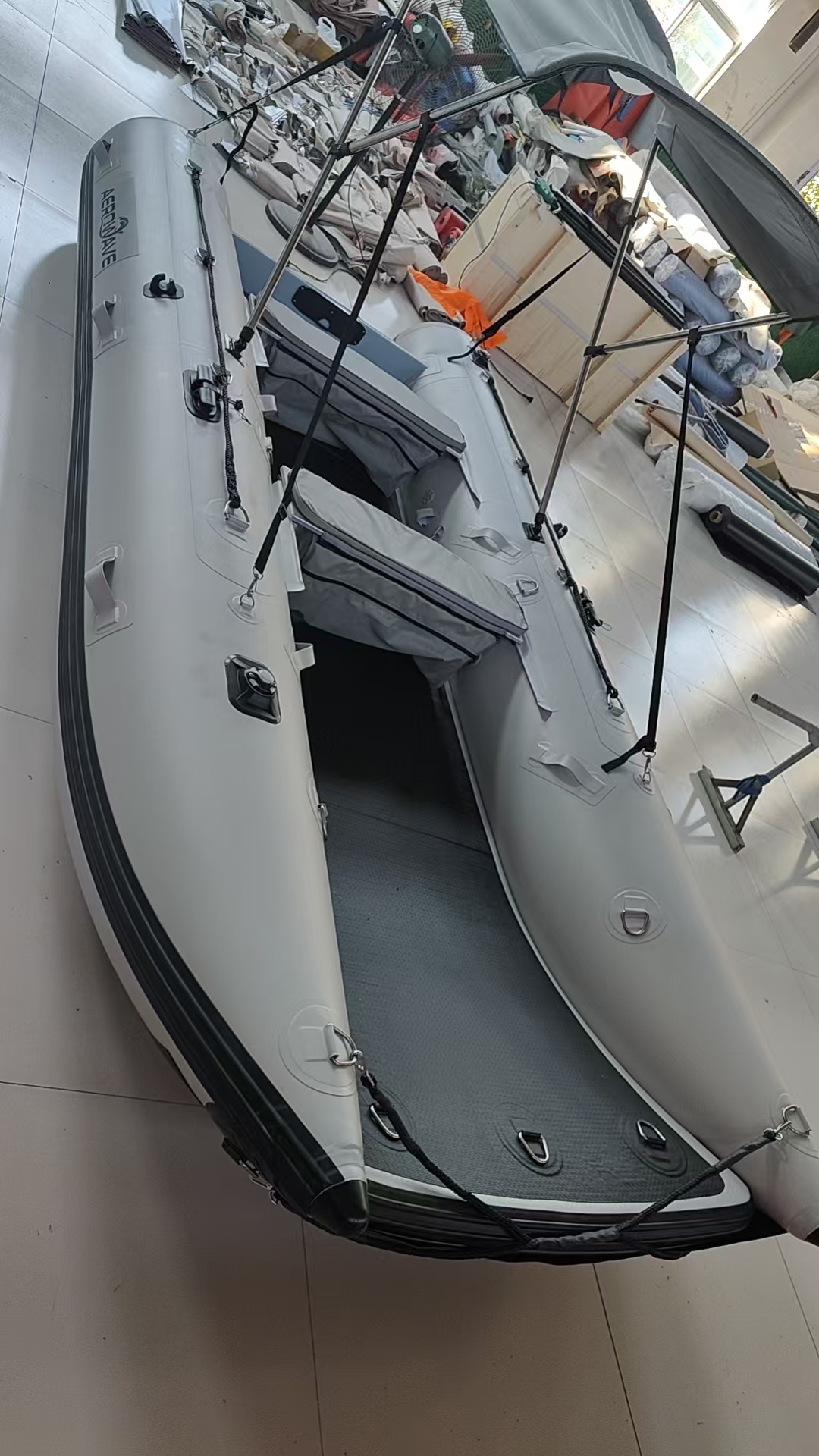
+-------------------------------------------------------------------------+ | INFLATABLE CATAMARAN vs TINNY | | | | [ INFLATABLE CATAMARAN ] [ PRESSED TINNY ] | | * Twin pontoons = wide footprint * Narrow V-hull = tippy | | * Dampens chop & hull slap * Loud metal vibration | | * Packs into car boot or roof racks * Requires registered | | * Roll-down wheels for beach launch trailer & driveway space| +-------------------------------------------------------------------------+
Why Choose an Inflatable Over a Tinny as a Small Fishing Boat in Australia?
Choosing an inflatable catamaran over a pressed tinny gives you cat-hull primary stability that prevents tipping, silent hull dampening that avoids spooking fish, and complete freedom from trailer registration, rust, and boat ramp queues. It transforms fishing from an orchestrated logistics operation into a spontaneous morning escape.
To understand why this design shift has gained such traction across Queensland estuaries, NSW coastal lakes, and Victorian bays, let us examine the mechanical and practical differences between both vessel types.
1. Zero Trailer Registration and No Council Ramp Queues
Trailer ownership in Australia is an expensive hidden headache. In New South Wales, Queensland, and Victoria, registering a light boat trailer adds annual registration fees, compulsory inspections on older frames, and unpredictable maintenance costs. Saltwater relentlessly attacks wheel bearings, leaf springs, LED wiring harnesses, and coupling hitches. If your trailer sits parked curbside, it becomes an easy target for council infringement notices or theft.
An inflatable catamaran changes this dynamic entirely:
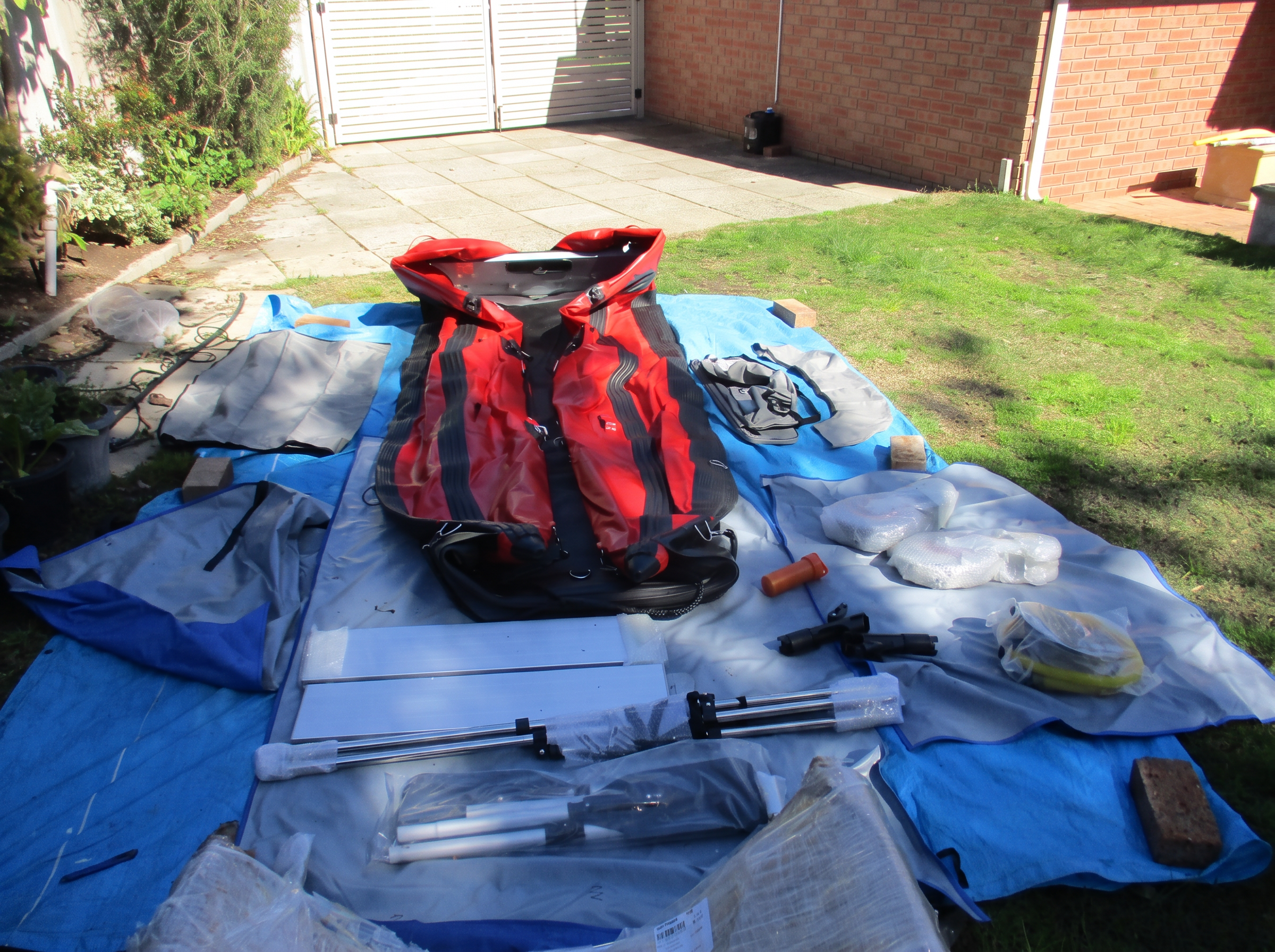
- Deflates into a compact package stored in the Aerowave Heavy-Duty Boat Bag (A$299) or Wheel Bag Set (A$389).
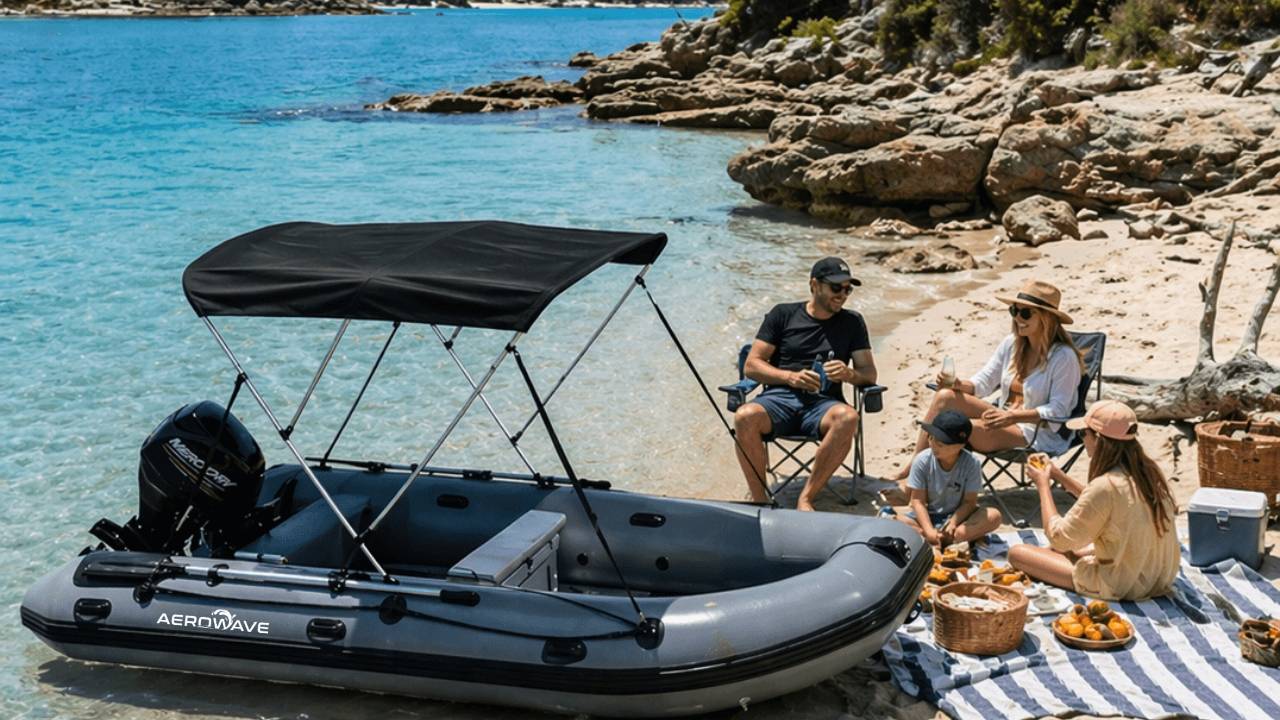
- Transports cleanly inside your vehicle's cargo bay, ute tray, or strapped directly to roof racks.
- Fits in an apartment storage cage, suburban garage corner, or garden shed without consuming vehicle space.
- Bypasses chaotic public boat ramps entirely on summer weekends.
With transom-mounted launch wheels, you can roll an assembled Aerowave Viper 330 (A$5,145) straight off a grassy foreshore, hard sand beach, or gravel riverbank directly into the tide—solo, unhurried, and without reversing a trailer down a moss-covered ramp.
2. Unmatched Casting Deck Stability: Twin Cat Sponsons vs Narrow Aluminium Vee
A traditional 3.2m to 3.7m pressed aluminium tinny relies on a narrow vee-hull or semi-flat bottom. When an 85 kg angler stands up to cast a lure, the boat immediately heels over several degrees. Stepping near the gunwale to lip-grip a jewfish or work an erratic surface lure demands constant balance correction, resulting in lower back fatigue after several hours.
Inflatable catamarans operate on twin buoyant sponsons separated by a raised centre tunnel. When you stand on the rigid drop-stitch floor (inflated to an unyielding 8–10 PSI), downward force is distributed across both sponsons simultaneously. The buoyant outboard tubes act as massive counterweights, creating an exceptionally stable casting platform in a sub-4-metre footprint.
You can stand directly against the tube edge, cast into heavy wind, or net fish without the craft pitching beneath your feet. For sight-casting over flats or poling through skinny backwaters, this level of stability is a game changer.
3. Acoustic Stealth: The Death of Hull Slap
Fish in heavily pressured Australian waterways—such as Hawkesbury mulloway, Gold Coast canal bream, or Port Phillip Bay whiting—are acutely sensitive to hull noise. Pressed aluminium acts like a metallic speaker cone. Every slap of wind chop against the chines, every dropped lead sinker, and every bump of an aluminium seat transmits acoustic shockwaves straight down through the water column.
Inflatable hulls naturally absorb vibration. Premium multi-layer PVC fabric, such as the German 1100 decitex / 0.9 mm VALMEX used on the AeroWave AeroCat series and the heavy-duty 1500 GSM / 1.2 mm VALMEX Heavy Plus on the Aerowave Viper range, acts as an acoustic damper. Water laps silently against air-filled tubes, and tackle boxes dropped onto the drop-stitch deck produce a muffled thud rather than a resonant metallic crack. You catch more fish because the fish do not know you are there.
Direct Head-to-Head: Inflatable Catamaran vs Aluminium Tinny
When evaluating a small fishing boat Australia wide, comparing running costs, performance metrics, and ownership burdens side-by-side clarifies why serious solo anglers are moving away from aluminium.
| Feature / Metric | Pressed Aluminium Tinny (3.5m) | Inflatable Catamaran (e.g. Aerowave Viper 330 / 365) | Solo Angler Advantage |
|---|---|---|---|
| Primary Keyword Hull Fit | Traditional small fishing boat Australia entry point | High-performance small fishing boat Australia alternative | Inflatable: zero ramp requirements |
| Bare Hull Weight | 65 kg – 85 kg | 42 kg – 54 kg | Inflatable: 30–40% lighter to handle |
| Transport Method | Dedicated road trailer or heavy roof-rack crane | Boot, ute tub, roof racks, or caravan drawbar | Inflatable: no trailer rego or maintenance |
| Storage Footprint | 5.0m x 1.8m driveway / yard footprint | 1.1m x 0.6m x 0.4m folded valise bag | Inflatable: fits in wardrobe or apartment cage |
| Stability at Rest | Poor to moderate (narrow beam, rolls on chine) | Exceptional (twin cat sponsons, wide footprint) | Inflatable: safe stand-up sight casting |
| Launch Versatility | Concrete or graded gravel ramps only | Sand flats, rocky shores, tidal mud, dirt banks | Inflatable: unlimited solo access |
| Acoustic Signature | Loud metallic slap; reverberates inside water | Deadened; flexible PVC absorbs chop sound | Inflatable: does not spook pressured fish |
| Maintenance Required | Trailer bearings, electrolysis, cracked welds | Fresh water rinse, valve checks, occasional UV wash | Inflatable: simple hose-down and pack away |
| Fabric / Hull Longevity | Indefinite hull life (corrosion/cracking risk) | 10–12 years lifespan (premium German VALMEX) | Tinny: longer life; Inflatable: lower total upkeep |
How Do Inflatables Handle Australian Coastal Conditions and Hidden Hazards?
Modern inflatable catamarans handle rough Australian coastal conditions far better than flat-bottomed tinnies because their twin tubes slice through chop and cushion wave impact, while puncture-resistant fabrics resist oyster leases, submerged timber, and gravel bars.
There remains an outdated misconception among old-school boaties that all inflatables are fragile pool toys waiting to be popped by the first stray hook. That reputation was earned by cheap single-layer vinyl imports, not purpose-built marine craft constructed with commercial-grade polymer textiles.
Puncture Resistance: VALMEX vs Mangrove Snags and Oyster Racks
When you buy an Aerowave inflatable, the engineering relies on German Mehler VALMEX fabrics:
- AeroCat Series (e.g. AeroCat 335 at A$3,895, AeroCat 380 at A$4,570): Built from 1100 decitex, 0.9 mm VALMEX PVC. This multi-layered composite contains an ultra-dense polyester base fabric coated on both sides with high-grade plastomers. It features extreme tear strength, abrasion resistance, and UV inhibitors specifically balanced for southern hemisphere sun exposure.
- Viper Series (e.g. Viper 330 at A$5,145, Viper 365 Open Bow at A$5,495, Viper 400 Sovereign at A$5,845): Upgrades to 1500 GSM, 1.2 mm VALMEX Heavy Plus fabric with additional full-length tube-underside rub strakes. This material is designed to handle dragging over coarse sand, crushed shell banks, and shallow bar crossings.
A deflected hook or fish dorsal spine cannot penetrate a properly pressurized 3.0 to 3.6 PSI tube made from 1100 decitex or 1500 GSM VALMEX. In the event of an extreme oyster lease collision, multi-chamber safety construction ensures peace of mind: our catamarans feature separate independent air chambers across the sponsons plus the isolated high-pressure drop-stitch deck. Even if one chamber loses pressure, the remaining chambers and deck keep you afloat and powered safely back to shore.
All Aerowave hulls are CE certified to ISO 6185-3 standards, and we back that build with real Australian warranties:
- Viper Range: 5 + 2-year warranty
- AeroCat, WaveRunner 380, and Sport Series: 5-year warranty
- Accessories: 1-year warranty
With a typical premium VALMEX fabric lifespan of 10–12 years under Australian conditions, you receive a decade of dependable, rot-free, electrolysis-free fishing without the structural weld fatigue that plagues aluminium hulls in choppy bays.
+-------------------------------------------------------------------------+ | VALMEX HEAVY PLUS LAYER PROFILE | | | | [ Top UV Protective Coating ] | | [ High-Grade Polymer PVC Outer Skin ] | | [ 1500 GSM / 1100 Decitex Dense Polyester Mesh Core (Anti-Tear) ] | | [ High-Grade Polymer PVC Inner Skin ] | | [ Air Retention Seal Layer ] | | + Thick External Underside Rubbing Strakes for Beach Landing | +-------------------------------------------------------------------------+
Shallow Draft and Mangrove Navigation
Solo anglers targeting mangrove jack in North Queensland or bream in the Gippsland Lakes need to reach skinny water that tinny skippers cannot touch. A loaded aluminium tinny has an underwater profile with a skeg and keel that easily catches sandbars.
An inflatable catamaran draws mere inches of water. Because the air tubes distribute weight across two broad pontoons, an AeroWave AeroCat 335 carrying an angler and gear draws less than 15 cm of water with the outboard tilted. You can glide across shallow mud flats, slip through mangrove tunnels, and drift over weed beds where big flathead lie camouflaged.
Outboard Pairing for a Solo Inflatable Fishing Setup
A solo inflatable fishing boat performs best when paired with a reliable, lightweight 4-stroke short shaft outboard that matches its 380 mm transom height and keeps total transom weight within safe solo-handling limits.
To keep your setup manageable when packing down into a vehicle without a trailer, engine weight is paramount. For solo anglers, modern short-shaft 4-stroke outboards—such as Hidea outboards—deliver exceptional fuel economy, whisper-quiet trolling, and smooth low-rpm trolling performance.
Here is how common package options align for solo fishing duties:
- Hidea 9.9HP 4-Stroke Short Shaft: When paired with the Aerowave Viper 330 in our turnkey package (A$8,245), this configuration hits the sweet spot for solo anglers. At approximately 38–40 kg, the outboard can be lifted onto the 380 mm transom by one person using proper lifting technique. On the water, 9.9 horsepower effortlessly pushes a single angler, safety gear, and tackle onto the plane at 18–22 knots while sipping under 2 litres of fuel per hour.
- Hidea 15HP 4-Stroke: Featured on the Aerowave WaveRunner 380 Series 3 package (A$8,189). Provides outstanding torque for carrying extra gear, tackling tidal river mouths, or making 10-nautical-mile runs across open bays.
- Hidea 20HP 4-Stroke Short Shaft: Available in the Aerowave Viper 400 Open Bow package (A$9,385) or the top-tier Aerowave Viper 400 Sovereign package (A$10,665). This is the powerhouse option for anglers who want blistering top speeds, plan to occasionally fish two-up, or tackle larger offshore swell zones while retaining car-toppable deflation capabilities.
Every Aerowave catamaran features a precision-engineered 380 mm marine-grade transom designed specifically for standard short-shaft engines, guaranteeing correct prop immersion without excessive cavitation or performance-robbing drag.
Solo Launching and Beach Retrieval: The Step-by-Step Reality
Launching a small fishing boat in Australia by yourself should not raise your blood pressure. The entire point of choosing an inflatable catamaran is liberating yourself from slippery concrete ramps, broken winches, and impatient queues at sunrise.
Here is how a solo launch actually looks when operating without a trailer:
- Arrival at the Waterside: Pull up to a park, beach foreshore, or grassy riverbank. Open the boot and remove the hull bag, high-pressure 12V electric pump, and tackle.
- Rapid Inflation (8–10 Minutes): Connect a two-stage digital electric pump to your vehicle’s 12V battery. Inflate the main sponsons to 3.0–3.6 PSI, then inflate the high-pressure drop-stitch air deck to its rigid operating pressure of 8–10 PSI.
- Deploy Launching Wheels: Swing down your transom-mounted pneumatic launching wheels and lock the quick-release pins in place.
- Mount the Motor and Gear: Clamp your short shaft outboard to the 380 mm transom. Load your fuel caddy, tackle kit, and rods inside the boat while it sits comfortably on dry land.
- The Solo Roll: Grab the bow handle. Thanks to balanced weight distribution over the rear launch wheels, moving the boat feels like pushing a wheelbarrow. Roll the boat down the sand or grass straight into ankle-deep water.
- Drive Away: Step aboard, tilt the launch wheels up into their locked travel position, pull the engine cord, and head to your fishing spot.
SOLO BEACH LAUNCH CHECKLIST [ ] 12V two-stage digital electric pump + manual double-action backup pump [ ] Pressure gauge verification (deck: 8-10 PSI, sponsons: 3.0-3.6 PSI) [ ] Transom launch wheels pinned down in beach roll position [ ] Outboard securely clamped and safety tether attached to transom eyelet [ ] Kill switch lanyard clipped to your lifejacket / PFD before starting [ ] Marine safety kit aboard (EPIRB/PLB, flares, torch, bailer, VHF/mobile in dry pouch) [ ] Transom bung checked and seated tightly [ ] Launch wheels locked UP once buoyant before lowering the outboard leg
Real Storage Solutions for Urban and Suburban Anglers
Storage limitations are the number one reason Australian anglers sell their traditional tinnies. A 3.5m aluminium boat on a trailer requires at least 5.2 metres of dedicated driveway, side access, or lawn space. For suburban homeowners with restrictive body corporates, or apartment dwellers in Sydney, Brisbane, or Melbourne, keeping a boat trailer at home is simply impossible.
An inflatable fishing boat solves the spatial crisis entirely:
- Apartment Balconies & Storage Cages: The deflated boat packs into an Australian-made heavy-duty PVC transport bag measuring approximately 110 x 60 x 40 cm. It easily slides onto standard storage cage shelving or fits neatly in a corner of your underground parking space.
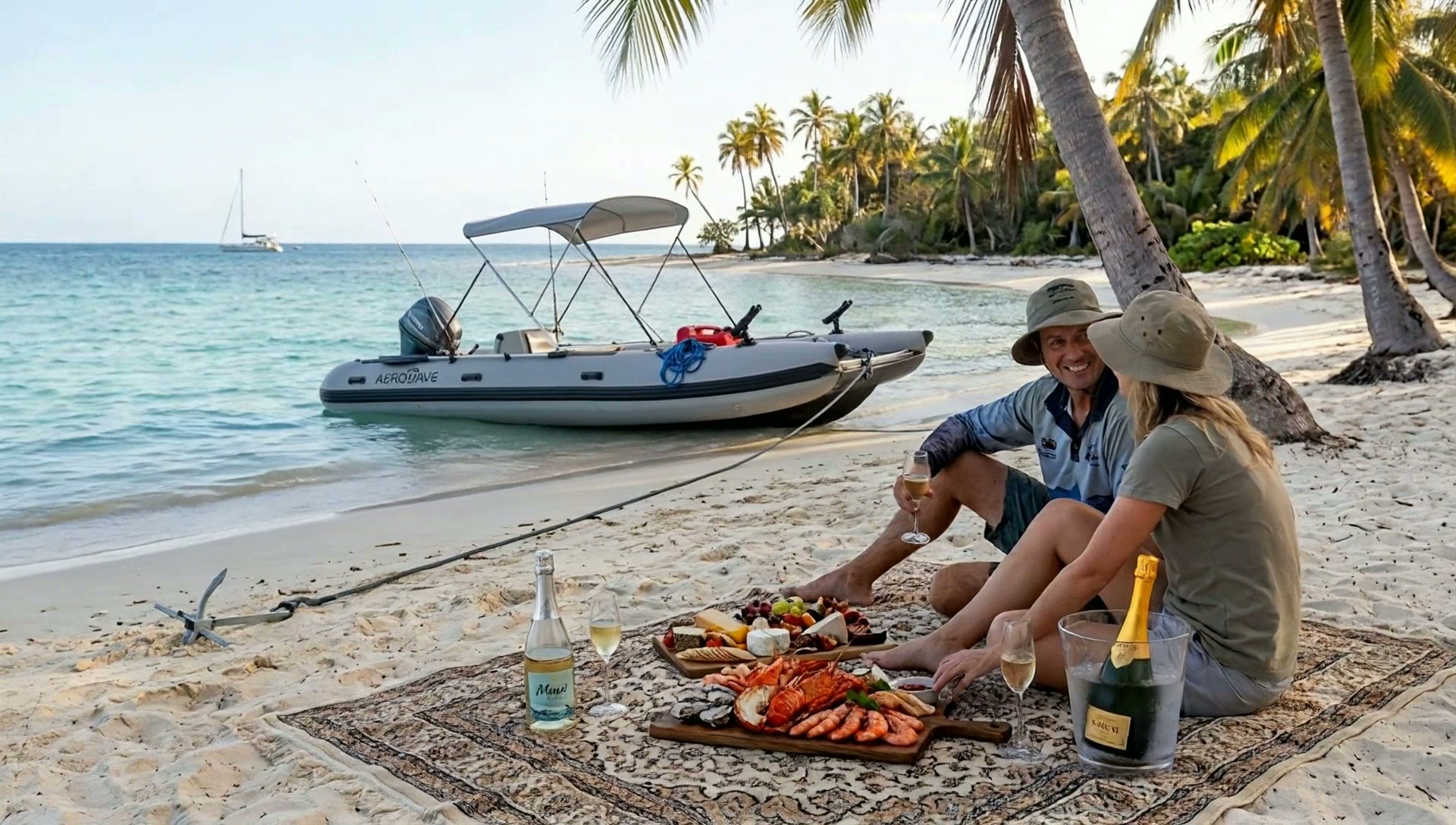
- Caravan and 4WD Travel: Touring anglers exploring the Kimberley, Cape York, or the Eyre Peninsula cannot tow both a caravan and an aluminium boat trailer. An Aerowave catamaran folds flat onto your caravan's drawbar box, roof platform, or inside the back of the 4WD. When you hit an isolated coastal campsite, you have a capable offshore-rated boat ready to fish in ten minutes.
- Protection from Weather & Theft: Storing your boat folded indoors or tucked inside your locked garage protects it from sun damage, suburban vandalism, and trailer theft.
If you prefer to keep your craft fully assembled on a lightweight utility trailer or garage rack, you can add handmade, custom-fitted Aerowave Tube Chaps (A$1,000) to protect the tubes from intense UV degradation, flying highway debris, and general wear.
Customising Your Inflatable Fishing Rig for Serious Solo Angling
Turning an inflatable catamaran into a dedicated fishing weapon requires smart modular rigging that maximizes deck space without adding excess weight.
Bow and Gear Storage
Because catamarans feature an open deck layout, keeping the high-pressure drop-stitch floor clear ensures safe footing when fighting fish. Adding an Aerowave Viper Sovereign Bow Bag (A$250) creates a weatherproof forward compartment for your anchor rope, chain, drift chute, and safety flares.
Rod Holders and Marine Electronics
Modern surface-mount accessory pads can be permanently bonded to the VALMEX tubes using specialized two-part adhesive. This allows you to mount:
- Adjustable rod holders for trolling or bait fishing.
- Compact fish finders with battery-integrated displays (such as 5-inch or 7-inch sounder units).
- Transducer arms mounted cleanly to the marine plywood transom, providing crystal-clear down-scan readings at planing speeds.
Tackle Management
Instead of heavy plastic tackle boxes sliding around the cockpit, seasoned inflatable anglers use soft-sided tackle bags secured with carabiners to the integrated D-rings. This keeps lures organized, eliminates trip hazards, and preserves the open, clutter-free casting deck.
What Does It Cost to Own a Small Fishing Boat in Australia?
Before purchasing any craft, realistic cost-of-ownership projections are critical. Here is an honest breakdown of the five-year running costs comparing an aluminium tinny on a trailer against an inflatable catamaran.
-
Aluminium Tinny on Trailer (5-Year Running Costs):
- Initial purchase (boat, motor, trailer): A$8,000 – A$11,000
- Annual trailer registration (varies by state): A$500 – A$1,200
- Trailer maintenance (bearings, leaf springs, lights, tyres, rust treatments): A$750 – A$1,500
- Council ramp permits / launch fees: A$200 – A$600
- Estimated 5-Year Ownership Overhead: A$1,450 – A$3,300 on trailer upkeep alone
-
Inflatable Catamaran Package (5-Year Running Costs):
- Initial purchase (e.g. AeroWave AeroCat 335 at A$3,895 + outboard, or turnkey Aerowave Viper 330 package at A$8,245)
- Annual trailer registration: A$0 (car-topped or boot-packed)
- Trailer maintenance: A$0
- Ramp parking fees: A$0 (launch from unmetered beaches and banks)
- Preventative maintenance (valve grease, UV protectant): A$100 – A$150
- Estimated 5-Year Ownership Overhead: A$100 – A$200
Over five seasons of ownership, the inflatable catamaran saves an angler thousands of dollars in registration fees and maintenance headaches—capital that is better spent on quality fishing tackle, fuel, and weekend adventures.
The Bottom Line
The traditional tinny will always hold a place in Australian boating lore, but for modern solo anglers who value their time, independence, and garage space, it is an outdated solution. A premium inflatable catamaran built with commercial German VALMEX fabric offers better casting stability, runs far quieter over pressured fish, draws less water in skinny tidal shallows, and packs away into your vehicle without the expense, maintenance, or storage nightmare of a road trailer.
Every Aerowave boat is custom-built to strict standards. Craft take up to three and a half weeks to build (up to four weeks for Hypalon models), followed by 10 to 13 days transit. Delivery is fully included for Australian customers, with builds secured by a 50% deposit and the balance due only once your boat passes quality control.
If you are ready to rethink how and where you fish, explore the Aerowave catamaran lineup or speak directly with our team on +61 2 4335 1603 (sales@easyinflatables.com.au) to configure your ideal solo fishing craft.
Related
Weekend-Proof Score 17 questions · about 2 minutes
Will the boat you're about to buy survive an Australian summer?
Seventeen straight questions about where you'll use it, what you'll ask of it and the boat you're weighing up. You get a score out of 100, the exact weak points in your plan, and the one boat that genuinely fits.
Free · your result shows on screen · no email required
So which one is yours?
Pick how you'll actually use it and we'll take you straight to the right hull.
I want to fish it
Open bow, rod holders, deck space you can stand and cast from.
Viper Sport 400Family, diving and the beach
3.8 m Series 3 catamaran — low bow to climb back in wearing fins or a tank.
WaveRunner 380Tender / one-person launch
3.3 m hard-floor boat that packs into a bag and still takes a beach landing.
Viper 330Shop gear featured in this guide
Aerowave WaveRunner 380 Series 3 Catamaran Package
The WaveRunner 380 Series 3 is a premium 3.8m inflatable catamaran package built for Australian and worldwide families, fishing, and coastal day boating — ideal for snorkeling and spearfishing — offering serious stability and premium German Valmex® construction.
Free freight to United States · taxes included, nothing to pay on arrival
Aerowave Viper 400 Sovereign
Flagship 4m enclosed-bow inflatable catamaran. German VALMEX® 7321 Heavy Plus 1.2mm commercial-grade fabric, 10 PSI high-pressure drop-stitch air deck floor with VALMEX non-slip surface, LockPro wheels, full Bimini and FREE express delivery Australia-wide included.
Free freight to United States · taxes included, nothing to pay on arrival
Aerowave Viper 365 Open Bow
Premium 3.65m Inflatable catamaran — built the same way as our flagship Viper 400 sports boat, just 35cm shorter. German VALMEX® 7321 Heavy Plus 1.2mm commercial-grade fabric, 10 PSI high-pressure drop-stitch air deck floor with VALMEX non-slip surface, LockPro wheels, full Bimini and FREE express delivery Australia-wide included.
Free freight to United States · taxes included, nothing to pay on arrival
Not sure which suits you? Talk to a real boat owner.
Before you spend a cent
Buying from Australia, delivered to United States
You have never heard of us, we are on the other side of the world, and the internet is full of fakes. Fair enough. Here is everything you would need to check us out, in one place — no forms, no chat bot.
Australian designed business
Easy Inflatables, Avoca Beach NSW 2251. ABN 96 856 548 613. International orders ship from our Hong Kong hub.
Rated 5.0 on Google
Every review is on our Google Business Profile, with the reviewer's name and the date.
CE certified, 5 + 2 year hull warranty
ISO 6185-3 and EU Directive 2013/53/EU. Warranty honoured worldwide.
Tracked, insured, door to door
Freight, duty & taxes included · nothing to pay on arrival.
- Who am I actually buying from?
- Easy Inflatables, Avoca Beach NSW 2251, Australia. ABN 96 856 548 613. Sean is the owner and skipper, Gary Stewart handles sales on +61 2 4335 1603, Karen Matthews handles email. The boats are Australian designed; international orders ship from our Hong Kong dispatch hub so your landed price stays competitive. Phone us before you pay a cent — a real person answers.
- Is this really an Australian product?
- Yes — Australian designed and engineered on the NSW Central Coast. Manufacturing is done offshore to our spec, and international orders ship direct from our Hong Kong dispatch hub. If we routed every boat through Australia first, the freight alone would roughly double or triple your cost for the same hull.
- What do I pay, and what is not included?
- The delivery and import terms depend on your country. US and UK boat orders include free express freight and prepaid import charges — nothing to pay on arrival. New Zealand and named Asia/Pacific lanes include duty and tax. EU buyers pay import charges on arrival. Other destinations show their terms before payment.
- How do I pay safely?
- Card through Stripe (Visa, Mastercard, Amex, Apple Pay, Google Pay) or bank transfer. Card payments carry your bank's own dispute protection. We never ask for crypto, gift cards or payment to a personal account.
- What if it arrives damaged?
- Every boat ships fully tracked and insured door to door. Photograph the carton and the boat on arrival and email us — transit damage is claimed and replaced through us, not left with you and the courier.
- Is the warranty real outside Australia?
- Yes. The 5 + 2 year hull warranty on 1.2 mm VALMEX Heavy Plus and Orca Hypalon hulls applies wherever you are. Replacement parts are held in Australia and at our overseas hub and go out by express courier to your door.
- Is the boat actually certified?
- All Aerowave catamarans are CE certified to ISO 6185-3 and EU Directive 2013/53/EU. Certification paperwork is supplied with the boat — ask and we will send it before you order.
Frequently asked questions
- What is the best small fishing boat in Australia for one person?
- For a solo angler, an inflatable catamaran between 3.3 and 3.8 metres—such as the AeroWave AeroCat 335 or Aerowave Viper 330—is widely considered the best choice. These craft offer exceptional casting stability thanks to their twin sponsons, weigh under 55 kg for easy handling, and pack down into a car boot or roof racks without requiring a boat trailer.
- Can fish hooks or oyster leases puncture a modern inflatable fishing boat?
- Quality inflatables built from heavy-duty fabrics like German 1100 decitex or 1500 GSM VALMEX are highly resistant to dropped hooks, fish spines, and accidental scrapes. The material features an ultra-dense polyester core coated in multiple polymer layers, making standard fishing mishaps virtually impossible to penetrate under normal operating pressure.
- Do you need a boat licence to operate a small fishing boat in Australia?
- Licensing regulations vary by state. In Queensland and Victoria, a marine licence is mandatory for any boat powered by an engine over 4.5 kW (approximately 6 HP) or capable of speeds over 10 knots. In New South Wales, you need a licence if you operate at 10 knots or more. Always check your state maritime authority before heading out.
- How long does a VALMEX inflatable boat last in the Australian sun?
- A boat constructed from genuine German Mehler VALMEX fabric has an expected operational lifespan of 10 to 12 years in Australian conditions. Rinsing the boat with fresh water after saltwater use, applying a UV protectant spray twice a year, or fitting protective tube chaps when stored outdoors ensures maximum fabric longevity.
- How do you launch an inflatable fishing boat without a boat ramp?
- You equip the craft with fold-down transom launching wheels. Once the boat is inflated near your vehicle, you load your tackle and outboard, swing the wheels down into their locked position, and roll the entire rig into the water like a wheelbarrow over sand, turf, or gravel. Once floating, you pin the wheels up and motor away.
- What size outboard motor do I need for a small solo inflatable fishing boat?
- A 9.9HP short shaft 4-stroke outboard is the ideal balance of power and portable weight for a solo angler on a 3.3m to 3.6m inflatable catamaran. It planes easily at speeds between 18 and 22 knots while weighing around 38–40 kg, which is manageable to lift onto the 380 mm transom single-handedly.
- Can you stand up and cast comfortably on an inflatable fishing boat?
- Yes. Unlike monohull tinnies that rock from chine to chine, inflatable catamarans feature twin sponsons that supply immense lateral stability. Coupled with a high-pressure drop-stitch air floor inflated to 8–10 PSI, the deck feels as firm as a timber platform, allowing you to walk gunwale-to-gunwale and sight-cast with total confidence.
Ready to set sail?
Premium German-fabric inflatable catamarans, built to order and delivered to your door. Talk to our team or browse the fleet.
Like this guide? Get the next one in your inbox.
Owner-tested tips, gear deep-dives and Aussie boating know-how — no spam.