Soft Inflatable Boats (SIBs) in Australia: The Complete Buyer's Guide
Everything you need to know about buying a soft inflatable boat in Australia—from air decks and hull designs to outboards, pack-down sizes, and fabric durability.
At a glance
Everything you need to know about buying a soft inflatable boat in Australia—from air decks and hull designs to outboards, pack-down sizes, and fabric durability.
- What Is a Soft Inflatable Boat Australia Boaters Are Turning To?
- Soft Inflatable Boat Australia: Air Deck vs Slatted Floor vs Interlocking Panels
- 1. High-Pressure Drop-Stitch Air Decks (The Gold Standard)
- 2. Slatted Roll-Up Floors
What we'd put you in

Aerowave Viper 400 Sovereign
Our best-selling boat: 4.0 m, 1.2 mm VALMEX hull, 5 + 2 year hull warranty.
US$4,449 USD
Delivered to your door, today's rate
- Free freight to United States · taxes included, nothing to pay on arrival
- 5 + 2 year hull warranty
🇺🇸 Shipping to United States · duty & taxes prepaid
Yes — we ship the Aerowave Viper 400 Sovereign to United States. Here's the landed price.
Our best-selling boat: 4.0 m, 1.2 mm VALMEX hull, 5 + 2 year hull warranty.
Written for Australian readers — but the boat ships to you. We are an Australian builder and this article is written from Australian waters. That changes nothing about what you can order: the same hull, the same 5 + 2 year warranty and the same certification go out to United States every week.
Aerowave Viper 400 Sovereign
- Boat package (export price)
- US$4,122
- 15% tariff relief credit
- − US$618
- Express air freight to United States
- Included
- Import duty, taxes & customs clearance
- US$946 — prepaid by us
- Estimated landed, USD
- US$4,449
Indicative, converted at today's rate. Ask below and we'll put a fixed figure in writing, valid 30 days.
- 5 + 2 year hull warranty
- 1500 GSM / 1.2 mm VALMEX® Heavy Plus hull
- CE certified to ISO 6185-3 and EU Directive 2013/53/EU
- Delivered duty paid — nothing to pay on arrival
Your price, delivered to your door — freight included.
We email the full PDF quote (spec, freight, finance, WavePay) to your inbox in under 60 seconds. No spam — one quote, one follow-up.
See it for yourself
Real boats. Real owners. Real people behind them.
Plenty of what you read online these days is generated. Check us out properly — the factory, the reviews and the owners are all one click away. Why we use AI, and how to check we’re real
How our boats are built
Walk the production line: thermo-welded seams, 1.2 mm VALMEX Heavy Plus hulls, over-pressure relief valves on every chamber.
See the buildGoogle Maps reviews
Real Australian owners, five stars, published on our Google Business Profile with the map — read them there, not just on our own site.
Open Google Maps reviewsOwner stories
Boats in use — offshore, on rivers, on rescue duty. Photos and words from the people who actually own them.
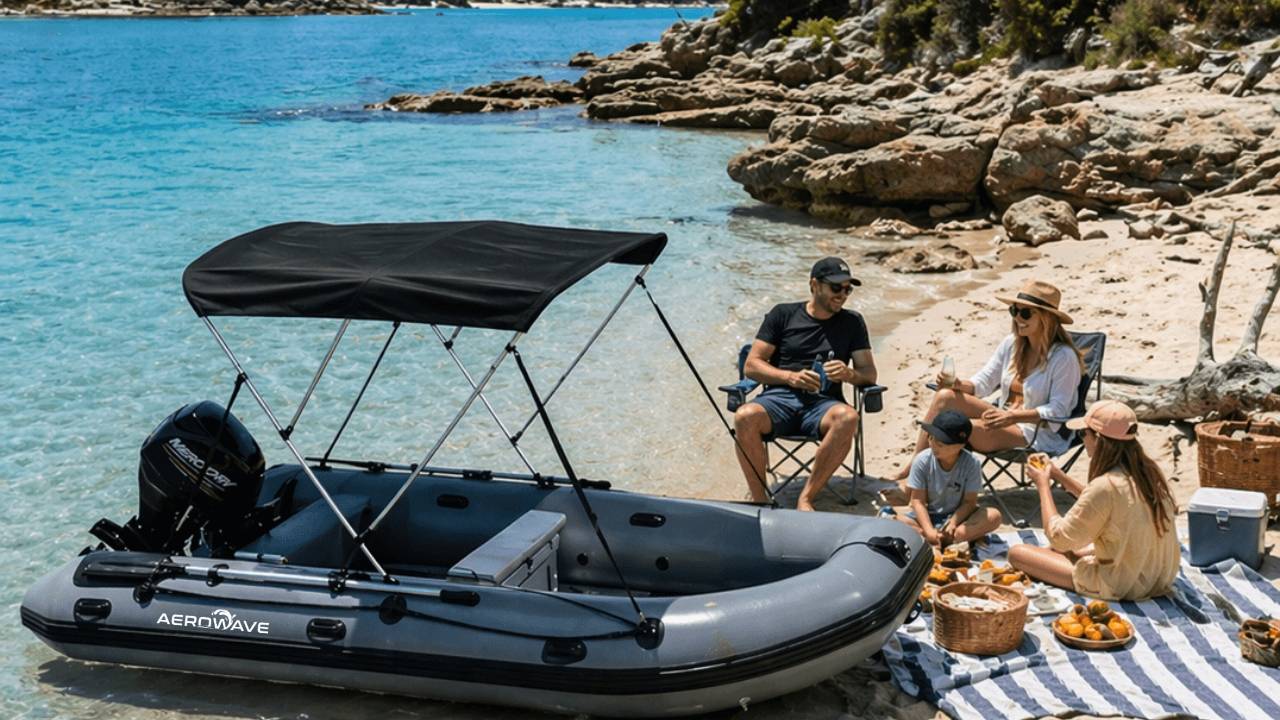
Read owner storiesA soft inflatable boat is the ultimate antidote to the logistical headaches of Australian trailered boating—giving you genuine open-water capability straight from the boot of an SUV without boat ramp queues, storage fees, or driveway clutter.
For decades, the standard path into Australian boating has been predictable: buy an aluminium tinny or a fibreglass runabout, hitch it to a tow bar, pay annual trailer registration, and spend your Saturday mornings reversing down crowded municipal boat ramps. While rigid vessels have their place, an increasing number of Australian boaters, coastal campers, four-wheel-drive tourers, and yacht owners are opting for an entirely different route: the soft inflatable boat (SIB).
Unlike rigid inflatable boats (RIBs)—which feature a permanent, rigid hull bonded to inflatable tubes—a true soft inflatable boat has no permanent rigid shell. The entire craft deflates, rolls up, and stows inside a heavy-duty carry bag. When engineered correctly with modern high-pressure drop-stitch decks and commercial-grade fabrics, a modern SIB delivers performance, stability, and load carrying that rivals, and often surpasses, traditional tinnies.
Yet the Australian market is flooded with conflicting terminology, wildly divergent price points, and cheap imports that quickly degrade under our intense UV index. This guide cuts through the marketing jargon to give you the objective engineering facts, practical dimensions, and hydrodynamics you need before investing in a soft inflatable boat in Australia.
What Is a Soft Inflatable Boat Australia Boaters Are Turning To?
A soft inflatable boat (SIB) is a fully collapsible marine craft consisting of inflatable buoyancy tubes, a flexible or inflatable floor system, and a structural transom designed to mount an outboard motor. When fully deflated, a SIB can be folded down into a footprint roughly the size of a large suitcase, requiring neither a trailer nor a dedicated boat bay.
The critical distinction between a SIB and a rigid-hull alternative lies in portability. A standard 3.5-metre aluminium tinny or a rigid fibreglass tender demands a road-registered trailer, grease for wheel bearings, garage floor space, and access to a ramp. In contrast, a soft inflatable boat can ride in the cargo area of a 4WD wagon, pack into a caravan tunnel boot, or sit neatly inside a coastal apartment cupboard.
Historically, soft inflatables suffered from a reputation of being spongy, sluggish, and prone to flexing in rough water. In the 1980s and 1990s, early SIB designs relied on loose slatted timber floors or low-pressure canvas air floors that bowed severely over waves. Modern engineering has eliminated these issues. With the introduction of high-pressure drop-stitch air decks running up to 8–10 PSI and advanced multi-chamber hull profiles, contemporary SIBs plane cleanly, corner predictably, and handle coastal conditions with remarkable composure.
Soft Inflatable Boat Australia: Air Deck vs Slatted Floor vs Interlocking Panels
The floor configuration dictates how a SIB behaves on the water, how quickly you can set it up, and how heavy it feels when you lift it from your vehicle. When shopping for a soft inflatable boat in Australia, you will encounter three core floor constructions.
1. High-Pressure Drop-Stitch Air Decks (The Gold Standard)
High-pressure air floors are built using drop-stitch technology—the same construction found in performance stand-up paddleboards. Tens of thousands of polyester threads link the upper and lower fabric skins. When inflated to between 8 and 10 PSI, the deck becomes rock hard underfoot, eliminating flex while remaining exceptionally light.
An air deck can remain installed inside the boat during pack-down. You simply deflate the chambers, open the valves, and roll the entire hull and deck together in one seamless operation. Because it displaces water and contains pure air, an air deck adds significant secondary buoyancy to the boat. Standing to cast, retrieving crab pots, or boarding from a dive platform feels entirely stable and solid.
2. Slatted Roll-Up Floors
Slatted floors utilise marine-ply or plastic slats spaced apart and sealed into sleeves on the boat's fabric bottom.
- Pros: They are inexpensive and allow the boat to be rolled up without removing the floor.
- Cons: They offer minimal structural rigidity. Because there is open fabric between the slats, the floor flexes significantly under power. Planing speeds are severely limited, and standing up while balanced in coastal swell can feel uncertain.
Slatted models suit short-range flat-water tenders transferring passengers across sheltered anchorages, but they are inadequate for fishing estuaries, running bar crossings, or open-bay cruising.
3. Aluminium or Marine Ply Interlocking Panel Floors
Interlocking sectional floors use extruded aluminium channels or varnished plywood boards that lock together with side stringers before the main tubes are fully inflated.
- Pros: They provide a completely flat, rigid surface that mimics a traditional boat floor.
- Cons: They largely defeat the primary appeal of a soft inflatable boat. Assembling aluminium stringers requires physical wrestling, kneeling on cold boat fabric, and aligning tight tolerance grooves. Disassembly is equally tedious, and the heavy metal panels add 15 to 25 kilograms of deadweight to your stowage bags.
Floor System Comparison
| Floor Type | Operating Pressure | Rigidity Score (1–10) | Pack-Down Time | Typical Weight | Best Suited For |
|---|---|---|---|---|---|
| High-Pressure Air Deck | 8–10 PSI | 9 / 10 | 5–8 minutes | 5–9 kg | All-round touring, estuary fishing, offshore tender |
| Slatted Timber/PVC | None (ambient) | 3 / 10 | 5 minutes | 4–7 kg | Calm harbour rowing, basic ship-to-shore transfers |
| Interlocking Aluminium | None (rigid plate) | 10 / 10 | 15–25 minutes | 18–30 kg | Heavy cargo transport, commercial dive platforms |
For 95% of Australian recreational owners, high-pressure drop-stitch air decks offer the ideal balance: genuine rigidity underfoot, fast single-person inflation, and minimum aggregate pack weight.
Monohull vs Tunnel-Hull Catamaran SIBs on Australian Waters
Not all soft inflatables share the same hull geometry. When evaluating your options, the choice between a classic monohull V-shape and a modern tunnel-hull catamaran profile is the single most critical performance decision you will make.
Monohull SIB (Standard V-Keel) Catamaran SIB (Dual Sponsons) [Tube] [Tube] [Tube] [Tube] \ / | | | | _ V / ||====== Deck ======|_| (Ploughs through chop) (Packs air, lifts hull, planes instantly)
Classic Monohull SIBs
Traditional soft inflatables feature a single inflatable keel tube running down the centreline beneath the floor. This creates a modest V-shape. While monohulls track well in displacement mode, their deep central displacement requires more horsepower to break surface tension and climb onto the plane. In short, choppy bay waters—common in places like Port Phillip Bay, Moreton Bay, or coastal estuaries—a monohull SIB tends to slap, hobby-horse, and push water forward rather than gliding across it.
Inflatable Catamarans (Tunnel-Hull Design)
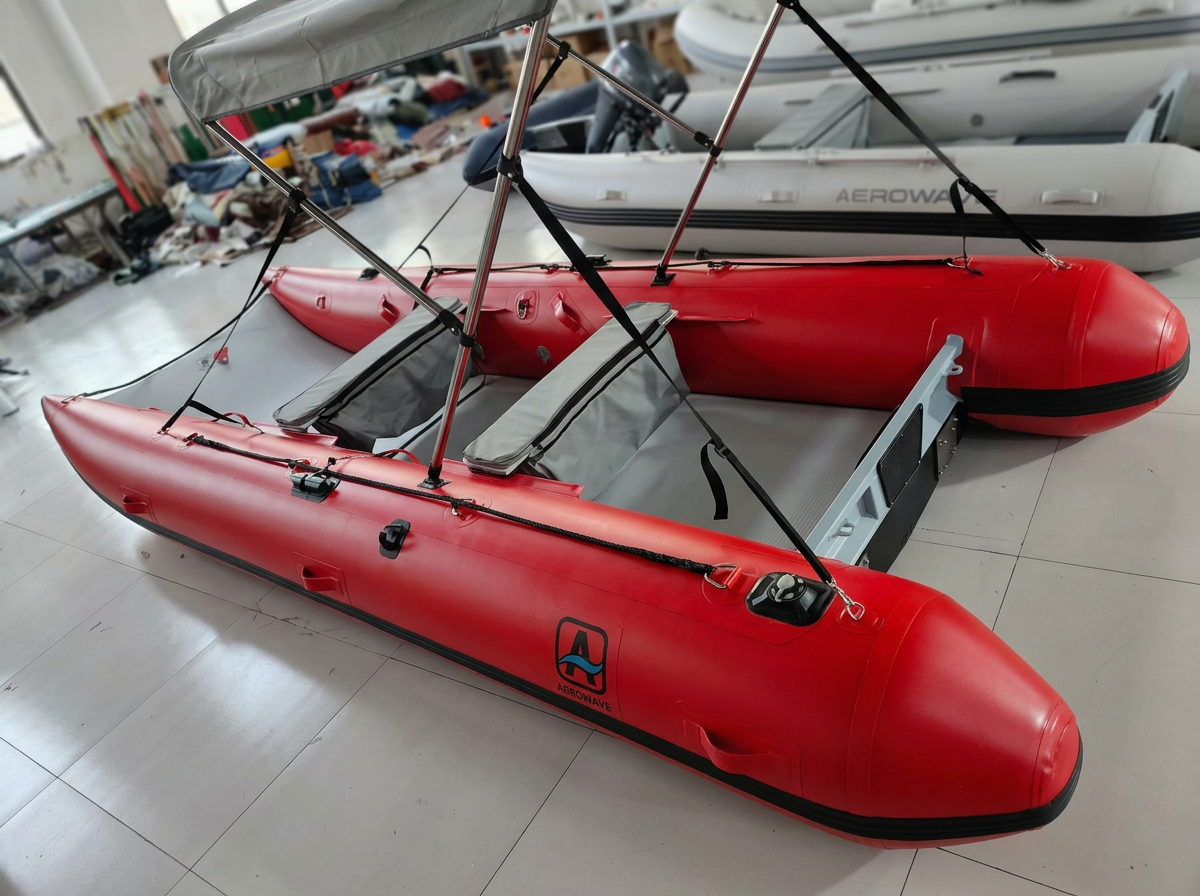
Inflatable catamarans—exemplified by modern designs such as the AeroWave AeroCat and Aerowave Viper platforms—utilise two parallel sponsons (tubes) running the length of the craft, lifting an elevated air-deck floor completely clear of the waterline.
This hull form delivers substantial performance advantages:
- Hydrodynamic Efficiency: Water passes freely between the twin hulls rather than building up resistance against a single bow. With minimal drag, an inflatable catamaran planes effortlessly with lower horsepower motors.
- Air Cushion Suspension: At planing speeds, air channels under the open bow into the tunnel, creating aerodynamic lift. This acts as a shock absorber over short chop, delivering a dry, comfortable ride that traditional monohull inflatables cannot match.
- Transverse Stability: The twin-tube stance places the buoyancy at the extreme outer edges of the beam. You can sit, stand, or retrieve crab pots directly on the tube collar without the boat rolling heavily to one side.
- Shallow Draft: With twin tubes distributing the displacement, these craft draw as little as 120–150 mm of water, making them exceptional for navigating shallow sandbars, mangrove creeks, and tidal flats.
Pack-Down Dimensions, Transportability, and Weight
The fundamental metric of any soft inflatable boat in Australia is how effortlessly it transitions from your vehicle to the water. A boat that is too cumbersome to assemble ends up sitting unused in the shed.
+-------------------------------------------------------------+ | TYPICAL PACKED PROFILE (AeroCat 380 / Viper 365) | | Dimensions: ~115 cm (L) x 65 cm (W) x 40 cm (H) | | Weight: ~38 kg (Hull & Deck) | | Fits neatly into: 4WD boots, station wagons, caravan lockers| +-------------------------------------------------------------+
Understanding Hull Weight vs Total Rig Weight
When researching weight specs, distinguish between the bare hull weight, the rigged boat, and the propulsion system:
- Ultralight tenders (2.3 m to 2.7 m): Typically weigh between 19 kg and 28 kg for the hull. These are easily lifted by one person and stowed in a car boot.
- Mid-size catamarans (3.3 m to 3.8 m): Weigh between 35 kg and 46 kg. Manageable by an individual using proper lifting technique, but effortless as a two-person lift.
- Heavy-duty commercial-spec SIBs (4.0 m to 4.5 m): Weigh between 48 kg and 62 kg due to thicker fabric laminates, reinforcing strakes, and broader transoms.
Vehicle Integration Options
- In the Boot: A folded 3.3 m to 3.8 m SIB fits cleanly across the rear cargo floor of a mid-size SUV (e.g., Subaru Outback, Toyota Prado) with room to spare for safety gear, fuel, and a portable outboard.
- Caravan Travel: SIBs fit directly into front caravan toolboxes, tunnel boots, or secured under island beds. This eliminates the need for expensive rear caravan boat-loaders or roof-top tinny tinnies that raise your vehicle's centre of gravity and increase fuel burn.
- Roof Basket Transport: If you plan to leave your SIB inflated between nearby camp spots, its lightweight structure can be secured upright to roof racks or roof platforms using wide cam-buckle tie-down straps (avoid ratchet straps that can crush tube chambers).
Outboard Sizing and Propulsion for a Soft Inflatable Boat Australia
Matching the correct outboard motor to your soft inflatable boat is critical for balance, safety, and fuel economy. A common pitfall among Australian boaters is over-powering an inflatable, assuming it requires the same displacement as a heavy pressed-aluminium hull.
Transom Height: Short Shaft (15 Inch / 380 mm)
Almost every recreational soft inflatable boat engineered for Australian coastal use incorporates a standard 380 mm (15-inch short shaft) marine transom. Installing a long-shaft (20-inch) motor pushes the cavitation plate too deep below the hull line, generating excessive drag, violent tiller steer, and roostertails of spray directly into the cockpit.
Realistic Horsepower Brackets
[ 2.5 HP - 6 HP ] --> Tenders (2.3m - 2.9m): Displacement speeds (4-7 knots), low fuel consumption, internal fuel tanks.
[ 9.9 HP - 15 HP ] --> Sports Catamarans (3.3m - 3.8m): Fast planing (16-22 knots), excellent power-to-weight, single-person manageable.
[ 20 HP ] --> High-Payload SIBs (3.8m - 4.5m): Heavy loads, multiple divers, reaches up to 25+ knots with short shaft 4-strokes.
- 2.5 HP to 6 HP (Ultralight Displacement): Ideal for smaller tenders such as the Aerowave Swift Tender 230 SI (A$2,599) or 270 SI (A$2,899). Motors in this class weigh 13–25 kg and feature internal fuel tanks, keeping your setup clean and uncluttered.
- 9.9 HP to 15 HP (The Planing Sweet Spot): For 3.3 m to 3.8 m platforms like the AeroWave AeroCat 335 (A$4,195) or WaveRunner 380 (A$4,945), a 9.9 HP to 15 HP outboard provides the ultimate balance of power and portability. A modern 15 HP short-shaft 4-stroke (such as the Hidea 15HP package) allows two adults and fishing gear to plane effortlessly at 18–22 knots while weighing approximately 45–49 kg.
- 20 HP (Maximum Performance & Payload): Larger open-bow craft like the Aerowave Viper 400 Open Bow (A$5,995) or Viper 400 Sovereign (A$6,245) easily accommodate a 20 HP motor. The Aerowave Viper 400 Open Bow paired with a Hidea 20HP 4-Stroke package (A$9,785) provides enough low-end torque to plane four adults into coastal chop without hesitation.
Electric Outboards on Soft Inflatables
For lake fishing, harbour cruising, or yacht tender runs, electric propulsion is gaining massive traction. Modern integrated lithium-battery outboards deliver whisper-quiet motoring with zero fuel smell in your car boot. A purpose-built package like the Aerowave Tender 290 SI paired with a Fuber Global 1.5 Electric Outboard (A$7,389) provides instant torque and emissions-free motoring without the fuss of petrol mixing or carburettor gumming.
Fabric Integrity: German Mehler VALMEX vs Budget PVC Imports
The Australian sun is the harshest testing ground on earth for inflatable craft. Our high ultraviolet index degrades cheap polymer plastics in a matter of seasons if the base textiles and coating chemistry are inferior.
BUDGET PVC IMPORTS PREMIUM VALMEX® GERMAN FABRIC [Thin 0.7-0.9mm low-grade PVC] [Multi-Layer German Polymer System] [Weak cold-glue chemical seams] [1100 dtex - 1500 GSM VALMEX Heavy Plus] [Vulnerable to UV chalking] [Exceptional UV, salt & puncture resistance] Typical Lifespan: 2-4 seasons Lifespan: 10-12 years
When buying a soft inflatable boat in Australia, examine the technical specifications of the fabric closely:
1. High-End German VALMEX (Mehler Texnologies)
Premium inflatables use German-engineered VALMEX fabric. For example, the AeroWave AeroCat series utilizes 1100 decitex / 0.9 mm VALMEX, offering exceptional puncture resistance, structural tension, and flexibility for easy folding.
For extreme environments, the Aerowave Viper series steps up to 1500 GSM / 1.2 mm VALMEX Heavy Plus. This commercial-grade material features a dense internal polyester weave that resists oyster leases, coral heads, and coarse boat ramps. VALMEX has an expected operational lifespan of 10–12 years under typical Australian conditions.
2. Budget Asian PVC Imports
Cheap entry-level inflatables sold on discount marketplaces often use low-grade PVC (frequently 500 to 800 GSM). These materials suffer from plasticiser migration—a chemical degradation where the fabric turns sticky, chalky, and brittle after 24 to 36 months of sun exposure.
3. Thermal Welded Seams vs Cold Glued Seams
Fabric choice is only half the battle; how those panels join determines whether your boat survives Australian humidity:
- Glued seams rely on contact adhesives that soften when exposed to 35°C+ summer heat on black or dark-coloured surfaces, leading to catastrophic baffle failures.
- Welded seams use thermo-bonding or high-frequency radio welding to fuse the polymer coatings into a single molecular bond, ensuring the seams are as durable as the fabric itself.
Every vessel should be built to strict international marine standards, carrying CE certification to ISO 6185-3. To protect your investment, look for robust local warranty coverage: the Viper range includes a 5 + 2-year warranty, while the AeroCat, WaveRunner, and Sport Series carry a standard 5-year warranty (accessories feature a 1-year warranty).
Who Does a Soft Inflatable Boat Australia Style Suit Best?
A soft inflatable boat is a versatile solution across diverse Australian boating lifestyles:
1. The 4WD Tourer and Coastal Camper
If your tow bar is already hitched to an off-road caravan, hybrid camper, or box trailer, you cannot tow a conventional boat. A SIB packs away into your rear vehicle cargo area or caravan tunnel boot, letting you fish remote estuaries, tidal rivers, and pristine bays from Ningaloo to Fraser Island without towing a double rig.
2. The Apartment or Unit Dweller
Urban boaters in Sydney, Brisbane, Melbourne, and Perth often face strict body-corporate bylaws that prohibit trailers parked on common property or streets. A folded SIB tucks into a balcony storage box, basement storage cage, or apartment wardrobe. When the weekend arrives, simply load it into the boot, drive to the coast, and inflate it at the water's edge.
3. The Cruising Yachtsman
For cruising yachts and large cruisers, storing a rigid tender on davits or foredecks causes windage, obscures forward sightlines, and clutters the deck. A soft inflatable catamaran or roll-up tender can be deflated and stowed in a lazarette during ocean passages, then deployed in minutes upon reaching your anchorage.
4. Estuary and Impoundment Anglers
Anglers targeting flathead, mangrove jack, or barramundi love the stealth and shallow-draft performance of an inflatable catamaran SIB. With a draft of just a few inches, you can slide silently over sandbars and access skinny creeks that would leave an aluminium tinny grounded on the mud.
Buyer's Pre-Purchase Checklist: Evaluating Your First SIB
Before ordering your craft, step through this essential evaluation checklist:
- Fabric Specification: Is the craft built from genuine, UV-stabilised fabric (such as German Mehler VALMEX at 0.9 mm / 1100 dtex or 1.2 mm / 1500 GSM Heavy Plus), or generic unbranded PVC?
- Deck Construction: Does it feature an 8–10 PSI drop-stitch high-pressure air floor with dedicated wear-patches, rather than unstable timber slats?
- Transom Integrity: Is the transom built from marine-grade composite or sealed structural marine-ply, bonded with heavy-duty engine pads and a standard 380 mm short-shaft drop?
- Chamber Safety: Are there at least 3 to 4 independent air chambers (excluding the deck) fitted with quality marine valves and over-pressure relief mechanisms?
- Total Bagged Dimensions: Have you measured your vehicle boot, ute tub, or caravan locker to confirm the packed bag (typically around 110–120 cm x 60 cm x 40 cm) fits comfortably?
- Certified Build Standards: Is the boat certified to ISO 6185-3 standards, and does the manufacturer offer clear multi-year warranty terms (e.g., 5-year or 5 + 2-year hull coverage)?
- Local Support & Delivery: Does the retailer provide full Australian domestic freight, hold factory parts locally, and supply responsive technical support?
The Bottom Line on Choosing a Soft Inflatable Boat Australia
A modern soft inflatable boat frees you from the maintenance, storage costs, and trailering hassles of traditional vessels. By combining commercial-grade textiles, rock-solid drop-stitch air decks, and efficient catamaran tunnel hulls, modern SIBs deliver high-level performance across a range of Australian marine conditions.
Whether you need an agile tender like the Swift Tender 290 SI (A$3,199), a multi-purpose fishing weapon like the AeroCat 380 (A$4,895), or an offshore-capable adventure platform like the Aerowave Viper 400 Open Bow (A$5,995), choosing the right setup comes down to your vehicle payload, your passenger capacity, and the build quality required to handle our climate.
At Easy Inflatables, every boat is custom-built to order. A 50% build deposit secures your production slot, with the balance due only once your boat passes full quality-control inspection. Construction takes up to three and a half weeks (up to four weeks for Hypalon), followed by 10 to 13 business days delivery, with freight fully included for all Australian customers.
Have questions about hull selection, transom balance, or matching the right outboard package? Contact our technical team on +61 2 4335 1603 or email sales@easyinflatables.com.au to discuss your build.
Related
Weekend-Proof Score 17 questions · about 2 minutes
Will the boat you're about to buy survive an Australian summer?
Seventeen straight questions about where you'll use it, what you'll ask of it and the boat you're weighing up. You get a score out of 100, the exact weak points in your plan, and the one boat that genuinely fits.
Free · score and full report sent to you
So which one is yours?
Pick how you'll actually use it and we'll take you straight to the right hull.
I want to fish it
Open bow, rod holders, deck space you can stand and cast from.
Viper Sport 400Family, diving and the beach
3.8 m Series 3 catamaran — low bow to climb back in wearing fins or a tank.
WaveRunner 380Tender / one-person launch
3.3 m hard-floor boat that packs into a bag and still takes a beach landing.
Viper 330Shop gear featured in this guide
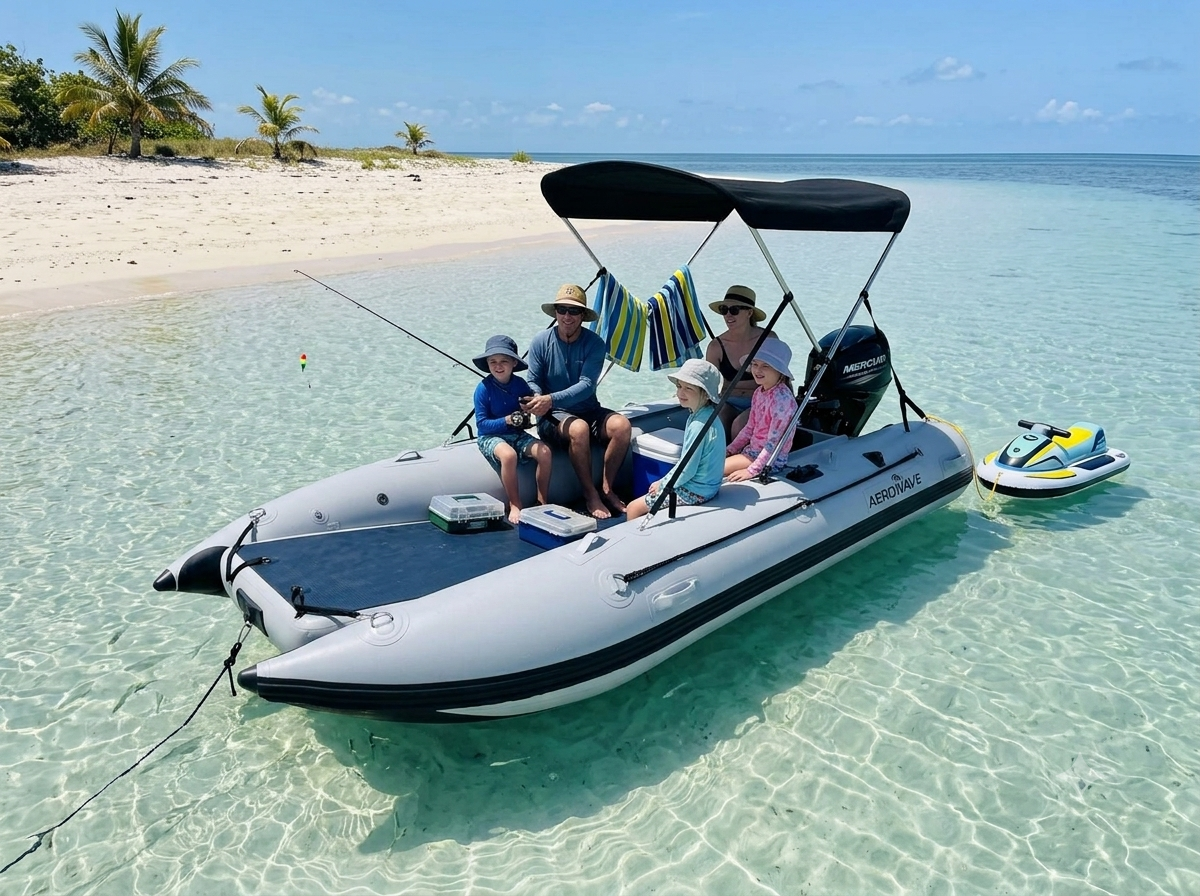
Aerowave WaveRunner 380 Series 3 Catamaran Package
The WaveRunner 380 Series 3 is a premium 3.8m inflatable catamaran package built for Australian and worldwide families, fishing, and coastal day boating — ideal for snorkeling and spearfishing — offering serious stability and premium German Valmex® construction.
Free freight to United States · taxes included, nothing to pay on arrival
Aerowave Viper 400 Sovereign
Flagship 4m enclosed-bow inflatable catamaran. German VALMEX® 7321 Heavy Plus 1.2mm commercial-grade fabric, 10 PSI high-pressure drop-stitch air deck floor with VALMEX non-slip surface, LockPro wheels, full Bimini and FREE express delivery Australia-wide included.
Free freight to United States · taxes included, nothing to pay on arrival
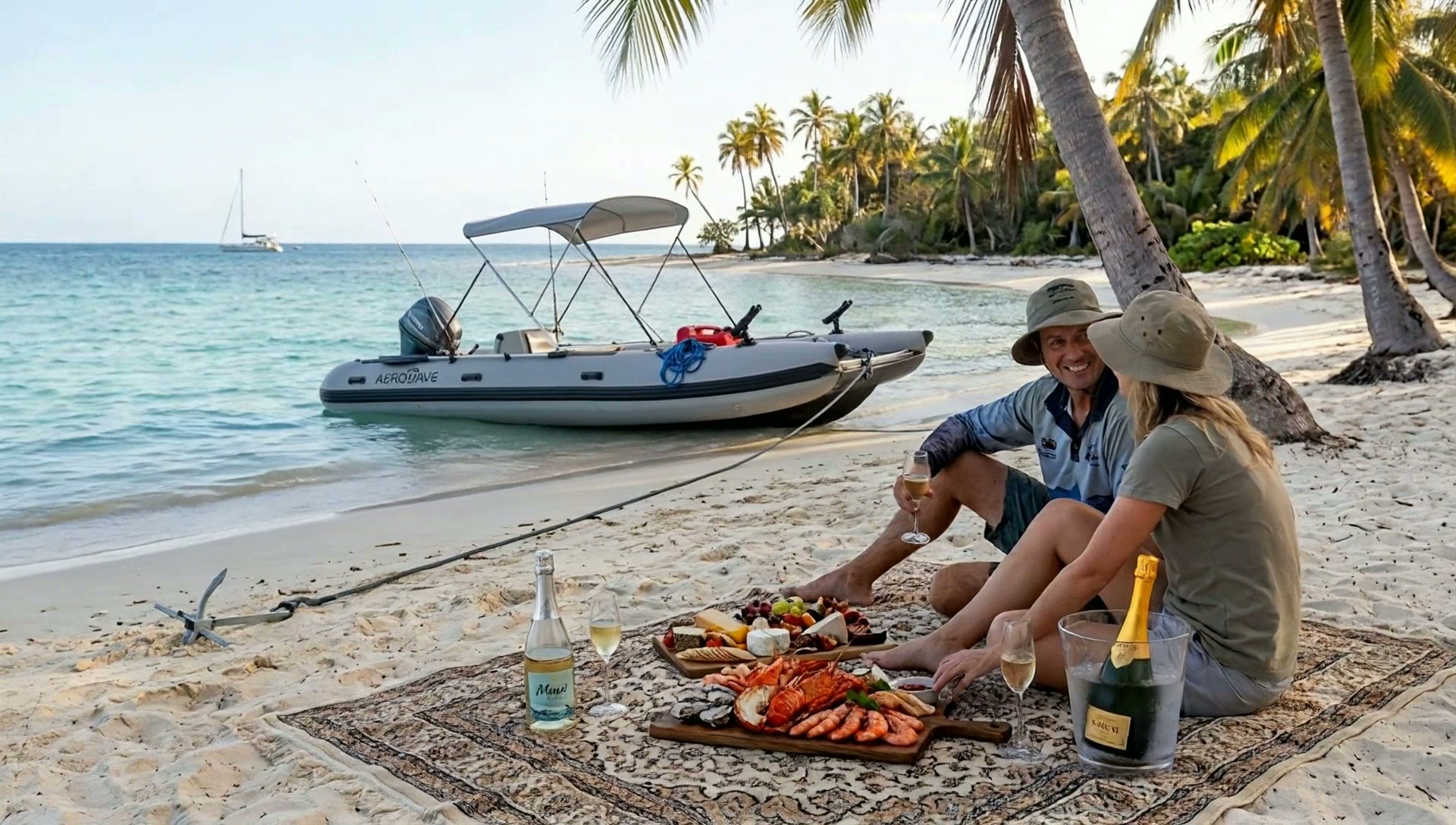
Aerowave Viper 365 Open Bow
Premium 3.65m Inflatable catamaran — built the same way as our flagship Viper 400 sports boat, just 35cm shorter. German VALMEX® 7321 Heavy Plus 1.2mm commercial-grade fabric, 10 PSI high-pressure drop-stitch air deck floor with VALMEX non-slip surface, LockPro wheels, full Bimini and FREE express delivery Australia-wide included.
Free freight to United States · taxes included, nothing to pay on arrival
Not sure which suits you? Talk to a real boat owner.
Before you spend a cent
Buying from Australia, delivered to United States
You have never heard of us, we are on the other side of the world, and the internet is full of fakes. Fair enough. Here is everything you would need to check us out, in one place — no forms, no chat bot.
Australian designed business
Easy Inflatables, Avoca Beach NSW 2251. ABN 96 856 548 613. International orders ship from our Hong Kong hub.
Rated 5.0 on Google
Every review is on our Google Business Profile, with the reviewer's name and the date.
CE certified, 5 + 2 year hull warranty
ISO 6185-3 and EU Directive 2013/53/EU. Warranty honoured worldwide.
Tracked, insured, door to door
Freight, duty & taxes included · nothing to pay on arrival.
- Who am I actually buying from?
- Easy Inflatables, Avoca Beach NSW 2251, Australia. ABN 96 856 548 613. Sean is the owner and skipper, Gary Stewart handles sales on +61 2 4335 1603, Karen Matthews handles email. The boats are Australian designed; international orders ship from our Hong Kong dispatch hub so your landed price stays competitive. Phone us before you pay a cent — a real person answers.
- Is this really an Australian product?
- Yes — Australian designed and engineered on the NSW Central Coast. Manufacturing is done offshore to our spec, and international orders ship direct from our Hong Kong dispatch hub. If we routed every boat through Australia first, the freight alone would roughly double or triple your cost for the same hull.
- What do I pay, and what is not included?
- The delivery and import terms depend on your country. US and UK boat orders include free express freight and prepaid import charges — nothing to pay on arrival. New Zealand and named Asia/Pacific lanes include duty and tax. EU buyers pay import charges on arrival. Other destinations show their terms before payment.
- How do I pay safely?
- Card through Stripe (Visa, Mastercard, Amex, Apple Pay, Google Pay) or bank transfer. Card payments carry your bank's own dispute protection. We never ask for crypto, gift cards or payment to a personal account.
- What if it arrives damaged?
- Every boat ships fully tracked and insured door to door. Photograph the carton and the boat on arrival and email us — transit damage is claimed and replaced through us, not left with you and the courier.
- Is the warranty real outside Australia?
- Yes. The 5 + 2 year hull warranty on 1.2 mm VALMEX Heavy Plus and Orca Hypalon hulls applies wherever you are. Replacement parts are held in Australia and at our overseas hub and go out by express courier to your door.
- Is the boat actually certified?
- All Aerowave catamarans are CE certified to ISO 6185-3 and EU Directive 2013/53/EU. Certification paperwork is supplied with the boat — ask and we will send it before you order.
Frequently asked questions
- What is the difference between a SIB and a RIB?
- A SIB (Soft Inflatable Boat) has a collapsible bottom, such as an 8–10 PSI high-pressure drop-stitch air deck, allowing the entire boat to deflate, fold up, and fit inside a vehicle boot. A RIB (Rigid Inflatable Boat) features a permanent, rigid aluminium or fibreglass hull surrounded by inflatable tubes, meaning it cannot be folded and must be transported on a dedicated boat trailer or large davit system.
- Can you stand up on a soft inflatable boat's air floor?
- Yes, provided the boat uses a modern high-pressure drop-stitch air deck inflated to 8–10 PSI. At this pressure, the floor feels as firm as a rigid timber deck, allowing adults to stand comfortably, cast fishing rods, pull up crab pots, and move around the cockpit without the floor bowing beneath their feet.
- How long does a soft inflatable boat last in the Australian sun?
- A boat constructed from premium German Mehler VALMEX fabric (such as 1100 dtex / 0.9 mm or 1500 GSM / 1.2 mm Heavy Plus) will typically achieve an operational lifespan of 10 to 12 years in Australian conditions with basic maintenance. Conversely, entry-level, unbranded PVC boats often degrade, become sticky, and suffer seam failure within 2 to 4 years under intense local UV radiation.
- What size outboard motor do I need for a soft inflatable catamaran?
- For lightweight 2.3 m to 2.9 m tenders, a 2.5 HP to 6 HP outboard is ideal for displacement cruising. For popular 3.3 m to 3.8 m catamaran models, a 9.9 HP to 15 HP short-shaft (380 mm transom) outboard offers the ideal sweet spot, easily planing two adults at 18–22 knots. Larger 4.0 m to 4.5 m craft perform best when paired with an 18 HP to 20 HP motor for heavy loads.
- How long does it take to inflate and assemble a soft inflatable boat?
- Using a standard two-stage 12V high-pressure electric pump connected to your vehicle battery, a 3.5-metre air-deck SIB can be completely unrolled and inflated in approximately 8 to 12 minutes without manual labour. Deflation and pack-down take under 8 minutes: simply open the valves, fold the side sponsons inward, and roll the hull tightly toward the transom.
- Do I need a boat licence to operate a soft inflatable boat in Australia?
- Marine licensing regulations depend on your specific Australian state or territory. Generally, if the inflatable is powered by an engine exceeding a certain threshold (typically over 4 kW / 5 HP in NSW and Queensland, or any engine capable of exceeding 10 knots), the skipper must hold a valid recreational boat driver's licence. Always verify requirements with your state maritime authority (such as NSW Maritime or Maritime Safety Queensland).
- How much does a fully packed soft inflatable boat weigh to lift?
- A high-performance air-deck catamaran hull measuring 3.3 m to 3.8 m typically weighs between 35 kg and 46 kg inside its heavy-duty carry bag. This makes it manageable as a single-person lift for short transfers or an effortless two-person carry into a 4WD cargo bay, caravan locker, or utility tub.
Ready to set sail?
Premium German-fabric inflatable catamarans, built to order and delivered to your door. Talk to our team or browse the fleet.
Like this guide? Get the next one in your inbox.
Owner-tested tips, gear deep-dives and Aussie boating know-how — no spam.